Governed prospecting, inbound, outbound, trial conversion and expansion agents that drive revenue for the mid-market.
Digital workers execute. Humans authorize.
PrescientIQ™ is your governed digital revenue crew. It prospects, runs outbound, converts trials and expands accounts, in the governance mode your team sets for each action class, and every action lands in the audit ledger. A coworker, not a copilot.
Published pricing from $399/mo, billed annually · No seat licenses · Every action recorded to the audit ledger
Illustrative — a single coordinator cycle, ending at the approval gate.
Two ways to put PrescientIQ™ to work
Why the last three attempts did not work
You have already bought software that does not do the work.
Three categories promised to fix mid-market revenue capacity. Each fails in a different, specific way — and the third is why an approval gate is a feature rather than friction.
Seat-based SaaS
You buy licenses, not work
A dozen tools billed per seat, whether or not a rep logs in. Adoption is the buyer's problem, the CRM fills with stale records, and the cost is fixed while the output is not.
Copilots
Still waiting for a human to type
A copilot produces nothing until someone sits down and prompts it. It raises the ceiling on an hour of work; it does not add hours. The bottleneck was never the drafting.
Ungated AI SDR bots
They send, then you find out
Autonomous send with no review step. It scales volume and domain damage at the same rate, and it puts your brand behind messages nobody read before a prospect did.
PrescientIQ™ is governed Labor as a Service. Agents do the heavy lifting continuously; your team decides, action class by action class, what waits for approval and what runs under standing policy.
Your governed digital revenue crew
Four specialist agents and a coordinator, operating under the governance mode your team sets. Each agent is independent and narrow-scoped, so a failure in one never stalls the others.
Scout
Ingests buyer intent signals, CRM records and web telemetry to continuously identify and score high-intent ICP targets. Scoring runs on deterministic code, so identical inputs produce identical scores.
Herald
Drafts personalized, trigger-grounded, multi-channel sequences, each one carrying the signal that produced it. Every draft is held until a named person on your team approves it.
Guide
Watches in-product behavior, flags trial accounts that stall before their key value event, and prepares a personalized activation sequence at the stall moment. The sequence is held until a named person on your team approves it.
Steward
Analyzes post-sale usage telemetry to flag cross-sell opportunities and surface churn-risk signals early. It prepares mitigation plays for your team between quarterly reviews, not at them.
Coordinated by Marshal · Revenue Operations Coordinator
Marshal routes work across the crew and enforces the governance mode you set. It routes intent to the right specialist and persists state after every decision, so a workflow survives a restart mid-run. Every external system — your CRM, outbound provider and intent-data feeds — is reached only through typed, scoped tool integrations, each behind its own least-privilege identity. Every action any agent takes is appended to an immutable audit ledger with actor, rationale, confidence and before/after state.
See the full Revenue Accelerator specification →Inside the platform
We would rather show you the console than describe it
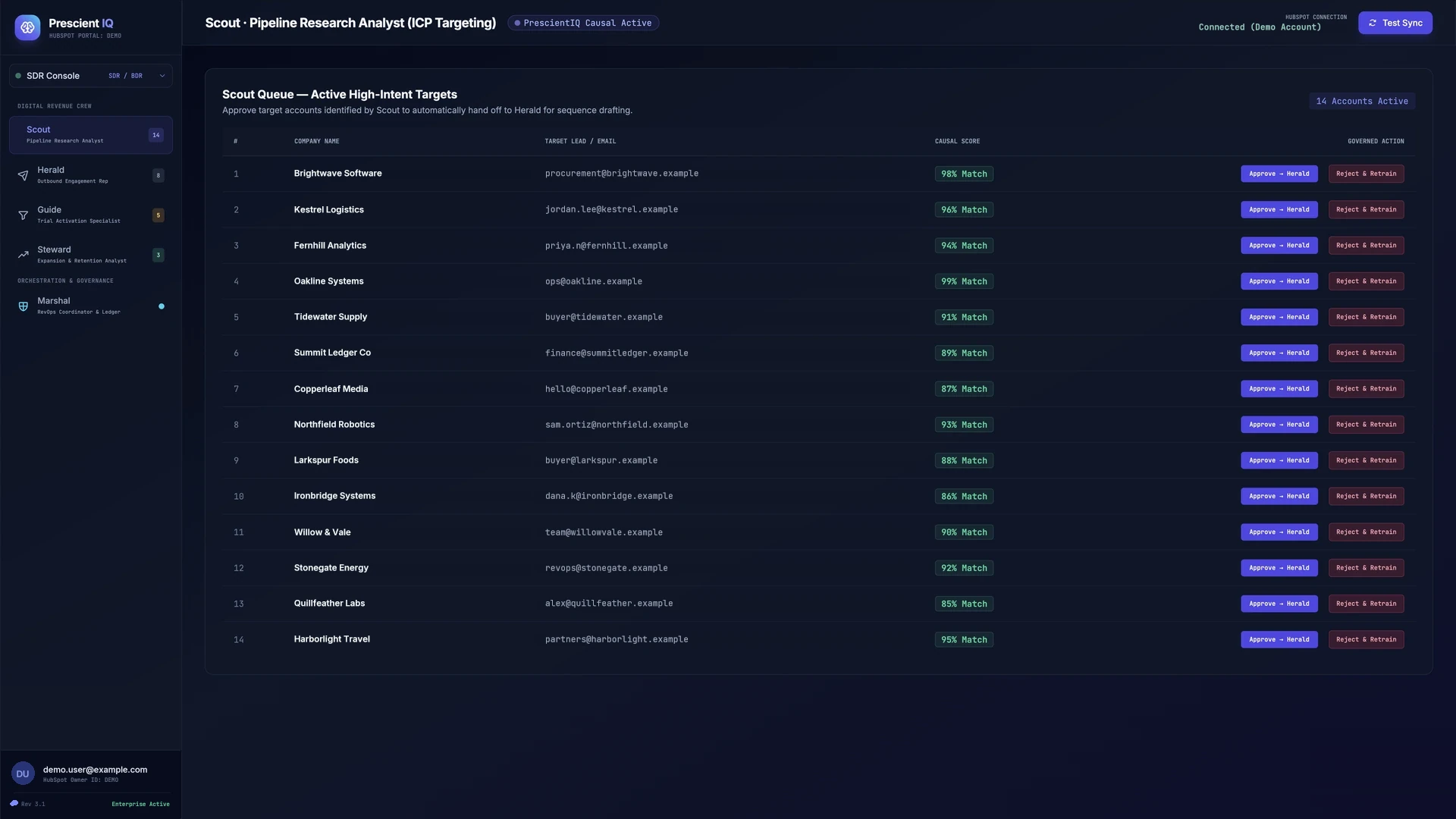
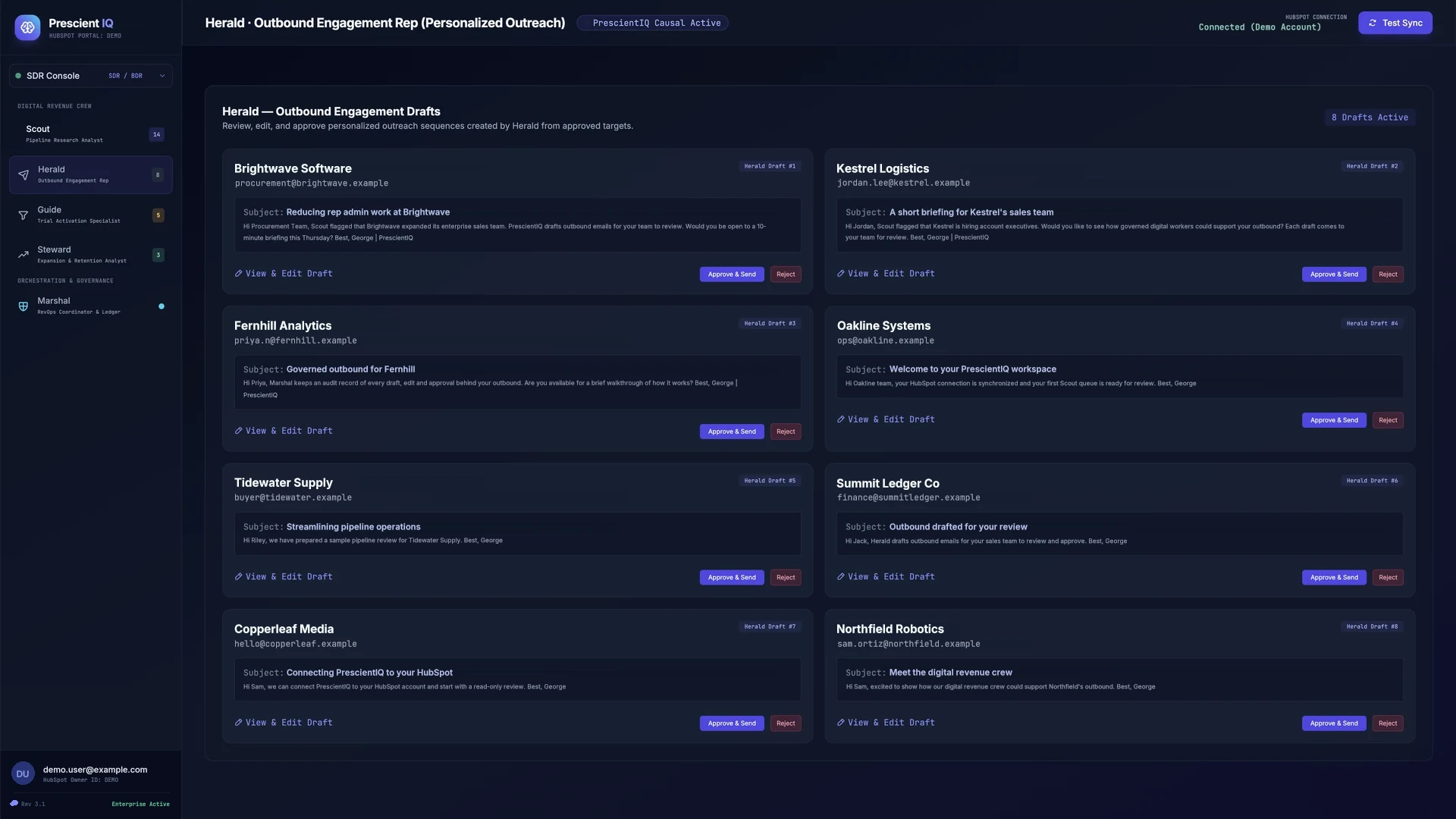
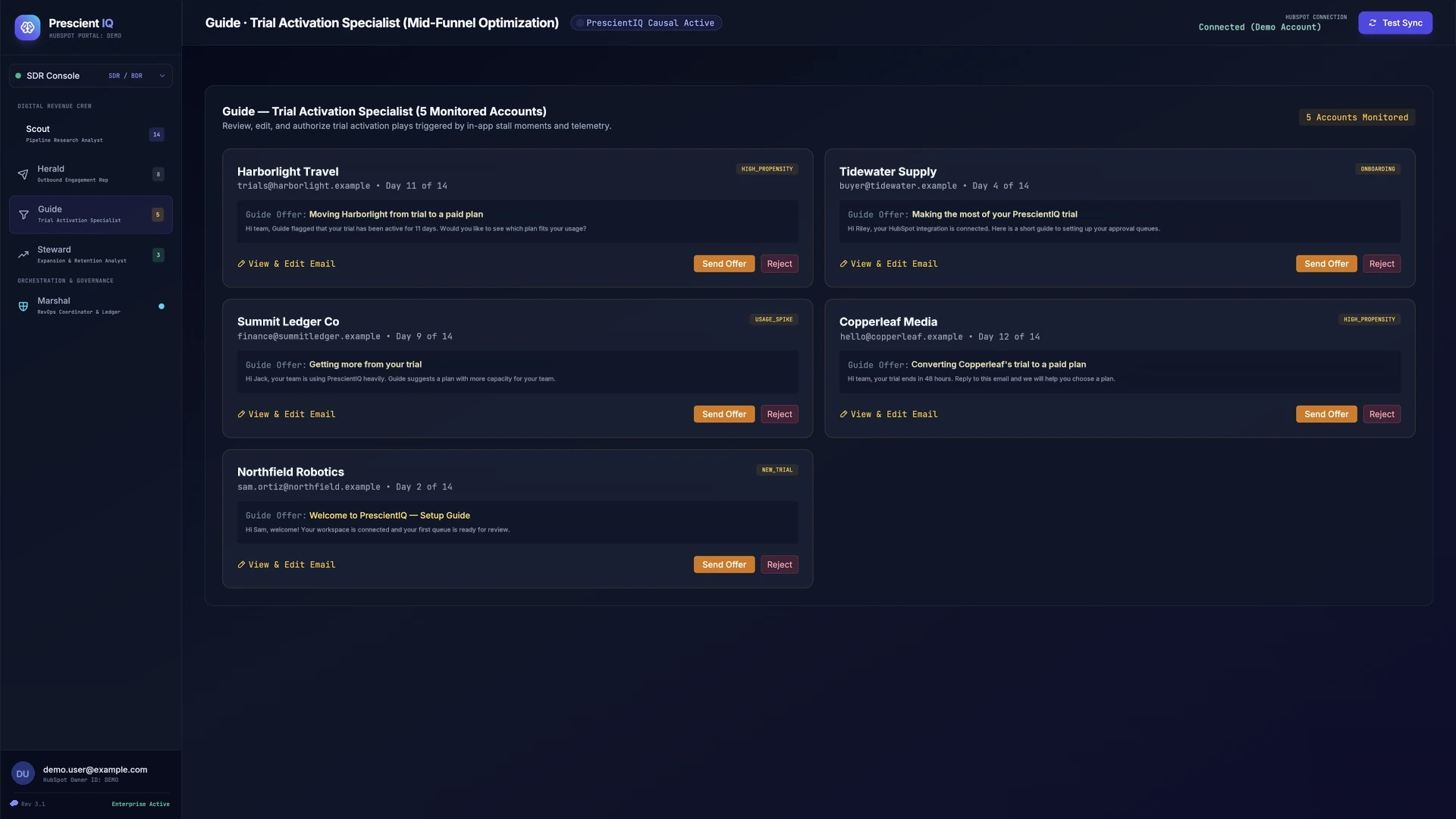
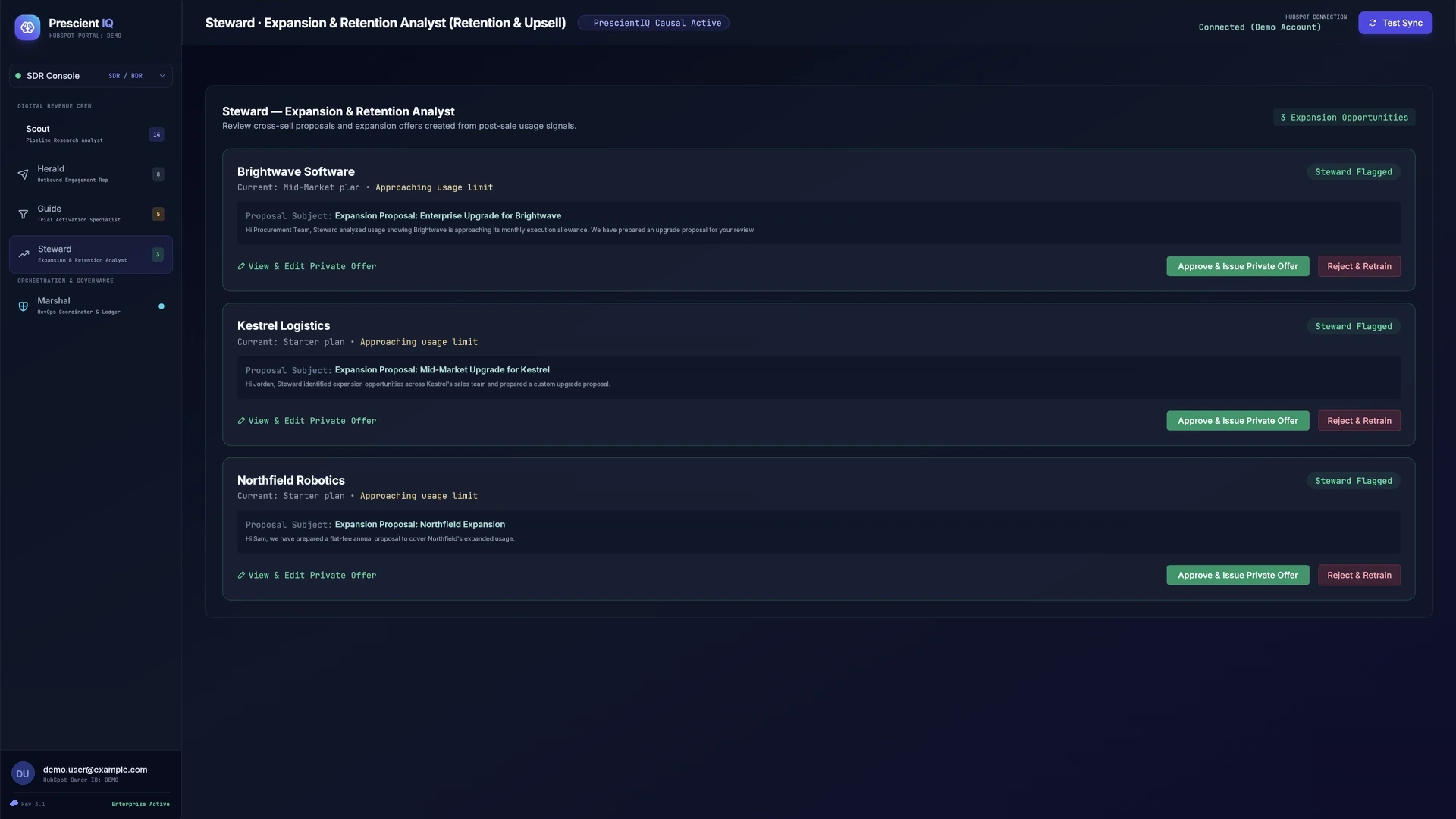
Five views from the console, in the order the work moves: Scout surfaces accounts from your CRM, Herald prepares outbound drafts, Guide watches trial accounts, Steward drafts expansion proposals, and Marshal writes every approval, edit and rejection to the audit ledger.
01 — Scout · Pipeline Research Analyst
02 — Herald · Outbound Engagement Rep
03 — Guide · Trial Activation Specialist
04 — Steward · Expansion & Retention Analyst
05 — Marshal · Revenue Operations Coordinator
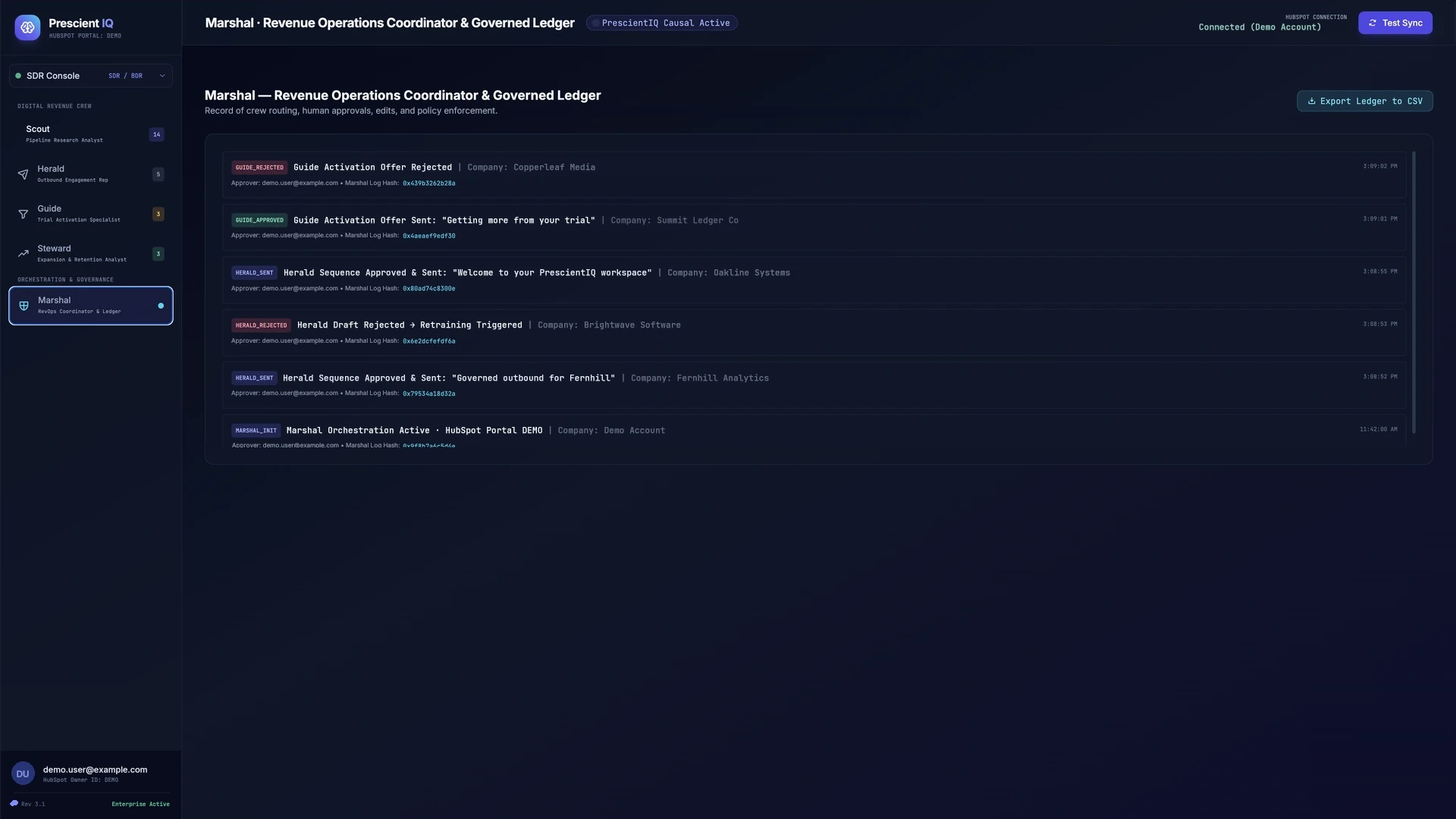
Screens show a demo workspace with sample data. The companies and addresses are fictional.
We don't publish borrowed averages. We model yours.
Every engagement opens with a free Autonomous Audit Report — a client-specific P&L projection built on your data. Measured figures state clean; modeled targets carry their label and are validated against your own environment before any commitment.
Figures labeled as targets are modeled against current human and copilot baselines. They are not guarantees. Every engagement begins with a free Autonomous Audit Report — a P&L projection built on your own data — and targets are validated against your environment before any commitment.
No named customer cases run on this page. Every figure above is either Measured, stated clean, or Target-class, labeled and validated per client.
Built for the C-suite
We speak to the metrics you own. Select your role.
Convert fixed acquisition cost into variable, approved labor.
Your MarTech stack is a fixed cost with unmeasurable ROI. PrescientIQ bills for executed work against a committed pool — never per seat. Rejected drafts, retries and internal agent steps never reach the invoice, and every billed line reconciles against the same ledger your auditors read.
Your Autonomous Audit Report models the delta on your own numbers before any commitment.
Illustrative — your AAR models your figures.
Vertical Industry Models
Purpose-built for your industry
Horizontal AI fails in complex enterprise environments. Our vertical models carry domain expertise from deployment day one.
B2B SaaS
SaaS Revenue Acceleration
Pipeline generation, trial conversion and expansion run continuously — agents draft and execute, your team approves.
Learn more →Financial Services
Governed Credit, KYC & Risk Workflows
Agents prepare credit memos, ownership maps, and risk observations; a designated human approves or supervises under standing policy, per action class, and every step is recorded to an immutable ledger.
Learn more →Healthcare
HealthTech & MedTech Revenue
Account research, buying-committee outreach, pilot activation and site-by-site expansion for companies selling into healthcare.
Learn more →Manufacturing
Signal-to-Revenue Automation
Agents monitor demand and supply signals and execute governed B2B outreach — closing the gap between production data and revenue outcomes.
Learn more →E-Commerce / Retail
Autonomous Commerce Execution
Governed execution across the commerce revenue loop — from cart recovery to merchandising to budget reallocation.
Learn more →Bundle 01 · CRO / RevOps · Available now
Revenue Accelerator. No seat licenses. Ever.
One annual platform fee, billed monthly, covering the execution a typical mid-market deployment runs. Work is tracked in the same deterministic ledger that backs your audit trail — never per seat, and never for a draft your team rejected.
| Component | Investment | Billing frequency |
|---|---|---|
| Annual platform feeEnvironment provisioning on Google Cloud, per-agent IAM, audit-ledger setup, and context ingestion from your CRM — plus four cooperating agents (Scout, Herald, Guide, and Steward), their coordinator Marshal, the approval queue and standing-policy controls, and the immutable audit ledger, and the monthly execution volume a typical mid-market deployment runs. One fee, from signature, every year.Target — modeled: live in 21 days or less$165,000/year is the complete platform fee. There is no separate implementation charge and no different first-year number — deployment work is included from signature, not billed as a distinct line. Scope beyond a typical deployment — additional bundles, sustained higher volume — is quoted at your AAR before anything is signed. | $165,000/yr | Billed monthly at $13,750/mo against an annual commitment |
Prefer we run it? See Managed Revenue Operations →
On the roadmap: Compliance Shield (governance and regulatory defense for FinServ and Healthcare) and the Generative Growth Engine (budget allocation and AI-search visibility for marketing). Neither is available today — see what each will cover.
Governed by design, not by policy
PrescientIQ is hosted and operated by MatrixLabX on Google Cloud. SOC 2, ISO 27001, and PCI DSS attestations are held by Google Cloud, which operates the underlying infrastructure. They are not MatrixLabX certifications. MatrixLabX application-layer SOC 2 is in progress.
Frequently asked questions
What is an autonomous digital workforce?
An autonomous digital workforce is a set of AI agents that execute business workflows end to end rather than assisting a person who executes them. PrescientIQ™ deploys four specialist agents — Scout (prospecting), Herald (outbound), Guide (trial conversion) and Steward (expansion) — coordinated by Marshal, the Revenue Operations Coordinator. They sense signals, decide the next-best action, and execute it, with your team choosing, per action class, whether a person approves each action or supervises under standing policy, and every action written to an immutable audit ledger.
Do the digital workers send email without a human seeing it first?
Only if your team chooses that. Each action class runs in one of two modes. In human-in-the-loop, the action is held until a named person approves it. In human-on-the-loop, it runs under a standing policy your team sets, and a named person keeps intervention, override, and revocation authority. Every action is recorded to the audit ledger.
How is this different from an AI copilot?
A copilot produces nothing until a person sits down and prompts it, so it raises the output of an hour of work without adding hours. An autonomous agent detects the signal itself, decides the action, and executes it continuously. The distinction matters commercially: you pay a copilot per seat regardless of use, and you pay PrescientIQ for executed work.
What does the Revenue Accelerator cost?
One number, contracted, never per seat: $165,000 a year, billed monthly, identical in year one and every year after. Environment provisioning on Google Cloud, per-agent IAM, audit-ledger setup, and context ingestion from your CRM — plus four cooperating agents (Scout, Herald, Guide, and Steward), their coordinator Marshal, the approval queue and standing-policy controls, and the immutable audit ledger, and the monthly execution volume a typical mid-market deployment runs. One fee, from signature, every year. There is no separate implementation fee — deployment is included from signature, not billed as its own line. Consumption beyond your pool bills at the overage rate fixed in your agreement, unchanged by this — a line we do not expect you to pay and do not forecast. Drafts, retries and rejected actions never bill.
Which CRMs and channels does it work with?
PrescientIQ connects to Salesforce and HubSpot today, plus licensed intent-data providers such as G2 and Bombora, through typed and scoped tool integrations. Outbound delivery runs through an authenticated email provider with SPF, DKIM and DMARC in place. Additional CRM and channel support is on the roadmap.
Who is PrescientIQ built for?
Mid-market B2B companies between $20M and $500M ARR running Salesforce or HubSpot, where a CRO or RevOps leader owns pipeline and a compliance or brand-safety requirement sits in the send path. It is available now through a founding pilot program.
How long does deployment take?
The target is 21 days or less from signed contract to production. That is a modeled target, not a commitment. The actual timeline depends on CRM data quality and integration scope, and it is set with you during the Autonomous Audit Report instead of assumed.
What is the Autonomous Audit Report?
The AAR is a free, read-only assessment that runs before any commitment. A solution architect reviews your stack, maps where operational drag sits, and models the projected P&L impact against your own CRM and pipeline data — turning modeled targets into your specific numbers before you sign anything.
Contact
Let's map your digital workforce.
Every engagement starts with a free Autonomous Audit Report— a read-only assessment that maps your operational drag and projects your P&L delta against your own data, before you commit to anything.
Requests sent through this page get a reply within 48 hours.
Support is staffed Monday through Friday, 9:00 AM to 4:00 PM Eastern Time.
Book your free AAR benchmark
Complimentary for qualified enterprise prospects. Read-only — we do not write to your CRM during the assessment.
Headquarters
Colchester, VT
424 Creek Farm Rd., Suite 201B Colchester, VT 05446
Satellite Office
Boulder, CO
4845 Pearl E Circle, Suite 101 Boulder, CO 80301