
The Future of Business is Agentic. We Build the Engine.

What Are the Impacts of AI in Hospitality?
The impacts of AI in hospitality include enhanced guest personalization, optimized revenue management (RevPAR), and streamlined back-office operations. Through IoT integration, AI remembers guest preferences—such as temperature and lighting—applying them automatically. Furthermore, AI optimizes room pricing multiple times daily based on local demand and competitor occupancy.

Key Impacts Across the Guest Lifecycle
- Personalized Guest Experiences: AI creates a “memory layer” that recalls guest preferences across stays and locations.
- Dynamic Revenue Optimization: Room pricing adjusts continuously in response to demand signals, competitor rates, and local events.
- Contactless Guest Journeys: Frictionless check-in, room access, and service requests improve convenience and safety.
- Operational Efficiency: Automation reduces manual workloads across finance, HR, and vendor management.
How Does AI Enhance Personalization in Hospitality?
AI in hospitality enhances the guest experience through contactless check-ins and personalized room settings. By integrating AI with channels, hotels can remember guest preferences—such as room temperature or lighting—and apply them automatically upon arrival. This fosters brand loyalty and operational efficiency.


Hospitality AI Scannable Elements
- Contactless Journey: AI-powered facial recognition for check-in and room access
- Smart Concierge: NLU-powered voice assistants for in-room service requests
- Operational RPA: Automating vendor invoicing, payroll, and staff scheduling
What Are the Benefits of AI in Hospitality?
AI in hospitality enhances the guest experience through contactless check-ins and personalized room settings. By integrating AI with IoT, hotels can remember guest preferences—such as room temperature or lighting—and apply them automatically upon arrival, fostering brand loyalty and operational efficiency.

Measurable Business Outcomes
- Faster Service Delivery with Lower Staff Dependency
- Increased Guest Loyalty and Repeat Bookings
- Higher RevPAR (Revenue Per Available Room)
- Reduced Operational Costs
- Improved Guest Satisfaction Scores (NPS)
How Does AI Improve Hotel Revenue Management?
AI transforms revenue management into a real-time optimization engine.
Hotels use AI to optimize “RevPAR” (Revenue Per Available Room) by analyzing local events, holidays, and competitor occupancy. The AI adjusts room rates multiple times per day to ensure the hotel remains competitive while maximizing daily revenue.

Revenue Optimization Inputs
- Cancellation and no-show probabilities
- Local events and tourism demand
- Competitor pricing and occupancy rates
- Seasonal patterns and booking trends
- Real-time booking velocity
Revenue Outcomes
- Improved forecasting accuracy
- Increased daily revenue yield
- Higher occupancy rates
- Reduced pricing inefficiencies

Why Hospitality Leaders Are Investing in AI Now
- Explosion of IoT-enabled environments
- Rising labor shortages and operational costs
- Increased competition from AI-native travel platforms
- Guest demand for seamless, digital-first experiences
- Pressure to maximize RevPAR and occupancy
Hospitality AI Tech Stack
| Technology | Function | Impact |
| Voice Assistants | In-room guest interaction | Faster service, improved satisfaction |
| Sentiment Analysis | Review and social monitoring | Real-time service improvement |
| RPA | Back-office automation | Reduced operational costs |
| Predictive Analytics | Demand and pricing optimization | Increased RevPAR |
Vertical AI Specializations
Industry Impact at a Glance
| Industry | Primary AI Application | Key Strategic Outcome |
| Finance | Fraud & Risk Modeling | 40% Reduction in False Positives |
| Healthcare | Diagnostic Assistance | 25% Increase in Triage Efficiency |
| Retail | Demand Forecasting | 15% Reduction in Inventory Costs |
| SaaS | User Behavior Analytics | 20% Improvement in LTV (Lifetime Value) |
Trusted by the world’s leading businesses




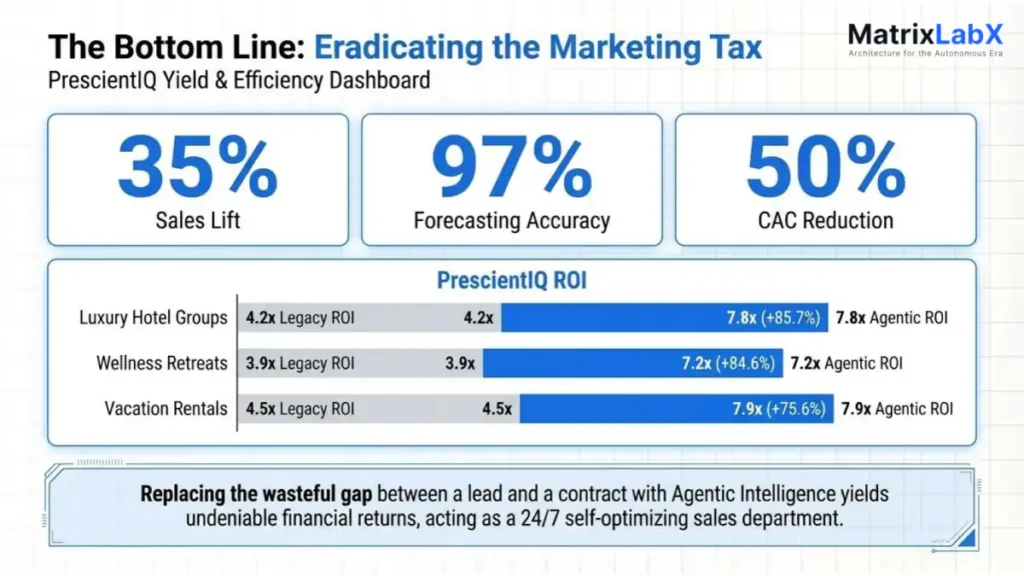
“Ad wastage was eliminated by 35% lift in sales.”
Lead Results You Can Measure
What is AI in hospitality?
AI in hospitality refers to the use of machine learning, IoT, and automation to enhance guest experiences, optimize pricing, and streamline operations.
How does AI improve guest experience?
AI improves guest experience by personalizing room settings, enabling contactless interactions, and delivering faster, more accurate service.
What is RevPAR, and how does AI improve it?
RevPAR (Revenue Per Available Room) is a key hospitality metric. AI improves it by dynamically adjusting pricing based on demand, competition, and market conditions.
What technologies power hospitality AI?
Key technologies include IoT, natural language processing (NLP), predictive analytics, and robotic process automation (RPA).