

Read the A Student’s Guide to Agentic AI vs. Traditional Automation and watch revenue soar. Move beyond basic automation. Our student guide breaks down the key differences between traditional automation and the autonomous power of Agentic AI.
The “14-Second” Reality Check
The shift from traditional tools to autonomous agents isn’t just a technical upgrade; it’s a fundamental change in the speed and availability of business. Consider this reality-check scenario from current enterprise data:
Picture a top account executive who just lost a $1.2 million deal.
It wasn’t because their product was inferior or their relationship was weak. It was because a competitor’s AI agent followed up 14 seconds faster. While the human representative was still asleep, the agent had already perceived the intent signal, prepared a relevant case study, and booked a personalized demo. The deal was essentially closed before the human representative even opened their laptop on a Monday morning.
This gap illustrates why “business as usual” is failing. This isn’t just about automation; it is about the rise of the Vertical Agentic Customer Platform (VACP)—a system engineered from the ground up to operate as a self-executing revenue engine.
Key Differences at a Glance for Agentic AI vs. Traditional Automation
| Feature | Traditional Automation | Agentic AI |
| Operational Logic | Rule-based (If/Then) | Reasoning-based (Goal/Action) |
| Instruction Style | “Tell me exactly what to do.” | “Tell me the outcome; I’ll figure it out.” |
| Handling Exceptions | Fails or requires human intervention | Autonomously adapts and course-corrects |
| Data Reliance | Static, historical data | Real-time signals and continuous learning |
| Primary Use Case | Predictable, high-volume repetitive tasks | Complex, messy, or dynamic multi-step workflows |
Tool vs. Worker: The Fundamental Shift
To understand the future, students must distinguish between “Systems of Record” and “Systems of Action.”
Traditional software like CRMs or Marketing Automation suites were designed to record what humans do. Agentic AI represents a shift from augmentation (helping a person do a task) to transformation (acting on their behalf).
- The Generalization Tax: The loss of time, money, and accuracy when a generic AI fails to understand industry-specific terminology or complex regulations.
- The Integration Tax: The technical drag created by layering disconnected point solutions that can’t “talk” to one another. This transition moves us from being “AI-assisted,” where we use a chatbot to draft an email, to being “AI-agentic,” where the system is engineered from the ground up to own the workflow.
Traditional horizontal tools suffer from two critical “taxes” that hinder performance:
| Feature | Traditional Software (System of Record) | Generic AI Tools (Assistants) | Vertical Agentic Customer Platforms (System of Action) |
| Industry Intelligence | None (Manual Entry) | Limited / General | Full Vertical-Specific Training |
| Action Trigger | Human-Triggered | Human-Assisted | End-to-End Autonomous |
| Execution Level | Static (Follows Playbooks) | Generative (Creates Text) | Strategic (Achieves Goals) |
Inside the Mind of an Agent: The Core Loop
What makes an agent “agentic” rather than just “automated”? AI pioneer Andrew Ng defines this as a transition from static code to a reasoning loop.
The Analogy:
- Traditional Automation is like a train on a track. It can only go where the rails (if-then rules) were pre-laid. If there is an obstacle, it stops or crashes.
- Agentic AI is like a self-driving car. It has a destination (a goal) and uses a continuous loop to navigate traffic and road conditions in real-time.
The Perceive-Decide-Act Loop:
- Perceive: The agent constantly monitors the environment for signals, such as “Intent Data” (e.g., a prospect researching a specific compliance solution).
- Decide: Using its memory and reasoning, the agent chooses the optimal path to reach a goal, such as prioritizing a high-value lead over a generic inquiry.
- Act: The agent executes the necessary tasks—writing an email, logging CRM data, or scheduling a meeting—without waiting for a human to click “send.”
The Practical Blueprint: The Autonomous Customer Lifecycle
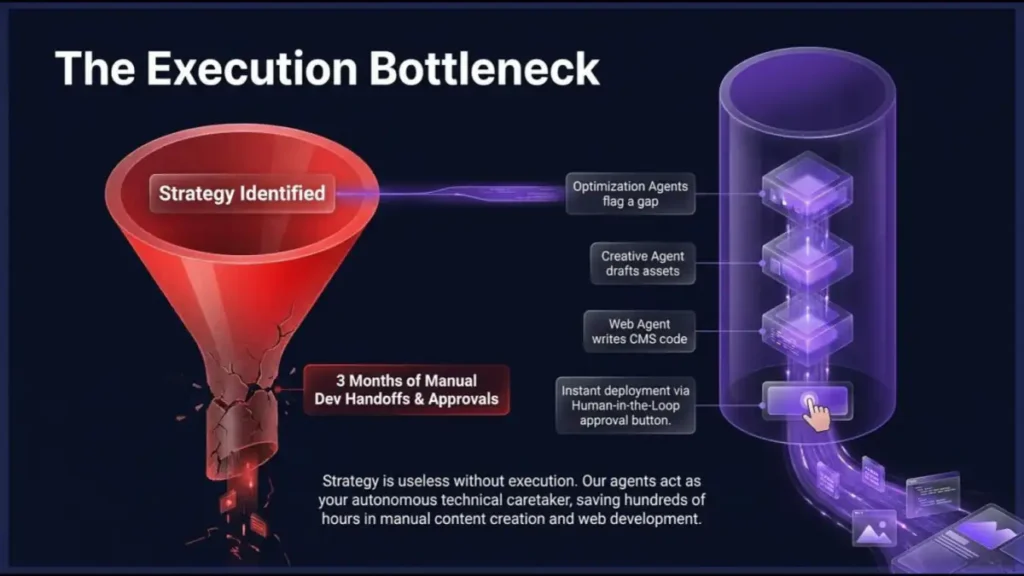
In a VACP, complex business goals are broken down into subtasks managed by a multi-agent architecture.
In this paradigm, specialized agents share a common memory and work in concert to decompose high-level goals into executable actions.
- Prospecting Agent: Monitors real-time signals to identify the “Ideal Customer Profile.”
- Outreach Agent: Executes multi-channel sequences and personalized nurturing.
- Personalization Agent: Drives account-level personalization using real-time intent data to ensure relevance.
- Scheduling Agent: Handles the logistical back-and-forth of booking meetings and provides pre-call briefings.
- Post-Call Agent: Automates CRM hygiene and ensures follow-up sequences launch immediately.
- Churn Detection Agent: Predicts at-risk accounts and intervenes autonomously to protect revenue.
Why “Vertical” Matters: Speaking the Language of the Market
“Vertical” means the AI is pre-trained for a specific industry. A generic AI might draft a professional email, but it lacks the “Contextual Fluency” to handle HIPAA constraints in healthcare or SEC compliance in finance.
| Vertical Sector | The “Agentic Advantage” (Context/Compliance) | Business Impact (Avg. Pipeline Velocity ROI) |
| Healthcare Tech | Navigates HIPAA; understands clinical vs. administrative roles. | +47% |
| Financial Services | Speaks in IRR/AUM; follows FINRA/SEC protocols. | +38% |
| Enterprise Software | Manages PLG-to-enterprise upsell; SOC 2 aware. | +55% |
This vertical specialization leads to “Role Elevation,” where the AI handles the industry-specific “grunt work,” allowing humans to focus on high-level strategy.
Human-AI Collaboration: From Task-Doer to Strategist
A core concept for the modern student is the Agentic Autonomy Ratio (AAR). This metric measures the percentage of tasks an AI can complete without human correction.
The 2026 Enterprise Target for stable autonomy is 85%. The rise of these platforms isn’t about job replacement; it’s about “Role Elevation.”
According to the IDC 2025 Future of Work report, humans in agentic organizations spend 73% of their time on high-cognition, relationship-intensive tasks, compared to just 31% in traditional organizations.
Insight Box: The Human Truth. Agents don’t replace top human performers; they replicate their best practices.
By achieving a high Agentic Autonomy Ratio (AAR), the system eliminates the “administrative drag” of manual signal processing, freeing humans to build the trust and navigate the complexity required to close six- and seven-figure deals.
The Student’s Roadmap to 2026 to Agentic AI vs. Traditional Automation
As you prepare to enter an agentic workforce, use this checklist to evaluate technology and strategy:
- Action vs. Record: Does the system act autonomously, or does it just record what I do?
- The Loop: Can the system perceive, decide, and Act based on real-time intent data?
- Context is King: Is the system vertically specialized for the industry’s specific compliance and terminology?
- Aim for 85%: Is the workflow designed to reach the 85% Agentic Autonomy Ratio, elevating humans to strategic roles?
The window to lead in this new era is open, but it is narrowing. The competitive divide of the future will be defined by those who can integrate autonomous agents into the core of their revenue engine. As the industry has learned the hard way, the window to be left behind is wider than most executives want to admit on a Monday morning.
The Power of Vertical Intelligence: Why Specialized AI is the Future of Professional Work
The “Generalist” Ceiling
The B2B revenue landscape has reached a point of structural latency. For decades, enterprises have layered disparate tools—CRMs, marketing automation, and analytics dashboards—onto their infrastructure, yet they remain plagued by disconnected data and misaligned teams.
The “moment everything changed” is no longer a future prediction; it is a current reality where a $1.2 million deal can be lost in exactly 14 seconds—the time it takes for a competitor’s specialized AI to respond with a personalized demo while your team is still processing the lead.
Generic AI tools are failing enterprises because of the Generalization Tax. This is the hidden cost of accuracy and speed lost when horizontal tools (like standard ChatGPT) attempt to operate without industry-specific “operating systems.”
This tax manifests as high token costs, increased latency from manual context window stuffing, and a fundamental inability to speak the language of the market. Furthermore, a new “Invisibility Trap” has emerged.
According to IBM research, 75% of B2B decision-makers now use AI-assisted search tools like Perplexity or ChatGPT to evaluate vendors before ever speaking to a human. If your enterprise data is not managed through a vertically intelligent system, your brand remains “invisible” to the LLMs that buyers use for research.”
The biggest mistake enterprises make is treating AI as a feature set rather than a fundamental operating system for revenue. A Vertical Agentic Customer Platform doesn’t augment your go-to-market—it becomes your go-to-market.” — George Schildge, CEO & CAIO at MatrixLabX
This shift marks the transition from augmentation (AI as a sidekick) to transformation (AI as the revenue engine). To move beyond the generalist ceiling, organizations must adopt a specialized vertical solution.
The Vertical Dimension: Context as a Competitive Advantage
In a Vertical Agentic Customer Platform (VACP), “Vertical” denotes a system engineered from the ground up for a specific industry.
Unlike horizontal AI, a VACP eliminates the Generalization Tax by utilizing long-context reasoning and multi-agent orchestration pre-tuned to a sector’s unique DNA.
Gartner (2025) reports that vertical-specific AI deployments outperform horizontal tools by 2.8x on measurable business outcomes. This is not a marginal gain; it is the result of removing the friction of manual prompting and retraining.
Why “Vertical” Matters: Speaking the Language of the Market
“Vertical” means the AI is pre-trained for a specific industry. A generic AI might draft a professional email, but it lacks the “Contextual Fluency” to handle HIPAA constraints in healthcare or SEC compliance in finance.
| Vertical Sector | The “Agentic Advantage” (Context/Compliance) | Business Impact (Avg. Pipeline Velocity ROI) |
| Healthcare Tech | Navigates HIPAA; understands clinical vs. administrative roles. | +47% |
| Financial Services | Speaks in IRR/AUM; follows FINRA/SEC protocols. | +38% |
| Enterprise Software | Manages PLG-to-enterprise upsell; SOC 2 aware. | +55% |
This vertical specialization leads to “Role Elevation,” where the AI handles the industry-specific “grunt work,” allowing humans to focus on high-level strategy.
Knowing the industry is the structural foundation; however, the true power of a VACP lies in its ability to move from static knowledge to autonomous execution.
From Output to Action: The “Agentic” Leap
The professional future belongs to Agentic AI. As defined by Andrew Ng, an “Agent” is a system that perceives its environment, makes decisions, and takes actions to achieve goals—it does not just generate text.
While “Output-based AI” creates a draft, “Agentic AI” executes the full task lifecycle. The distinction is sharp: Output AI suggests a strategy; Agentic AI autonomously handles prospecting, engagement, and CRM logging.
To track this, we use the Agentic Autonomy Ratio (AAR), with an 85% autonomy target for the modern enterprise.
- Level 1 (Manual): Workflows are entirely human-executed; AI is a passive search tool.
- Level 2 (Assisted): AI generates drafts or suggestions that require human “copy-pasting.”
- Level 3 (Semi-Autonomous): AI handles specific loops (like nurture sequences) but waits for human triggers.
- Level 4 (Full Autonomy): The system manages the full lifecycle (e.g., from lead signal to booked meeting) in under 14 seconds, escalating only when human trust is required.
By achieving high AAR, professionals experience a “role elevation.” Workers move from repetitive, low-cognitive tasks—the “manual drag” of revenue operations—to high-cognitive, relationship-intensive activities. This shift moves the focus from theory to the clinical reality of specialized industries.
Industry Deep-Dives: Intelligence in Practice
Vertical Intelligence manifests as a tailored infrastructure that understands the specific “guardrails” of high-complexity sectors.
Healthcare Technology
The Compliance Consideration: HIPAA and FDA Digital Health Guidelines. VACP Solution: “Pre-validation Logic.” By baking compliance directly into the agent’s decision-making architecture, firms eliminate the 6-8 week “legal review bottleneck.” The system flags violations before a human ever sees the outreach, reducing review time by 78% while maintaining perfect accuracy.
Financial Services
The Compliance Consideration: SEC, FINRA, and MiFID II protocols. VACP Solution: “Behavioral Replication.” The system captures the communication patterns and market commentary of the firm’s top 1% performers. By cloning these “elite behaviors” into the digital workforce, the platform enables average reps to operate with the same proactive scheduling and terminology fluency (AUM, basis points) as master relationship managers.
These systems do more than work faster; they provide the precision required for measurable, high-stakes business impact.
5. The Value Framework: Why Specialized Systems Win
| Vertical Sector | The “Agentic Advantage” (Context/Compliance) | Business Impact (Avg. Pipeline Velocity ROI) |
| Healthcare Tech | Navigates HIPAA; understands clinical vs. administrative roles. | +47% |
| Financial Services | Speaks in IRR/AUM; follows FINRA/SEC protocols. | +38% |
| Enterprise Software | Manages PLG-to-enterprise upsell; SOC 2 aware. | +55% |
Conclusion: Navigating the Shift (Agentic AI vs. Traditional Automation)
Final Directive for Agentic AI vs. Traditional Automation
The 6-month transition to a MatrixLabX Vertical Agentic Revenue Engine is the difference between a manual department and a self-executing engine.
By Month 6, your organization will operate with a 24/7 digital workforce, a 4.1x revenue achievement advantage, and a measurable lead in pipeline velocity. The window to lead is open, but the window to catch up is rapidly closing.
Vertical AI is the Revenue Operating System of 2026. In an era of AI-driven research, being “invisible” to the LLMs buyers use is a death sentence.
Verticalization is no longer an efficiency play; it is a mandate for survival in a market defined by agentic speed.
Top 3 Signs You Need Vertical Intelligence:
- Structural Latency: Your response times to inbound leads exceed five minutes, while competitors respond in under 30 seconds.
- Administrative Drain: Your “high-value” sales and marketing talent is spending more than 40% of their week on manual CRM data entry and signal processing.
- Compliance Paralysis: Fear of regulatory violations (HIPAA, SEC) is preventing your organization from deploying AI at scale, causing you to lose market share to faster, compliant competitors. The transition from a “tools-based” organization to an “agentic enterprise” is the defining divide of the next decade.
The future belongs to those who architect their systems to speak the language of their vertical and act with the speed of an agent.
FAQ
What is AEO (Answer Engine Optimization)?
AEO is a strategy hyper-focused on winning the “zero-click” search. Its primary purpose is to reverse-engineer direct user queries, optimize content for voice search, and secure featured snippets by formatting content as authoritative, standalone answers.
How does the AEO Agent fit into a multi-agent system like MatrixLabX’s PrescientIQ™?
The AEO Agent (The Answer Engine) works in concert with other specialized agents to create a cohesive workflow. It receives topic and keyword data from the SEO Agent (The Scout). It generates concise, NLP-friendly answers (Q&A formats, bulleted lists) and corresponding Schema Markup (FAQPage, QAPage). It passes this formatted data to the GEO Agent (The Authority) for deep semantic context and brand citation enrichment. The AIO Agent (The Orchestrator/Revenue Engine) then pushes the content live and monitors performance.
What is the core function that makes an AI system “Agentic” rather than simply “Automated”?
An agent is defined by its ability to execute a continuous, real-time reasoning loop called the Perceive-Decide-Act Loop. Perceive: Constantly monitors the environment for signals, such as “Intent Data” (e.g., a prospect researching a compliance solution). Decide: Uses memory and reasoning to choose the optimal path to reach a high-level goal (e.g., prioritizing a high-value lead). Act: Executes the necessary tasks (e.g., writing an email, scheduling a meeting, or logging CRM data) without requiring a human trigger.
What is a Vertical Agentic Customer Platform (VACP), and why does “Vertical” matter?
A VACP is a system engineered from the ground up to operate as a self-executing revenue engine. “Vertical” means the AI is pre-trained for a specific industry, eliminating the Generalization Tax. This vertical specialization provides “Contextual Fluency” to handle complex industry guardrails and terminology, such as HIPAA in healthcare or SEC compliance in finance.
What is the Agentic Autonomy Ratio (AAR), and what is the target?
The AAR is a metric that measures the percentage of tasks an AI can complete without requiring human correction. The 2026 Enterprise Target for stable autonomy is 85%. Achieving a high AAR leads to “Role Elevation,” freeing humans to focus 73% of their time on high-cognition, relationship-intensive tasks.