
Agentic AI Is Turning SaaS Into Self-Running Ecosystems — And It’s Changing the Agency Partner Game Forever.
Learn How PrescientIQ and MatrixLabX Are Redefining the Modern Agency-Partner Landscape.
Agentic AI is transforming SaaS and partnerships by replacing manual integrations with intelligent, self-running ecosystems.
Discover how MatrixLabX’s PrescientIQ is leading the era of autonomous agencies, predictive growth, and performance-based ecosystems.
1. The Shift from Software-as-a-Service to Systems-that-Serve
For nearly two decades, the SaaS industry has been the engine of digital transformation. But what began as subscription software has evolved into something far more powerful: agentic AI — software that doesn’t wait for commands but acts on context and intent.
Traditional SaaS relied on integrations: connect your CRM to your email system, your analytics tool to your ERP, and your automation platform to your CMS. It worked — but it was brittle. Data moved, but intelligence didn’t.
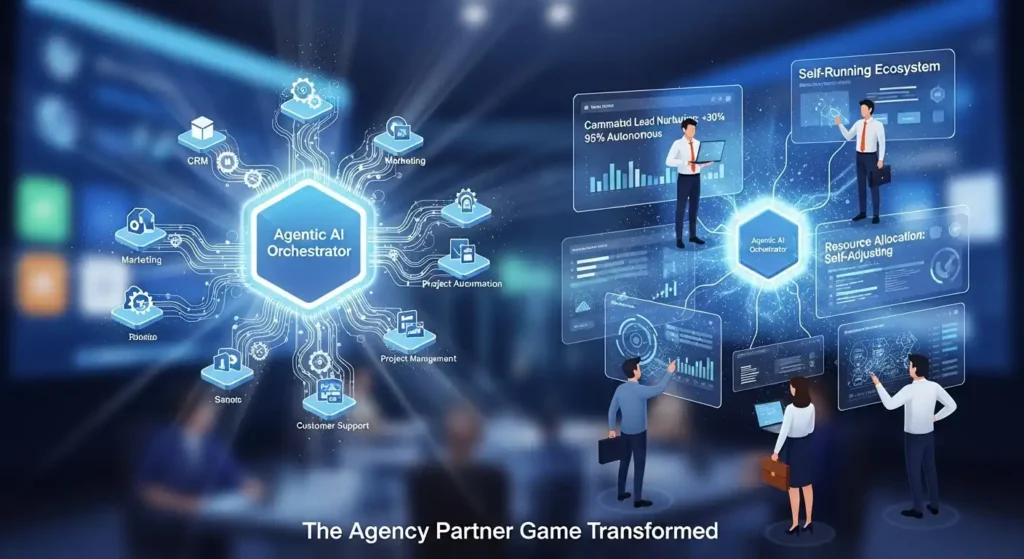
Agentic AI changes this equation. It turns SaaS into self-optimizing systems that serve. These systems learn, adapt, and autonomously coordinate workflows, budgets, and campaigns. They are ecosystems that think, not just pipelines that sync.
2. Why Old-School Integrations Are Dead

Integrations made the SaaS revolution possible. But in 2025, connections without cognition are legacy infrastructure.
Agentic AI introduces intent-driven orchestration — where software interprets business goals, predicts outcomes, and takes informed action.
- A CRM no longer just stores leads; it prioritizes and nurtures them autonomously.
- An analytics dashboard doesn’t just show what happened; it reallocates resources to what will work next.
- A marketing platform doesn’t just execute campaigns; it runs continuous simulations to maximize ROI.
Companies like HubSpot and Salesforce are embedding agentic assistants that act autonomously. But MatrixLabX’s PrescientIQ is going further — creating what it calls “pre-factual intelligence.” The platform simulates go-to-market strategies before execution, allowing teams to test decisions in virtual sandboxes before committing real dollars.
Five Key Metrics & Statistics for Agency / Channel / Partner Performance

- Partner-Sourced / Partner-Influenced Revenue / ARR
- This is the portion of SaaS revenue (or Annual Recurring Revenue) that is directly attributable to a partner (sourced) or that the partner helped influence (co-sell, lead referral).
- A mature partner program may aim for 20–30% (or more) of net-new incremental ARR to be partner-sourced or partner-influenced (though this depends heavily on your business model, market, and maturity stage).
- Sometimes vendors target a “partner prime rate” (i.e. the share of deals for which a partner is the primary driver) to grow over time.
- Partner Pipeline / Deal Registration Metrics (Coverage, Conversion, Velocity)
- Volume of partner-registered opportunities (pipeline coverage) per partner or in aggregate, relative to target quotas or coverage ratios.
- Conversion rates (pipeline → won) compared to direct sales deals (to monitor partner effectiveness).
- Sales cycle times (velocity) of partner-sourced vs direct deals (you’ll often observe that partner deals have longer or more fragmented cycles).
- Average deal size (ASP) or average contract value via partner deals (are they skewing small or large?).
- Partner Activation & Time-to-First-Sale
- Among the partners you recruit, how many become “active” (i.e., able to sell or co-sell) within a certain timeframe (e.g., 3, 6, 12 months)?
- Time from partner onboarding to closing their first deal (time-to-first-sale). If this is too long, you’re burning partner goodwill, training costs, and momentum.
- Drop-off/attrition in partner onboarding (i.e., partners that sign up but never become active). This is an early warning signal.
- Partner Retention / Churn & Tier Migration
- Retention rate of partners (i.e,. what % of partners remain active year over year). A high turnover among your partner base erodes returns.
- Movement of partners upward (e.g., from lower tiers to higher tiers) or downward (drop in engagement) in your partner program.
- Declining or stagnating partner engagement or sales over time (e.g., “zombie” partners) is a red flag.
- Unit Economics: Partner ROI, MDF Efficiency, Payback Metrics
- Return on Investment (ROI) of partner incentives, co-marketing spend, or Market Development Funds (MDF) — i.e., pipeline or revenue generated per dollar of incentive funding.
- Payback period: how long it takes for a partner-driven deal to “pay back” the incentives, onboarding costs, training, etc.
- Incremental gross margin or net margin on partner-originated deals (i.e., factoring in partner margin, discounting, support cost, etc.).
- Compare partner-driven CAC (customer acquisition cost) to direct costs of your SaaS vendor side (if you run affiliate or reseller models).
Some Benchmarks / Reference Points & Agency Metrics You Should Also Monitor
- Among agencies (i.e., the partner as a business), typical revenue growth rates are often in the 20–25 % range in thriving agencies. In a recent survey of ~300 agencies, 74 % reported growing revenue last year, and 49 % increased by ≥ 25 %.(MatrixLabX)
- Agency profit margins: 8-figure agencies often maintain net margins of 25–32%, while smaller agencies average 18–22%.
- For agencies, client retention is also critical: 8-figure agencies report ~92% annual client retention, versus ~78% for 7-figure agencies.
- In agency operations, common metrics include utilization rate (billable hours vs. total), average billable rate, overhead ratio, client churn, project margin, etc.
- For SaaS vendors with partner programs, companies that apply rigorous measurement see ~48 % higher partner-influenced revenue growth than those with ad hoc programs, according to a PartnerStack report.
Why These Metrics Matter (Risks & Signals)
- If your partner-sourced revenue remains a tiny fraction year over year, it indicates weak partner enablement, suboptimal incentives, or misaligned program structure.
- Long time-to-first-sale or weak activation suggests friction in training, tools, sales readiness, conflict resolution, or a lack of clarity in program mechanics.
- Poor conversion or velocity in partner pipeline (compared to direct) might reflect misalignment in sales support, co-selling conflicts, or discounting pressures.
- High partner churn or downward migration is costly: you spent time and money recruiting and enabling them, only to lose engagement.
- If your MDF spend or partner incentives don’t generate return (i.e. partner ROI is negative), the program becomes a cost center rather than a scalable channel.
3. The Modern Agency at a Crossroads
Few industries feel this transformation more than marketing and revenue operations agencies.
The traditional agency model — manual campaign execution, time-based billing, and tool management — is collapsing under the weight of automation. As AI systems begin to make decisions once reserved for analysts and strategists, agencies face two options:
- Compete with AI, or
- Collaborate through it.
Forward-thinking agencies are choosing the second path. They’re evolving into agentic agencies — hybrid consultancies that combine human insight with autonomous execution.
These new agencies no longer “run campaigns.” They design intelligent systems that learn and optimize autonomously. They are the architects of continuous intelligence.
4. Case Study: How PrescientIQ Redefined the Agency Model
Case 1: B2B SaaS Company Boosts Pipeline 40%
A mid-market SaaS company faced challenges with lengthy sales cycles and inconsistent lead quality. Traditional lead-scoring models lagged behind real-time buyer behavior.
By integrating PrescientIQ’s Predictive Intelligence & Simulation Engine, the system began autonomously prioritizing leads and optimizing budget allocation across channels.
Within six months:
- +40% increase in marketing-sourced pipeline
- 25% faster lead-to-opportunity conversions
- Improved resource allocation agility
PrescientIQ didn’t just automate tasks — it redefined how strategy itself is executed.
Case 2: Manufacturing Enterprise Cuts Campaign Time by 55%
A global manufacturing client’s campaigns took weeks to deploy due to data silos and manual workflows. PrescientIQ unified its advertising, content, and email operations under one orchestration layer.
The system dynamically adjusted creatives and scheduling based on market signals.
Results:
- 55% reduction in campaign deployment time
- 35% improvement in ROI
- Near real-time responsiveness to market changes
With its glass-box transparency, every AI decision was traceable — transforming skepticism into trust.
5. How Agentic AI Transforms the Partner Ecosystem
Agentic AI doesn’t just change software — it changes how partnerships are formed, managed, and monetized.
From Linear Supply Chains to Neural Networks
Traditional ecosystems were transactional: vendors built, partners sold, clients used.
Agentic ecosystems are collaborative and self-evolving.
Each node — technology partners, data providers, or agencies — feeds intelligence back into the system.
- Technology partners such as Google Cloud and Salesforce provide data pipelines that enhance model accuracy.
- Channel Partners (agencies, VARs, consultants) implement AI orchestration for clients.
- Data Vendors contribute context for predictive simulations.
It’s not a hierarchy; it’s a living network of shared intelligence.
Outcome-Based Collaboration
In this model, compensation evolves from commissions to performance-based partnerships — fees tied to measurable outcomes like revenue growth, CAC reduction, or qualified lead generation.
This shift aligns every partner’s incentive around a single metric: success.
6. The AI-Native Agency: A New Breed of Partner
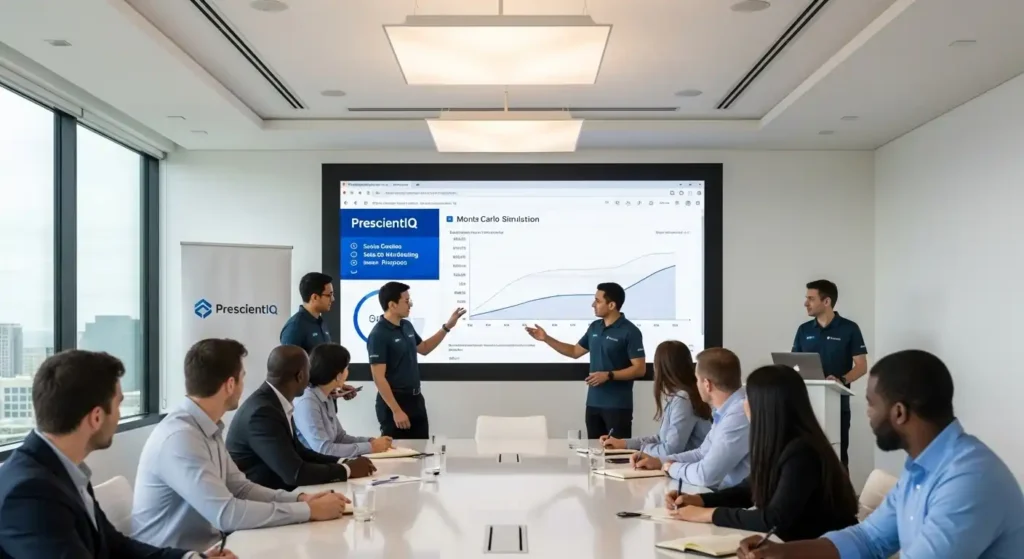
MatrixLabX’s PrescientIQ doesn’t just empower clients — it retools agencies into AI-first enterprises.
Built on a modular architecture of “AIPads” (autonomous agentic modules for content, SEO, social, and analytics), PrescientIQ allows agencies to:
- Simulate strategy: Test messages, budgets, and channels before launch.
- Automate optimization: Enable agents to make real-time adjustments based on performance signals.
- Scale human oversight: Strategists supervise rather than execute.
The agency’s role shifts from operation to orchestration.
Their value lies in designing how intelligence behaves, not in pushing buttons.
7. Strategic Framework: From Service to System
Here’s how the business model shifts when agentic AI enters the picture:
| Legacy Model | Agentic AI Model |
| Manual data collection | Unified cognitive data fabric |
| Static integrations | Context-aware orchestration |
| Reactive dashboards | Predictive and pre-factual simulation |
| Hourly billing | Outcome-linked pricing |
| Tool silos | Shared learning ecosystems |
PrescientIQ embodies this change with what MatrixLabX calls a “Cognitive Operating System for Growth” — a platform where AI continuously learns, simulates, and executes.
8. Case Study: BlueSignal Digital — From Agency to Intelligence Architect
Before: BlueSignal Digital, a 30-person B2B marketing agency, juggled six tools and countless spreadsheets. Reporting lagged by weeks, and optimization cycles were reactive.
After adopting an agentic framework via PrescientIQ:
- Campaign data flowed into a unified intelligence core.
- Monte Carlo simulations predicted ROI outcomes across ad channels.
- The AI autonomously reallocated budgets based on predicted performance.
- Strategists focused on client relationships, ethics, and innovation.
Results:
- +40% client ROI
- +30% retention increase
- 50% faster optimization cycles
The agency didn’t lose jobs — it gained strategic bandwidth.
They stopped being “service providers” and became intelligence architects.
9. Agentic AI Beyond Marketing
The implications extend far beyond creative agencies.
- Customer Success Platforms now predict churn and intervene automatically.
- Pricing SaaS products use stochastic modeling (like PrescientIQ’s Monte Carlo simulations) to test pricing elasticity in real time.
- HR Tech firms deploy agents that dynamically adjust hiring campaigns based on role scarcity and candidate behavior.
The pattern is universal: AI is moving from insight delivery to autonomous execution.
10. The Human Edge: From Operators to Orchestrators
Agentic AI doesn’t replace humans — it elevates them.
In MatrixLabX’s model, the AI Marketing Strategist is the “human in the loop.” This role ensures AI aligns with brand ethics, data governance, and long-term strategy.
These strategists blend:
- Systems Thinking — seeing the interdependencies between tools and processes.
- Data Fluency — interpreting how AI learns and adapts.
- Ethical Literacy — governing fairness, compliance, and explainability.
AI runs the tasks. Humans guide the mission.
11. The Compounding Intelligence Flywheel
The most powerful outcome of agentic ecosystems is compounding intelligence.
Every deployment feeds back into the network, making the system smarter. When PrescientIQ optimizes lead scoring for one SaaS client, the insights gained improve accuracy for others in similar industries.
This is the agency’s new competitive moat: collective learning at scale.
It’s the same principle that powers Google’s search algorithm or OpenAI’s model improvements — now applied to business growth.
12. What’s Next: Autonomous Collaboration
Over the next three years, the agentic era will solidify five major shifts:
- Smart Partner Meshes: Interconnected agents from multiple vendors collaborating across ecosystems.
- Predictive Commerce: AI simulates pricing, supply, and go-to-market moves in advance.
- Ethical Transparency: “Glass-box” AI becomes mandatory for trust and compliance.
- No-Code Agent Builders: Agencies train and deploy bespoke AI agents without coding.
- Performance-as-a-Service: SaaS evolves into outcome-driven contracts where AI proves ROI daily.
The line between software vendor, partner, and strategist will blur — replaced by adaptive ecosystems that co-learn in real time.
13. The Autonomous Agency Playbook
For leaders building the next generation of AI-native organizations, here’s a distilled blueprint inspired by MatrixLabX and PrescientIQ:
- Adopt AI-First Infrastructure: Treat intelligence as a core business layer, not an add-on.
- Unify Your Data Core: Integrate CRM, analytics, and campaign data into a single, unified cognitive foundation.
- Deploy Agentic Layers: Use AI modules that analyze and act autonomously.
- Embrace Outcome-Based Models: Tie compensation to growth metrics like CAC, LTV, or revenue lift.
- Champion Transparency: Implement explainable AI dashboards to build trust.
- Design Partner Intelligence Loops: Share anonymized insights across your ecosystem to accelerate learning.
- Empower Human Strategists: Develop “AI Conductors” who manage systems, not spreadsheets.
The outcome: a self-learning, continuously improving business capable of predictive growth.
14. Conclusion: The Age of Predictive Growth
Agentic AI is not a passing trend — it’s a tectonic shift redefining how software, agencies, and ecosystems operate.
Platforms like PrescientIQ demonstrate that the next generation of SaaS will be mentored by people, rather than managed by them.
These systems predict, simulate, and act with precision, allowing humans to focus on creativity, ethics, and innovation.
In the end, success in this new era won’t come from managing more tools —
It will come from teaching your tools to think.
Because the future of SaaS isn’t about faster software. It’s about ecosystems that run themselves.
