

Autonomous AI Industry Models and Predictive Analytics for SME Technology Companies
A comprehensive look at how Autonomous AI Industry Models and Predictive Analytics are creating a new paradigm for growth, efficiency, and market dominance for SME Technology Companies.
Author: Matrix Marketing Group & MatrixLabX
Date: July 11, 2025
Executive Summary for Autonomous AI Industry Models

The modern Chief Marketing Officer (CMO) operates in an environment of unprecedented complexity. A deluge of data, a fragmented technology stack, and relentless pressure to prove ROI have made sustainable growth an elusive target.
Traditional marketing, with its reactive posture and labor-intensive processes, is fundamentally broken. It’s a system that leaves value on the table and forces leaders to make high-stakes decisions based on historical data and intuition.
The solution is a paradigm shift from manual effort to intelligent automation: the Autonomous Industry Model. This white paper provides a strategic guide for CMOs and marketing managers on this transformation.
We will dissect the framework of an Autonomous Marketing Agent (AMA)—a self-learning system that replaces guesswork with certainty. Drawing on the advanced AI platforms of MatrixLabX and the strategic expertise of Matrix Marketing Group, we will demonstrate how this technology drives sales and creates a defensible competitive advantage.
The core of this revolution is a unified, “glass box” platform that combines a Reinforcement Learning Core (The Brain), a Predictive Engine (The Seer), and a Real-Time Execution Layer (The Hands). Someone the other day said, it’s like your content architecture: head, heart, and hands model. Love it!
This integrated system moves beyond tactical AI shortcuts to create a proprietary model of your market, customers, and sales funnel.
Key Takeaways for the CMO: This document will provide you with a comprehensive understanding of the shift from reactive to predictive marketing, the core components of an autonomous system, the tangible impact on sales and ROI, and a practical roadmap for implementation.
This is your guide to not just participating in the future of marketing but actively building it to drive more sales and secure market leadership.
Here’s a professional rewrite of the challenges technology firms face when implementing AI sales and marketing platforms.
Reimagining the Marketing Department
What if you could achieve 10x the output with a fraction of the team? Compare the traditional 10-person department to a lean, AI-First Marketing Operation.
The Traditional Department
A 10-person team focused on manual execution in siloed roles. High overhead, slow to adapt, and difficult to scale without significant cost.
The AI-First Operation
A 3-person team focused on strategy, augmented by an AI platform. Lean, agile, and capable of massive, scalable output with predictable ROI.
Productivity & Output Comparison
By automating execution, an AI-first operation can produce significantly more high-quality output, from content to campaigns, in the same amount of time.
Monthly Output Comparison
The Matrix Marketing Group Advantage
We transform your marketing function from a cost center into a lean, AI-powered growth engine. Our MatrixLabX platform acts as your tireless digital workforce, allowing your human talent to focus on what matters most: strategy, innovation, and customers.
The Financial Impact: Smarter Budgeting
The AI-first model dramatically shifts budget allocation. Instead of spending the majority on salaries for manual execution, you invest in technology that scales and media that drives direct growth.
Typical Monthly Marketing Budget Allocation
Each of the five core challenges includes deeper context with 2–3 explanatory paragraphs to guide executive understanding and planning:
1. Data Quality and Fragmentation
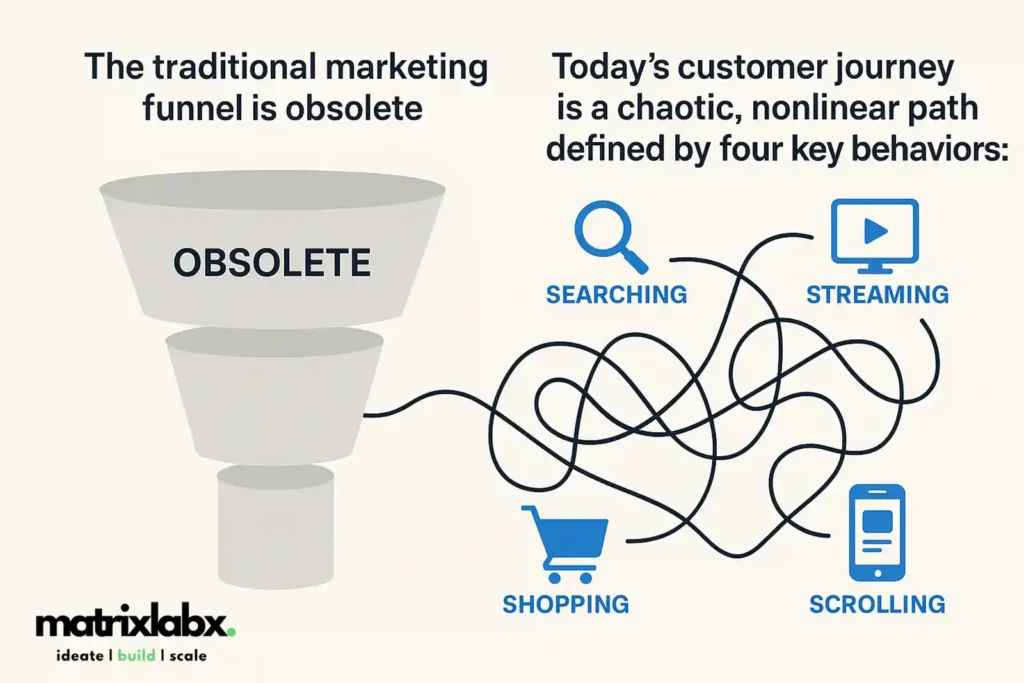
Many technology companies struggle with fragmented customer and sales data stored across disparate systems, CRMs, marketing automation tools, ERPs, and customer success platforms.
Without a unified data infrastructure, AI models lack the consistent, structured input required for high-performance prediction, targeting, or content generation. The result is inaccurate lead scoring, misaligned personalization efforts, and limited insight into customer behavior.
Even when large volumes of data exist, poor data hygiene, such as duplicate records, missing fields, or outdated customer profiles, can significantly undermine model accuracy.
This often leads to wasted ad spend, misdirected outbound campaigns, and weak performance from AI-generated content. For firms to gain traction with AI in sales and marketing, the foundation must be a clean, well-structured, and connected data environment.
2. Lack of In-House AI Talent and Organizational Readiness
Implementing AI requires more than just plugging in a platform; it demands a cross-functional team that understands how to guide, evaluate, and optimize AI tools. Unfortunately, most technology firms, especially mid-market or growth-stage companies, lack sufficient in-house expertise in AI, machine learning, or data engineering.
This talent gap can result in misconfiguration, underutilization of features, or complete abandonment of the initiative.
Furthermore, marketing and sales teams may not be trained to work with AI-generated insights or understand how to interpret predictive scores and content suggestions.
Without a baseline of AI literacy and support from leadership, even the most powerful platforms can go unused. Firms that succeed with AI implementation invest in onboarding, training, and cross-departmental alignment to ensure platform adoption and strategic integration.
3. Complex Integration with Existing Tech Stack
AI sales and marketing platforms rarely operate as standalone tools. They must integrate tightly with existing systems such as Salesforce, HubSpot, Marketo, content management systems, and analytics platforms.
These integrations can be complex, especially in environments where legacy software or custom-built solutions exist. Compatibility challenges often require middleware, custom APIs, or third-party connectors—each of which adds cost and complexity.
Without seamless integration, AI tools become isolated and fail to influence the broader sales and marketing workflow.
For instance, predictive lead scoring has limited value if sales reps can’t see it in their CRM or act on it within their outbound platform. Successful AI implementation hinges on creating a connected, real-time feedback loop between systems, so the AI can learn, adapt, and impact outcomes directly.
4. Adoption Resistance from Sales and Marketing Teams
Even the best AI platform is useless if the people meant to use it don’t trust or adopt it. Resistance often stems from a lack of transparency, AI is perceived as a black box, and from fear that automation may replace human judgment or reduce creative control.
This skepticism is particularly strong in sales teams that rely on intuition and relationship-based selling, or in marketing teams that prize brand voice and originality.
Additionally, if the AI platform introduces friction—such as requiring prompt engineering, technical configuration, or a steep learning curve—users may revert to manual processes.
Adoption also falters when the tool fails to map onto current workflows or when output quality doesn’t match expectations.
The path to adoption requires more than training; it involves rethinking workflows, embedding AI insights into daily routines, and giving teams confidence in the value AI brings.
5. Unclear Metrics, ROI Attribution, and Executive Buy-in
Executives are unlikely to support ongoing AI investment without measurable business outcomes.
However, connecting AI-driven activities, such as content personalization, automated outreach, or predictive scoring, to concrete ROI is notoriously difficult.
Attribution challenges arise when AI works behind the scenes or across channels, making it hard to isolate its impact on pipeline velocity, deal size, or customer lifetime value.
Many AI platforms also fail to provide intuitive dashboards or reporting frameworks tailored to executive-level decision-making.
Without a clear connection between AI use and business KPIs like revenue growth, CAC reduction, or lead-to-opportunity conversion, CFOs and CMOs hesitate to commit further resources.
Firms that succeed tend to define success metrics in advance, align AI outputs with revenue targets, and build closed-loop measurement systems to track impact over time.
1. Introduction: The Crisis in Modern Marketing
For too long, marketing departments have been trapped in a reactive cycle, perpetually looking in the rearview mirror. Too late.
The result is a performance plateau, where increased effort and budget no longer translate to meaningful growth.
The modern CMO faces a set of critical, interconnected challenges that legacy systems cannot solve.
- Data Overload, Insight Deficit: Your teams are swimming in data from dozens of “best-of-breed” tools, yet they struggle to connect the dots into a single, coherent view of the customer journey. This fragmentation leads to a “death by dashboard” scenario, where analysis is constant, but actionable, forward-looking insight is rare.
- The “What Happened Yesterday” Syndrome: The majority of marketing resources are spent analyzing past performance. This historical focus means you are always a step behind, reacting to performance dips that have already cost you revenue and market share.
- The A/B Testing Fallacy: While valuable, traditional A/B testing is often slow, resource-intensive, and yields inconclusive or incremental results. It cannot keep pace with the speed of digital markets, leaving significant optimization opportunities undiscovered.
- Budget Anxiety and “Gut Feel” Decisions: Without the ability to accurately forecast the ROI of campaigns, budget allocation becomes a high-stakes guessing game. You are forced to shift resources based on intuition, hoping you’ve made the right call.
- The Human Bottleneck: The speed of your growth is limited by the speed of your team. Manual execution, analysis, and optimization create inherent delays, preventing you from capitalizing on fleeting market opportunities that appear and disappear in hours, not days.
These pain points are symptoms of a larger problem: a broken, inefficient system.
The thesis of this white paper is that Autonomous AI Industry Models represent the most significant leap forward in marketing technology since the advent of the internet.
They offer a solution that moves beyond incremental improvements to create a state of continuous, compounding growth, enabling your team to focus on strategic vision while the machine handles the velocity.
2. Understanding the Autonomous AI Industry Model

An Industry Model is more than just an algorithm; it’s a sophisticated, data-driven simulation of your specific industry’s ecosystem. It understands the unique dynamics, customer behaviors, and competitive landscapes of your vertical.
However, the true revolution comes with the addition of autonomy.
The Autonomous Marketing Agent (AMA), paired with Autonomous AI Industry Models, a concept perfected by MatrixLabX, transforms a static model into a living, breathing system that learns, predicts, and acts in real-time.
It is built on three interconnected pillars that function as a cohesive unit for Autonomous AI Industry Models.
- 2.1 The Reinforcement Learning Core: “The Brain”
This is where the strategic magic happens. Inspired by the AI that masters complex games like Go, the Core’s purpose is to find the winning marketing strategy. It constantly plays thousands of “marketing games” a minute, exploring every possible sequence of actions—bid adjustments, channel shifts, new audience targets, creative variations—to learn which combination produces the highest reward. This reward is tied directly to your business outcomes, whether that’s a lower Customer Acquisition Cost (CAC) or a higher Return on Ad Spend (ROAS). It removes human bias and discovers hidden patterns in data that even the most experienced marketer would miss. - 2.2 The Predictive Engine: “The Seer”
The Predictive Engine gives your organization the power of foresight. Instead of just analyzing the past, it leverages advanced machine learning to forecast the future with unparalleled accuracy.- Advanced Tip for CMOs: Move your team’s focus from “what happened?” to “what’s next?”. Use the Predictive Engine for:
- Revenue Forecasting: Gain a clear, data-driven projection of future revenue to inform business planning.
- Predictive Lead Scoring: Go beyond traditional demographic scoring. The engine analyzes behavioral data to identify leads that are truly ready to convert, allowing your sales team to focus its efforts with ruthless efficiency.
- Emerging Segment Identification: Uncover high-value customer segments before they fully materialize, giving you a first-mover advantage.
- Advanced Tip for CMOs: Move your team’s focus from “what happened?” to “what’s next?”. Use the Predictive Engine for:
- 2.3 The Real-Time Execution Layer: “The Hands”
Insights are useless without action. The Execution Layer is the crucial link that translates the Brain’s strategy and the Seer’s predictions into immediate, tangible results. It autonomously interacts with your marketing platforms (Google Ads, Meta, LinkedIn, etc.) to deploy the winning strategies the instant a decision is made. It operates 24/7/365, capitalizing on opportunities at machine speed. While your competitor’s team is asleep, your AMA is reallocating budget to a high-performing ad, personalizing a landing page for a promising new segment, and nurturing leads around the clock.
3. The Power of Predictive Marketing Performance
Is Your Marketing Stack Leaving Money on the Table?
Your disconnected tools see pieces of the puzzle. A unified AI platform sees the whole picture. Enter your metrics to quantify the impact of switching to MatrixLabX.
Your Current Metrics
Core Business Inputs
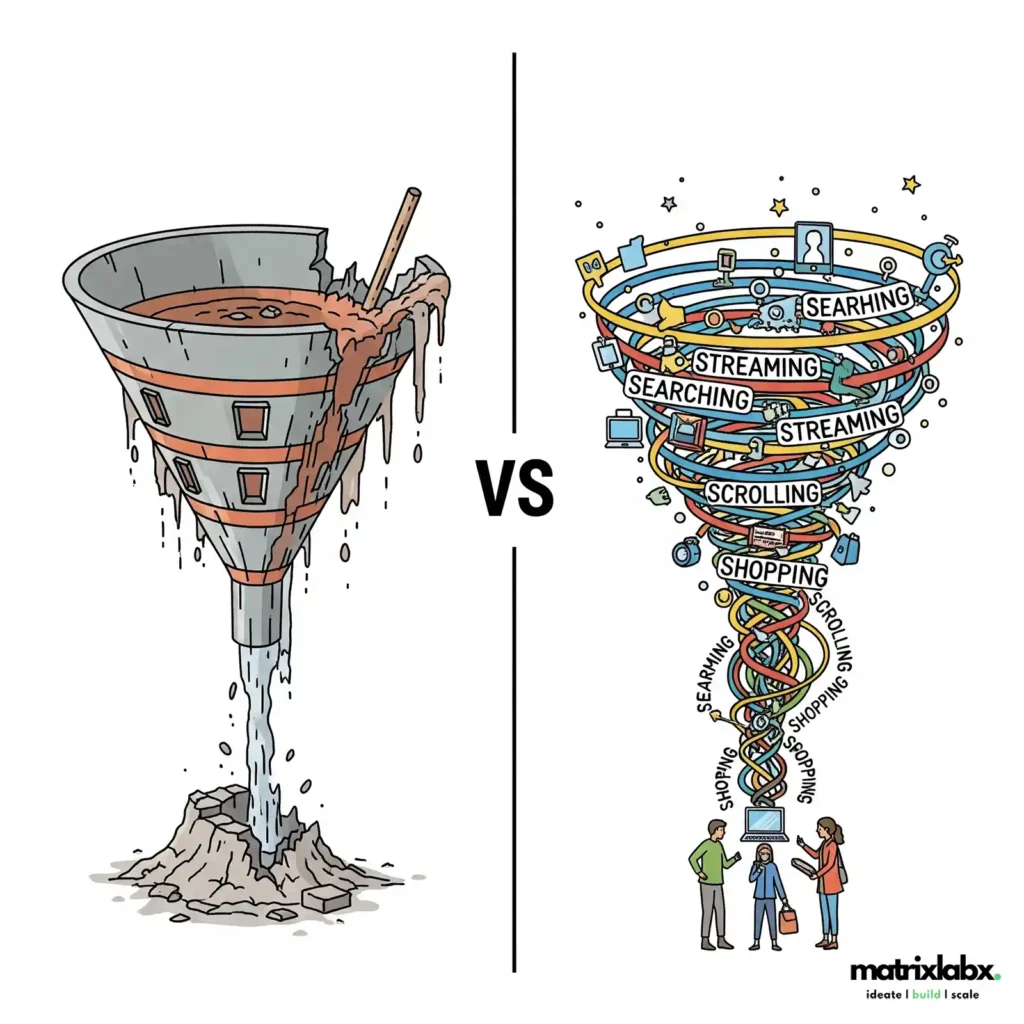
1. Searching
2. Streaming
3. Scrolling
4. Shopping
Your Performance Transformed
| Metric | Your Platform | MatrixLabX | Monthly Lift |
|---|
Total Estimated Annual Gain
$0
from improved conversions and recovered revenue
Predictive marketing marks a fundamental shift in mindset.
It’s the difference between driving by looking in the rearview mirror and driving with a sophisticated GPS that anticipates traffic and suggests the optimal route in real-time.
- From Reactive to Proactive:
- Reactive CMO: “Why did our lead conversion rate drop 10% last week?”
- Proactive CMO: “Our AMA has alerted us to a predicted 15% drop in conversions from our enterprise segment next week due to market trends. It has already automatically shifted budget to a more stable mid-market campaign and deployed a new creative asset to mitigate the impact.”
- Advanced Applications of Predictive Analytics for Sales Growth:
- Dynamic, Personalized Content: Use AI to move beyond simple “first name” personalization. The system can dynamically adjust website content, layouts, and offers in real-time based on a user’s profile, past behavior, and predicted intent.
- Proactive Churn Reduction: For subscription-based businesses, this is a game-changer. The model identifies customers exhibiting behaviors that correlate with a high risk of churning and can automatically trigger a personalized retention campaign, such as a special offer or a support outreach, before they cancel.
- Intelligent Budget Allocation: Stop allocating budgets on a quarterly or monthly basis. The AMA can shift marketing spend across channels on an hourly basis, moving funds from underperforming campaigns to those with the highest predicted ROI, maximizing the efficiency of every dollar spent.
The most powerful aspect of predictive marketing is its compounding effect.
Each accurate prediction and automated action refines the model, making it smarter and more effective.
Small, consistent gains, driven by thousands of micro-optimizations per day, compound over time to create an exponential growth curve and a nearly insurmountable competitive advantage.
4. The MatrixLabX & Matrix Marketing Group Approach: A Unified, AI-First Platform
The fatal flaw of the modern marketing tech stack is its fragmentation. A collection of “best-of-breed” tools creates data silos, integration headaches, and a broken view of the customer.
Each tool may be a “black box,” offering tactical shortcuts (like writing an ad) but providing zero strategic insight. You don’t know why something works, so you can’t build a proprietary, defensible system from it.
The solution is a unified, “glass box” platform. This approach, championed by MatrixLabX, enables you to create a proprietary model of your market.
You can analyze, predict, and understand the “why” behind your performance, turning your data into a strategic asset.
- The Vertically Optimized Growth Engine:
This model integrates the entire marketing lifecycle, from strategy and content creation to execution and reporting, into a single, cohesive system. This eliminates the inefficiencies and value leakage that occur when handing data off between disconnected tools. - The Integrated AI “Pads”: An Arsenal for the Modern CMO
To power this unified system, a suite of integrated applications is essential:- AIContentPad: Moves beyond simple generation. It automates the creation of high-performing, on-brand content that is pre-optimized for specific audience segments and channels. One client doubled their content output while cutting production time in half.
- AISEOPad: Automates the complex, time-consuming tasks of technical and content-based SEO, ensuring your digital assets are primed for maximum visibility.
- AIBrandPad: Acts as your brand’s guardian in the age of AI. It ensures that all automated communications remain consistent and on-brand, expanding your reach to new markets without diluting your message.
- AIsalesPad: Bridges the critical gap between marketing and sales, automating lead nurturing with hyper-personalized communication and equipping the sales team with deep, actionable insights.
This synergy of integration creates a self-evolving ecosystem that slashes operational complexity, eliminates human bottlenecks, and accelerates your path to market dominance.
5. Core Business Inputs and Performance Transformation
The Autonomous Marketing Agent is not a mystical “black box”; it is a powerful engine that requires high-quality fuel.
The performance of the system is directly tied to the quality and granularity of the data you provide.
- Fueling the Engine: The Data That Drives Sales:
To build a robust industry model, the AMA needs to be fed core business metrics. These inputs provide the foundation for its learning and optimization processes.- Key Inputs:
- Average Monthly Website Visitors
- Average Value per Qualified Lead ($)
- Lead Conversion Rate from Search (%)
- Average Customer Lifetime Value (CLV) ($)
- Cart Abandonment Rate (%)
- Average Order Value ($)
- Conversion Rate from Social Commerce (%)
- Key Inputs:
Case Study: “SaaS-Tech Inc.”
Let’s visualize the transformation. A B2B SaaS company is facing stalled growth and rising acquisition costs.
| Metric | Before AMA (Monthly) | After AMA (Monthly) | Impact |
| Qualified Leads | 500 | 650 | +30% (Higher quality, better targeting) |
| Lead-to-Close Rate | 15% | 22% | +47% (Predictive scoring, better nurturing) |
| Customer Acquisition Cost (CAC) | $2,500 | $1,800 | -28% (Efficient spend, reduced waste) |
| Customer Lifetime Value (CLV) | $15,000 | $19,500 | +30% (Proactive retention, cross-sells) |
| Sales Revenue | $1,125,000 | $2,749,500 | +144% |
This is not just about incremental improvements. The AMA creates a step-change in performance by optimizing the entire funnel simultaneously, a feat impossible through manual efforts.
6. Implementing the Autonomous Marketing Agent (AMA): A Practical Guide for CMOs
Adopting an autonomous system is a strategic initiative that requires careful planning and execution. It’s a journey, not a flip of a switch.
- Step 1: Unify Your Data & Embrace the “Glass Box”
The first and most critical step is to break down data silos. Invest in a platform that can integrate your disparate data sources (CRM, web analytics, ad platforms) into a single, unified view. This is the foundation of your proprietary model. - Step 2: Define Your North Star Metric
What is the single most important business outcome you want the AMA to achieve? Is it reducing CAC, increasing Marketing Qualified Leads (MQLs), or maximizing CLV? Clearly defining this “North Star” metric will focus the AMA’s learning process. - Step 3: Train and Calibrate the Model
Feed the system your historical data. This is the calibration phase where the model learns the unique DNA of your business—your sales cycles, your customer behaviors, and your market dynamics. - Step 4: Phased Rollout & Fostering Trust
Advanced Tip: Do not attempt a “big bang” rollout. Start with a limited scope. For example, allow the AMA to manage a single Google Ads campaign or nurture a specific lead segment. Use this pilot phase to build trust with your team and demonstrate value to stakeholders. As confidence grows, gradually expand the AMA’s scope of autonomy. - Step 5: Upskill Your Team for the Future
The AMA doesn’t replace marketers; it elevates them. Your team’s focus will shift from tedious manual execution to high-level strategy. Invest in training to develop “Marketing Orchestrators”—professionals who can set goals for the AI, interpret its insights, and manage the overall strategic direction. - Step 6: Embrace Ethical AI and Zero-Party Data
In an era of increasing privacy concerns, building trust is paramount. Prioritize ethical data practices and transparency. Leverage the AI to collect Zero-Party Data—data that customers intentionally and proactively share with you through personalized surveys, quizzes, or preference centers. This not only ensures compliance but also provides richer, more accurate data for personalization.
7. The Future of Marketing: Autonomous, Intelligent, and Predictive
The trends are clear. The marketing department of tomorrow will bear little resemblance to the one of today. We are on the cusp of a future that is:
- Fully Autonomous: The majority of campaign execution, optimization, and reporting will be handled by AI, freeing human talent to focus on creativity, brand building, and strategic partnerships.
- Hyper-Personalized: The concept of a “segment” will become obsolete. Marketing will be a “segment of one,” with every interaction between a brand and a customer being uniquely tailored in real-time.
- The Rise of the Marketing Orchestrator: The most valuable marketing professionals will be those who can effectively manage a portfolio of AI agents, setting their strategic goals and interpreting their complex outputs to guide the business.
- The Democratization of Power: Unified, autonomous platforms will level the playing field, allowing agile, forward-thinking companies to compete with and outperform larger, slower-moving incumbents.
8. Conclusion: Seize Your Unfair Advantage
The transition from reactive, manual marketing to an autonomous, predictive system is the single greatest opportunity for growth-focused CMOs today.
It is the definitive answer to the challenges of data overload, budget anxiety, and performance plateaus.
By embracing an Autonomous Industry Model, you are not just buying a tool; you are building a proprietary, intelligent growth engine that becomes a defensible asset for your business.
It is a system that delivers increased efficiency, unparalleled conversion rates, higher customer value, and a sustainable, compounding competitive advantage.
The companies that hesitate will be left competing on a playing field that no longer exists. The ones that act now will not just survive the future; they will define it. The time to build your Autonomous Marketing Agent is now.