

Agentic SaaS Transformation in 2026: Discover how Agentic AI is solving the SaaS execution gap by replacing manual workflows with autonomous digital labor. Learn how MatrixLabX architects Vertical Agentic Customer Platforms to reduce churn by 50% and drive a 10x ROI for high-growth enterprises in the USA and Europe.
What is an Agentic Readiness Audit for SaaS?
An Agentic Readiness Audit is a systematic evaluation of a B2B organization’s data architecture, workflow complexity, and technical infrastructure to assess its capacity to deploy autonomous AI agents that can perceive, reason, and act within a Vertical Agentic Customer Platform. By identifying where infrastructure is “agent-ready” versus “agent-allergic,” SaaS leaders can transition from manual oversight to strategic orchestration.
Why are Traditional SaaS Copilots Failing in 2026?
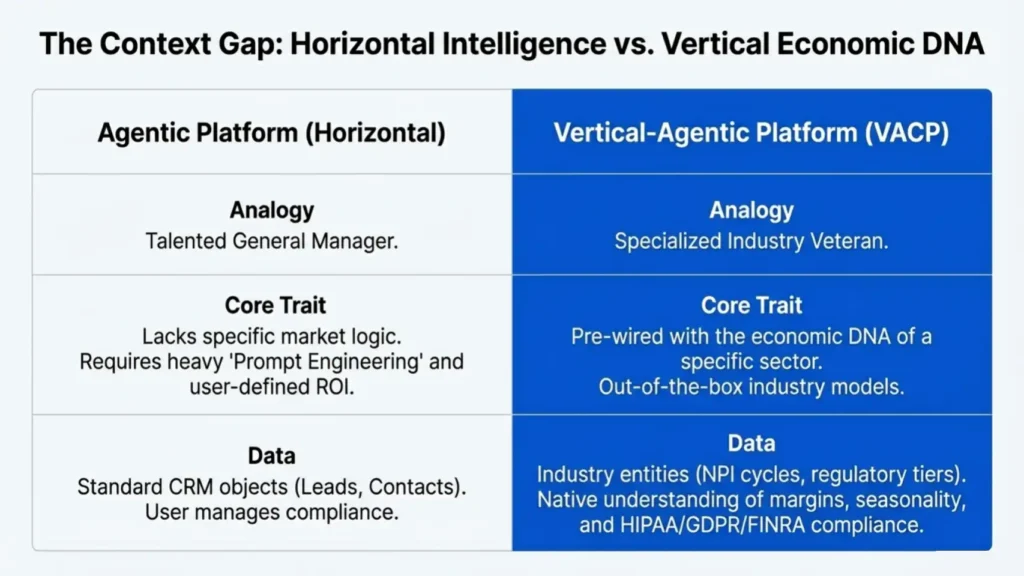
The board meeting for a mid-market SaaS leader—let’s call them NexaFlow—started at 9:00 AM, but by 9:15 AM, the air had left the room. Their pipeline was up 40% due to “AI Copilots” firing off thousands of automated emails, yet revenue remained stagnant because win rates had cratered. Sales reps were spending four hours a day “managing” their AI assistants instead of closing deals.
This is the “Copilot Paradox”. While enterprises treated AI like a digital intern in 2024, the weight of supervising those interns has become a secondary job in 2026. The tension lies in the failure of human-in-the-loop systems to scale when the “loop” moves at machine speed.
Key Takeaways for SaaS Executives
- Infrastructure over Interface: Success requires moving beyond chatbots to integrated Vertical Agentic Systems that execute end-to-end workflows.
- Data Liquidity is Non-Negotiable: Effective agents require structured, high-fidelity data to prevent hallucinations and execution errors.
- Human-in-the-Loop Governance: Auditing readiness means establishing clear “red lines” where autonomous agents hand off tasks to human experts to ensure brand trust.
- Economic Defensibility: Companies integrating agents now are training them on proprietary data, creating an “organizational intuition” that laggards cannot buy off a shelf.
How does Agentic AI Solve the “Execution Gap”?
Agentic AI refers to systems that independently perceive data, make decisions, and execute actions without constant human oversight. Unlike traditional AI, which provides recommendations, agentic AI operates as an autonomous decision-maker within defined parameters.
In the SaaS sector, this creates an Agentic Execution Layer (AEL) that sits between your data and your execution. This layer possesses cross-platform memory, the ability to break high-level goals into sub-tasks, and the ability to independently use tools like your CRM and ERP.
Diagnostic Contrast: Traditional SaaS vs. Vertical Agentic AI
| Feature | Traditional SaaS AI (The Copilot Era) | MatrixLabX Agentic AI (The Agentic Era) |
| Operational Model | Human-in-the-loop (HITL) | Autonomous / Agentic |
| Primary Logic | Predictive Correlation (Historical trends) | Causal Inference (Resolution paths) |
| Action Trigger | Manual Playbooks (Requires “Click Start”) | Self-Executing Agents |
| Implementation | 6–12 Months | 4–8 Weeks (Context-as-a-Service) |
| Data Utilization | Structured CRM Data Only | Unstructured Telemetry, IoT & Bio-data |
| Market ROI | $3.70 per $1 spent | $10.00+ per $1 spent |
Use Case: Reclaiming the “Middle 80%” Revenue Leak
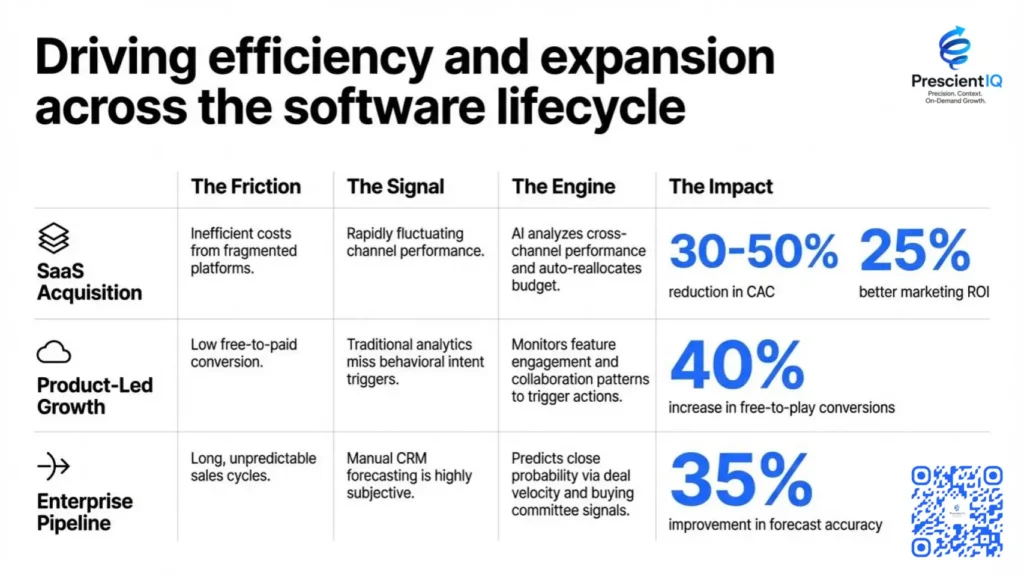
A leading Enterprise Software firm found its traditional funnels collapsing because users weren’t realizing value fast enough. Success teams were reactive, reaching out only after a user had been inactive for 30 days—often too late.
The Pivot: An audit revealed a lack of “Data Liquidity”; behavioral data existed but wasn’t accessible to the execution layer in real time. MatrixLabX implemented PQL (Product Qualified Lead) Conversion Agents. These agents detect in-app buying signals and trigger personalized executive outreach the moment a friction point is detected.
The Payoff: The firm saw a 45–50% reduction in churn and a 20% improvement in Customer Lifetime Value (LTV). By activating the “Middle 80%” of abandoned signals, the company achieved a 3x higher response rate compared to legacy methods.
4-Step Implementation: Building Your Agentic Execution Layer
- Inventory Your Data Entities: Use Entity Mapping to identify core concepts (e.g., “Customer Lifecycle,” “Contract Clause”) and ensure they are defined in a machine-readable format.
- Map Workflow Atomicization: Break complex processes into “atomic” steps. If a human has to “just know” how to do something, the agent will fail; you must document the explicit logic.
- Test for Semantic Interoperability: Ensure your CRM, ERP, and CMS can exchange data without losing context using JSON-LD or similar structured formats.
- Establish Governance Guardrails: Define the limits of your agents’ authority. Set “Red Lines” for which decisions—such as high-stakes contract finalizations—require human approval.
Why Might This Not Work For You?
An Agentic Readiness Audit will fail if your organization is plagued by Data Silos that leadership is unwilling to break down.
Furthermore, if your culture views AI as a threat to job security rather than a capability multiplier, internal resistance will likely sabotage the implementation.
Finally, agents require a digital footprint; if your transactions are entirely “handshake-based” with no data, there is nothing for them to learn.
Closing the Customer Execution Gap: Agentic SaaS Transformation in 2026 all starts with an assessment.
Frequently Asked Questions (People Also Ask)
How long does an Agentic Readiness Audit take?
Typically, a comprehensive audit for a mid-market B2B firm takes 4 to 6 weeks. This includes data discovery, workflow mapping, and infrastructure stress testing to ensure a Vertical Agentic Customer Platform can be supported.
Is agentic AI different from standard automation?
Yes. While standard automation follows “if-then” rules, agentic AI uses reasoning to handle ambiguity and can change its path to achieve a goal, making it far more flexible for complex B2B sales cycles.
What is the ROI of being “Agent-Ready”?
Companies typically see a 20-30% reduction in operational costs and significant “Information Gain” that improves their ranking in AI-driven search results. Leaders often realize $10 in ROI for every $1 invested.
Do I need a large IT team to implement this?
Not necessarily. The audit identifies where you can leverage existing APIs. Many businesses use Vertical Agentic Systems that integrate with existing stacks, requiring strategic oversight rather than extensive coding.
Can agents handle B2B contract negotiations?
Agents can handle initial stages, such as aligning on standard terms and pricing tiers, but high-stakes finalizations still require human oversight to manage nuanced relationship dynamics.
Last Updated: April 6, 2026 | Author: George Schildge, CEO & Chief AI Officer, MatrixLabX