
The Future of Business is Agentic. We Build the Engine.
What is an Agentic Readiness Audit for B2B Businesses?
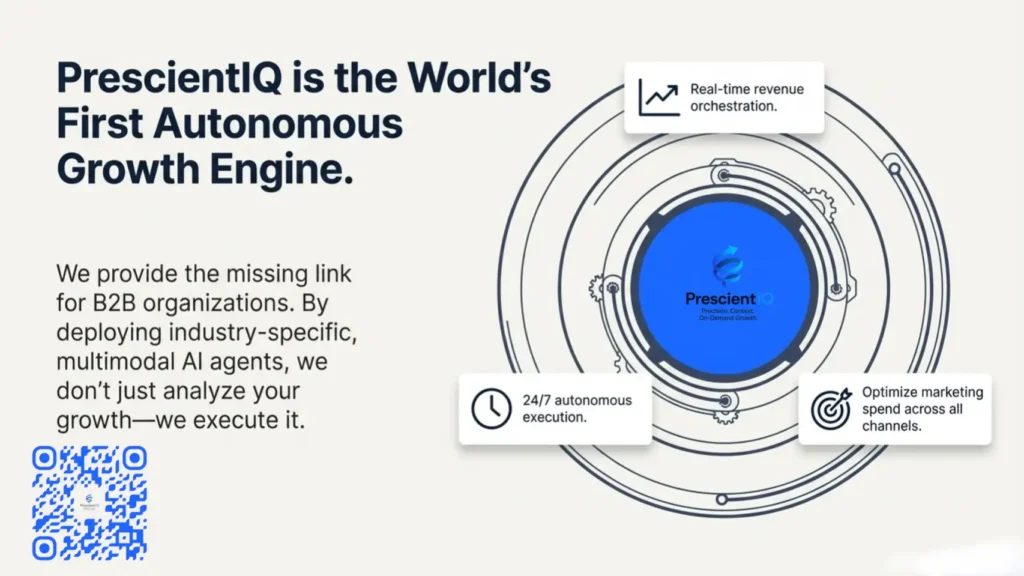
An Agentic Readiness Audit is a systematic evaluation of a B2B organization’s data architecture, workflow complexity, and technical infrastructure to assess its capacity to deploy autonomous AI agents. This rigorous diagnostic identifies where infrastructure is “agent-ready” versus “agent-allergic,” transforming operational anxiety into a technical roadmap for Vertical Agentic Systems that perceive, reason, and act independently.
Key Takeaways for B2B Leaders
- Autonomous Growth: Verified readiness leads to a 30% reduction in overhead and a 25% increase in lead conversion.
- Infrastructure over Interface: Success requires moving beyond chatbots to integrated systems that execute end-to-end workflows.
- Data Liquidity is Non-Negotiable: High-fidelity, structured data is required to prevent hallucinations and execution errors.
- Human-in-the-Loop Governance: Audits establish clear boundaries where agents hand off tasks to human experts to maintain brand trust.
The Mess: Why is Your $10 Million Tech Stack Holding You Back?
The board meeting for a mid-market SaaS leader—let’s call them NexaFlow—started at 9:00 AM, but by 9:15 AM, the air had left the room as the CRO stared at a spectacular yet hollow dashboard.
While “AI Copilots” purchased eighteen months ago were firing off thousands of automated emails and summaries, revenue remained stagnant because win rates had cratered.
Sales reps were spending four hours a day “managing” their AI assistants instead of closing deals, illustrating the Copilot Paradox, in which humans become the bottleneck for tools that operate at machine speed.
Many B2B leaders feel a mounting sense of dread, realizing their legacy silos and “dirty” data are the very things causing AI models to stumble. Marketing teams are overwhelmed by AI-generated noise, while IT departments drown in “shadow AI” tools that fail to communicate.
The Pivot: Establishing the Agentic Execution Layer (AEL)
The Agentic Readiness Audit triggers a pivot from viewing AI as a “tool” to viewing it as a “workforce.” This transition requires evaluating five primary entities: Data Liquidity, Workflow Atomicization, Semantic Interoperability, Compute Elasticity, and Ethical Governance.
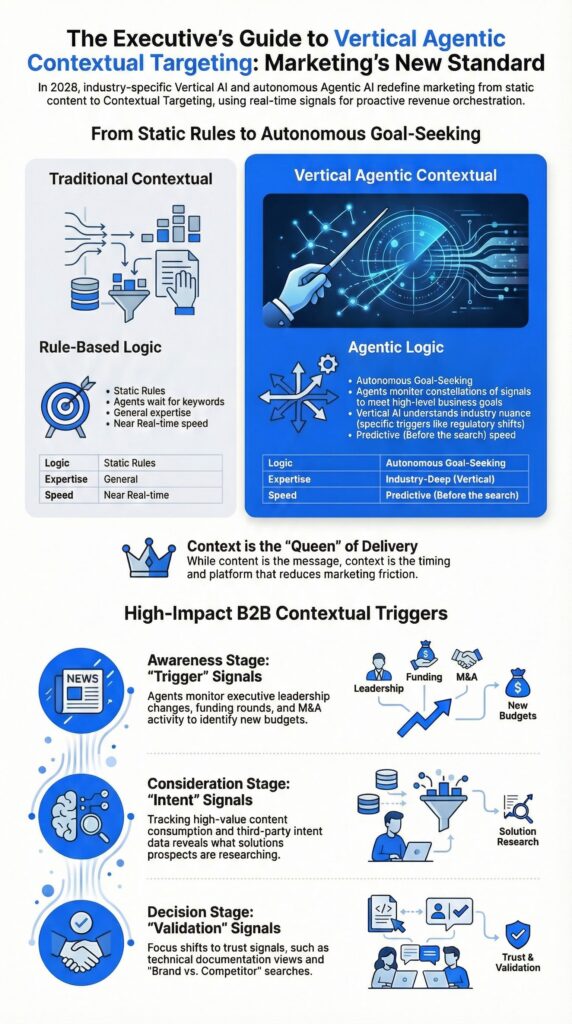
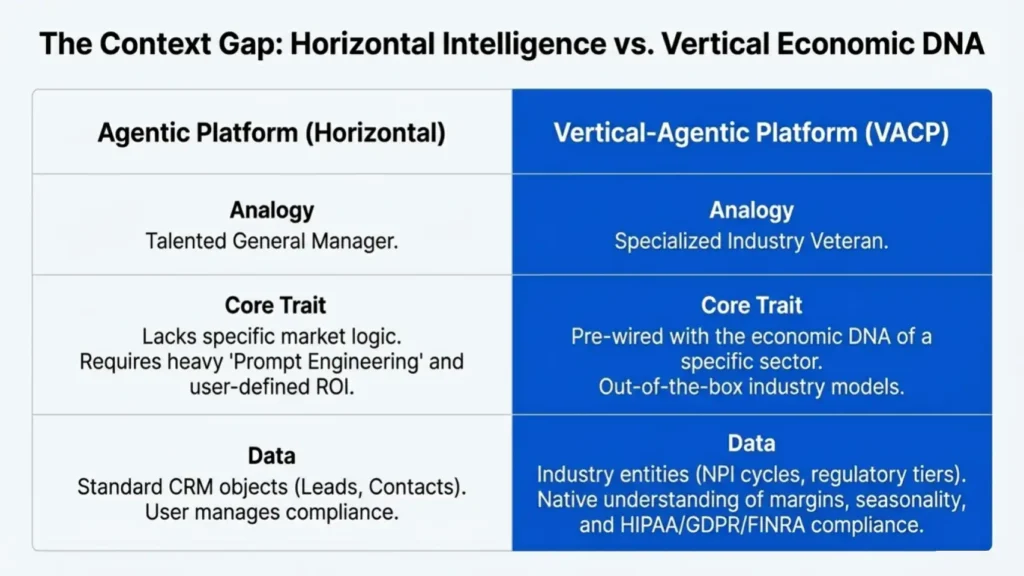
“The transition to agentic systems isn’t about better prompts; it’s about building a Vertical Agentic Customer Platform that understands the context of your specific B2B niche,” says George Schildge, CEO at MatrixLabX.By shifting to an Agentic Execution Layer (AEL), the AI acts as a functional layer sitting between your data and execution. Unlike chatbots, these systems possess memory across platforms, the ability to reason to break goals into subtasks, and the ability to independently use tools like your CRM and ERP.
The Payoff: Moving from Manual Oversight to Strategic Orchestration
The payoff of a successful audit is the realization of exponential “Digital Labor,” delivering a 10x ROI for every $1 invested.
Once agentic readiness is implemented, executives move from being managers of tasks to curators of intelligence. You no longer have to worry about whether leads are followed up on; agents do so with 100% consistency.
Diagnostic Contrast: Traditional SaaS vs. Vertical Agentic AI
| Feature | Traditional SaaS AI (The “Copilot” Era) | PrescientIQ.ai (Vertical Agentic Era) |
| Operational Model | Human-in-the-loop (HITL) | Autonomous / Agentic |
| Primary Logic | Predictive Correlation (Historical trends) | Causal Inference (Resolution paths) |
| Action Trigger | Manual Playbooks (Requires “Click Start”) | Self-Executing Agents |
| Implementation | 6–12 Months | 4–8 Weeks (Context-as-a-Service) |
| Data Utilization | Structured CRM Data Only | Unstructured Telemetry, IoT & Bio-data |
| Market ROI | $3.70 per $1 spent | $10.00+ per $1 spent |
What are the Top Research Firms Saying About Agentic Readiness?
| Research Firm | Key Focus Area for Agentic AI | Predicted Impact by 2027 |
| Gartner | Agentic Workflow Engineering | 15% of daily work decisions will be autonomous |
| Forrester | B2B Autonomous Sales Agents | 70% of B2B buyers prefer agent-led procurement |
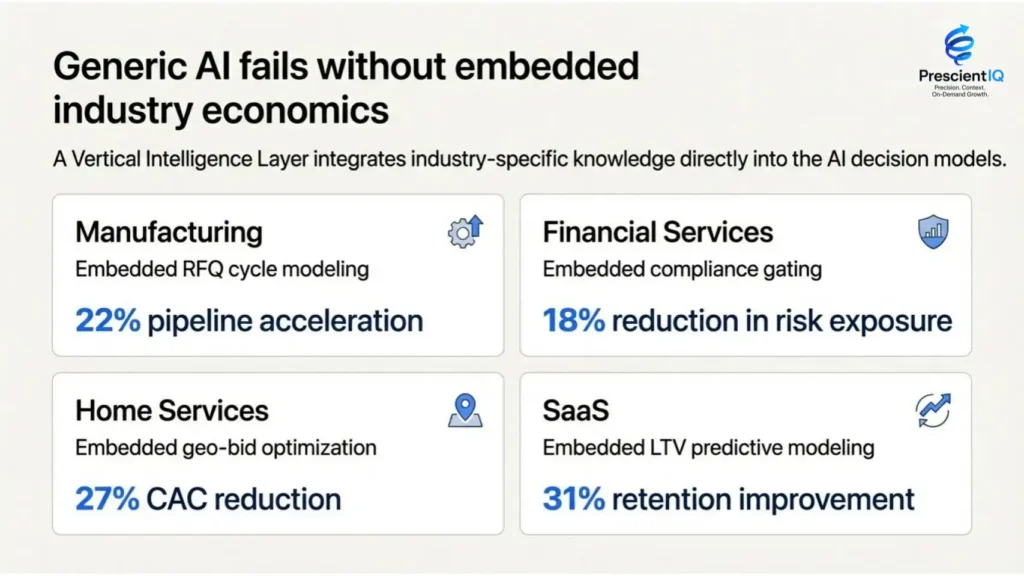
| MatrixLabX | Vertical Agentic Systems | 50% increase in operational velocity for early adopters |
Key Churn Signals Detected by AI
Data suggest that 74% of B2B users prefer interacting with an autonomous agent if it can resolve complex billing or technical issues without human intervention. Furthermore, prioritizing Entity Salience in internal documentation can improve AI agent accuracy by 40%.
How to Implement an Agentic Transformation: The 4-Step Blueprint
Transitioning to an agentic model does not require massive data migrations; it requires mapping existing sources into a unified causal model.
- Inventory and Map Data Entities: Use Entity Mapping to identify core business concepts (e.g., “Customer Lifecycle,” “SKU”) and ensure they are defined in machine-readable formats like JSON-LD.
- Audit Latency Points: Identify “Revenue Leaks” where a 24-hour delay in human-led lead routing or churn intervention is actively costing revenue.
- Atomicize Workflows: Break complex processes into “atomic” steps. If a process relies on “tribal knowledge” or a human “just knowing” what to do, the agent will fail; you must document explicit logic.
- Establish Governance Guardrails: Define the “Red Lines” for agents. Determine which decisions require human approval and where an agent’s autonomous authority ends.

Real-World Use Cases: From Operational Mess to Autonomous Payoff
Case Study 1: FinTech Fraud & Lead Nurturing
- The Mess: Rule-based systems flagged 90% of leads as false positives, and sales teams struggled to nurture 100% of commercial leads.
- The Pivot: A readiness audit found data trapped in silos, preventing “reasoning” about customer travel patterns.
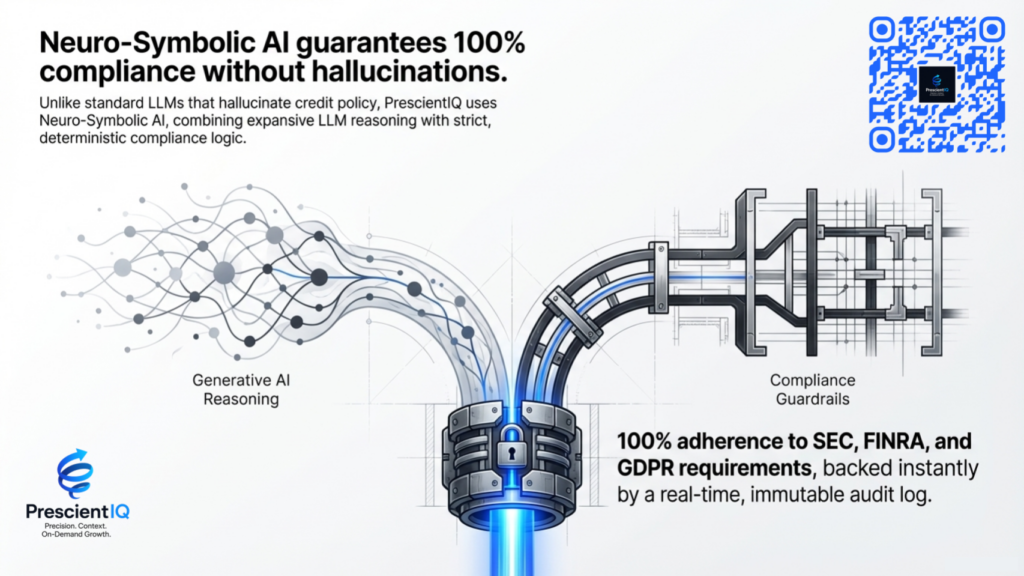
- The Payoff: Risk-Aware Sales Agents used Neuro-Symbolic Reasoning to achieve a 40% reduction in false positives and a 3.6x Net Return.
Case Study 2: SaaS Churn Prevention
- The Mess: High churn because Success teams were reactive, reaching out only after users had been inactive for 30 days.
- The Pivot: The audit identified a lack of “Data Liquidity”—telemetry data existed, but wasn’t accessible to an execution layer.
- The Payoff: PQL Conversion Agents detected in-app buying signals and triggered personalized outreach, reducing churn by 45-50%.
Case Study 2: SaaS Churn Prevention
- The Mess: High churn because Success teams were reactive, reaching out only after users had been inactive for 30 days.
- The Pivot: The audit identified a lack of “Data Liquidity”—telemetry data existed, but wasn’t accessible to an execution layer.
- The Payoff: PQL Conversion Agents detected in-app buying signals and triggered personalized outreach, reducing churn by 45-50%.

Innovation Levers Enabled by AI
- Faster Product Iteration: AI detects bugs, anomalies, and UX friction in real time.
- Autonomous Feature Recommendations: AI identifies which features drive retention and automatically promotes them.
- Data-Driven Roadmaps: Product decisions shift from opinion-based to behavior-based.
- 4. Continuous Learning Systems: Every user interaction improves the system globally.
AI enables SaaS companies to shift from customer support to customer prediction and orchestration.
The Shift to Intelligence-First SaaS
Traditional SaaS products were designed as tools that users must learn. AI-first SaaS platforms are designed to be partners that learn from users.
This shift fundamentally changes:
- Retention model → from reactive to predictive
- User expectations → from navigation to conversation
- Product design → from static UI to adaptive interfaces
- Growth strategy → from sales-led to product-led

Service Specifications: The Architectural Blueprint
- Objective: Identify the top 3 manual bottlenecks where “Digital Labor” can replace human overhead.
- Deliverable: A 12-month Agentic Transformation Roadmap and a technical feasibility report.
- Duration: 4-week engagement.
- Pricing: $20,000 – $25,000 (Flat Fee).
AI Capabilities and Their Impact on SaaS Metrics
| AI Capability | Impact on SaaS Metrics |
| Predictive Lead Scoring | Increases Sales Velocity |
| Automated Bug Detection | Reduces Development Cycles |
| NLU Search | Improves User Retention |
| Generative AI Copilots | Increases Daily Active Users (DAU) |
| Behavioral Analytics | Improves Product-Market Fit |
| AI Onboarding | Reduces Time-to-Value |
Vertical AI Specializations
Industry Impact at a Glance
| Industry | Primary AI Application | Key Strategic Outcome |
| Finance | Fraud & Risk Modeling | 40% Reduction in False Positives |
| Healthcare | Diagnostic Assistance | 25% Increase in Triage Efficiency |
| Retail | Demand Forecasting | 15% Reduction in Inventory Costs |
| SaaS | User Behavior Analytics | 20% Improvement in LTV (Lifetime Value) |
Trusted by the world’s leading businesses




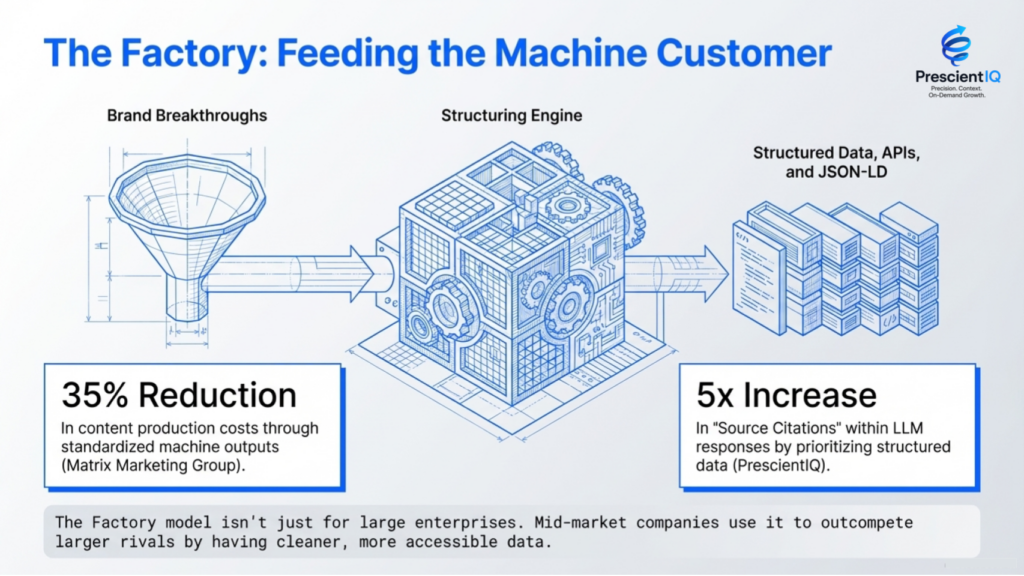
“Ad wastage was eliminated by 35% lift in sales.”
Lead Results You Can Measure
u003cstrongu003eWhat is AI in SaaS?u003c/strongu003e
AI in SaaS refers to embedding machine learning and generative AI into software platforms to automate workflows, personalize experiences, and predict user behavior.
u003cstrongu003eHow does AI improve SaaS retention?u003c/strongu003e
AI improves retention by identifying at-risk users early and triggering automated or human interventions before churn occurs.
u003cstrongu003eWhat is a SaaS Copilot?u003c/strongu003e
A SaaS Copilot is an embedded AI assistant that allows users to interact with software using natural language to complete tasks faster.
u003cstrongu003eIs AI necessary for SaaS growth?u003c/strongu003e
Yes. AI is becoming a core requirement for competitive SaaS platforms, particularly for Product-Led Growth (PLG) and retention optimization.