

The provided “Key Points” focus heavily on organizational and communication alignment as the solution to Attribution 1.0’s failure.
An alternative perspective would be to focus on the technological and methodological limitations that persist, regardless of alignment:
- Attribution is fundamentally flawed because marketing influence is non-linear and non-deterministic.
- AI models for attribution atomization (or granular, data-driven attribution) use machine learning to break down complex, multi-touch customer journeys into individual, weighted interactions. Unlike static rule-based models (e.g., first/last-click), AI dynamically assigns conversion credit to every touchpoint, offering real-time, actionable insights.
Even with perfect alignment (Attribution 2.0), the models are still attempting to assign discrete credit to a continuous, probabilistic, and often hidden customer journey.
The “3-5 decisive moments” might just be the easiest to measure, not the most impactful. From this perspective, the real “Attribution 2.0” isn’t a better measurement, but better forecasting and resource allocation that abandons the pretense of precise credit assignment altogether.
The true goal is “Optimized Spend” rather than “Accurate Credit.”
What is Marketing Attribution 3.0?
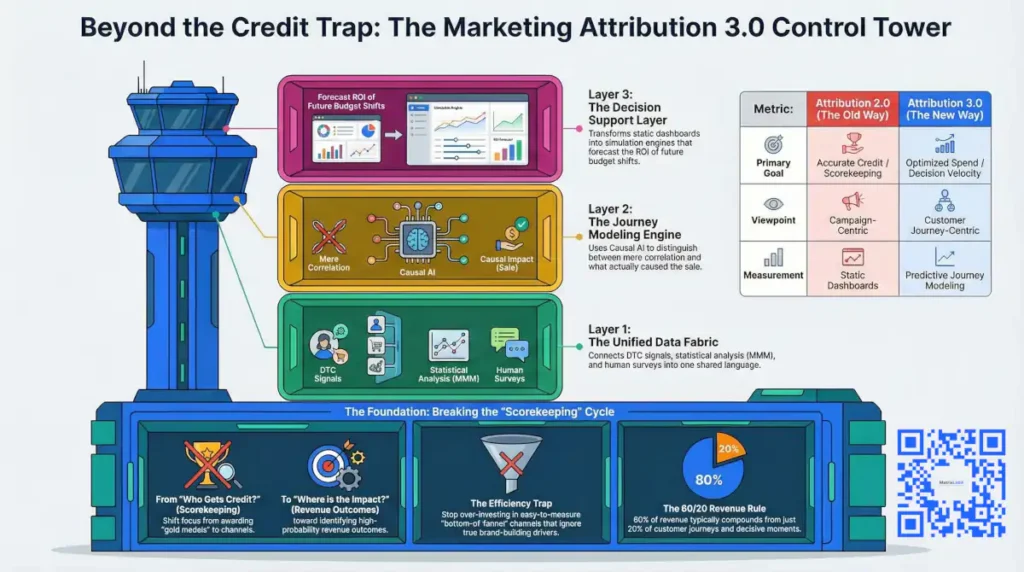
Marketing Attribution 3.0 is the next evolution of attribution—moving beyond static, rule-based models (like first-touch or last-touch) like HubSpot attribution 2.0 models into AI-driven, continuously learning systems that connect marketing activity directly to revenue in real time.
It reflects a shift from “what channel got credit?” to “what actually caused revenue—and how do we optimize it dynamically?”
The Evolution to Attribution 3.0
1. Attribution 1.0 — Rule-Based (Legacy)
- First-touch / last-touch / linear models
- Simple, but misleading
- Over-credits channels like paid search or direct traffic
👉 Problem: Ignores the real buyer journey
2. Attribution 2.0 — Multi-Touch (MTA)
- Assigns fractional credit across touchpoints
- Uses predefined models (time decay, U-shaped, etc.)
- More accurate—but still static and assumption-driven
👉 Problem: Still doesn’t understand causality or adapt in real time
3. Attribution 3.0 — AI + Causal + Predictive
- Uses machine learning + probabilistic modeling
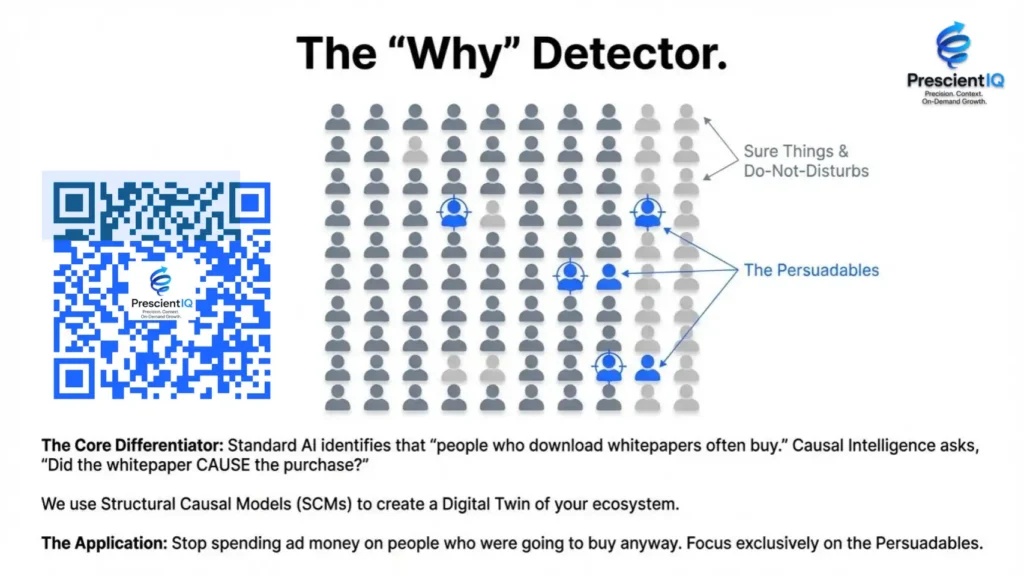
- Identifies what actually drives conversions (causation vs correlation)
- Continuously updates attribution weights based on new data
- Connects marketing → pipeline → revenue → LTV
👉 Outcome: Autonomous optimization, not just reporting
Let’s take a deep dive.
Section 1: The Moment Everything Breaks
The Monday morning executive sprint started like any other, until the “Double-Counting Crisis” hit the floor. The CMO sat at one end of the mahogany table, proudly displaying a dashboard that showed the new influencer campaign driving $4.2M in attributed revenue.
At the other end, the Head of Performance Marketing tapped a pen against his tablet, showing a search spend report that claimed those exact same dollars.
In the middle sat the CFO, looking at a bank balance that hadn’t moved nearly enough to justify both claims.
“If I add up the revenue every department is claiming,” she remarked, her voice dry and clinical, “we’ve apparently grown by 400% this month. So why am I still looking at a flat EBITDA?”
The room went silent. This wasn’t a data error; it was a fundamental collapse of trust. The “truth” had become departmentalized. The tools were working exactly as designed—tracking clicks, pixels, and sessions—but they were failing to track reality.
This is the moment the glass breaks for every major Ecommerce brand: the realization that your “source of truth” is actually just a collection of competing narratives.
When attribution becomes a political tool for budget protection rather than a compass for growth, the business stops moving forward. We aren’t just missing the “last click”; we are missing the customer.
Section 2: The Hidden Problem (What Others Miss)
The industry has spent a decade obsessing over “Accurate Credit.” We’ve treated marketing like a courtroom drama where we must prove, beyond a reasonable doubt, which specific ad “caused” the sale.
But here is the hard truth: The customer does not live in your funnel. The hidden problem isn’t the lack of data; it’s the fragmentation of the customer journey into siloed “outputs”. While brands obsess over whether a Facebook view or a Google click deserves the 20% commission, the customer is bouncing between a podcast, an unboxing video, a Reddit thread, and a physical store.
Traditional models assume a linear path that no longer exists in a world of Generative AI and semantic search. When an AI-powered answer engine tells a shopper which “sustainable running shoe” is best, there is no “click” to track in the traditional sense.
The cost of this delusion is staggering. Companies are currently over-investing in high-intent “bottom-of-funnel” channels because they are the easiest to measure, not because they are the most effective at driving incremental growth. We are effectively paying for customers who were already walking through the door, while starving the very brand-building activities that create the door in the first place.
Section 3: Why Traditional Approaches Fail
The dashboards on your screen are lying to you by omission. Traditional Attribution 1.0 (Single-touch) and 2.0 (Multi-touch) fail for three systemic reasons:
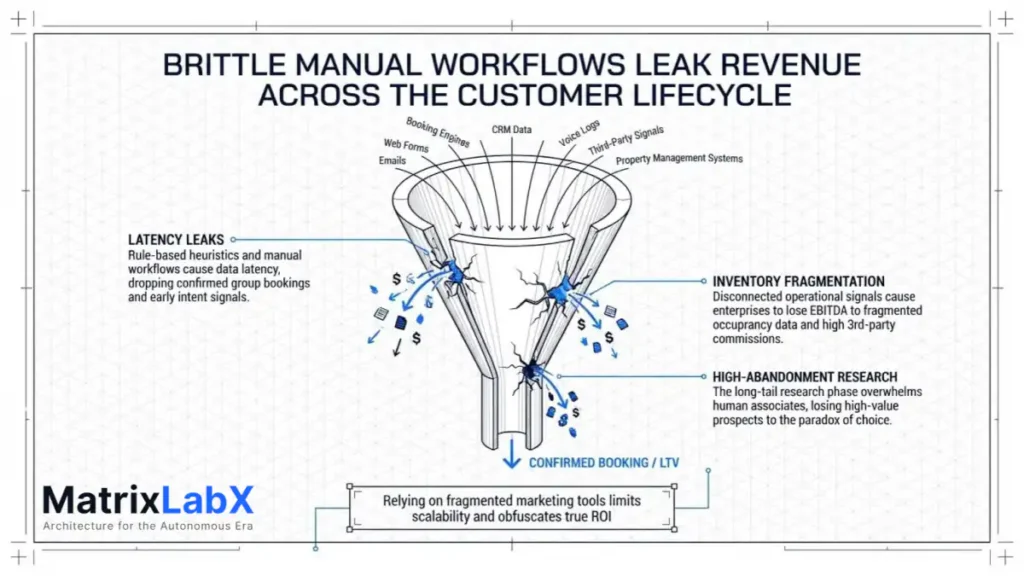
- The Privacy Tax: With the death of third-party cookies and the rise of ATT (App Tracking Transparency), the “thread” we used to sew together a journey has been cut. Your MTA (Multi-Touch Attribution) tool is now guessing about 40-60% of the journey.
- The “Scorekeeper” Mentality: Most attribution is used for retrospective justification. It answers: “What happened?” but it cannot answer: “What should I do next?”.
- The Siloed Truth: When your search team uses Google’s model and your social team uses Meta’s model, you aren’t running one company; you are running five competing agencies under one roof.
There is a moment of realization for every Head of Growth when they see a “Perfect” ROAS on a dashboard, yet the company is facing a cash flow crunch. That is the moment you realize your tools are optimized for reporting, not for outcomes.
Section 4: The New Model: Marketing Attribution 3.0
We are entering the era of Attribution 3.0: The Journey Modeling Paradigm.
This is not an incremental update; it is a category shift. We are moving from “Campaign-Centric Scorekeeping” to “Customer-Centric Decision Support”.
In this new model, we stop trying to find the “one true path” and start building a Journey Model. This utilizes Agentic Systems and Semantic Analysis to understand the influence of every touchpoint, regardless of whether a pixel was fired.
The Core Thesis: Optimized Spend Over Accurate Credit
The goal of Marketing Attribution 3.0 is not to award a gold medal to a specific channel. The goal is Optimized Spend. We move away from asking “Who gets credit?” and begin asking “If I put an extra $100,000 into this lever, what is the mathematical probability of a revenue outcome?”.
Section 5: How It Works: The Operational Breakdown
Attribution 3.0 operates through a three-layer architecture designed for the AI-native enterprise.
1. The Unified Data Fabric (The Shared Language)
Instead of disparate spreadsheets, all signals—online, offline, and qualitative—are fed into a single environment. This includes:
- Direct-to-Consumer (DTC) signals (clicks, site behavior).
- Media Mix Modeling (MMM) (top-down statistical analysis).
- Post-Purchase Surveys (the “human” layer).
2. The Journey Modeling Engine
Using Generative AI and semantic search principles, the system looks for patterns in customer intent rather than just click sequences. It identifies “The Customer Execution Gap”—the space between where a customer is and where the purchase happens—and models the most efficient way to close it.
3. The Decision Support Layer
The output is no longer a static dashboard. It is a simulation engine. A VP of Growth can ask, “How does my CAC (Customer Acquisition Cost) change if I shift 20% of my search budget into influencer-led video?”. The system provides a probability-based forecast, not just a historical report.
Section 6: Real-World Applications
Use Case 1: The Global Fashion Retailer
The Challenge: A major Ecommerce fashion brand saw strong “last-click” performance on Google Search but a decline in overall brand search volume.
The Transformation: By moving to Attribution 3.0, they realized their YouTube “top-of-funnel” content was the primary driver of high-intent searches.
The Outcome: They increased YouTube spend by 40%. While “attributed” ROAS for YouTube looked low, the overall Pipeline Velocity increased by 22%, and total company revenue grew by 15% in one quarter.
Use Case 2: The Subscription SaaS Disruptor
The Challenge: The team was trapped in a “Last-Click” cycle, over-bidding on their own brand terms.
The Transformation: Using a Journey Modeling approach, they identified that technical blog posts (optimized for semantic search) were the true entry point for 70% of high-LTV (Lifetime Value) customers.
The Outcome: They reallocated budget from brand bidding to content engineering, resulting in a 30% reduction in CAC.
Section 7: Business Impact: Metrics That Matter
In the 3.0 world, we stop talking about “Clicks” and start talking about Revenue Outcomes.
| Metric | The Old Way (2.0) | The New Way (3.0) |
| Primary Goal | Accurate Credit | Optimized Spend |
| Focus | Activity Outputs | Revenue Outcomes |
| Measurement | Dashboarding | Journey Modeling |
| Velocity | Monthly Reporting | Real-time Decision Support |
When you shift to this model, Efficiency Gains are not just about saving money—they are about Capital Agility. You gain the ability to move the budget as fast as the market changes. You aren’t just measuring the business; you are steering it.
Section 8: What This Means for Leaders
For the CMO and CFO, the implications are clear: The era of “guessing and defending” is over.
If you continue to rely on siloed, platform-based attribution, you are making multi-million dollar decisions based on incomplete data.
The risk of inaction is a slow death by “Efficiency Trap”—where your dashboards look great, but your market share is shrinking because you aren’t investing in the areas that actually drive growth.
The future of marketing belongs to the “Decision-First” organization. Those who can model the customer journey with high fidelity will be the ones who can afford to out-acquire their competition.
Section 9: The Path Forward
Marketing Channel Attribution 3.0 isn’t just a technical upgrade; it’s a leadership mandate. It requires a shift from defending budgets to optimizing outcomes.
At our firm, we don’t just build dashboards; we build the systems that drive executive clarity. We invite you to move beyond the “Scorekeeping” era and join the leaders already modeling the way to the next stage of growth.
Ready to see the true shape of your customer journey? Let’s move from credit to confidence. Contact our senior strategy team for a diagnostic of your current attribution architecture.
Based on the content of the “Marketing Channel Attribution 3.0” document, here are the requested additions tailored for matrixlabx.com.
Conclusion: The Mandate for Attribution 3.0
The transition from Attribution 2.0 to 3.0 represents a fundamental shift in how modern enterprises value their marketing investments. By moving away from the “Scorekeeper” mentality—which prioritizes retrospective credit assignment—and embracing “Decision Velocity,” brands can finally bridge the gap between dashboard metrics and actual bank balances.
In an era defined by privacy constraints and non-linear customer journeys, the goal is no longer to find a single source of truth, but to build a robust Journey Model that prioritizes optimized spend over accurate credit. For leaders at the helm of growth, the choice is clear: continue defending legacy budgets with fragmented data, or adopt a decision-first architecture that turns marketing into a predictable engine for capital agility.
Frequently Asked Questions (FAQs)
1. What is the main difference between Attribution 2.0 and 3.0?
Attribution 2.0 focuses on “Accurate Credit”—trying to prove which channel caused a sale using rules-based or multi-touch models. Attribution 3.0 focuses on “Optimized Spend,” using AI-driven journey modeling and predictive simulations to determine where the next dollar is most likely to drive revenue.
2. Why are traditional attribution models failing now?
Traditional models rely heavily on tracking pixels and third-party cookies, which have been severely curtailed by privacy regulations such as Apple’s App Tracking Transparency (ATT). Furthermore, traditional models struggle to account for nonlinear influences such as podcasts, dark social, and AI-powered search engines.
3. How does Marketing Attribution 3.0 handle the “Privacy Tax”?
Instead of stitching together a broken path of individual clicks, Attribution 3.0 uses a “Unified Data Fabric.” It combines top-down Media Mix Modeling (MMM), qualitative post-purchase surveys, and first-party data to model customer influence rather than just tracking sessions.
4. What is “Decision Velocity” in the context of marketing?
Decision Velocity is an organization’s ability to move budget and strategy as quickly as the market changes. Instead of waiting for monthly reports to justify past spend, Attribution 3.0 provides real-time decision support, allowing teams to simulate outcomes and reallocate capital instantly.
5. Does this model replace my existing Google or Meta dashboards?
It doesn’t necessarily replace them, but it contextualizes them. While platform-specific dashboards are useful for granular campaign adjustments, Attribution 3.0 serves as the “Executive Layer” that prevents double-counting and ensures all channels work toward a unified EBITDA goal.