
Agentic Autonomy Ratio (AAR) Benchmark
As enterprises move from static automation to autonomous systems, leadership must shift from managing tools to orchestrating outcomes. The primary metric for measuring this shift is the Agentic Autonomy Ratio (AAR), defined as the percentage of complex, multi-step tasks an AI agent completes without manual human intervention.
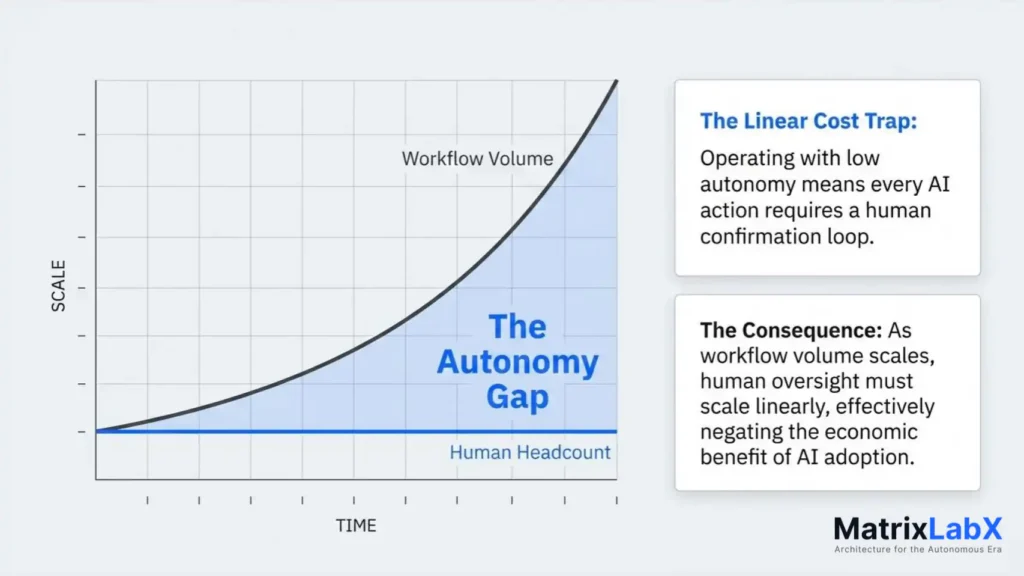
Operating with low autonomy creates a “Linear Cost Trap,” where scaling your workflow volume requires linearly scaling human oversight, effectively negating the economic benefits of AI adoption. To remain cost-competitive in 2026, leading organizations require a minimum AAR of 85% for routine business processes.
Here is how to calculate your baseline, identify your operational level, and benchmark your progress against industry standards.
Step 1: Understand the AAR Formula
AAR is not just a math problem; it is a balancing act between scale potential and operational drag. Mathematically, decreasing your intervention rate forces exponential gains in operational velocity.
The calculation uses the following formula:
AAR = (T_a / T_t) \times (1 – R_{hi})
- Total Tasks (T_t): The total required actions within a specific workflow.
- Attempted Tasks (T_a): The number of those tasks routed to and attempted by an AI agent.
- (The ratio of T_a / T_t represents your Task Completion Capacity or Scale Potential).
- Human Intervention Rate (R_{hi}): The percentage of AI-attempted tasks that require human correction, subjective aesthetic evaluation, ethical judgment, or approval before final execution. (This represents your Operational Drag or Cost).
Step 2: Determine Your Autonomy Level
Once you have calculated your AAR percentage, map it to the four levels of agentic integration to understand your human operators’ current role.
- Level 1 (Assisted): 10-30% AAR. The human role is a “Constant Co-pilot,” resulting in linear scaling and slow response times.
- Level 2 (Conditional): 31-70% AAR. The human acts as the “Final Arbiter” for gray areas. This is good for routine sequences, but halts at ambiguity.
- Level 3 (High): 71-90% AAR. Humans act only as an “Emergency Override”. The system achieves sandbox independence and 24/7 lights-out operations.
- Level 4 (Full): 91%+ AAR. There is zero day-to-day human oversight. The impact is self-healing, self-optimizing resilience.
Step 3: Compare Against Industry Benchmarks
To understand how your workflows compare with enterprise environments, use the following AAR benchmarks.
Note: The data below is drawn strictly from the MatrixLabX 2026 Executive Blueprints. Specific quantitative baselines for E-commerce, Travel and Hospitality, and general Professional Services were not explicitly tracked in these core enterprise audits. For those sectors, we recommend aiming for the cross-industry 2026 Enterprise Target of 85%.
| Industry | Average AAR | Key Use Case & Impact |
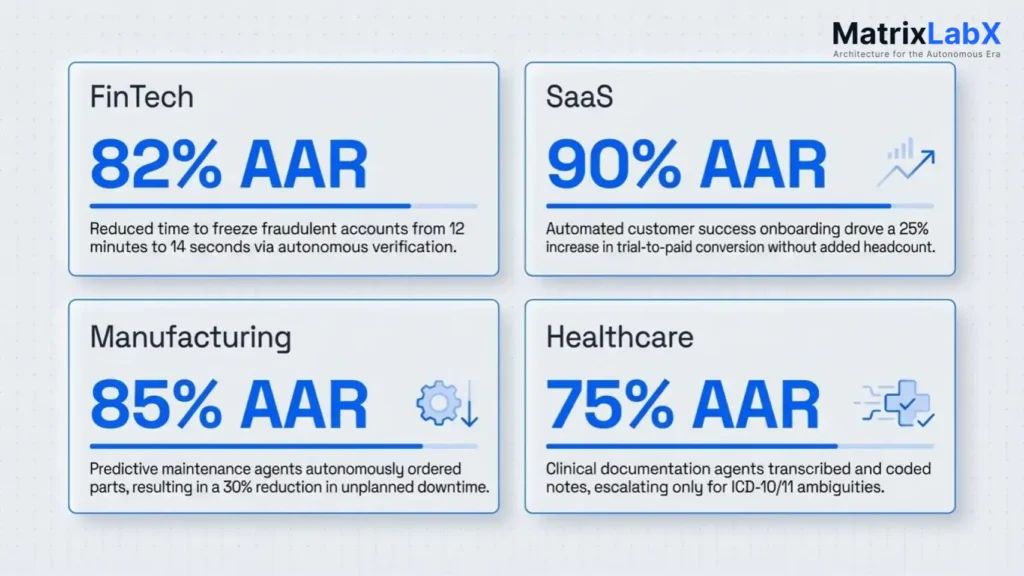
| SaaS & Marketing | 90% | Automated customer success onboarding drove a 25% increase in trial-to-paid conversions without added headcount. Autonomous marketing agents optimize live campaigns, reducing Customer Acquisition Cost (CAC) by up to 50%. |
| Support / Customer Success | 88% | Complex ticket resolution and transforming high-volume telemetry into self-executing interventions without adding human overhead. |
| Manufacturing | 85% | Predictive maintenance agents autonomously order parts, resulting in a 30% reduction in unplanned downtime. Supply chain environments see a 25% reduction in inventory carrying costs. |
| Financial Services (FinTech) | 82% | Automated reporting and data extraction reduced the time to freeze fraudulent accounts from 12 minutes to 14 seconds via autonomous verification. Compliance costs are lowered by 35%. |
| Supply Chain & Logistics | 81% | General inventory and route optimization. |
| Healthcare | 75% | Clinical documentation agents transcribe and code notes, escalating only for ICD-10/11 ambiguities. Drives a 60% reduction in administrative workload. |
| Software Development | 62% | Bug fixing and unit testing. |
Agentic Autonomy Ratio (AAR) Benchmark
The total number of tasks in the workflow.
How many of those tasks are routed to an AI agent?
Percentage of AI tasks requiring human correction/confirmation (0-100).
⚠️ Competitive Risk Warning
Your workflow falls below the 2026 Enterprise Target of 85% autonomy. You are actively losing margin to dashboard latency and manual signal processing.
You are at Level X. Learn how to reach Level 4 (Full Autonomy) in 45 days.
Reserve Your Technical AuditStep 4: Activate the Flywheel of Stable Autonomy
If your AAR is below the 85% target, you are actively losing margin. Improving your score requires moving through the "Flywheel of Stable Autonomy":
- Baseline Audit: Identify breakpoints and systemic vulnerabilities, such as ambiguity or API errors.
- Semantic Tool Grounding: Provide clear metadata and unambiguous API access to your agents.
- Recursive Self-Correction: Add a reflection step to catch hallucinations, which can boost your AAR by 15-20%.
Synthetic Data Fine-Tuning: Ensure successful autonomous runs are logged and used to train the agent for the next cycle. Low-AAR systems generate logs dominated by human corrections, while high-AAR systems generate pristine data from autonomous success, creating a competitive moat.
What is the Agentic Autonomy Ratio (AAR)?
The Agentic Autonomy Ratio (AAR) is the primary metric for evaluating human-AI workflow efficiency. It measures the percentage of multi-step tasks an AI agent completes without manual human intervention. It is calculated using the formula $AAR = (T_a / T_t) \times (1 - R_{hi})$, where $T_a$ is attempted AI tasks, $T_t$ is total tasks, and $R_{hi}$ is the human intervention rate.
Why is a high AAR critical for enterprise growth in 2026?
Operating with a low AAR creates a "Linear Cost Trap." If your AI workflows require constant human oversight, scaling your operations means linearly scaling your headcount, negating the ROI of AI. To remain cost-competitive and achieve non-linear growth, the 2026 Enterprise Target requires a minimum AAR of 85%.
What is the difference between Copilot AI and Agentic AI?
"Copilot" AI (Level 1 and 2 Autonomy) requires a human to act as the constant driver, summarizing data or drafting content that a human must review and execute. "Agentic" AI (Level 3 and 4 Autonomy) is goal-oriented; it can interpret telemetry, make decisions, execute actions across multiple software systems, and self-correct without human intervention.
How does MatrixLabX help organizations achieve Full Autonomy?
MatrixLabX conducts deep technical and strategic audits to identify the "Autonomy Gap" in your current architecture. We then help deploy Agentic Microservices that bypass legacy SaaS bottlenecks, fundamentally rewriting the unit economics of your growth and moving your operations from manual oversight to stable autonomy.
What is the "Dashboard Fallacy" in legacy SaaS?
The Dashboard Fallacy is the reliance on visual dashboards to manage operations. In high-volume environments, humans physically cannot process all dashboard telemetry, leading to "Abandoned Signals" (the middle 80% of data). Agentic systems bypass the dashboard entirely, routing data directly to autonomous agents for immediate action.