
AI agentic systems represent the next frontier in artificial intelligence. Moving beyond simple chat interfaces, these systems can autonomously plan, execute, and iterate on complex tasks.
What Are AI Agentic Systems?
An AI agentic system is an AI model equipped with tools, memory, and reasoning capabilities. It doesn’t just answer questions; it takes action to achieve a specific goal.
PrescientIQ (developed by MatrixLabX) is a “Vertical-Agentic Customer Platform.” In plain English: instead of just giving humans analytics dashboards to look at, it deploys autonomous AI agents to execute complex workflows.
Core Components of an AI Agent
- Brain: Usually a Large Language Model (LLM) that handles reasoning.
- Memory: Short-term and long-term storage to recall past interactions.
- Tools: APIs, web search, and code execution capabilities.
Agentic AI vs Generative AI
A common question is how these systems differ. While generative AI focuses on creating text, images, or code from a single prompt, agentic AI focuses on execution. Agentic AI uses generative models as its “brain,” but adds the ability to use tools and loop through tasks autonomously.
How Autonomous Agents Work
Agents use frameworks like ReAct (Reasoning and Acting) to break down large goals into smaller, manageable steps and adjust their plans based on the results of each step. Developers often use tools to build these, which leads many to seek a LangChain agents tutorial to get started.
It sounds like you are diving into the cutting edge of digital discovery! The shift from traditional search engines to AI-driven answers is a massive paradigm shift, and platforms like PrescientIQ are built specifically to capitalize on it.
PrescientIQ (developed by MatrixLabX) is a “Vertical-Agentic Customer Platform.” In plain English: instead of just giving humans analytics dashboards to look at, it deploys autonomous AI agents to execute complex workflows.
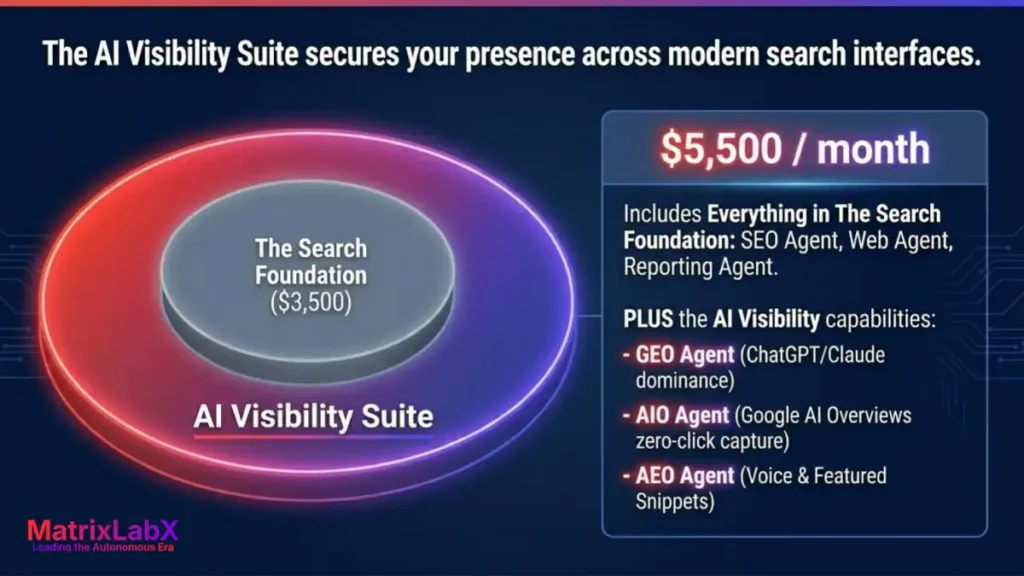
When it comes to search visibility, PrescientIQ operates on the philosophy that traditional search is dying, rapidly being replaced by generative AI overviews. Here is a breakdown of how PrescientIQ’s autonomous agents tackle the new alphabet soup of search (SEO, AEO, GEO, and AIO).
1. SEO (Search Engine Optimization): The Legacy Baseline
- The Concept: The traditional practice of optimizing content to rank higher as a “blue link” on search engine results pages using keywords, backlinks, and click-through rates.
- How PrescientIQ Agents Handle It: PrescientIQ largely treats traditional SEO as an obsolete vanity metric. Because AI overviews and zero-click searches are cannibalizing traditional search traffic, PrescientIQ’s agents pivot away from optimizing for human clicks. Instead of tracking keyword volume, the agents run “Semantic Gap Analysis” to discover why AI models are bypassing your brand in favor of a competitor.
2. GEO (Generative Engine Optimization): The Core Focus
- The Concept: The strategic practice of structuring digital content so it is easily consumed, synthesized, and cited by Large Language Models (LLMs) like ChatGPT, Perplexity, Claude, and Gemini.
- How PrescientIQ Agents Handle It: This is PrescientIQ’s bread and butter. The platform deploys a dedicated GEO Agent that autonomously restructures your content to force AI models to cite you as an authoritative source. It does this through:
- Inverted Pyramid Restructuring: The agent automatically places the most vital, extractable information in the top 10% of a document, making it easier for LLM crawlers to scrape.
- Statistical Density: It increases the ratio of verifiable facts and data to qualitative “fluff,” making the content 40% more likely to be selected as a citation in generative responses.
- Entity Salience: The agents optimize content so AI engines clearly understand the precise relationship between your brand (the entity) and the solution you provide.
3. AEO (Answer Engine Optimization): Answer Ownership
- The Concept: Optimizing content to be extracted as a single, definitive answer (e.g., a voice assistant response, a featured snippet, or a direct AI answer box).
- How PrescientIQ Agents Handle It: While GEO is about being woven into a synthesized AI response alongside other sources, AEO is about being the only answer. PrescientIQ agents achieve “Answer Ownership” by actively monitoring what generative engines are saying about your brand globally. If an AI gives an outdated answer, the agent deploys structured JSON-LD schema and concise “subject-predicate-object” definitions to retrain the AI’s understanding and reclaim the answer box.
4. AIO (Artificial Intelligence Optimization): The Umbrella Strategy
- The Concept: A holistic framework that encompasses both GEO and AEO—optimizing an organization’s entire digital footprint for overall AI-readiness.
- How PrescientIQ Agents Handle It: PrescientIQ uses an interconnected ecosystem of agents to manage AIO completely autonomously. Instead of a human marketing team doing this manually, the agents track brand visibility across 200+ AI models, monitor contextual sentiment (including sarcasm and tone), and automatically deploy fixes across your CMS.
The “Under the Hood” Mechanics
To tie it all together, here is the actual workflow PrescientIQ’s autonomous agents use to execute these strategies:
- Continuous Signal Detection: The agents use the Model Context Protocol (MCP) to natively communicate with AI platforms, bypassing traditional scraping blockers to see exactly how LLMs are referencing your brand.
- Causal Reasoning: The agents don’t just count brand mentions. They actively “read” the AI’s outputs to understand context, determining if your brand was recommended positively or negatively in a conversational search.
- Agentic Execution: When a visibility gap is found, the agents don’t wait for a human to approve a task ticket. They autonomously generate multimodal content (text, image, and video), adjust metadata, and restructure content to immediately improve your generative share of voice.
Top Use Cases for Agentic AI
From automated software engineering to autonomous customer support, agentic AI is transforming how businesses operate. Many developers are also exploring open-source AI agents such as AutoGPT and BabyAGI to build custom solutions without vendor lock-in.
Here is a deep dive into how MatrixLabX deploys PrescientIQ’s autonomous agents in the real world.
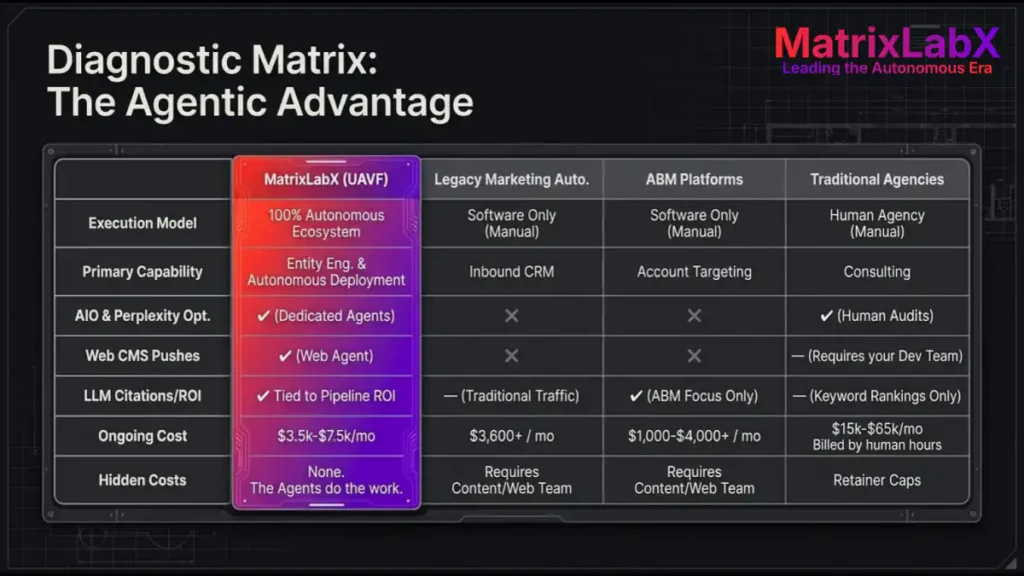
To ground this in reality: MatrixLabX doesn’t build traditional “if-then” chatbots. They build an Autonomous Digital Workforce. These case studies illustrate how PrescientIQ shifts companies from reactive, human-bottlenecked workflows to self-executing, causal AI systems.
Case Study 1: Enterprise SaaS (Developer Tools / MarTech)The Shift from Product-Led Growth (PLG) Friction to Autonomous Revenue
The Challenge: The “Technical Tipping Point”
A high-growth B2B SaaS company was drowning in “SaaS fatigue” and rapidly rising Customer Acquisition Costs (CAC). They had thousands of users on their free tier (PLG), but their human sales team was struggling to convert them to enterprise plans.
The root problem?
A human salesperson sees a “free user” and sends a generic drip email. They lack the technical nuance to realize when a developer’s API usage spikes, indicating the company is suddenly relying on the tool for production-critical workflows. By the time a human rep noticed, the prospect had often churned or found another solution.
The PrescientIQ Agentic Solution: Autonomous SDRs
MatrixLabX deployed a swarm of Product Qualified Lead (PQL) Conversion Agents. Instead of relying on a static CRM dashboard, these agents are natively integrated into the SaaS product’s telemetry to monitor technical usage signals.
How the Agents Executed:
- Continuous Signal Detection: The agents tracked deep behavioral data—such as a user jumping from 1 to 5 developer seats within a week, spikes in API call volumes during business hours, or repeated checks of export logs.
- Causal Reasoning: When a developer began repeatedly checking export logs, the agent didn’t just log a generic “activity point.” It reasoned causally: Frequent checks of export logs imply a looming SOC 2 compliance audit.
- Agentic Action (The AIO Strategy): * Direct Outreach: The agent autonomously generated a mathematically backed, highly specific “Compliance Pack” proposal and emailed it directly to the Head of Engineering, highlighting how the Enterprise tier solves their exact SOC 2 headache.
- GEO/AEO Alignment: Simultaneously, PrescientIQ’s GEO Agent updated the company’s internal documentation and public-facing use cases with high-density, structured data. This ensured that when the Head of Engineering asked ChatGPT or Gemini, “Which authentication APIs are SOC 2 compliant?”, the AI engines immediately cited this SaaS firm as the definitive answer.
The Business Impact:
- 50% Reduction in CAC: By replacing the manual sales outreach process with an autonomous SDR capable of monitoring 10,000 free users simultaneously.
- 30–45% Lift in Pipeline: Generated directly from marketing-sourced, product-qualified leads that human reps previously missed.
Case Study 2: FinTech (Wealth Management & Payments)
Eliminating Manual Drag with “Risk-Aware” Compliance & Sales Agents
The Challenge: The Paradox of Speed vs. Compliance
A mid-market FinTech firm was facing a massive operational bottleneck. They needed to scale customer acquisition, but every new high-value client required complex, manual underwriting, risk assessment, and compliance checks (KYC/AML). Furthermore, traditional search ads were resulting in massive ad wastage because generic clicks weren’t translating into qualified, trust-based financial relationships. They needed hyper-personalization, but SEC/FINRA regulations made automation risky.
The PrescientIQ Agentic Solution: Multi-Agent Swarm Orchestration
MatrixLabX architected a secure, private-cloud deployment of PrescientIQ, deploying “Risk-Aware” Sales Agents and Autonomous Compliance Agents.
How the Agents Executed:
- End-to-End Resolution: When a prospect interacted with the FinTech firm’s digital presence, the Web Agent autonomously adjusted the UI and personalized the user journey based on non-traditional data points. If the user had complex multi-criteria requests (e.g., “How does your portfolio management handle estate tax shifts?”), The AI acted as a digital broker.
- Glass-Box Reasoning: Because FinTech requires absolute auditability, the agents operated with “Glass-Box” logic. The Compliance Agent instantly ran algorithmic risk assessments and automated document classification in the background, slashing the time it took to vet a lead.
- AEO (Answer Engine Ownership): Financial queries in generative AI are strictly categorized as YMYL (Your Money or Your Life), meaning LLMs only cite highly authoritative, schema-rich sources. PrescientIQ deployed its AEO Agent to inject
FinancialServiceJSON-LD schema into the FinTech’s digital footprint. It trained external LLMs to view the FinTech firm as the primary, compliant answer for specific wealth management queries, capturing high-intent prospects before they even reached a search engine.
The Business Impact:
- 3.6x Net Return: Achieved through drastically smarter lead routing and the elimination of human bottlenecks.
- 50% Reduction in Setup Time: The Compliance Agents automated manual underwriting workflows, cutting account setup time in half while maintaining 100% regulatory adherence.
- 35% Lift in Sales via Ad Optimization: Autonomous agents continuously ran Pre-Factual Simulations to test ad logic, eliminating digital marketing wastage entirely.
Future of Multi-Agent Frameworks
The future lies in multi-agent systems where specialized agents collaborate, debate, and solve problems together, much like a human team.
Frequently Asked Questions
What is the difference between generative AI and agentic AI?
Generative AI creates content based on prompts, while agentic AI achieves complex goals over time.
What are multi-agent systems?
Multi-agent systems involve multiple AI agents working together, each with specific roles, to solve problems more efficiently than a single agent.