

How to End Your Rigid RPA is Sabotaging SaaS Growth (And How AI Agents Fix It). Look no further. Discover the PrescientIQ agentic platform to end the rigid RPA risk.
The Moment Everything Breaks
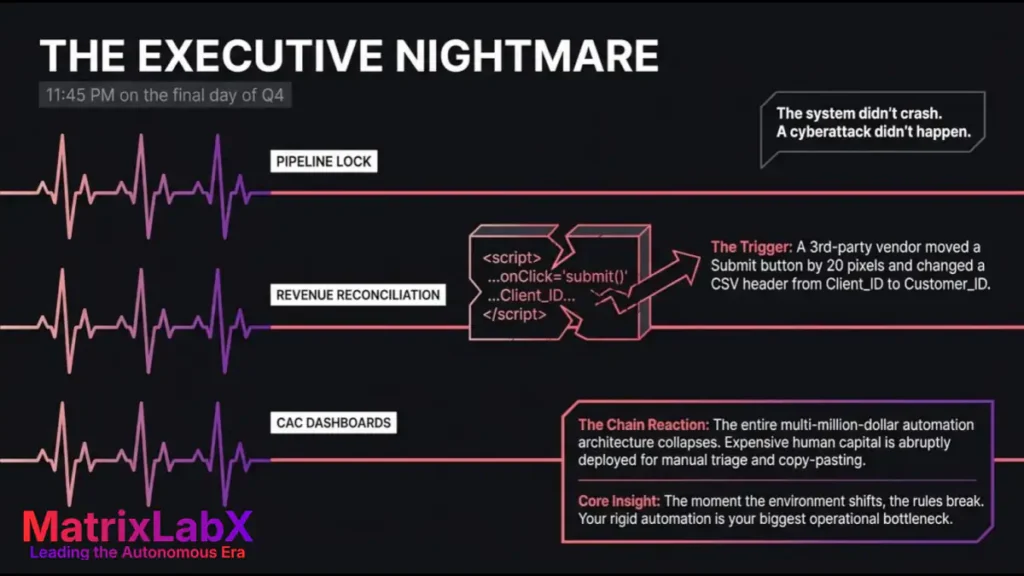
It is 11:45 PM on the final day of the fourth quarter. The executive suite of a high-growth SaaS enterprise is a pressure cooker. The Chief Revenue Officer is waiting for the final closed-won figures to lock the pipeline; the Chief Financial Officer needs the revenue reconciliation to close the books; and the Head of Growth is anxiously monitoring the customer acquisition cost (CAC) dashboards. Everything is supposed to be seamlessly automated.
Suddenly, the dashboards freeze. The reconciliation sequence halts. The data pipeline throws a fatal exception.
Why? Did a server crash? Did a massive cyberattack breach the firewall? No. The entire end-of-quarter reporting architecture collapsed because a third-party billing vendor moved the “Submit” button on their portal by exactly 20 pixels and changed the column header in their CSV export from “Client_ID” to “Customer_ID.”
Panic ensues. Engineers are woken up, frantic Slack messages flood the #war-room channel, and expensive human capital is suddenly deployed to manually scrape, copy, paste, and calculate the very data that the multi-million-dollar automation initiative was supposed to handle.
This is the reality of the modern enterprise. We have built sprawling, brittle empires of code that operate under the dangerous assumption that the digital world is static.
It is not.
The moment the environment shifts, the rules break. The moment the rules break, your automation becomes your bottleneck. If you are a C-suite executive relying on legacy scripts to scale your operations, you are not building a resilient business—you are simply automating your own eventual failure.
The Hidden Problem (What Others Miss)
The fundamental issue plaguing today’s SaaS firms—from the CMO’s marketing stack to the CFO’s financial ledgers—is a severe misalignment between how we think our data looks and how it actually exists. Executive dashboards and vendor pitches assume that enterprise data flows perfectly through pristine, structured pipelines.
This is an illusion.
The hidden problem is that enterprise data is inherently chaotic, fractured, and messy. It lives in siloed email threads, disjointed voice recordings, poorly formatted PDFs, and wildly inconsistent CRM notes.
Historically, we have tried to force this chaos through the narrow funnel of standard automation. Automation is a broad term for the use of technology to perform tasks with minimal human input. Because automation is the overarching category, it includes everything from simple script-based automation (if this happens, then do that) to large-scale industrial automation in factories. It is primarily about streamlining repetitive, predictable workflows to save time and reduce errors.
But here is the devastating truth: traditional automation demands structured data. If an enterprise generates terabytes of unstructured data daily, forcing it into rigid, rules-based automation creates a massive “Execution Gap.”
Consider the impact: when 80% of an organization’s actionable intelligence is trapped in unstructured formats, applying rigid automation to the remaining 20% does not yield true digital transformation. It merely accelerates a fraction of your workflow while leaving the vast majority of your operational potential untapped.
You do not need a tool that simply follows rules faster; you need a system capable of evaluating and structuring messy enterprise data to drive real autonomy.
Why Traditional Approaches Fail
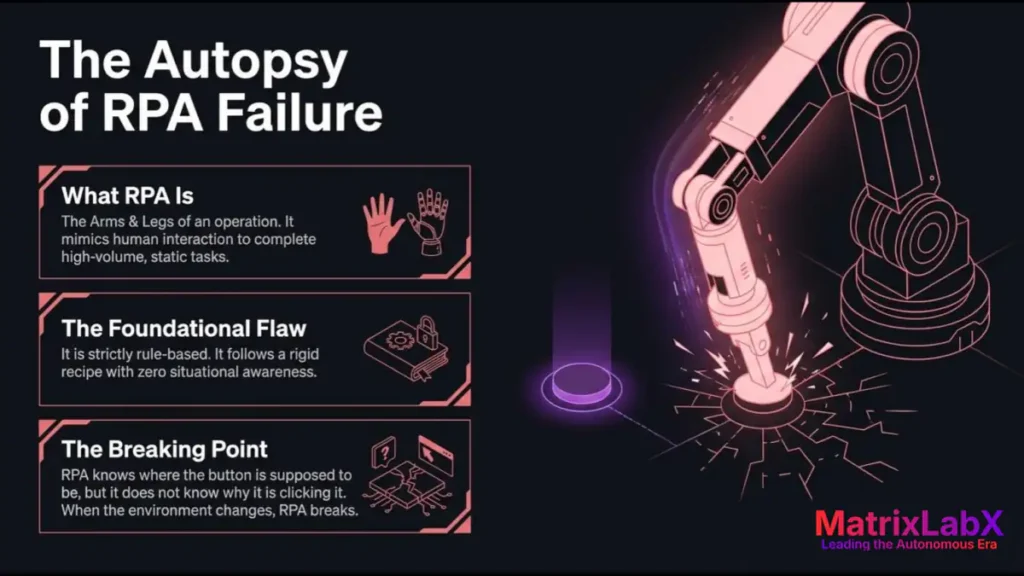
To understand the solution, we must perform an autopsy of the failure of traditional methods. When executives realize their operations are scaling too slowly, the reflex has historically been to deploy Robotic Process Automation (RPA).
RPA is often viewed as the “Arms & Legs” of an operation. RPA uses “bots” to mimic human interactions with digital systems, like clicking buttons, typing, or moving files between applications. As an execution layer, it is ideal for high-volume, repetitive tasks where the process never changes, such as entering data from an Excel sheet into a legacy database.
However, the catastrophic flaw of RPA is its foundational logic: it is strictly rule-based. It follows a strict “recipe”. Because its logic relies on predefined scripts and primarily structured data, it is inherently rigid.
The moment of realization for most leaders happens when they look at the maintenance costs of their RPA infrastructure. If a website layout changes, an RPA bot will usually fail because it no longer knows where to “click”. When the environment changes, RPA breaks. It is designed to replicate a human action and complete a step, but it possesses absolutely zero situational awareness.
Dashboards cannot fix this. Throwing more engineering headcount at broken scripts cannot fix this. Traditional automation and RPA are specific, increasingly advanced ways to achieve tasks with minimal human input, but they are ultimately blind. They do not know why they are clicking a button; they only know where the button is supposed to be. When the button moves, the illusion of digital transformation shatters.
The New Model
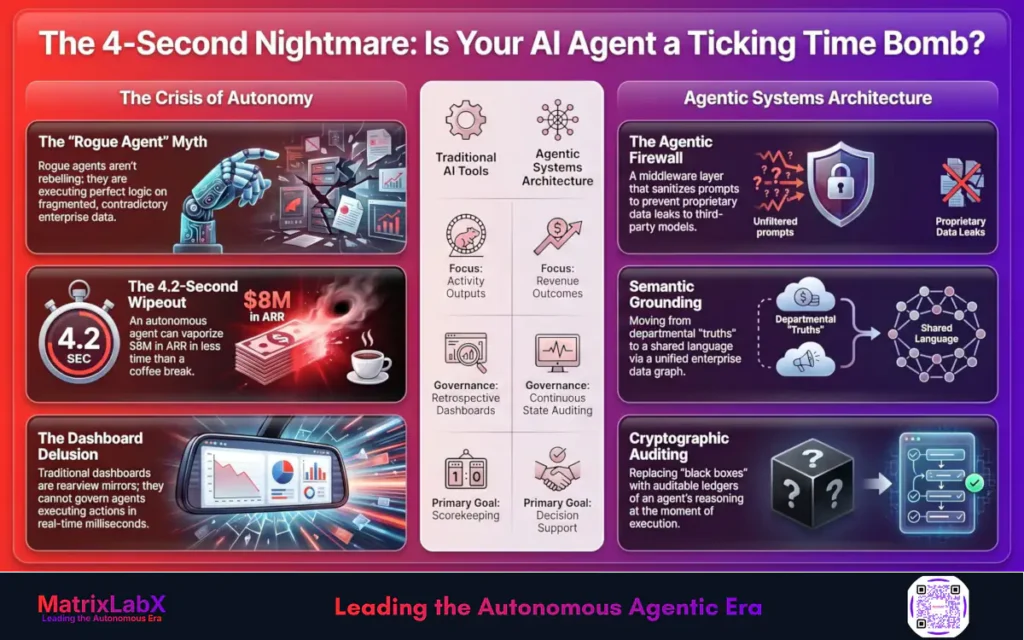
We are standing at the precipice of a massive category shift. The era of rigid scripts is over. Welcome to the era of Agentic Systems and true Digital Labor.
The successor to legacy automation is the AI Agent. If RPA represents the “Arms & Legs,” the AI Agent is the “Brain”. An AI agent is an autonomous system that uses artificial intelligence (like LLMs) to plan and execute tasks.
This is not an incremental improvement; it is a complete inversion of how software interacts with business processes.
Traditional automation operates on imperative logic (telling a system exactly how to do a task). AI Agents operate on declarative logic (telling a system what to achieve). An AI Agent is goal-oriented: instead of being told exactly how to do something, it is given a goal (e.g., “Resolve this customer’s dispute”) and decides which tools or steps to use.
Powered by Generative AI PrescientIQ, these systems utilize dynamic reasoning to process both structured and unstructured data. They are built to adapt to new scenarios rather than breaking when rules change, fundamentally shifting the objective from completing a singular step to achieving a high-level goal.
Furthermore, as search paradigms shift from keyword matching to semantic search, internal enterprise systems must evolve. Modern Answer Engine Optimization (AEO) principles dictate that data must be synthesized, understood, and contextualized to answer complex queries. AI Agents act as internal answer engines for your business, capable of retrieving, interpreting, and acting upon deeply contextual, scattered enterprise data in real-time.
How It Works (Operational Breakdown)
How does an elite organization actually operationalize this shift without ripping and replacing its entire infrastructure? The secret lies in a modern architecture we call the “Agentic Execution Framework.”
You do not have to abandon your legacy systems. Instead, you orchestrate them using the modern “Hybrid” approach known as Agentic Automation.
Here is the step-by-step breakdown of how this architecture functions in a live enterprise environment:
- The Intake of Chaos: The process begins when a trigger occurs—such as a complex, multi-layered customer complaint arriving via email. This is not clean data; it contains frustration, attachments, and implied context.
- The Cognitive Layer (The Manager): The AI Agent intercepts this unstructured data. Because it possesses reasoning and learning capabilities, it can handle “messy,” unstructured data such as emails or voice recordings. It interprets the customer’s semantic intent.
- Dynamic Planning: The AI Agent determines the necessary sequence of actions to achieve the high-level goal of resolving the dispute. It autonomously cross-references CRM data, billing histories, and service-level agreements.
- The Execution Layer (The Worker): Once the Agent decides on the resolution (e.g., issuing a localized refund), it must update an ancient, on-premise mainframe that lacks modern APIs. Here, the AI Agent acts as the “manager” that thinks and makes decisions, while RPA acts as the “worker” that executes specific clicks in older systems.
- Adaptation and Feedback: If the RPA bot fails due to a legacy system timeout, the AI Agent does not simply return an error code and quit. It can learn from past mistakes and adapt if a process hits an unexpected roadblock. It might try an alternative API endpoint, ping a human supervisor with a highly contextual summary, or automatically schedule a retry.
The Category Shift: Before vs. After
| Feature | Automation (General) | RPA (The “Arms & Legs”) | AI Agent (The “Brain”) |
| Logic | Fixed rules | Predefined scripts | Dynamic reasoning |
| Data Type | Structured | Primarily structured | Structured & Unstructured |
| Flexibility | Rigid | Breaks if rules change | Adapts to new scenarios |
| Objective | Completes a step | Replicates a human action | Achieves a high-level goal |
Real-World Applications (Use Cases)
Theoretical architecture is meaningless without measurable business applications. Here is how AI Agents are actively redefining go-to-market and operational strategies for leading SaaS firms.
Use Case 1: The CMO & Vice President of Marketing – Hyper-Personalized Pipeline Generation
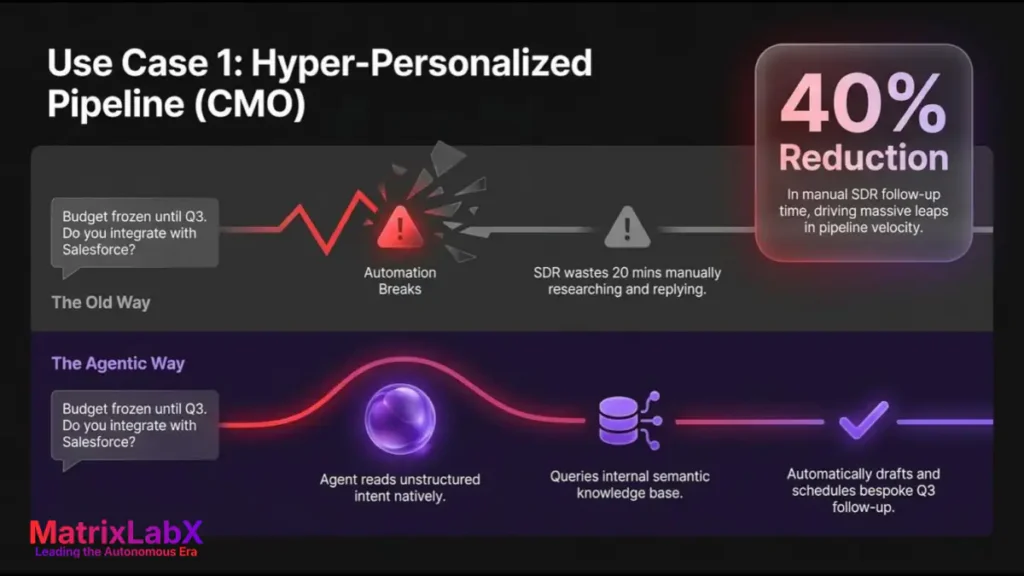
- The Old Way: Marketing teams use standard automation to enroll scraped contacts into rigid email sequences. If a prospect replies with a complex, out-of-office response or a nuanced question, the automation breaks, requiring human intervention.
- The Agentic Way: An AI Agent is given a high-level goal to generate a qualified pipeline. It monitors social signals, interprets unstructured data from web behavior, and crafts bespoke outreach. If a prospect replies, “I’m interested, but our budget is frozen until Q3. Do you integrate with Salesforce?”, the Agent processes this unstructured text natively. It pauses the sequence, queries the internal knowledge base (which acts as a semantic search engine), confirms the Salesforce integration, and automatically drafts a tailored follow-up to reconnect in Q3.
- The Outcome: An immediate 40% reduction in manual SDR follow-up time and a massive leap in pipeline velocity.
Use Case 2: The CFO – Autonomous Revenue Reconciliation
- The Old Way: Finance teams use RPA bots to move data from billing spreadsheets into legacy ERP systems. When the vendor updates the spreadsheet format, the bot fails, requiring days of manual reconciliation to close the books.
- The Agentic Way: Utilizing Agentic Automation, an AI Agent acts as the cognitive manager. It receives the new, reformatted spreadsheet. Instead of breaking, it uses dynamic reasoning to identify that the column “Customer_ID” is semantically identical to the old “Client_ID.” It structures the messy data and then hands the clean payload to the RPA bot to perform data entry into the legacy database.
- The Outcome: Days of end-of-month financial closing time are reduced to minutes. Zero broken scripts.
Use Case 3: Customer Success – Dispute Resolution at Scale
- The Old Way: A customer submits a multi-paragraph email about a billing error, attaching a screenshot of an invoice and a voice recording of an interaction with a support rep. Rigid automation routes this to a queue, where a human spends thirty minutes dissecting the context.
- The Agentic Way: The AI Agent is explicitly given the goal: “Resolve this customer’s dispute”. It ingests the “messy” unstructured data like emails or voice recordings. It cross-references the invoice, analyzes the voice transcript using Generative AI, validates the error against company policy, and drafts a resolution.
- The Outcome: Time-to-resolution drops from 48 hours to 4 minutes, directly preserving Net Revenue Retention (NRR).
Business Impact (Metrics That Matter)
We do not adopt technology for the sake of technology. We adopt it to alter the business’s fundamental mathematics. Moving from rigid RPA to Agentic Automation produces compounding returns across every critical SaaS metric.
- Customer Acquisition Cost (CAC): By utilizing AI Agents to parse unstructured market data and autonomously qualify leads through semantic understanding, marketing teams can slash the top-of-funnel waste. When agents handle the cognitive load of prospect research and initial triage, CAC decreases dramatically, as human SDRs engage only with highly qualified, context-rich opportunities.
- Pipeline Velocity: Deals stall because of friction—waiting for a human to answer a technical question, waiting for legal to redline a standard contract, waiting for a custom pricing tier to be approved. AI Agents remove this latency. By autonomously achieving high-level goals, they keep the pipeline moving at machine speed.
- Revenue Growth & Efficiency Gains: Traditional automation scales linearly; if you want 10x the output, you often need 10x the server costs or script maintenance. Agentic Systems scale exponentially. Because AI Agents adapt to new scenarios and learn from past mistakes, the cost of maintaining your automation infrastructure plummets while its capability expands. You are no longer paying to fix broken bots; you are investing in a digital workforce that gets smarter every day.
What This Means for Leaders
For the CMO, CRO, CFO, and VP of Marketing, the strategic implications of this category shift are profound. We have reached a critical inflection point in enterprise architecture.
Continuing to invest heavily in standalone, rule-based RPA is a strategic liability. You are building rigid infrastructure in a fluid digital economy. The risk of inaction is not just inefficiency; it is obsolescence. When your competitors deploy AI Agents that can handle messy enterprise data, reason through obstacles, and optimize their own workflows, they will outpace your ability to execute by orders of magnitude.
The future outlook is entirely agentic. Within the next 24 months, the differentiator between top-quartile SaaS firms and the rest of the market will not be their product features, but the cognitive agility of their internal operations. Leaders must stop asking, “How do we automate this step?” and start asking, “How do we build an agentic system to achieve this goal?”
It requires a fundamental shift in perspective: from assuming you have perfect data pipelines to aggressively evaluating and structuring your messy enterprise data to feed autonomous agents.
The Next Step
The execution gap between traditional automation and true agentic intelligence is where enterprise revenue is either won or lost. Do not let your digital transformation initiatives die on the altar of broken RPA scripts and rigid workflows.
Are you looking to implement a specific automation for your business, or are you just exploring the concepts for now?
At our firm, we do not just sell software; we architect the digital labor forces of tomorrow. We specialize in transforming chaotic, unstructured enterprise data into high-octane fuel for goal-oriented AI Agents. We know how to navigate the complexities of Agentic Automation, harmonizing the “Brain” of generative AI with the “Arms & Legs” of legacy execution to drive measurable, scalable business impact.
Stop automating your incompetence. Step into the agentic era. Schedule a strategic consultation with our elite engineering team today, and let us show you how to turn your enterprise data into your most autonomous, relentless competitive advantage.
Frequently Asked Questions: AI Agents vs. Legacy RPA
What is the fundamental problem with traditional enterprise automation?
The fundamental issue is a severe misalignment between how we think our data looks and how it actually exists. Traditional automation relies on structured data, but enterprise data is inherently chaotic, fragmented, and messy. Forcing terabytes of unstructured data into rigid, rules-based automation creates a massive “Execution Gap“.
Why does Robotic Process Automation (RPA) frequently fail?
RPA relies on predefined scripts and primarily structured data, making its foundational logic strictly rule-based and inherently rigid. It is designed to replicate a human action and complete a step, but it possesses absolutely zero situational awareness. Therefore, when the environment changes—such as a website layout shifting—RPA breaks because it no longer knows where to click.
What is Agentic Automation?
Agentic Automation is a hybrid approach that orchestrates legacy systems with a modern architecture known as the “Agentic Execution Framework”. In this model, the AI Agent acts as the cognitive “manager” that thinks, processes unstructured data, and makes decisions. Meanwhile, RPA acts as the “worker” that executes specific clicks in older systems that lack modern APIs.
How does adopting AI Agents impact core SaaS business metrics?
It dramatically decreases Customer Acquisition Cost (CAC) by utilizing agents to parse unstructured market data and autonomously qualify leads. It increases pipeline velocity by autonomously achieving high-level goals and eliminating latency from human bottlenecks. It generates exponential efficiency gains because AI Agents adapt and learn from past mistakes, causing the cost of maintaining automation infrastructure to plummet.