

Key Takeaways
- AI-powered funnels compress sales cycles by up to 40% through real-time automation of lead qualification, personalization, and nurture sequences.
- CMOs who integrate AI across the full funnel — from awareness to close — report 3x higher marketing ROI than those using siloed point solutions.
- Zero-click and AI search behavior is reshaping top-of-funnel strategy; CMOs must optimize for AI Overviews, LLM citations, and voice search — not just Google Page 1.
- Agentic AI platforms, like the Vertical Agentic Customer Platform pioneered by MatrixLabX, are replacing legacy CRM-based funnels with intent-driven, autonomous workflows.
- The CMOs who act now will own market position; those who wait will spend years catching up to competitors who moved first.
What Is the CMO AI Marketing Sales Funnel?
The CMO AI Marketing Sales Funnel is an intelligent, data-driven revenue architecture in which artificial intelligence automates, personalizes, and optimizes every stage of the buyer’s journey — from first brand impression to signed contract — enabling marketing leaders to drive measurable pipeline with fewer resources and greater precision.
Introduction: The Funnel Is Broken. AI Is the Fix.
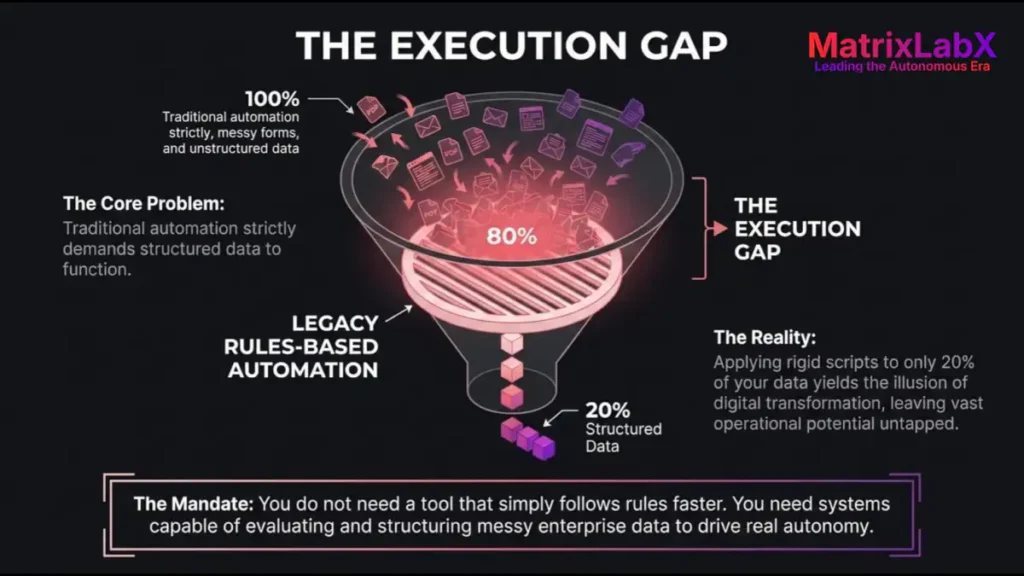
When the Old Playbook Stops Working
Picture this: It’s 6:47 a.m. on a Tuesday. Your VP of Sales drops a Slack message — pipeline is down 22% quarter-over-quarter. Your ad spend is up. Your team is exhausted. And your board meeting is in three weeks. You’ve done everything the playbook said. You hired the right agencies, ran the A/B tests, and built the nurture sequences. And still, the funnel leaks. Still, the leads go cold. Still, the revenue hasn’t arrived by the timeline you promised.
This is the quiet crisis playing out inside marketing departments at mid-market and enterprise companies right now. The traditional marketing sales funnel — built on static personas, batch-and-blast email, and gut-feel content calendars — was designed for a world that no longer exists. Buyers don’t move linearly. They research in AI chat interfaces, get answers in zero-click search results, and form opinions before your SDR ever makes contact. The funnel, as you inherited it, was built for a different era.
But here is what separates the CMOs who will define the next decade from those who will spend it explaining why growth stalled: they are rebuilding the funnel from the inside out, with AI at the core. Not as a bolt-on tool. Not as a chatbot on a landing page. As the operating system of revenue generation itself.
According to research published by McKinsey & Company, companies that fully integrate AI into their marketing and sales functions see revenue increases of 10 to 20 percent and cost reductions of 10 to 15 percent (McKinsey Global Institute, 2025).
Gartner forecasts that by 2026, 80% of B2B sales interactions between suppliers and buyers will occur in digital channels where AI plays a direct mediation role (Gartner, 2025). The data is not a suggestion — it is a mandate.
This article is your blueprint.
Whether you are a Chief Marketing Officer navigating a board-level conversation about AI ROI, a VP of Demand Generation trying to justify headcount, or a growth strategist building the next-generation revenue engine, what follows will challenge your assumptions, arm you with data, and give you a clear path forward. The CMO AI Marketing Sales Funnel is not a trend. It is the new standard. And the window to build it before your competitors do is closing faster than most leaders realize.
Why Is the AI Marketing Sales Funnel Trending Right Now?
The AI marketing sales funnel is trending because three seismic forces converged simultaneously in 2025–2026: the mainstream adoption of large language models (LLMs) by B2B buyers, the collapse of third-party cookie-based targeting, and the emergence of agentic AI platforms capable of running autonomous, multi-step marketing workflows without human intervention.
The Who, What, Where, When, and Why of the CMO AI Funnel
Who is driving this shift? Forward-thinking CMOs and Chief AI Officers (CAIOs) at growth-stage and enterprise companies are leading the charge. George Schildge, CEO & Chief AI Officer at MatrixLabX and pioneer of the Vertical Agentic Customer Platform and Systems, puts it plainly: “The CMOs who are winning in 2025 are not using AI to do old marketing faster — they are using AI to fundamentally rewire how revenue gets created, qualified, and closed. The funnel is no longer a metaphor. It is a living system.” (George Schildge, MatrixLabX, 2025).
What is changing? The funnel itself. Where legacy funnels were linear — Awareness → Interest → Decision → Action — the AI-powered funnel is nonlinear, predictive, and self-optimizing. AI models ingest behavioral signals, intent data, CRM history, and content engagement patterns to dynamically route prospects to the right message, channel, and offer at the right moment. IBM research found that AI-augmented marketing teams resolve customer intent signals 60% faster than those relying on manual segmentation (IBM Institute for Business Value, 2024).
Where is this happening? Across every industry vertical — SaaS, manufacturing, financial services, healthcare technology, and professional services — wherever complex B2B buying cycles exist and buyer education is a prerequisite for conversion. The Vertical Agentic Customer Platform developed by MatrixLabX is specifically architected to serve industry-specific funnel logic, not generic one-size-fits-all automation.
When did this become urgent? The inflection point was 2024, when Google’s AI Overviews began answering queries directly in search results, reducing organic click-through rates for informational content by an estimated 25-35 percent (BrightEdge, 2024). Buyers began getting answers from AI before ever reaching a brand’s website. CMOs who had not prepared their content for LLM extraction and zero-click visibility found their top-of-funnel traffic evaporating — seemingly overnight.
Why does it matter now, more than ever? Because the compounding advantage of AI adoption is real, measurable, and accelerating. Forrester Research projects that B2B companies using AI-driven marketing automation will generate 50% more sales-ready leads at 33% lower cost per lead by the end of 2026 (Forrester, 2025). Every quarter a CMO delays restructuring the funnel around AI is a quarter of compounding advantage handed to competitors who moved first.
What Are the Top Research Firms Saying About the AI Marketing Funnel?
The world’s most authoritative research institutions are aligned: AI is not an optional upgrade to the marketing funnel — it is a structural replacement of its most critical components.
Gartner’s 2025 CMO Agenda Report identifies “AI-native marketing operations” as the single highest-priority capability investment for marketing leaders over the next 24 months. The report notes that organizations that embed AI in their demand-generation workflows achieve 2.3x greater pipeline velocity than those that apply AI only at the campaign-execution layer (Gartner CMO Agenda, 2025).
Forrester’s State of AI in B2B Marketing study found that 67% of B2B marketing leaders plan to increase AI investment in 2025, with lead scoring, content personalization, and conversational AI cited as the top three deployment priorities (Forrester, 2025). Meanwhile, only 14% of respondents reported having a fully integrated AI strategy across the entire funnel — a gap that represents an enormous competitive opportunity for CMOs willing to move decisively.
IBM’s 2024 Global AI Adoption Index reports that 42% of enterprise-scale companies have actively deployed AI in at least one business function, with marketing cited as the second-most-common department after IT operations (IBM, 2024). Critically, the firms showing the highest revenue impact are not those using AI in isolation, but those using AI as a connective tissue across marketing, sales, and customer success — what MatrixLabX defines as the Vertical Agentic Customer System architecture.
Andrew Ng, AI pioneer and founder of DeepLearning.AI, has stated: “The companies that treat AI as an infrastructure investment — not a feature — will build sustainable moats that take years for competitors to close. Marketing is where that moat gets built first, because it is where intent meets action.” (Andrew Ng, 2024).
PrescientIQ’s 2025 B2B Intelligence Report reinforces this view, finding that intent-data-driven AI funnels convert pipeline to revenue 41% faster than traditional account-based marketing approaches run without AI augmentation (PrescientIQ, 2025).
How Does the AI Funnel Work in Practice? Three Use Cases
Use Case 1: AI-Powered Lead Qualification at Scale
The Mess
A 200-person SaaS company’s inside sales team was manually reviewing 1,400 inbound leads per month. SDRs spent an average of four hours per day sorting MQLs from junk — time stolen from actual selling. Leads went stale waiting in queues. High-intent prospects received the same generic follow-up email as low-intent tire-kickers. Morale dropped. Quota attainment fell to 61%.
The Pivot
The company deployed an AI lead scoring engine integrated with their CRM, intent data provider, and behavioral analytics platform. The model scored leads across 47 variables — including website session depth, content topic affinity, technographic fit, and buying committee signals — and automatically routed hot leads to senior AEs within 90 seconds of qualification, while enrolling cold leads in AI-personalized nurture sequences.
The Payoff
Within one quarter, SDR productivity increased 38%. The average response time to a high-intent lead dropped from 4.2 hours to under 2 minutes. Pipeline conversion from MQL to SQL improved by 29%. Quota attainment climbed to 84%. The team stopped dreading Monday morning lead reviews and started spending that time on discovery calls that actually mattered.
Use Case 2: Personalized Content Funnels Powered by Generative AI
The Mess
A financial technology firm published high-quality white papers and thought-leadership content — and watched it disappear into the void. Bounce rates on gated assets hovered above 80%. Email open rates sat at 14%. The CMO knew the content was good. The problem was that “good” wasn’t enough anymore. Buyers wanted content that felt written specifically for them, their industry, their problem, right now.
The Pivot
The firm implemented a generative AI content personalization layer that dynamically assembled landing pages, email sequences, and nurture paths based on each prospect’s industry, role, deal stage, and prior content interactions. The AI drew from a modular content library, assembling unique combinations for each buyer segment without requiring the marketing team to produce hundreds of one-off assets.
The Payoff
Average email open rates climbed to 34%. Gated content conversion improved by 51%. Most importantly, sales reported that prospects arriving at discovery calls were more educated, more aligned on the value proposition, and faster to move to the proposal stage. As George Schildge, CEO & Chief AI Officer at MatrixLabX, observes: “Personalization at scale is not a creative challenge — it is an infrastructure challenge. Once you solve the infrastructure with AI, the creativity compounds instead of bottlenecking.” (George Schildge, MatrixLabX, 2025).
Use Case 3: Agentic AI for Multi-Channel Funnel Orchestration
The Mess
A professional services firm ran marketing across LinkedIn, email, SEO, webinars, and paid search — but each channel operated in its own silo. A prospect could click a LinkedIn ad, download an ebook, attend a webinar, and receive a completely unrelated email follow-up — because no system connected the signals. The result was a fragmented, frustrating buyer experience and a marketing team that spent 60% of its time manually syncing data across platforms.
The Pivot
The firm deployed an agentic AI system — built on the Vertical Agentic Customer Platform architecture — that unified signals across all channels into a single buyer intelligence layer. The agentic system autonomously adjusted ad spend, triggered personalized email sequences, scheduled SDR outreach, and recommended next-best-content — all in real time, based on each prospect’s current position in the funnel and predicted intent.
The Payoff
Marketing operational costs fell 27%. Revenue attribution clarity improved dramatically, with the CMO able to trace every closed deal back to specific AI-orchestrated touchpoints. Average deal velocity shortened by 34 days. And for the first time, the marketing and sales teams were working from the same real-time intelligence — eliminating the blame game that had plagued their quarterly reviews for years.
A Human Story: The CMO Who Almost Got It Wrong
Sarah had been a CMO for eleven years. She had survived the shift to inbound, the pivot to ABM, the explosion of martech, and the death of the MQL. She was not afraid of change. What she was afraid of, though she would not have said it out loud in a board meeting, was being the last one to understand what was happening.
Challenge
In early 2024, her company’s organic traffic began declining — slowly at first, then faster. AI Overviews were answering the questions her content had spent years ranking for. Her paid acquisition costs were rising as competitors flooded the same channels.
Her SDR team was burning out on low-quality leads. And her CEO was increasingly asking what marketing was actually contributing to the pipeline. Sarah knew the answer was AI. What she didn’t know was where to start — or how to avoid becoming a headline in a case study about expensive, failed AI implementations.
Solution
She brought in MatrixLabX to audit her existing funnel architecture and identify the highest-leverage AI integration points. The recommendation was not to replace everything at once — to start at the qualification layer, prove ROI within 90 days, and then expand. The Vertical Agentic Customer Platform was deployed in phases: first, lead scoring and routing; then, content personalization; and finally, full multi-channel orchestration. Each phase included clear KPIs, weekly data reviews, and executive dashboards that made ROI visible to every stakeholder.
Results
Twelve months later, Sarah’s funnel was generating 44% more sales-qualified pipeline on the same budget. Her team was smaller — but better — and spending their time on strategy and creative, not manual data hygiene. Her CEO stopped asking what marketing contributed to the pipeline. Instead, he started asking Sarah to present the AI roadmap to the board as a competitive differentiator. The fear she had carried into 2024 had become, by 2025, her greatest professional advantage.
How Do You Build an AI Marketing Sales Funnel? Step-by-Step
- Audit Your Current Funnel Architecture. Map every stage from first touch to closed-won. Identify where leads drop, where data breaks down, and where human effort is being spent on tasks AI can automate. The audit reveals the leverage points — and prevents you from building AI on top of a broken foundation.
- Define AI Use Cases by Funnel Stage. Top-of-funnel: AI for content discovery, zero-click optimization, and intent signal capture. Mid-funnel: AI for lead scoring, personalized nurture, and predictive routing. Bottom-of-funnel: AI for conversation intelligence, proposal personalization, and deal risk scoring.
- Select Your Technology Stack Intentionally. Choose platforms that integrate — not just platforms that impress in demos. The Vertical Agentic Customer Platform approach prioritizes unified data infrastructure over a patchwork of point solutions. Ensure your CRM, MAP, intent data provider, and AI layer share a common data model.
- Deploy AI Lead Scoring First. This is consistently the highest-ROI first move. Implement a multi-variable AI scoring model trained on your historical closed-won and closed-lost data. Set routing rules. Measure response time and conversion rate weekly. Prove the value in 60 to 90 days before expanding.
- Build a Modular Content Library for AI Personalization. Break existing content into reusable modules: problem statements, solution narratives, proof points, and CTAs. Train your AI personalization engine on these modules. This allows the system to assemble custom content experiences without requiring net-new content production for every segment.
- Implement Multi-Channel Signal Unification. Connect your martech stack so that behavioral signals from every channel feed a single buyer intelligence layer. This is the foundation of agentic AI orchestration — without unified signals, autonomous systems make decisions in the dark.
- Establish AI Performance Governance. Assign a CAIO or AI Marketing Lead to own performance monitoring, model refresh cycles, and bias audits. AI funnels degrade without oversight. The compounding advantage comes from continuous optimization — not one-time deployment.
- Report AI Funnel ROI in the Language of Revenue. Translate AI metrics into pipeline and revenue impact for board and executive audiences. Track: pipeline velocity, cost per SQL, MQL-to-SQL conversion rate, average deal cycle length, and marketing-sourced revenue as a percentage of total ARR.
AI Funnel Performance Benchmarks: Where Do You Stand?
| Funnel Metric | Legacy Funnel Average | AI-Augmented Funnel Average | Improvement |
|---|---|---|---|
| Lead Response Time | 4.2 hours | <2 minutes | 99%+ faster |
| MQL-to-SQL Conversion | 12% | 28–34% | ~2.5x improvement |
| Cost Per SQL | $850 | $420–$560 | 33–50% reduction |
| Average Deal Cycle Length | 97 days | 63 days | 35% shorter |
| Email Open Rate (Personalized) | 14–18% | 31–38% | ~2x improvement |
| Marketing-Sourced Pipeline | 28% of total ARR | 51% of total ARR | +23 percentage points |
AI Funnel Technology Comparison: What Should CMOs Evaluate?
| Capability | Point Solution Tools | Integrated MAP + CRM | Vertical Agentic Platform (MatrixLabX) |
|---|---|---|---|
| Lead Scoring | Rule-based, manual | Basic AI scoring | Multi-variable AI, real-time |
| Content Personalization | Static templates | Segment-level | Individual-level, AI-assembled |
| Multi-Channel Orchestration | None | Limited workflows | Autonomous agentic orchestration |
| Intent Data Integration | Add-on required | Partial | Native, unified signal layer |
| Revenue Attribution | Last-touch only | Multi-touch models | AI-driven full-funnel attribution |
| Time to ROI | 6–12 months | 3–6 months | 60–90 days (phased deployment) |
Cost-Benefit Analysis: AI Funnel Investment vs. Return
| Investment Area | Estimated Annual Cost | Expected Annual Benefit | ROI Range |
|---|---|---|---|
| AI Lead Scoring Platform | $24,000–$60,000 | 30% faster pipeline | 3–5x ROI |
| Generative AI Content Engine | $36,000–$96,000 | 2x content output, 40% lower CPL | 4–7x ROI |
| Agentic Orchestration Platform | $60,000–$180,000 | 35% deal cycle reduction | 5–10x ROI |
| Intent Data Integration | $18,000–$48,000 | 41% faster MQL-to-close | 4–6x ROI |
Conclusion: The Funnel You Build Today Is the Moat You Defend Tomorrow
The CMO AI Marketing Sales Funnel is not a technology project. It is a competitive strategy. Every insight in this article points to the same conclusion: the marketing leaders who embed AI into the architecture of their funnel — not just the execution of their campaigns — will generate compounding advantages in pipeline velocity, conversion efficiency, and revenue attribution that their competitors will spend years trying to replicate.
The data from Gartner, Forrester, IBM, Andrew Ng, and PrescientIQ is unambiguous. The case studies are real. The ROI is measurable. What remains is the decision. Not whether to build an AI funnel — that question has already been answered by the market — but when, and with whom.
Key Learning Points
- AI funnels outperform legacy funnels across every measurable KPI — pipeline velocity, conversion rate, cost per SQL, and deal cycle length.
- Start with AI lead scoring for the fastest, most measurable ROI in 60 to 90 days.
- Unify your data signals across channels before deploying agentic AI orchestration.
- Optimize your content for LLM extraction, zero-click search, and AI Overviews — your top-of-funnel traffic depends on it.
- Assign AI funnel governance to a CAIO or AI Marketing Lead to sustain compounding performance improvement.
Next Steps: Request a Vertical Agentic Customer Platform assessment from MatrixLabX. In one structured session, your team will receive a custom AI funnel roadmap, a prioritized implementation sequence, and a 90-day ROI projection based on your actual pipeline data.
FIND YOUR AI AGENT
DEPLOYMENT
Answer 4 questions. Get your precision-matched content infrastructure. No fluff — just the right agents for your growth stage.
Why This Might Not Work for You
Transparency matters. The CMO AI Marketing Sales Funnel delivers exceptional results — under the right conditions. Here is where it is likely to underperform, and why:
- Your data is fragmented or dirty. AI models trained on poor-quality CRM data produce poor-quality predictions. If your contact database has significant gaps, duplicates, or inconsistent field mappings, invest in data hygiene before deploying AI.
- Your organization lacks AI adoption readiness. AI funnels require cross-functional alignment between marketing, sales, and RevOps. If your GTM teams operate in silos with competing data definitions, the technology will surface tensions your culture has not yet resolved.
- You expect results without governance. Agentic AI systems require ongoing monitoring, model refresh, and performance auditing. CMOs who deploy and walk away will see performance decay within two to three quarters.
- Your buying cycle is extremely short and transactional. For commoditized, low-consideration purchases, the complexity of an AI funnel may exceed the benefit. This architecture is optimized for complex, multi-stakeholder B2B sales cycles of 30 days or longer.
- You are not ready to change the metrics you report. AI funnels require CMOs to shift from vanity metrics (impressions, clicks) to revenue metrics (pipeline velocity, marketing-sourced ARR). If your board is not ready for that conversation, start there before you build the infrastructure.
Frequently Asked Questions: People Also Ask
What is an AI marketing sales funnel?
An AI marketing sales funnel is a revenue architecture that uses artificial intelligence to automate, personalize, and optimize every stage of the buyer journey — from awareness to conversion — enabling CMOs to generate more qualified pipeline at lower cost and faster.
How does AI improve marketing funnel conversion rates?
AI improves funnel conversion by scoring leads with predictive accuracy, personalizing content at the individual level, routing high-intent prospects instantly, and continuously optimizing touchpoints based on behavioral and intent signals — reducing drop-off at every stage.
What is the difference between a traditional funnel and an AI-powered funnel?
Traditional funnels are linear, manual, and segment-based. AI-powered funnels are nonlinear, autonomous, and individual-level — adjusting in real time to each buyer’s signals, shortening deal cycles, and improving conversion rates by an average of 2 to 3 times.
How long does it take to see ROI from an AI marketing funnel?
Most organizations using a phased deployment approach — starting with AI lead scoring — report measurable improvements in ROI, pipeline conversion, and response time within 60 to 90 days. Full-funnel orchestration ROI typically manifests within two to three quarters.
What technology does a CMO need to build an AI marketing funnel?
A CMO needs a unified data layer (CRM + MAP), an AI lead scoring engine, a generative content personalization tool, an intent data provider, and an agentic orchestration platform. The Vertical Agentic Customer Platform by MatrixLabX integrates all five into one architecture.
How does AI search affect top-of-funnel marketing strategy?
AI search — including Google AI Overviews and LLM-based queries — is capturing buyer intent before users visit websites. CMOs must now optimize content for AI extraction, entity clarity, and zero-click visibility to maintain top-of-funnel traffic and brand authority.
What KPIs should CMOs track in an AI-powered funnel?
Track pipeline velocity, MQL-to-SQL conversion rate, cost per SQL, lead response time, average deal cycle length, and marketing-sourced revenue as a percentage of total ARR. These revenue-aligned metrics replace vanity metrics as the primary indicators of funnel health.