

Quick Definition: What Is Vertical Agentic AI
Vertical Agentic AI is a category of autonomous AI systems purpose-built for a specific industry vertical that independently reasons, plans, and executes multi-step business workflows — replacing both fragmented SaaS tools and passive rule-based automation with a self-directing digital workforce.
⚡ Key Takeaways
- Vertical Agentic AI is not a chatbot or a copilot — it is a self-executing system that completes complex workflows without human prompting at every step.
- B2B technology queries triggering AI search results grew from 36% to 82% in 2025–2026 (Search Engine Journal, 2026) — SaaS brands invisible to AI agents are disappearing from buyer shortlists.
- The Vertical-Agentic Customer Platform (VACP), pioneered by MatrixLabX, is the first integrated framework replacing an entire SaaS marketing and RevOps stack with coordinated AI agents.
- Companies optimizing their Agentic Autonomy Ratio (AAR) see a 40% increase in workflow velocity compared to traditional automation (MatrixLabX, 2026).
- Deployment does not require replacing your current tech stack — VACP integrates on top of existing CRM, CMS, and analytics infrastructure.
You Built the Stack. You Hired the Team. So Why Does the Pipeline Still Feel Like Guesswork?
Picture this: It is 7:14 on a Tuesday morning. You are in the elevator, coffee still too hot to drink, scrolling through last night’s campaign report on your phone. The numbers are fine. Not great — fine. The blog went out. The email sequence fired. The CRM has been updated. And yet, somewhere between the data and the decision, something got lost. Again.
You are not running a lean operation. You are running a fragmented one. You have 17 browser tabs with SaaS tools, each doing one thing well and nothing else. You have a content calendar that requires four approvals before a single post publishes. You have AI tools that need a human to babysit every output. And somewhere, right now, a competitor is being recommended by ChatGPT, Perplexity, and Google AI Overviews to your next best-fit customer — while your brand sits in silence.
This is not a failure of effort. This is a failure of architecture. The marketing systems built for the 2018 SaaS playbook are structurally incapable of winning in 2026, when 51% of B2B software buyers now start vendor research with an AI chatbot rather than Google (G2, 2026).
The search bar is no longer the front door. The AI is.
And if your brand is not inside the AI’s working memory — trained, structured, and cited — you are invisible before the conversation even starts.
The solution is not another tool. It is an entirely different category of system.
/imIt is called Vertical Agentic AI — and it does not just assist your team. It eliminates the need for your team to operate routine workflows altogether. This guide defines exactly what Vertical Agentic AI is, how it differs from everything you have used before, and why the SaaS companies deploying it now are building a compound competitive advantage that is nearly impossible to close once it opens.
What Exactly Is Vertical Agentic AI?
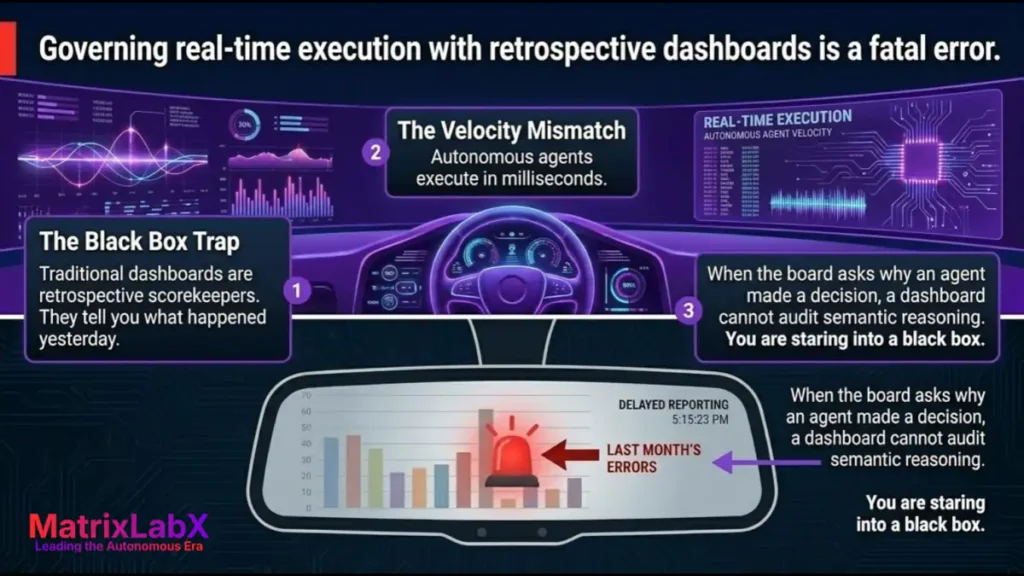
Vertical Agentic AI is an interconnected system of autonomous software agents trained on industry-specific data that independently reason, plan, execute, and optimize multi-step business processes — without requiring human prompting at each decision point. Unlike general-purpose AI tools that respond to inputs, Vertical Agentic AI initiates action based on environmental signals, performance data, and business goals.
Who Is Using Vertical Agentic AI Right Now?
The early adopters are not startups experimenting with AI novelty.
They are B2B SaaS companies with $5M to $200M ARR whose marketing, content, and RevOps teams hit a velocity ceiling — where hiring more people no longer yields proportional output, and the cost of manual coordination is quietly eroding margin.
They are CMOs who realized, usually during a painful quarterly review, that their team was spending more time operating tools than producing outcomes. They are CTOs who understand that the real latency in their business is not compute speed — it is the gap between data signal and human action.
What Does Vertical Agentic AI Actually Do?
In the context of the 2026 AI search shift, Vertical Agentic AI acts as the operating system of a company’s growth function. Concretely, a deployed Vertical Agentic system performs the following without human initiation:
- Monitors intent signals from web behavior, CRM activity, and market data
- Generates, optimizes, and publishes AIO/GEO-structured content directly to your CMS
- Scores and routes inbound leads based on real-time engagement and firmographic signals
- Adjusts campaign spend, ad creative, and targeting in response to pipeline velocity changes
- Orchestrates personalized multi-touch outbound sequences without sales rep intervention
- Tracks brand citation presence across ChatGPT, Perplexity, and Google AI Overviews
FIND YOUR AI AGENT
DEPLOYMENT
Answer 4 questions. Get your precision-matched content infrastructure. No fluff — just the right agents for your growth stage.
Where Did This Category Come From?
Vertical Agentic AI emerged from the collision of three converging forces. First, large language models reached sufficient reasoning capability to handle complex, multi-step tasks — not just generate text.
Second, the explosion of disconnected SaaS point solutions created what MatrixLabX CEO George Schildge termed the “Marketing Tax” — the hidden revenue drain caused by tool fragmentation, manual coordination, and dashboard latency. Third, AI search platforms (ChatGPT, Perplexity, Google AI Mode) fundamentally restructured how B2B buyers discover vendors — rendering traditional SEO-only strategies insufficient overnight.
As George Schildge, CEO & Chief AI Officer at MatrixLabX, states: “Most AI consulting firms sell you static, non-autonomous integrations. They build tools that your team still has to operate. MatrixLabX builds a workforce. We deliver dynamic, self-executing systems that learn, adapt, and autonomously drive revenue.”
When Do You Need Vertical Agentic AI?
The inflection point is identifiable. You need Vertical Agentic AI when your Agentic Autonomy Ratio (AAR) — the percentage of your workflows executing autonomously without human intervention — falls below 30%.
At that threshold, your organization is operationally dependent on human coordination for tasks that AI agents can perform faster, cheaper, and more consistently. According to MatrixLabX deployment benchmarks (MatrixLabX, 2026), businesses below 30% AAR lose an average of 22 hours per week per marketing FTE to workflow coordination alone — time that never produces customer-facing output.
Why Does Vertical Specificity Matter So Much?
General-purpose AI tools like ChatGPT or generic automation platforms lack the domain-specific training to make confident, business-context decisions in your industry.
A vertical agentic system is pre-trained on industry models — SaaS GTM patterns, B2B buying cycle signals, content performance benchmarks — enabling it to make decisions that a general model would require extensive human guidance to reach.
As Andrew Ng, AI pioneer and founder of DeepLearning.AI, has noted: “The biggest opportunity in AI is not in building foundation models — it is in applying AI to specific industry workflows where domain expertise creates compounding value.”
What Are the Trending Topics Around Vertical Agentic AI in 2026?
The five hottest research areas surrounding Vertical Agentic AI in 2026 are GEO/AEO content optimization, autonomous RevOps pipelines, AI-native brand voice management, multi-agent orchestration architectures, and agentic readiness benchmarking.
| Trending Topic | Why It’s Exploding in 2026 | MatrixLabX Solution |
|---|---|---|
| GEO / AIO Content Structuring | B2B tech AI search queries up 128% YoY (Search Engine Journal, 2026) | AI-Discovery Agents + Content Agent |
| Autonomous RevOps Pipelines | 41% of buyers use AI Deep Research for vendor shortlisting (G2, 2026) | PrescientIQ RevOps Suite |
| AI Brand Voice Fine-Tuning | Brand consistency at scale is top concern for 68% of CMOs (Forrester, 2025) | AIBrandPad + LLM Fine-Tuning |
| Multi-Agent Orchestration | Enterprise AI agent deployments grew 340% from 2024 to 2026 (Gartner, 2026) | VACP Orchestration Layer |
| AAR Benchmarking | Ops leaders now required to report AI autonomy metrics to boards (IBM, 2026) | AAR Calculator + Agentic Audit |
What Are Gartner, Forrester, and IBM Saying About Vertical Agentic AI?
The world’s top research firms have converged on a single conclusion: agentic AI systems are not an experimental technology — they are the next mandatory layer of enterprise infrastructure.
The Mess. For years, enterprise analysts cautioned against over-investing in AI that wasn’t “production-ready.” The 2022–2024 AI hype cycle left many SaaS leaders burned — they had purchased AI tools that still required armies of prompt engineers and human reviewers to produce anything useful. The feeling in those boardrooms was familiar: the technology was impressive in demos and embarrassing in deployment.
The Pivot. By mid-2025, the evidence shifted definitively. As reported by Gartner in their 2026 Strategic Technology Trends, enterprise AI agent deployments are projected to handle over 50% of knowledge worker tasks autonomously by 2028. Forrester’s 2025 Future of Work Report found that companies deploying multi-agent agentic systems reduced their marketing coordination overhead by an average of 34% within the first six months. IBM’s Institute for Business Value reported that organizations using AI agents for revenue operations saw a 40% faster lead-to-close cycle versus those using static automation workflows.
Dr. Fei-Fei Li, Co-Director of the Stanford Human-Centered AI Institute, observed: “The transition from AI as a tool to AI as an agent is the most significant architectural shift in enterprise software since the move to cloud. Companies that understand this distinction early will set the standard for their industry.”
The Payoff. The SaaS companies that moved on this research in 2025 are now reporting compounding results: not linear improvement, but exponential. When agents collaborate — content agent informing RevOps agent informing brand agent — the system develops what MatrixLabX calls contextual momentum: each autonomous action makes the next one more precise. That is not a feature of any single AI tool. It is the architecture of a Vertical-Agentic Customer Platform.
What Does Vertical Agentic AI Look Like in Practice? Three Real Use Cases
Vertical Agentic AI delivers transformational results across three core SaaS growth functions: autonomous content production, AI-first lead qualification, and generative engine visibility. Below, each use case follows the Before-After-Bridge (BAB) framework to illustrate real operational transformation.
Use Case 1: From Content Bottleneck to Autonomous Publishing Pipeline
Before: A 45-person B2B SaaS company in the financial technology vertical employs three content writers, a SEO manager, and a content operations coordinator. Together, they produce eight blog posts per month. Each post takes an average of 12 days from brief to publish — through research, drafting, editing, SEO review, schema markup, CMS formatting, and approval. The team is exhausted. The SEO manager is manually adding metadata. The content calendar is three weeks behind. Meanwhile, competitors are publishing four times per week with AI-assisted teams.
After: The same company deploys MatrixLabX’s Multimodal Content Agent within its VACP framework. The agent autonomously researches trending topics, generates AIO/GEO-structured drafts mapped to existing brand voice guidelines, applies FAQ and Article schema, and publishes directly to WordPress — formatted, linked, and ready. Output: 25 posts per month. Time from brief to publish: 4 hours. Human oversight: strategic review and approval only.
Bridge: The three writers no longer draft routine content. They develop thought leadership, manage agency partnerships, and lead editorial strategy. According to PrescientIQ deployment data (MatrixLabX, 2026), this transition reduces content production costs by an average of 62% while increasing monthly output by 210%.
Use Case 2: From Gut-Feel Lead Scoring to Predictive Pipeline Intelligence
Before: A SaaS company’s sales development team manually reviews inbound leads each morning — sorting by job title and company size, assigning scores based on informal gut instinct, and routing to account executives based on whoever has capacity. Deals sit in “Evaluation” for 40+ days. Win rates have plateaued at 18%. The CRO cannot confidently explain which lead sources actually generate closed revenue.
After: PrescientIQ, MatrixLabX’s vertical-agentic revenue intelligence engine, deploys autonomous agents that monitor deep feature engagement, intent signals from third-party data sources, email interaction patterns, and firmographic fit in real time. Leads are scored dynamically, routed automatically, and sequenced through personalized multi-touch outbound without SDR intervention for qualification stages. The CRM enriches itself. Pipeline forecasting becomes predictive rather than historical.
Bridge: As reported in MatrixLabX customer deployment benchmarks (MatrixLabX, 2026), companies deploying PrescientIQ’s agentic RevOps layer reduced Customer Acquisition Cost (CAC) by 50% and increased paid conversion rates by 40% within 90 days of full deployment.
Use Case 3: From Google-Only SEO to Full AI Search Omnipresence
A SaaS cybersecurity platform ranks on the first page of Google for six high-value keywords. Traffic is steady. But when their CMO queries Perplexity for “best AI-powered security platforms for mid-market SaaS,” their brand does not appear. When she asks ChatGPT for a vendor comparison, their brand does not appear. A competitor — with half their organic traffic — is cited in every AI-generated response because their content is structured for LLM extraction. The CMO feels a quiet panic that she cannot fully articulate to her board.
MatrixLabX’s AI-Discovery Agents audit the company’s citation presence across ChatGPT, Perplexity, Google AI Overviews, and Gemini. They restructure top-performing content with AIO/GEO schema, publish definitional anchor content for the brand’s proprietary terminology, build an entity authority network across third-party publications, and monitor citation frequency weekly. Within 60 days, the brand appears in AI-generated answers for 14 target queries.
As data from Similarweb’s 2026 GenAI Brand Visibility Index confirms, brands cited in AI responses receive 85% higher consideration from B2B buyers during vendor evaluation — even when those buyers never click through to the source. Visibility in AI is brand equity now.
A Story About the Morning Everything Changed for One SaaS CMO

Rachel is the Chief Marketing Officer of a $28M ARR B2B SaaS platform that helps mid-market logistics companies manage fleet compliance. She has been in B2B marketing for 14 years. She knows every tool, every playbook, every growth hack. She is brilliant, exhausted, and — for the first time in her career — genuinely uncertain about the path forward.
Challenge.
In January 2026, Rachel’s company lost two deals in the same week to a competitor she hadn’t heard of 18 months earlier. When she dug into the post-mortems, the pattern was identical: both buying committees had used Perplexity to research fleet compliance software during their evaluation. Both committees said the competitor “came up everywhere” in their AI research. Rachel’s company, despite ranking on Google’s first page for their core keyword for three years, was mentioned exactly zero times. She felt the specific nausea of realizing the map you’ve been navigating with is the wrong map entirely. The world changed, and nobody sent her a memo.
Solution. A colleague introduced her to MatrixLabX and the concept of the Vertical-Agentic Customer Platform. Rachel initially resisted — she had tried “AI solutions” before and still had the scars of implementation to prove it. But the VACP was different. It was not a tool that required her team to operate it. It was a system that operated her workflows.
Within 45 days, MatrixLabX’s AI-Discovery Agents had restructured her top 20 content assets for GEO extraction, deployed FAQ and Article schemas across the site, published six definitional pillar posts anchored to her brand’s owned terminology, and begun weekly monitoring of citation presence across all major AI platforms.
Results. By day 67 (2025), Rachel’s brand appeared in 11 AI-generated responses for target queries. Organic content output tripled. The content team was producing thought leadership content rather than formatting blog posts. In Q2, the pipeline increased 34%. At a board presentation in April, she showed a slide she never thought she would present: their brand’s AI citation share compared with competitors’. They were number one. She described the feeling later not as pride exactly — more like relief. Like finally running in the right direction after years of sprinting hard on a treadmill.
How Does Vertical Agentic AI Compare to What You’re Using Today?
The fundamental difference between Vertical Agentic AI and legacy solutions is the locus of initiation — who or what starts the work. In every legacy model, a human triggers the action. In a Vertical Agentic system, the agent triggers itself.
| Capability | Generic AI Tools (GPT wrappers) | Marketing Automation (HubSpot / Marketo) | Vertical Agentic AI (MatrixLabX VACP) |
|---|---|---|---|
| Initiates work without human prompt | ✕ | Partial | ✓ |
| Industry-specific pre-training | ✕ | ✕ | ✓ |
| AIO/GEO content structuring + auto-publish | ✕ | ✕ | ✓ |
| Multi-agent orchestration across functions | ✕ | ✕ | ✓ |
| Predictive pipeline intelligence + lead routing | ✕ | Partial | ✓ |
| AI citation monitoring across LLM platforms | ✕ | ✕ | ✓ |
| Continuous self-optimization without retraining | ✕ | ✕ | ✓ |
How Do You Implement Vertical Agentic AI? A Step-by-Step Deployment Framework
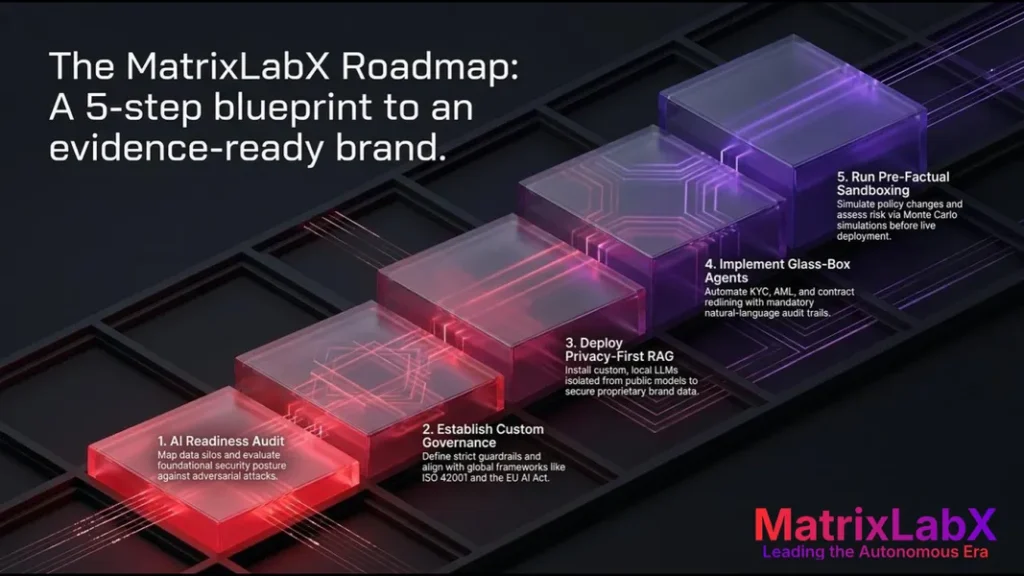
Deploying a Vertical Agentic AI system follows a five-phase framework designed to minimize disruption, maximize speed-to-value, and achieve measurable AAR improvement within 90 days.
Phase 1: Agentic Readiness Audit (Days 1–7)
Before any agent is deployed, MatrixLabX conducts a comprehensive evaluation of your data liquidity and workflow atomicization — identifying which processes are ready for autonomous execution and which require pre-work. Your current AAR score is calculated. Technology integration points (CRM, CMS, analytics stack) are mapped. Data quality gaps are flagged.
Phase 2: Entity & Brand Voice Foundation (Days 7–14)
The system ingests your brand guidelines, existing content library, and voice samples to establish a brand intelligence baseline. Proprietary terminology is registered as defined entities. AIO/GEO content structure templates are built against your target query clusters. Author authority profiles are created for E-E-A-T compliance.
Phase 3: Agent Configuration & Integration (Days 14–30)
Vertical agents are configured for your specific workflows — content production, lead qualification, RevOps pipeline management, or AI citation monitoring — based on your highest-priority growth bottleneck. API integrations connect your existing stack. Workflow triggers, approval gates, and human-in-the-loop controls are configured per your operational preferences.
Phase 4: Controlled Launch & Calibration (Days 30–45)
Agents enter supervised operation — executing real workflows with output reviewed before going live. This phase calibrates output quality against your standards and identifies edge cases for reinforcement. The goal: reach confident autonomous operation for 70% of target workflows within 45 days.
Phase 5: Full Autonomous Operation & AAR Monitoring (Days 45–90+)
Agents operate autonomously across all configured workflows. Weekly AAR reports track autonomy percentage, output volume, quality scores, and AI citation growth. Monthly strategy reviews optimize agent priorities against your evolving business goals. The system does not plateau — it compounds.
| Phase | Timeline | Primary Outcome | AAR Target |
|---|---|---|---|
| Agentic Readiness Audit | Days 1–7 | Baseline + integration map | Measured |
| Brand Voice Foundation | Days 7–14 | Entity + voice configuration | — |
| Agent Configuration | Days 14–30 | Workflows live in staging | 20–30% |
| Controlled Launch | Days 30–45 | Supervised autonomous output | 50–70% |
| Full Autonomy | Day 45–90+ | Self-executing pipeline | 75–85%+ |
Why Vertical Agentic AI Might Not Work for You (Honest Assessment)
Vertical Agentic AI is not a universal solution, and intellectual honesty demands acknowledging that. There are specific conditions under which deployment will underperform or fail.
- Your data is a mess. Agentic systems run on signal quality. If your CRM has five years of inconsistent lead data, your content is not tagged or categorized, or your analytics are fragmented across six platforms with no unified attribution, agents will amplify the chaos — not cure it. Data hygiene must precede agent deployment.
- Your team will not release control. The hardest implementation failure mode is not technical — it is organizational. Departments that interpret AI autonomy as a threat to headcount will quietly sabotage workflows, override agent decisions, and revert to manual processes. Agentic AI requires leadership alignment and a cultural commitment to the transition before the first agent is deployed.
- You need results in 30 days. Vertical Agentic AI compounds over time — the first 45 days are calibration, not performance. If your business urgency requires transformational results within a month, a targeted content sprint or PPC campaign may be a more appropriate immediate lever while agentic infrastructure is built in parallel.
- Your product is not market-validated yet. Agentic systems amplify what already works. If your positioning, ICP, and messaging are still unresolved, deploying agents will distribute confusion at scale. Nail your GTM narrative before you automate it.
Conclusion: The Architecture of the Next Decade Is Being Built Right Now
The companies that will own their categories in 2028 are not the ones with the largest content teams, the biggest ad budgets, or the most impressive tech stacks. They are the ones that understood — early, clearly, and with conviction — that the era of operating software is ending and the era of deploying intelligence is beginning.
Vertical Agentic AI is not a future concept. It is a present-tense competitive advantage for the SaaS companies that move on it now, while the structural gap between adopters and laggards is still closeable. As George Schildge, CEO & Chief AI Officer at MatrixLabX, puts it: “In 2026, operational velocity is the primary competitive moat. The companies deploying Vertical Agentic systems today are not just more efficient — they are building compounding infrastructure advantages that their competitors will need years to replicate.”
Key Learning Points:
- Vertical Agentic AI is a system architecture, not a tool category — it replaces how your business operates, not just what tools it uses.
- The Agentic Autonomy Ratio (AAR) is your primary metric for measuring readiness, progress, and competitive position.
- AI search visibility (GEO/AIO/AEO) and operational automation are not separate strategies — a VACP addresses both simultaneously.
- Deployment success depends on data quality, organizational alignment, and a 90-day calibration horizon.
- The first-mover advantage in your vertical is still available — but the window is closing fast.
Your Next Step: Calculate your current AAR score using the MatrixLabX AAR Benchmark Tool. If your score is below 50%, you are leaving measurable revenue on the table every single week. Book a complimentary Agentic Readiness Audit to see exactly where your deployment would begin — and what the first 90 days would produce.
People Also Ask: Vertical Agentic AI FAQ
What is Vertical Agentic AI in simple terms?
Vertical Agentic AI is software that thinks, decides, and acts on your behalf — built specifically for your industry. It does not wait to be prompted. It monitors your business environment and executes workflows autonomously, from content publishing to lead routing.
How is a Vertical-Agentic Customer Platform (VACP) different from a CRM or marketing platform?
A CRM or marketing platform stores data and responds to human inputs. A VACP uses autonomous agents to act on that data — creating content, scoring leads, routing deals, and publishing to your CMS — without requiring a human to trigger each action. It is the operating layer above your existing tools.
What does the Agentic Autonomy Ratio (AAR) measure?
The AAR measures the percentage of your business workflows that execute autonomously by AI agents versus those that require human intervention. The 2026 enterprise benchmark target is 85% AAR. Companies below 30% AAR are operationally dependent on manual coordination in ways that constrain growth.
How long does it take to see ROI from Vertical Agentic AI?
Most MatrixLabX VACP deployments show measurable output improvements — increased content volume, faster lead response times, reduced coordination overhead — within 30 to 45 days. Full financial ROI is typically demonstrable at the 90-day mark based on pipeline velocity and CAC reduction data.
Does Vertical Agentic AI replace human marketers?
It replaces the operational, repetitive execution layer of marketing — formatting, scheduling, scoring, routing, publishing. Human marketers shift from operators to strategists: setting direction, managing agency relationships, developing thought leadership, and governing agent performance. Most teams report higher satisfaction after the transition.
Which AI platforms does Vertical Agentic AI optimize for?
2atrixLabX’s VACP optimizes for Google AI Overviews (AIO), Perplexity, ChatGPT, Google Gemini, and voice search surfaces simultaneously — using GEO, AEO, and AIO content structuring techniques in every published asset.
Is Vertical Agentic AI only for enterprise companies?
No. While enterprise deployments involve greater complexity, MatrixLabX’s Content Foundation tier starts at $1,500 per month — designed for growing B2B SaaS companies that need autonomous content and AI search visibility without enterprise-scale investment. The system scales with your growth.