

Agentic Inflection: The Moment Everything Breaks
Here’s Why CEO’s Should Listen.
The board meeting for a mid-market SaaS leader—let’s call them NexaFlow—started at 9:00 AM. By 9:15 AM, the air had left the room.
The CRO sat staring at a dashboard that looked spectacular on the surface. Pipeline was up 40%. The “AI Copilots” purchased eighteen months ago were firing off thousands of automated outbound emails, summarizing every Zoom call, and generating endless “personalized” LinkedIn touchpoints.
But the revenue wasn’t moving.
“We have more activity than ever,” the CRO admitted, “but our win rates have cratered. Our sales reps are spending four hours a day ‘managing’ their AI assistants instead of actually closing deals. We’ve automated the noise, but we haven’t automated the outcome”.
This is the “Copilot Paradox“. In 2024 and 2025, enterprises treated AI like a digital intern—a helpful, chatty sidekick that required constant supervision.
By 2026, the weight of that supervision has become a secondary job. The tension at NexaFlow isn’t about a lack of technology; it’s about the failure of human-in-the-loop systems to scale when the “loop” is moving at machine speed.
The moment of failure happens when your tools provide “suggestions” that your humans don’t have the time to validate. At that point, the technology isn’t an asset; it’s a bottleneck.
Section 2: The Hidden Problem (What Others Miss)
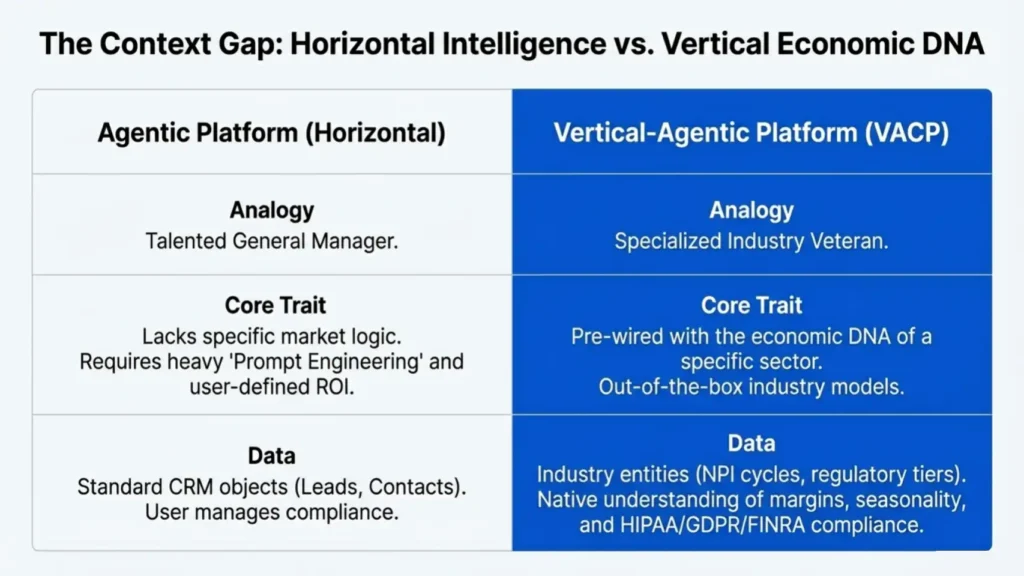
The market is currently witnessing a massive, silent migration. As of early 2026, 40% of enterprise applications have transitioned from passive assistants to autonomous agents that function as core operational layers.
Most executives think the problem is “AI adoption”. It isn’t. The problem is agency.
- The Old Way (The Copilot Era): AI acts as a UI overlay. It waits for a prompt, generates a draft, and asks a human for permission to proceed. Humans remain the “integration engine” between different software tools.
- The New Reality (The Agentic Inflection): AI acts as a functional layer. It identifies a goal (e.g., “reduce churn by 5%”), accesses the necessary data across the stack, and executes the multi-step workflows required to achieve it—only notifying the human when a strategic threshold is met.
The hidden problem is that 79% of mid-market companies are now deploying these agents, creating a massive performance delta. While the Fortune 500 is paralyzed by legacy governance committees, the $20M–$300M segment has become the primary battleground. These agile firms have the “data density” to fuel agents without the “bureaucratic drag” of global conglomerates.
The result? Top-performing AI leaders in this segment are realizing $10 in ROI for every $1 invested, while the laggards—still stuck correcting their Copilot’s grammar—are scraping by at a market average of $3.70.
Section 3: Why Traditional Approaches Fail
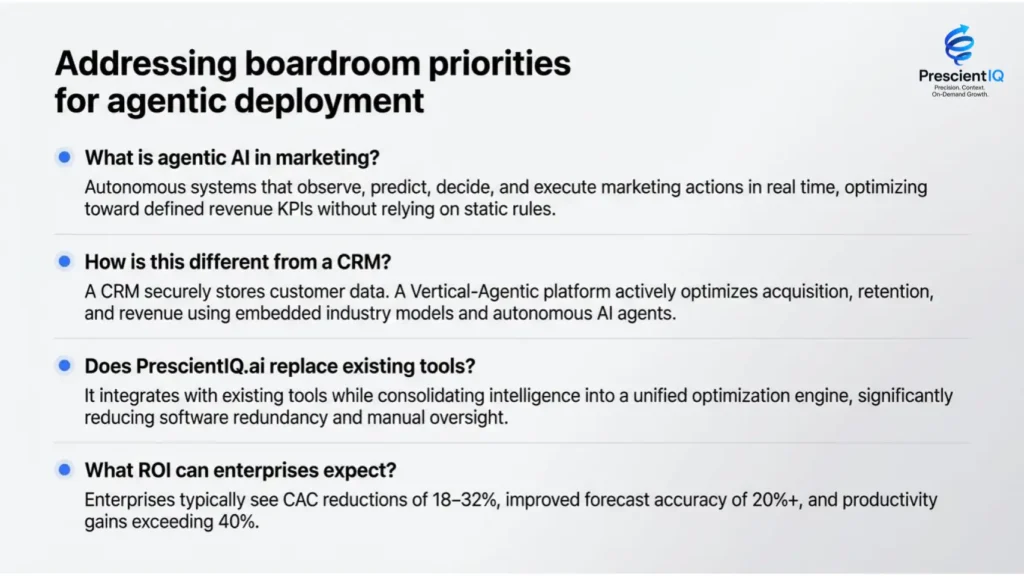
Traditional SaaS was built on the “Dashboard Fallacy”. We assumed that if we gave a VP of Marketing enough data and enough “productivity tools,” they would magically find the time to be a strategist.
Instead, we gave them a cockpit with 400 blinking lights.
The realization usually hits during the third quarter of stagnant growth. A CFO looks at the software spend—SaaS seats, AI add-ons, “pro” licenses—and then looks at the headcount. If the AI is so “productive,” why hasn’t the CAC (Customer Acquisition Cost) gone down?
The tools are failing because they are point solutions in a system-wide crisis. A “Copilot” can write an email, but it can’t manage a territory. It can summarize a ticket, but it can’t resolve a multi-departmental billing dispute.
Traditional approaches fail because they focus on Individual Productivity rather than Organizational Velocity. You don’t need a faster way to write emails; you need a system that ensures the right customer is touched at the right time with the right solution, without a human having to click “send” 500 times a day.
Section 4: The New Model: The “Agentic Execution Layer”
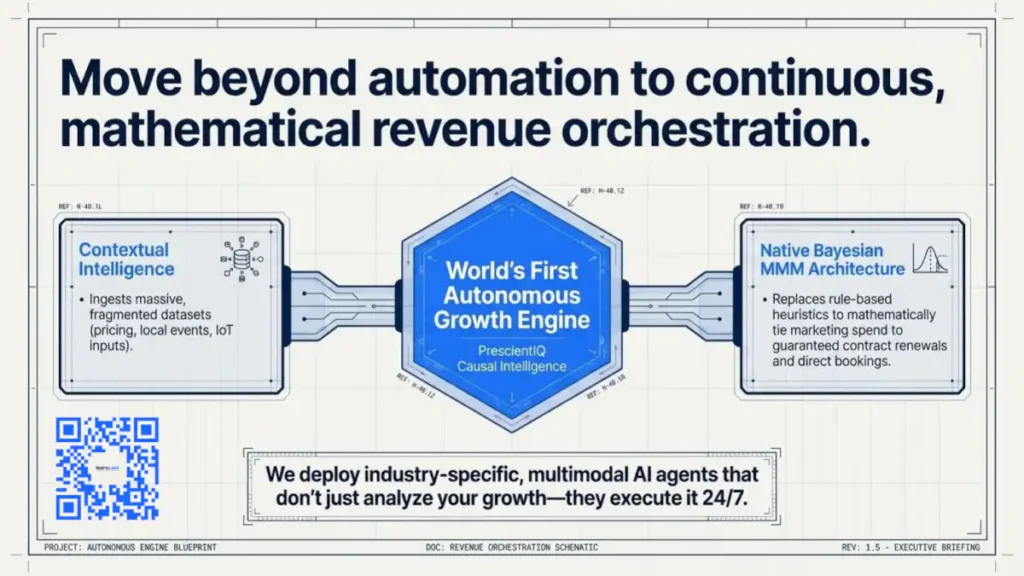
We are moving past “Generative AI” (which creates content) toward “Agentic AI” (which creates outcomes).
This is not an incremental update; it is a category shift into Digital Labor. We define this as the Agentic Execution Layer (AEL).
The AEL is a sophisticated architectural shift where the “Agent” sits between your data and your execution. Unlike a chatbot, an Agentic System possesses:
- Memory: It remembers customer history across platforms, not just the current “chat”.
- Reasoning: It can break a high-level goal into 15 sub-tasks.
- Tool Use: It can independently use your CRM, your ERP, and your Slack.
“In 2024, you hired people to use software. In 2026, you hire software to use software, so your people can focus on the mission.”
By treating AI as a functional layer rather than a tool, companies are effectively expanding their “digital headcount” without increasing their office footprint.
Section 5: How It Works (Operational Breakdown)
To move from a “Copilot” culture to an “Agentic” culture, the architecture must change. It follows a three-step transformation:
1. Semantic Integration (The Foundation)
You cannot point an agent at a messy database and expect results. The first step is creating a Semantic Search layer—a “map” of your company’s knowledge that the agent can navigate. This allows the AI to understand that “Sigma Corp” in the CRM is the same as “Sigma Holdings” in the billing system.
2. Goal-Directed Orchestration
Instead of writing prompts (e.g., “Write a follow-up email”), leaders define Objectives and Constraints.
- Objective: “Identify any accounts in the Manufacturing vertical with a health score below 60 and initiate a multi-channel re-engagement sequence.”
- Constraint: “Do not offer discounts higher than 15% without VP approval.”
3. Autonomous Execution & Feedback Loops
The agent executes the plan. It monitors the response rates, adjusts the tone of the second message based on the sentiment of the first, and only loops in a human “Growth Lead” when a meeting is requested or a specific objection arises that it isn’t authorized to handle.
Section 6: Real-World Applications (Use Cases)

Case Study 1: The Manufacturing Pivot
A mid-sized industrial parts manufacturer experienced a 22% churn rate due to slow technical support response times.
- Before: Support staff spent 60% of their time looking up technical specs across legacy PDF manuals.
- The Agentic Shift: They deployed a “Technical Resolution Agent” that didn’t just answer questions—it diagnosed the issue by pulling IoT sensor data from the client’s machine and automatically shipped the replacement part.
- Outcome: Churn dropped to 4%; ROI was measured at 12x within six months.
Case Study 2: Professional Services Velocity
A regional consulting firm struggled with “Proposal Fatigue”—taking two weeks to turn around a custom SOW (Statement of Work).
- The Agentic Shift: An “Operations Agent” was built to monitor incoming leads. It researched the prospect’s recent SEC filings, compared the request against 500 previous projects, and drafted a 20-page, technically accurate proposal for partner review within 15 minutes.
- Outcome: Pipeline velocity increased by 300%.
Case Study 3: Marketing Agency Customer Service
As the agentic era is upon us, marketing agencies are suffering from a lack of artificial intelligence and uncertainty about how to apply it across specific industries.
With PrescientIQ’s industry models and agenetic systems by vertical, time to value is sometimes less than 30 days. The marketing agency topped out at 30 writers, all of whom were doing multimodal content generation for clients. With hyper-personalization required, it became impossible to scale the agency without hiring more people.
When the agentic multimodal system was introduced, it reduced labor costs by 62% (a $2.4M savings), and the audio in videos was of commercial quality. Now the agency was able to scale with a healthy profit margin, and everybody was happy.
Section 7: Business Impact (Metrics That Matter)
The “Agentic Inflection” is fundamentally changing the math of the SaaS and services world. We are seeing a shift from “vanity AI metrics” (like prompts sent) to Core Economic Indicators.
| Metric | The Copilot Era (2024-2025) | The Agentic Era (2026) |
| CAC | Increasing due to “automated noise” saturation. | Decreasing through hyper-relevant, autonomous targeting. |
| Revenue per Employee | Flat; employees are busy managing AI. | 2x-3x increase via “Digital Labor” leverage. |
| Pipeline Velocity | Limited by human review bottlenecks. | Exponential; agents move at the speed of data. |
| Market ROI | $3.70 per $1 spent. | $10.00+ per $1 spent for leaders. |
This isn’t just about “saving time”. It’s about Economic Defensibility. In a world where your competitors are using autonomous agents to capture market share while you are still “chatting” with a bot, the gap becomes unbridgeable within quarters, not years.
Section 8: What This Means for Leaders
For the CMO, CRO, and CFO, the “Agentic Inflection” is a mandate to move from Resource Management to System Orchestration.
The risks of inaction are no longer theoretical. We are entering a period of “Compound Productivity”.
Companies that integrate agents now are training those agents on their proprietary data. By the time a laggard decides to start, the leader’s agents will have two years of “organizational intuition” that cannot be bought off a shelf.
The Strategic Outlook:
- Short Term: Audit your “Copilot” spend. If it isn’t reducing your human-to-output ratio, it’s a toy, not a tool.
- Medium Term: Build your Semantic Knowledge Layer. Agents are only as good as the truth they can access.
- Long Term: Redesign your hiring. You don’t need “AI specialists”; you need business architects who can design the workflows that agents execute.
Section 9: The Path Forward
The “Agentic Inflection” is the most significant shift in business architecture since the move to the Cloud. The era of AI as a curiosity is over; the era of AI as a workforce has begun.
At our firm, we don’t just “implement AI.”
We architect the Agentic Execution Layer that turns your data into a self-sustaining growth engine. We specialize in the $20M–$300M mid-market—the “Agile Middle”—where the greatest ROI is currently being won.
The window for the “First-Mover” advantage is closing. By the end of 2026, autonomous agents will be the baseline, not the breakthrough.
Are you leading the inflection, or are you the one being inflected?
Executive FAQs
What is the “Agentic Inflection” in the 2026 SaaS market?
A: The Agentic Inflection is the strategic transition where enterprises move from passive “Copilots” to autonomous AI agents that function as core operational layers. As of early 2026, 40% of enterprise applications have embedded these agents to execute multi-step workflows independently rather than merely providing suggestions to a human-in-the-loop.
Why are mid-market companies seeing higher AI ROI than the Fortune 500?
Mid-market firms (typically $20M–$300M in revenue) possess the ideal balance of “data density” and organizational agility. Unlike Fortune 500 companies, which are often hampered by legacy governance, these firms can deploy agentic systems rapidly, yielding an average ROI of $10 for every $1 invested.
How does an “Agentic Execution Layer” differ from traditional AI software?
Traditional AI acts as a UI overlay requiring constant human prompts; the Agentic Execution Layer (AEL) acts as a functional layer with memory, reasoning, and tool-use capabilities. An AEL identifies goals, accesses data across the entire software stack, and executes outcomes without requiring a human to manage every micro-task.