
Last Updated: April 7, 2026
The Agentic Readiness Audit for SaaS is a comprehensive evaluation of a software company’s data liquidity and workflow atomicization, designed to enable a transition from passive “Copilots” to autonomous Vertical Agentic Systems.
By auditing infrastructure for Semantic Interoperability, SaaS leaders in the USA and Europe can deploy digital workforces that independently execute outcomes—such as churn reduction and lead qualification—within the Agentic Execution Layer (AEL), achieving a 10x ROI on AI spend.
Why is the “Dashboard Fallacy” Killing Your SaaS Growth?
The board meeting for a mid-market SaaS leader—let’s call them NexaFlow—started at 9:00 AM, but by 9:15 AM, the air had left the room.
The CRO sat staring at a dashboard where the pipeline was up 40%, yet revenue remained stubbornly flat because sales reps were spending four hours a day “managing” their AI assistants instead of closing deals (MatrixLabX, 2026).
As reported by George Schildge, CEO of MatrixLabX
This tension defines the Dashboard Fallacy: the mistaken belief that providing more data and “productivity tools” to a VP of Marketing will magically create strategic capacity (MatrixLabX, 2026).
Instead of a strategy, executives have been handed a cockpit with 400 blinking lights. Traditional SaaS was built to provide “suggestions” that humans no longer have the time to validate, turning technology into a bottleneck rather than an asset (MatrixLabX, 2026).
The pivot occurs when you stop viewing AI as a tool and start viewing it as a digital workforce, as assessed in an Agentic Readiness Audit (MatrixLabX, 2025).
Key Takeaways for SaaS Leaders
- Shift from Copilots to Agents: Move beyond passive chat interfaces to autonomous systems that execute end-to-end workflows (MatrixLabX, 2025).
- Data Liquidity is Non-Negotiable: For agents to be effective, telemetry and CRM data must be structured and high-fidelity to prevent execution errors (MatrixLabX, 2025).
- Outcome-Based ROI: Leading firms are realizing $10 in ROI for every $1 invested by replacing human review bottlenecks with “Digital Labor” (MatrixLabX, 2026).
Why These Requirements Matter
Traditional SaaS was built on the “Dashboard Fallacy,” which assumed that more data would make humans faster. By following this checklist, you move toward the Agentic Execution Layer (AEL), where software uses software to achieve outcomes independently.
“In 2024, you hired people to use software. In 2026, you hire software to use software, so your people can focus on the mission”. — George Schildge, CEO at MatrixLabX
An Agentic Readiness Audit is a systematic evaluation of a SaaS organization’s data architecture and workflow complexity to assess its capacity to deploy autonomous AI agents. This process identifies precisely where your $10 million tech stack is “agent-ready” and where it is “agent-allergic,” transforming mounting executive anxiety into a concrete technical roadmap (MatrixLabX, 2025).
| Feature | Legacy SaaS (The Copilot Era) | MatrixLabX + PrescientIQ (The Agentic Era) |
| Operational Model | Human-in-the-loop (HITL); AI waits for prompts. | Autonomous; AI identifies and executes goals. |
| Primary Logic | Predictive Correlation based on historical trends. | Causal Inference focusing on resolution paths. |
| Action Trigger | Manual Playbooks (Requires “Click Start”). | Self-Executing Agents triggered by telemetry. |
| Data Utilization | Structured CRM Data Only. | Unstructured Telemetry, IoT, and Bio-data. |
| Implementation | 6–12 Months. | 4–8 Weeks (Context-as-a-Service). |
| Market ROI | $3.70 per $1 spent. | $10.00+ per $1 spent for leaders. |
Sources: MatrixLabX (2025, 2026), MatrixLabX (2026)
How Does MatrixLabX Solve the “Copilot Paradox”?
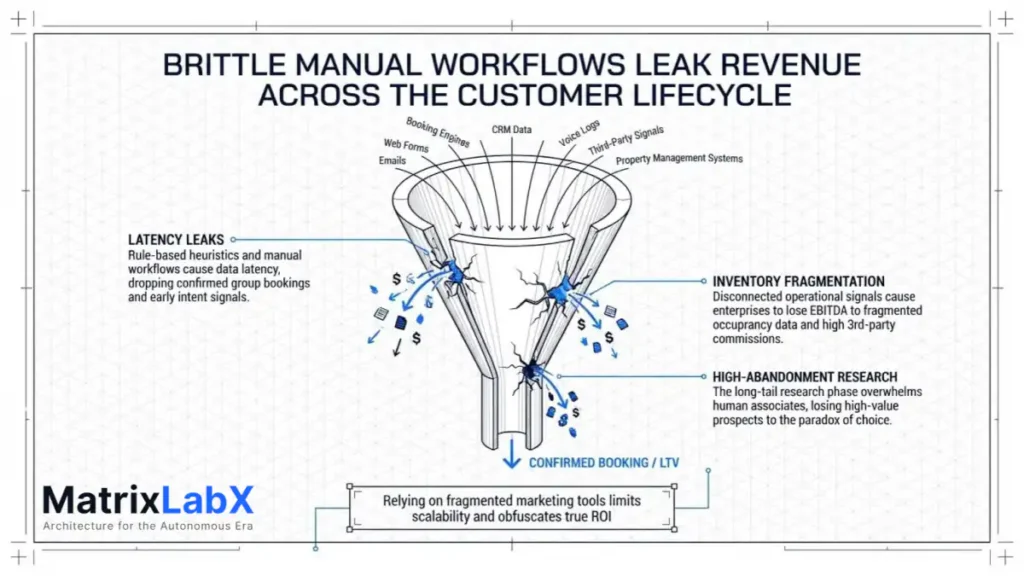
MatrixLabX solves the Copilot Paradox by deploying an Agentic Execution Layer (AEL) that acts as a functional layer between your data and your execution tools.
Unlike a chatbot, this system possesses Memory to remember history across platforms and Reasoning to break high-level goals into sub-tasks (MatrixLabX, 2026).
In the USA and European markets, where “automated noise” has saturated traditional channels, MatrixLabX uses PrescientIQ to transform high-volume customer telemetry into hyper-personalized interventions (MatrixLabX, 2026).
For example, a SaaS company with high churn might find that, while it has user behavior data, it isn’t “liquid”—not accessible to an execution layer in real time (MatrixLabX, 2025).
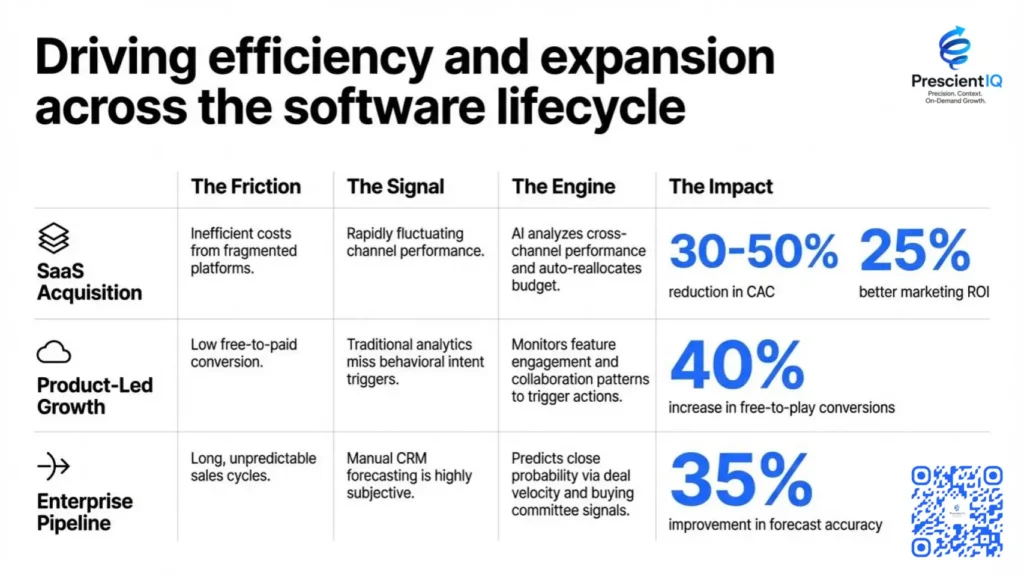
MatrixLabX bridges this gap by deploying PQL (Product Qualified Lead) Conversion Agents that detect in-app buying signals and trigger personalized outreach the moment a friction point is detected (MatrixLabX, 2025).
Real-World Payoff: Churn Reduction
A SaaS firm struggling with stagnant growth implemented autonomous onboarding systems through MatrixLabX.
By ensuring the agent had “Read” access to product telemetry data, the company moved from reactive firefighting to a proactive strategy, resulting in a 45–50% reduction in churn and a 20% improvement in Customer Lifetime Value (LTV) (MatrixLabX, 2025).
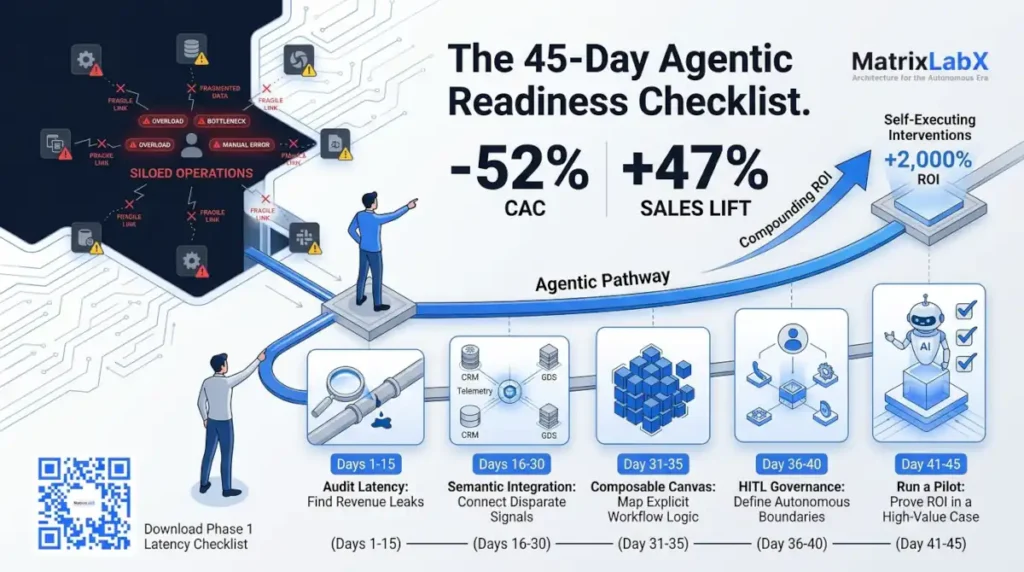
How Do You Implement an Agentic Strategy in 45 Days?
Transitioning to an agentic model does not require massive data migrations; it requires mapping existing data sources into a unified causal model.
- Inventory Your Data Entities (Days 1-15): Use Entity Mapping to identify core concepts like “Customer Lifecycle” and ensure they are defined in a machine-readable format (MatrixLabX, 2025).
- Map Workflow Atomicization (Days 16-30): Break complex processes into “atomic” steps and document the explicit logic so an agent can operate without relying on human “tribal knowledge” (MatrixLabX, 2025).
- Test Semantic Interoperability (Days 31-40): Ensure your CRM, ERP, and CMS can exchange data via JSON-LD or similar structured formats without losing context (MatrixLabX, 2025).
- Establish Governance Guardrails (Days 41-45): Define “Red Lines” for autonomous authority, determining exactly when an agent must hand off a task to a human expert to ensure brand trust (MatrixLabX, 2025).
Pre-Onboarding: The “Agentic Readiness” Requirements
Before the audit begins, your organization must designate an AI Orchestrator—a cross-departmental lead to oversee the integration. To ensure the audit doesn’t fail due to “Agent-Allergic” infrastructure, the following technical and cultural assets are required:
- Data Access & Liquidity: Full “Read” access to product telemetry, CRM (Salesforce/HubSpot), and ERP systems to ensure data is “liquid” and accessible to the execution layer.
- Workflow Documentation: Identification of at least one critical manual bottleneck (e.g., lead qualification or procurement reconciliation) that currently relies on “tribal knowledge”.
- Semantic Readiness: Availability of existing data dictionaries or entity definitions to be mapped into machine-readable formats like JSON-LD.
- Leadership Alignment: A commitment from the C-suite to break down data silos and view AI as a “digital workforce” rather than just a tool.
This 12-month roadmap facilitates the transition from a “Copilot” culture—where humans are the integration engine—to an Agentic Execution Layer (AEL), where autonomous software manages outcomes independently.
By the end of this cycle, a mid-market SaaS firm can expect a $10.00+ ROI per $1 spent and a 45–50% reduction in churn.
Here are the phases of the 12-month Agentic Readiness Audit and implementation plan
Phase 1: The Diagnostic Foundation (Months 1–2)
Objective: Identify “Agent-Allergic” legacy silos and map the initial architectural blueprint.
- Month 1: The Agentic Readiness Audit: Conduct a systematic evaluation of data architecture and workflow complexity to identify the top 3 manual bottlenecks.
- Month 2: Entity Mapping & Semantic Search: Define core business concepts (e.g., “Customer Lifecycle,” “SKU”) in machine-readable formats like JSON-LD to build the “Knowledge Graph”.
- Deliverable: A technical feasibility report and a 12-month prioritized roadmap.
Phase 2: Pilot & Latency Elimination (Months 3–5)
Objective: Deploy “Shadow Agents” to recover revenue lost to human-led delays.
- Month 3: Latency Point Audit: Identify high-value telemetry signals (e.g., a user failing to log in for 7 days) that currently trigger slow, manual human responses.
- Month 4: PQL Conversion Agent Pilot: Implement agents that detect in-app buying signals and autonomously trigger personalized executive outreach.
- Month 5: Governance & Guardrails: Establish “Red Lines” for autonomous actions, defining exactly where an agent’s authority ends, and human expertise begins.
Phase 3: Vertical Scaling & Multi-Agent Orchestration (Months 6–9)
Objective: Expand from single-point solutions to a collaborative “Digital Workforce”.
- Month 6: Workflow Atomicization: Break complex departmental processes into “atomic” steps, converting “tribal knowledge” into explicit machine logic.
- Month 7: Deployment of “AI Pods”: Implement specialized multi-agent systems where “researcher” agents and “writer” agents collaborate on complex tasks like custom SOW generation.
- Month 8: CRM & ERP Deep Integration: Embed agents directly into core systems (Salesforce/NetSuite) to allow them to trigger real-world actions like billing adjustments.
- Month 9: Continuous Optimization Loop: Agents begin sensing, deciding, and acting in a closed loop, improving performance dynamically without fixed reporting cycles.
Phase 4: Full Enterprise Autonomy (Months 10–12)
Objective: Shift C-suite focus from “Resource Management” to “System Orchestration”.
- Month 10: Autonomous Marketing & Sales: Transition lead qualification and content production to self-optimizing growth engines, aiming for a 30–50% reduction in CAC.
- Month 11: Real-Time Audit Trails: Deploy “Evidence Agents” to capture approval artifacts (emails/signatures) in real-time, eliminating manual month-end reconciliation.
- Month 12: The Agentic Inflection Review: Verify the transition from “software as a tool” to “AI as a teammate,” achieving a 2x-3x increase in revenue per employee.
To successfully navigate the 12-month transformation roadmap, your organization must transition from Resource Management to System Orchestration.
This requires a specific blend of technical infrastructure, “Data Liquidity,” and specialized human cognitive skills to manage the new “Digital Labor”.
Required Skills for the Deployment Team

The “Agentic Inflection” requires moving away from traditional “AI specialists” toward Business Architects who can design the workflows that agents execute.
1. Strategic & Systems Thinking
- Orchestration Mindset: The ability to define high-level objectives and constraints rather than writing specific manual prompts.
- Workflow Atomicization: Skill in breaking complex, “tribal knowledge” processes into discrete, machine-readable logic steps.
- Causal Reasoning: Moving beyond historical trends to understand “Resolution Paths”—predicting what specific action will fix a customer friction point.
2. Technical Data Literacy
- Semantic Mapping: Understanding how to link disparate entities (e.g., “Customer ID” in CRM vs. “User UUID” in telemetry) into a unified Knowledge Graph.
- Data Liquidity Management: Ensuring that internal data is not just “stored” but is “liquid”—accessible to an execution layer in real-time.
- Neuro-Symbolic Integration: Ability to combine traditional rule-based logic with LLM-driven reasoning.
3. Governance & Ethical Oversight
- Guardrail Architecture: Designing “Red Lines” and human-in-the-loop (HITL) checkpoints for high-stakes autonomous decisions.
- Risk-Aware Design: Calibrating autonomy levels based on account tier or monetary thresholds.
Instructions for the Client: 4 Steps to Enable Deployment
For the MatrixLabX team to deploy an Agentic Execution Layer (AEL) effectively, the client must provide the following structural support:
Step 1: Appoint an AI Orchestrator
Designate a single lead to oversee the cross-departmental audit. This individual must have the authority to break down departmental silos (CRM, ERP, and Support) that otherwise sabotage agentic reasoning.
Step 2: Ensure “Read/Write” Data Liquidity
Agents require more than just a dashboard view. You must provide:
- Product Telemetry: Real-time user behavior data.
- API Access: Connectivity to existing stacks (Salesforce, Slack, NetSuite) so agents can “independently use” your tools to execute tasks.
- Machine-Readable Documentation: Transitioning PDF manuals or “handshake-based” processes into structured formats like JSON-LD.
Step 3: Calibrate the “Autonomy Dial”
Before deployment, leadership must define the Execution Modality for different scenarios:
- The Review-First Path: For high-touch enterprise accounts where a human must click “Approve & Send”.
- The Autopilot Path: For long-tail/retail customers where the agent resolves issues (e.g., disputes <$50) instantly without intervention.
Step 4: Cultural Alignment & Training
Shift the internal narrative from “AI as a threat” to “AI as a capability multiplier”.
- Hiring Shift: Redesign hiring goals toward architects who can manage “Digital Labor” leverage.
- Outcome-Based KPIs: Stop measuring “hours worked” and start measuring “Organizational Velocity” and “Churn Mitigation”.
Implementation Constraints: Why This Might Fail
- Handshake-Only Culture: If your B2B transactions have no digital footprint, there is no data for an agent to act upon.
- Infrastructure Latency: High-performance agents require low-latency environments; high delays in your current cloud stack will cause reasoning “stumbles”.
- Governance Vacuum: Without clear ethical limits, autonomous agents may hallucinate or exceed their strategic authority.
Summary of Economic Impact
| Timeline | Milestone | Economic Driver | Target Outcome |
| Day 45 | Audit Completion | Efficiency Discovery | Identified $2M+ in manual overhead |
| Day 120 | Pilot Success | Abandoned Signal Recovery | 3x higher response rate on “Middle 80%” leads |
| Month 9 | Full Integration | Digital Labor Leverage | 85% of operational time reclaimed |
| Month 12 | Market Dominance | Compound Productivity | >2,000% Annual ROI on churn mitigation |
Next Steps: Appoint an AI Orchestrator to lead the Month 1 Audit and establish your baseline “Data Liquidity”.
The 45-Day Agentic Readiness Checklist
The following checklist tracks your transition through the three phases of the MatrixLabX Deployment Roadmap.
Phase 1: The Latency Audit (Days 1–15)
Focus: Identifying “Revenue Leaks” caused by human-led delays.
- [ ] Map Customer Telemetry: Identify high-value signals (e.g., usage drops, billing friction) that are currently ignored by human staff.
- [ ] Quantify the “Evidence Gap”: Calculate the hours spent manually chasing approval trails or reconciling invoices.
- [ ] Define Baseline Metrics: Establish current Customer Acquisition Cost (CAC) and Lifetime Value (LTV) to measure the “Agentic Payoff”.
Phase 2: Context-as-a-Service Integration (Days 16–45)
Focus: Creating a “Semantic Search” layer so agents understand business logic.
- [ ] Perform Entity Mapping: Define core concepts (SKUs, Contract Clauses, Customer Life Cycles) in a machine-readable format.
- [ ] Stress-Test Interoperability: Ensure the CRM, ERP, and CMS can exchange data without losing context.
- [ ] Atomicize Logic: Document the explicit “if-then” reasoning used by human experts so it can be ingested by the agentic reasoning engine.
Phase 3: Synthesis & Governance (Post-Audit)
Focus: Establishing “Red Lines” and launching the first autonomous squad.
- [ ] Define Governance Guardrails: Set specific thresholds (e.g., “No discounts >15% without VP approval”) where agents must hand off to humans.
- [ ] Deploy a “Shadow Forecast”: Run a 30-day pilot for a single high-value case to prove the model before full execution.
- [ ] Shift KPIs to Outcomes: Transition from tracking “tasks completed” to “outcomes achieved” (e.g., 20% churn reduction).
Conclusion
The transition from the “Copilot Era” to the Agentic Era is the most significant strategic inflection point for SaaS companies in the next five years.
The 45-Day Agentic Readiness Checklist is not merely a technical audit; it is a mandate for organizational transformation. By confronting the Dashboard Fallacy—the myth that more data yields greater strategic capacity—SaaS leaders must pivot from managing human resources to orchestrating Digital Labor.
The successful implementation of an Agentic Execution Layer (AEL) hinges on achieving Data Liquidity and Workflow Atomicization.
Organizations that embrace this shift, moving beyond passive tools to autonomous systems capable of Causal Inference, are already realizing $10.00+ ROI per $1 invested and significant reductions in core friction points such as churn.
The roadmap is clear: appoint an AI Orchestrator, break down data silos, and shift Key Performance Indicators (KPIs) to measure concrete outcomes achieved by the autonomous digital workforce. The future of SaaS is not about optimizing human effort; it is about deploying software that can operate autonomously to scale revenue and value.
Key Learning Points
Strategic Shift & ROI
- From Copilot to Agent: The primary objective is to move from passive, human-prompted AI assistants (Copilots) to autonomous, goal-oriented agents that execute end-to-end workflows independently.
- Outcome-Based ROI: Leading firms achieve a target ROI of $10.00+ for every $1 invested in agentic systems by replacing human reviewers. Is there a recall? bottlenecks and dramatically reducing operational friction.
- Defeating the Dashboard Fallacy: More data does not solve strategic problems; Agentic Systems solve problems by acting directly on high-fidelity data to achieve specific outcomes (e.g., churn reduction) without human intervention.
Technical Requirements
- Data Liquidity is the Foundation: For agents to function, data (especially unstructured telemetry, CRM, and ERP data) must be “liquid” and accessible in real-time to the Agentic Execution Layer (AEL).
- Semantic Interoperability: Systems must be capable of exchanging context-rich data (e.g., via JSON-LD) to form a unified Knowledge Graph, ensuring that agents “understand” core business entities such as “Customer Lifecycle” and “SKU.”
- Workflow Atomicization: Complex, human-reliant processes (“tribal knowledge”) must be broken down into discrete, machine-readable logic steps to enable autonomous execution.
Organizational & Cultural Mandates
- The AI Orchestrator: Success requires designating a cross-departmental leader with the authority to break down organizational data silos.
- System Orchestration, Not Resource Management: Leadership must shift its focus from managing human resources and task lists to designing and governing the workflows executed by the “Digital Labor.”
- Calibrate the Autonomy Dial: Essential governance involves defining clear Guardrails (“Red Lines”) for autonomous authority and setting explicit human-in-the-loop (HITL) checkpoints for high-stakes decisions.
People Also Ask (FAQ)
How long does an Agentic Readiness Audit take?
Typically, a comprehensive audit for a mid-market B2B firm takes 4 to 6 weeks, covering data discovery, workflow mapping, and infrastructure stress testing to support a Vertical Agentic Customer Platform (MatrixLabX, 2025).
Is agentic AI different from standard automation?
Yes. While standard automation follows “if-then” rules, agentic AI uses reasoning to handle ambiguity and can change its path to achieve a goal, making it far more flexible for complex SaaS sales cycles (MatrixLabX, 2025).
What is the ROI of being “Agent-Ready”?
Companies that achieve agentic readiness typically see a 20-30% reduction in operational costs and a significant “Information Gain,” improving their visibility in AI-driven search results (MatrixLabX, 2025).
Do I need a large IT team to implement this?
Not necessarily. The audit identifies where you can leverage existing APIs. Many businesses use Vertical Agentic Systems that integrate with existing stacks, requiring strategic oversight rather than extensive coding (MatrixLabX, 2025).
Can agents handle B2B contract negotiations?
Agents can handle initial stages, such as aligning on standard terms and pricing tiers, but high-stakes finalizations still require human oversight to manage nuanced relationship dynamics (MatrixLabX, 2025).