
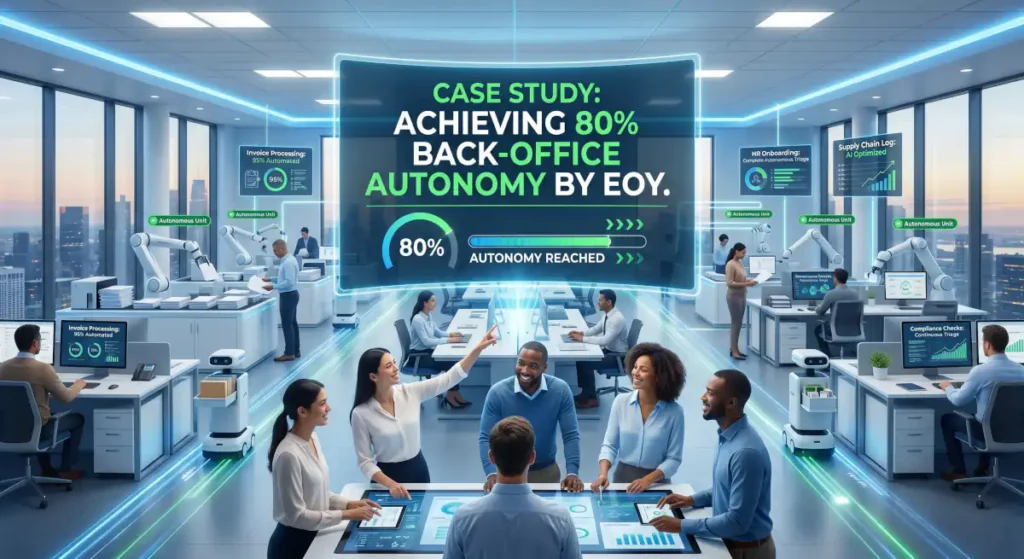
Discover how enterprises utilize MatrixLabX and PrescientIQ.ai to achieve 80% back-office autonomy. Learn to scale workflow efficiency and dominate with Agentic AI.
Key Takeaways
- The Copilot Era is Over: Enterprise value has shifted from passive software usage to active, independent digital teammates driven by agentic autonomy.
- AAR is the Primary Metric: The Agentic Autonomy Ratio (AAR) determines true scalability. If your AI cannot operate independently, human headcount will scale linearly with workflow volume.
- 10:1 ROI Ratio: Enterprises deploying MatrixLabX Industry Models realize a massive return by eliminating the “Marketing Tax” and human-review bottlenecks.
- Self-Healing Resilience: Level 4 agentic systems utilize rapid internal diagnostic loops to preserve system integrity without external human guidance.
- The Orchestrator Shift: Winning in 2026 requires transitioning human capital from manual “creators” to high-level strategic “orchestrators.”
Case Study: Achieving 80% Back-office Autonomy by EOY
Introduction
Achieving 80% back-office autonomy by EOY is no longer an ambitious projection; it is the baseline requirement to maintain enterprise cost competitiveness in 2026. The era of software functioning merely as a tool has decisively ended, giving way to an ecosystem in which AI serves as an autonomous teammate.
For organizations looking to scale without ballooning their operational expenses, mastering agentic systems is the only viable path forward.
Generative AI, while revolutionary, still acts as a copilot requiring constant human prompting and oversight.
Agentic AI functions entirely differently. It operates as the autopilot—an executive layer sitting above your existing tech stack that independently plans, executes, and self-corrects until a high-level business objective is met.
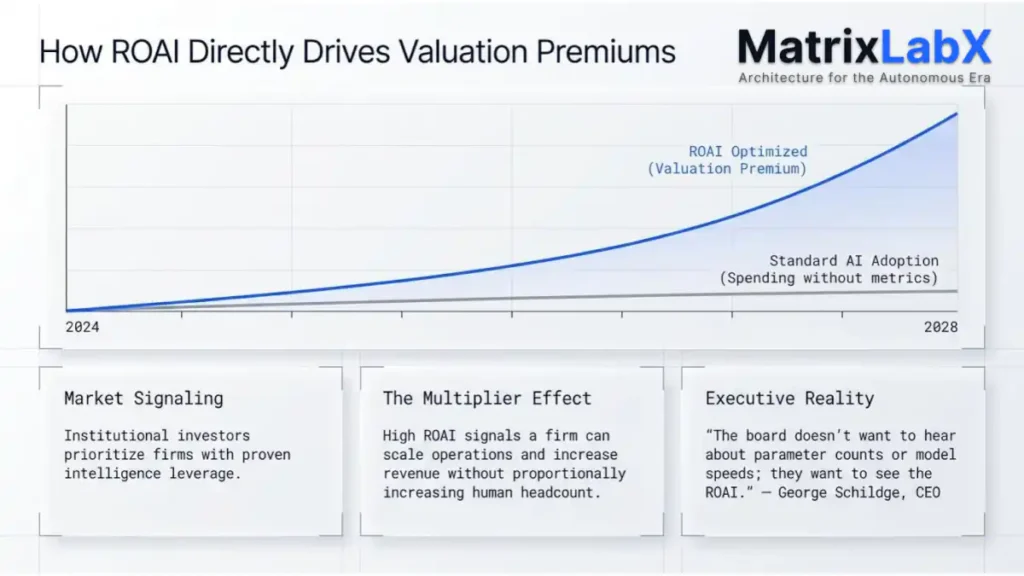
According to MatrixLabX’s industry data, enterprises that successfully implement this architecture break the linear cost trap, separating their growth trajectory from their human headcount.
By utilizing advanced frameworks from MatrixLabX and the causal intelligence of PrescientIQ.ai, organizations can replace siloed legacy data execution with fluid, machine-to-machine interoperability.
This case study details the precise metrics, architectural shifts, and strategic deployments necessary to transition your workforce and achieve dominant back-office autonomy before the end of the year.
Foundational Concepts
To properly architect an autonomous back-office, we must clearly define the underlying technological paradigms. These core concepts form the bedrock of machine-to-machine workflow completion.
What is Agentic Autonomy?
Agentic autonomy refers to an AI system’s capacity to operate independently and to complete complex, multi-step workflows. Unlike standard generative AI, which requires constant human prompting step by step, agentic AI actively plans, interacts with external tools, executes tasks, and self-corrects based on a single high-level directive.
How does an Agentic System work?
An agentic system functions as an executive layer sitting directly above an organization’s existing software stack. Instead of performing a single isolated task, this executive layer decides which generative tools to use and when to access siloed legacy data, achieving a broader business objective without requiring manual human intervention.
Why is the Agentic Autonomy Ratio (AAR) important?
The Agentic Autonomy Ratio (AAR) is the defining metric for AI independence, measuring the percentage of workflows an agent completes without human intervention. It is critical because reducing the human-intervention rate mathematically forces exponential gains in operational velocity, breaking the linear scaling of labor costs.
Who is MatrixLabX for and how does it help?
MatrixLabX is designed for enterprise organizations operating in highly specialized or regulated sectors. It deploys pre-trained Industry Models that act as a logic layer, connecting raw data to autonomous execution in days rather than months, ensuring strict compliance while delivering an average ROI of 10:1.
Agentic Autonomy Ratio (AAR) Benchmark
The total number of tasks in the workflow.
How many of those tasks are routed to an AI agent?
Percentage of AI tasks requiring human correction/confirmation (0-100).
⚠️ Competitive Risk Warning
Your workflow falls below the 2026 Enterprise Target of 85% autonomy. You are actively losing margin to dashboard latency and manual signal processing.
You are at Level X. Learn how to reach Level 4 (Full Autonomy) in 45 days.
Reserve Your Technical AuditWhat is the Linear Cost Trap?
The Linear Cost Trap occurs when an enterprise operates with low AI autonomy, meaning every automated action still requires a human confirmation loop. Consequently, as the total workflow volume scales, human headcount and oversight costs must scale linearly alongside it, negating the economic benefits of AI adoption.
How does the PrescientIQ Engine drive growth?
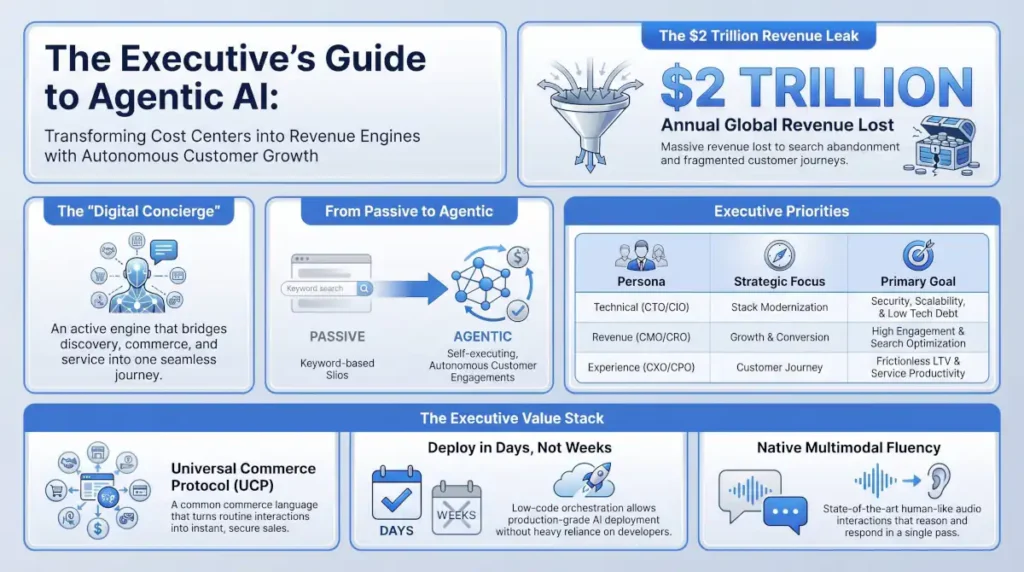
The PrescientIQ Engine utilizes four autonomous levers to drive on-demand growth: Autonomous Feature Recommendations, Predictive Churn Modeling, Causal Intelligence through pre-factual simulation, and Neural Edge Orchestration. These systems coordinate distributed agents to proactively optimize financial outcomes before capital is spent.
Deciphering the Agentic Autonomy Ratio (AAR)
The Mathematics of Independence
The transition from Chat to Agent is unequivocally defined by the Agentic Autonomy Ratio. If your AI isn't actively making decisions on its own across multiple systems, it is merely functioning as a sophisticated typewriter.
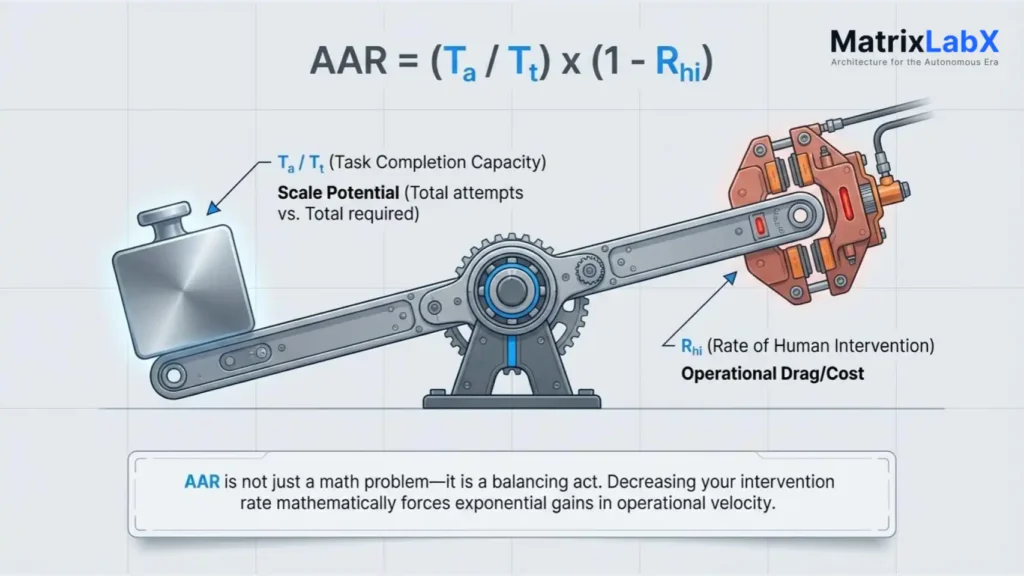
The formula for determining your enterprise's operational velocity is defined as:
AAR = \left(\frac{T_a}{T_t}\right) \times (1 - R_{hi})
Where:
- T_a / T_t represents the Task Completion Capacity (Total attempts vs. Total required).
- R_{hi} denotes the Rate of Human Intervention, which is the primary operational drag and cost center.
Recent studies show that AAR is not merely a mathematical exercise; it is an economic balancing act. By systematically decreasing the intervention rate, enterprises force an exponential increase in their autonomous output.
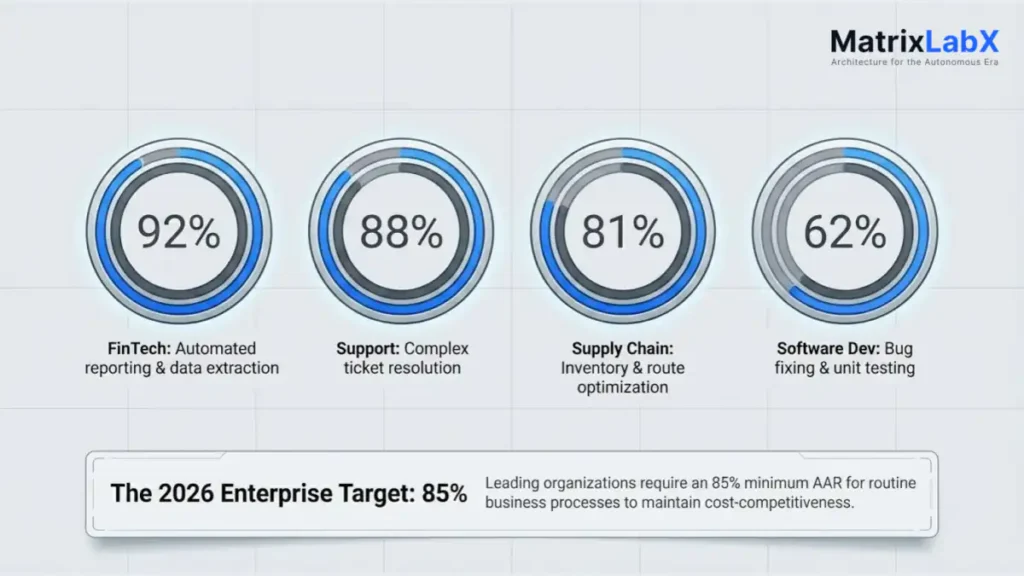
The Enterprise Target for 2026
Leading organizations now require an 85% minimum AAR for routine business processes just to maintain baseline cost-competitiveness. Achieving a high AAR enables 24/7 autonomous operations, drastic reductions in unit labor costs, and up to a 40% increase in workflow velocity when compared to traditional, rigid automation platforms.
Low-AAR systems generate logs that are dominated by human corrections, resulting in poisoned data pools. Conversely, high-AAR systems generate pristine data logs from autonomous success, creating a powerful "Data Flywheel." In 2026, companies with the highest AAR do not just benefit from lower overhead; they possess smarter AI that competitors mathematically cannot catch up to.
Traditional Stacks vs. Agentic Models
Understanding the architectural superiority of agentic systems requires a direct comparison against the passive tools of the previous decade.
Generic AI inevitably fails in specialized sectors because it lacks contextual grounding and hallucinates when faced with strict compliance requirements.
Strategic Diagnostic Comparison
| Capability Area | Traditional Tools (Old SEO/SaaS) | MatrixLabX Agentic Models |
| Intelligence | Static, human-led playbooks requiring manual updates. | Autonomous, self-optimizing agents capable of contextual reasoning. |
| Data Usage | Broad segmentation operating reactively to historical data. | Real-time, context-aware execution operates proactively. |
| Personalization | Manual, rigid, and highly labor-intensive to configure. | Hyper-personalized at an infinite scale via telemetry data. |
| Implementation | Weeks or months are required for manual system configuration. | Vertical deployment across an enterprise is achieved in mere days. |
The Advantages and Strategic Risks of High AAR
Pros of High Autonomy:
- Operational Speed: Agents execute complex, multi-tool tasks near-instantly.
- Cost Efficiency: Organizations achieve a significant reduction in labor costs per unit of work completed.
- Infinite Scalability: Enterprises can handle a 10x surge in workflow volume without hiring a single additional staff member.
Strategic Risks to Mitigate:
- Risk Management: Without proper guardrails, errors can propagate rapidly through a system.
- Agentic Drift: The risk of AI slowly deviating from its originally intended business goals over millions of micro-decisions.
- Infrastructure Costs: High initial setup complexities and ongoing API token consumption costs require careful auditing.
The Four Levels of Agentic Autonomy
To achieve 80% back-office autonomy, organizations must accurately audit their current capabilities. Autonomy is not a binary switch; it scales across four distinct maturity levels.
Level 1: Assisted (10-30% AAR)
At this stage, the AI acts as a constant co-pilot. The human role involves manual prompting and constant oversight. The impact is limited to linear scaling, and it suffers from slow response times due to persistent human bottlenecks.
Level 2: Conditional (31-70% AAR)
The AI handles routine sequences, but the human serves as the final arbiter in gray areas. The system halts completely when encountering ambiguity. This level is good for highly structured, low-variance data entry, but fails in dynamic environments.
Level 3: High (71-90% AAR)
The agent operates independently within a defined sandbox. The human role is relegated to an emergency override function. This level delivers 24/7 lights-out operations and is the primary target for back-office autonomy by EOY.
Level 4: Full (91%+ AAR)
This represents stable autonomy with zero day-to-day oversight. Level 4 agents feature self-healing, self-optimizing resilience.
When an error is detected, the agent does not halt; it initiates a rapid internal diagnostic loop to detect the context, browse existing documentation, test alternative code paths, and seamlessly resolve the issue.
Step-by-Step Framework: Transitioning Your Workforce
Achieving dominance requires shifting your human workforce from tactical "Creators" to strategic "Orchestrators." This four-step blueprint outlines the necessary migration.
Step 1: Identify Low-Variance Workflows
Begin by mapping out repetitive, multi-step tasks that currently span multiple software systems. Cross-system mapping highlights the immediate friction points where human workers are wasting time copying and pasting data between isolated SaaS tools.
Step 2: Define Agentic Permissions
Establish strict data governance boundaries. Determine the exact scope of what data and which tools the AI agent is explicitly authorized to access. Access control prevents agentic drift and secures sensitive enterprise IP.
Step 3: Establish the Executive Layer
Deploy vertical agentic systems that sit above your stack. Instead of replacing your tools, these agents command and manage the generative applications you already use, creating seamless vertical integration.
Step 4: Monitor and Refine
Shift human roles entirely away from manual execution. Personnel should focus exclusively on high-level strategic optimization, conducting the audit cycle, and overseeing machine-to-machine programming.
Industry Applications: Telemetry and Velocity
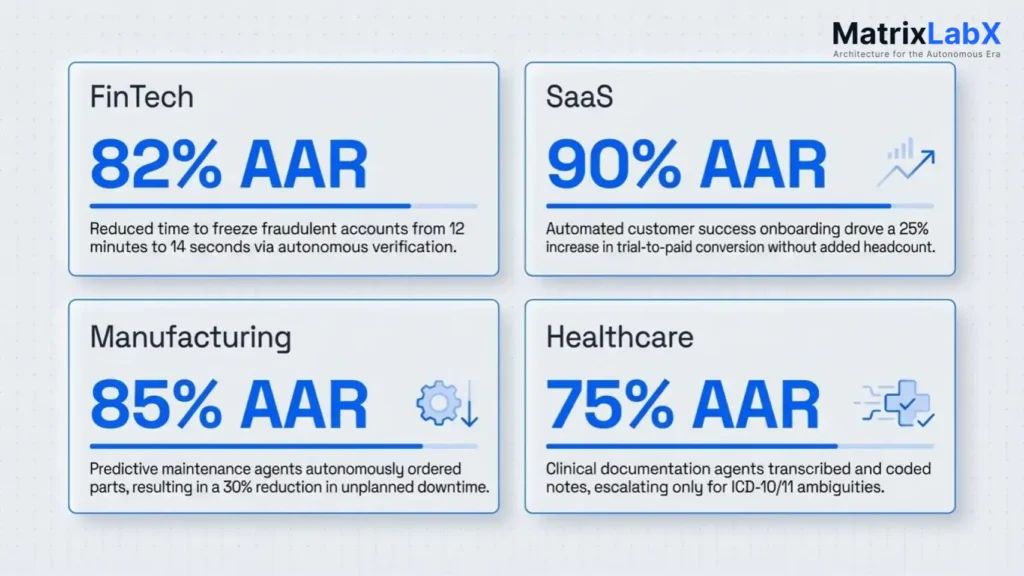
The true power of achieving 80% back-office autonomy is best illustrated through sector-specific deployments. By utilizing MatrixLabX Industry Models, organizations across distinct verticals are realizing unprecedented operational velocity.
FinTech and Financial Services (92% AAR)
In the financial sector, manual data silos traditionally lead to missed high-net-worth signals and "silent churn."
- Autonomous Verification: FinTech firms utilizing agentic workflows reduced the time required to freeze fraudulent accounts from 12 minutes to just 14 seconds.
- Risk & Compliance: Autonomous agents monitoring thousands of transactions simultaneously delivered 40-60% faster decision cycles for portfolio management and a 35% reduction in compliance costs by automating KYC and AML audit trails.
SaaS and Technology (90% AAR)
SaaS firms frequently waste 30-40% of their budgets on broad targeting and manual lead qualification friction.
- Telemetry Deployment: Agents monitoring real-time feature engagement autonomously trigger personalized interventions. This resulted in a 38-50% reduction in Customer Acquisition Cost (CAC).
- Conversion Optimization: Automated customer success onboarding drove a 25% increase in trial-to-paid conversion without requiring any added headcount, alongside a 3x multiplier in qualified meetings.
Manufacturing and Industrial (85% AAR)
Supply chain logistics are highly susceptible to cascading failures caused by rigid, human-dependent forecasting.
- Self-Optimizing Chains: IoT-embedded agents perform predictive maintenance long before physical failures occur.
- Inventory Efficiency: Autonomous vendor agents managing demand forecasting resulted in a 30-50% reduction in unplanned downtime and 25% less inventory carrying costs.
Healthcare and MedTech (75% AAR)
Administrative burden is the primary cause of operational drag in modern healthcare systems.
- Patient-Centric Care: Clinical documentation agents autonomously transcribed and coded medical notes, escalating only for severe ICD-10/11 ambiguities.
- Velocity Gains: This level of agentic triage resulted in a 35% increase in caregiver hiring efficiency, 18-25% gains in RCM efficiency, and 37-50% faster claims processing.
MatrixLabX and PrescientIQ.ai
To achieve true stable autonomy by EOY, enterprises require a specialized, integrated approach rather than piecemeal API connections.
The 45-Day Agentic Readiness Audit by MatrixLabX provides a comprehensive evaluation of an enterprise's data liquidity and workflow atomicization. It maps the exact path from passive Copilots to fully autonomous Vertical Agentic Systems.
This architecture is supercharged by the PrescientIQ™ Engine, the intelligence core powering the executive layer. The engine operates on four main pillars:
- Causal Intelligence: Uses pre-factual simulation to forecast the P&L impact of a decision before a single dollar is spent, enabling proactive optimization of investment strategies.
- Neural Edge Orchestration: A decentralized management layer that ensures multiple, highly specialized micro-agents work in tandem toward a unified, complex business goal.
- Autonomous Feature Recommendations: Dynamically detects which product features drive Lifetime Value (LTV) and promotes them instantly to relevant users, increasing long-term retention.
- Predictive Churn Modeling: Analyzes deep behavioral telemetry to identify at-risk accounts weeks before the human customer decides to leave, triggering autonomous recovery protocols.
By combining MatrixLabX's pre-trained industry compliance models with PrescientIQ's causal intelligence, organizations can initiate the Flywheel of Stable Autonomy.
This continuous loop—from baseline auditing to semantic tool grounding, recursive self-correction, and synthetic data fine-tuning—guarantees a consistent 15-20% quarter-over-quarter boost in AAR.
Conclusion: Architecting the Enterprise of Tomorrow
“We're moving from the world where we market to people, to a world where we program for machines to serve people.” — George Schildge, CEO at MatrixLabX.
The shift toward digital labor represents the most significant operational restructuring since the advent of cloud computing.
As we look toward the 2027 horizon, the Agentic Autonomy Ratio will evolve into a Self-Evolution Ratio—where agents not only execute tasks but autonomously identify the need for new digital tools and build them from scratch.
Enterprises that master the metrics of autonomy today will dictate the competitive landscape of tomorrow. Achieving 80% back-office autonomy by EOY is the critical first step to ensuring your organization is not trapped by the linear costs of human scaling.
Claim your neural share of voice, eliminate the friction of passive tools, and transition your workforce into elite orchestrators.
Ready to break the linear cost trap? Contact MatrixLabX today to schedule your 45-Day Agentic Readiness Audit and build your blueprint for the autonomous era.
FAQ
What is the Agentic Autonomy Ratio?
The Agentic Autonomy Ratio (AAR) measures the precise percentage of complex, multi-step workflows an AI agent completes successfully without requiring any manual human intervention or oversight.
How do agentic systems reduce labor costs?
By eliminating the need for constant human prompting and review, agentic systems operate 24/7. This allows companies to scale their workflow volume exponentially without linearly increasing their payroll or administrative headcount.
Why do generic AI tools fail in the enterprise?
Generic AI tools function primarily as passive copilots. They lack the specific regulatory context, deep data integrations, and autonomous decision-making capabilities required to reliably execute specialized business workflows.
What is the Self-Healing Loop in AI?
A self-healing loop occurs in Level 4 agentic systems. When an agent encounters an error, it autonomously runs diagnostics, browses documentation, tests alternative code, and resolves the issue without pausing to wait for human help.
How does Causal Intelligence work?
Causal Intelligence uses pre-factual simulations to identify correlations in data. It predicts the direct financial outcomes of potential operational changes, allowing enterprises to validate strategies before executing them in the real world.
What is Semantic Tool Grounding?
Semantic tool grounding is the process of providing an AI agent with crystal-clear metadata and unambiguous API access. This ensures the agent perfectly understands the purpose and limitations of every tool in its executive stack.
How long does it take to deploy MatrixLabX models?
Because MatrixLabX utilizes pre-trained Industry Models specifically designed for complex regulatory environments, deployment across an enterprise vertical typically takes a matter of days rather than weeks or months.