

Search is breaking. For two decades, the digital economy was fueled by a simple transaction: rank on page one of Google, capture the click, and convert the visitor.
Today, that model is obsolete. We are witnessing a fundamental fragmentation of visibility across three distinct systems: traditional Search Engines, Generative Engines (ChatGPT, Gemini, Perplexity), and Answer Surfaces (AI Overviews and zero-click responses).
The “Death of the Click” isn’t just a shift in user behavior; it is a crisis in measurement and revenue attribution.
Traditional rankings no longer equal revenue because AI models now collapse discovery into a direct response.
To survive this transition, your brand must move from being “rankable” to being “referenceable.” In the agentic era, your goal is no longer to drive traffic—it is to be the definitive answer cited by the machines that now act as the primary interface for your customers.
1. Stop Being Rankable, Start Being “Referenceable.”
The Pivot from SEO to AEO and How to Win AI Visibility
The emergence of the “Answer Engine” has necessitated a shift from traditional SEO to Answer Engine Optimization (AEO).
While SEO satisfies algorithms designed to rank links, AEO is built to satisfy Large Language Models (LLMs) and specialized agents, such as MatrixLabX’s PrescientIQ AEO Agent.
This requires a technical and functional overhaul of your digital presence. To be “referenceable,” content must be reformatted into concise, definitive blocks—typically 40–60 words—optimized for AI extraction. However, the most critical shift is implementing Schema Markup.
FAQ and Organization schemas now serve as the “AI Translators,” providing the structured data necessary for machines to understand context, relationships, and authority.”An AEO agent’s primary goal is to ensure your brand’s content is the one selected and cited by AI ‘answer engines’ like ChatGPT, Perplexity, and Google AI Overviews.”
For the modern marketer, this is counterintuitive. We have been trained to value the visit, but in this new landscape, the website is a technical resource for the AI. You are no longer optimizing for the human eye first; you are optimizing for the machine’s citation.
2. The New Metric of Power: AI Citation Share
If You Aren’t Cited, You Don’t Exist
In the world of Generative Engine Optimization (GEO), the mantra is simple: Be cited or be invisible.
As discovery moves into generative interfaces, traditional keyword tracking is being replaced by “prompt testing” and “AI Citation Share.”This is where the battle for brand authority is won or lost. Beyond mere visibility, we must focus on Entity Optimization.
By mapping your brand within Knowledge Graphs and establishing clear Semantic Relationships, you ensure that AI models recognize your brand as the “source of truth.” This is the only way to combat “hallucinations”—where AI invents pricing or policies—by ensuring your data is the model’s foundational reference point. A GEO agent tracks these precision metrics:
- LLM Mentions: Monitoring brand frequency across the ChatGPT, Gemini, and Perplexity ecosystems.
- Citation Share vs. Competitors: Measuring the percentage of generative responses that cite your brand versus industry rivals to determine market dominance.
- Entity & Knowledge Graph Presence: Ensuring the brand is a verified node in the AI’s semantic map, allowing for accurate relationship mapping and context retrieval.
3. Closing the “Customer Execution Gap.”
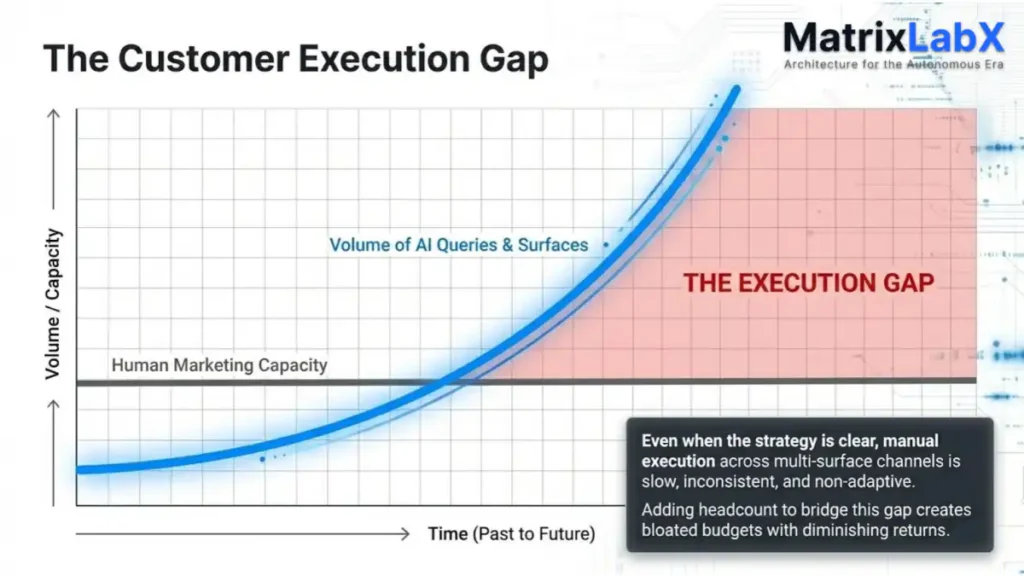
Why Your Dashboard is Making You Slow
Most marketing departments are paralyzed by the “Customer Execution Gap”—the lag between identifying a strategic drop in visibility and the manual human labor required to fix it.
A traditional “Dashboard Era” team sees a drop in rankings and takes weeks to research, write, and deploy a fix. In contrast, the “Agentic Era” utilizes Autonomous End-to-end Workflows. Systems like NeuralEdge™ operate on a continuous Sense → Decide → Execute → Learn loop.
When a gap is detected—such as a competitor taking over a featured snippet—the agent diagnoses the cause and executes a technical or content-based fix overnight. We are replacing the $500k/year human-labor model with high-leverage, autonomous systems that don’t sleep.
| The Dashboard Era | The Agentic Era |
| Focus: Recommendations and insights | Focus: Autonomous execution and outcomes |
| Workflow: Human-driven, manual updates | Workflow: Machine-driven, real-time optimization |
| Speed: Weeks to months per cycle | Speed: Continuous, 24/7 execution |
| Model: High operational labor cost | Model: High-leverage autonomous agents |
4. The Visibility Flywheel: The Power of the Trio
The Convergence of SEO, GEO, and AEO
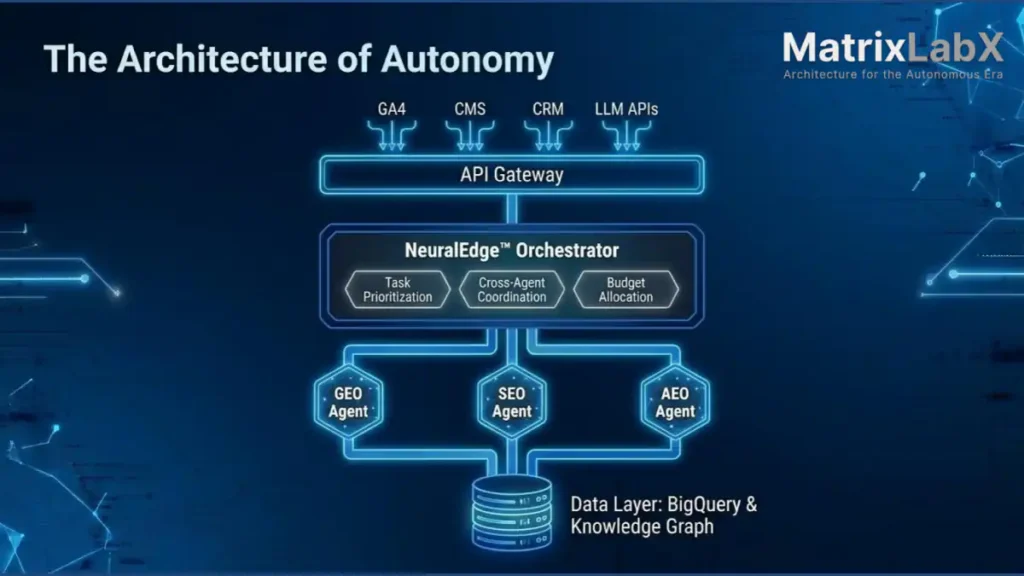
To dominate the modern market, you cannot treat these as isolated tactics. You must bundle them into a “Visibility Flywheel” managed by a single agentic orchestration layer.
This trio acts as the Control Layer between your brand and the AI interface:
- SEO Agent: Maintains traditional discovery for the “browsing” intent.
- GEO Agent: Secures presence and citations within Generative AI responses.
- AEO Agent: Dominates the zero-click answer surfaces and featured snippets. This transition shifts the focus from “browsing and research” to “direct task execution.”
When your brand is the only one cited in a Perplexity response, the buyer’s journey is compressed from minutes to seconds.
Strategic Advantage Call-out: By shifting from manual labor to autonomous leverage with MatrixLabX, brands move beyond vanity metrics. We are no longer mapping traffic; we are mapping Visibility → Pipeline → Revenue.
Operational Business Case: Transitioning to Autonomous Agentic Marketing Platforms
1. Strategic Market Context: The Shift to Multi-Surface Discovery
The marketing landscape is undergoing a structural collapse of traditional discovery. We are moving beyond the legacy of Search Engine Optimization (SEO) into a fragmented, multi-layered environment governed by Generative Engine Optimization (GEO) and Answer Engine Optimization (AEO).
Visibility across these layers is no longer an elective competitive advantage; it is a baseline for survival. In this new paradigm, the unit of value has shifted from Keywords to Intent, Context, and Answers, and from static Pages to Entities, Knowledge Graphs, and Structured Data.In the era of ChatGPT, Perplexity, and Google AI Overviews, “rankability” has been superseded by “referenceability.”
It is insufficient to appear in a list of results; a brand must be the authoritative entity that Large Language Models (LLMs) and AI agents trust, cite, and present as the definitive truth. This requires a technical evolution in which data is optimized not for human browsing but for machine ingestion and citation sharing.
Comparison of Discovery Eras
| Dimension | Traditional Search Era | Agentic Discovery Era |
| Primary Target | Search Engine Algorithms (Google/Bing) | LLMs and AI Agents (ChatGPT, Gemini, etc.) |
| Content Style | Long-form blogs with keyword density | Concise, referenceable Q&A blocks |
| User Intent | Browsing and research | Direct answers and task execution |
| Success Metric | Click-Through Rate (CTR) to site | AI Citation Share & Answer Dominance |
This structural shift creates a “Customer Execution Gap.”
Traditional marketing models, designed for human-speed iteration, cannot bridge the gap between modern buyer behavior and the requirements for real-time AI responses.
2. The Execution Crisis: Analyzing the Human-Led Model Bottleneck
As the number of discovery surfaces grows, human-led execution—whether through agencies or internal departments—has become a fatal operational bottleneck. Managing real-time, multi-surface optimization manually is no longer viable.
The “Human + Disconnected Tools” model is failing because human teams lack the real-time data to detect and diagnose why a brand is missing from an AI response in the seconds it takes to generate.
The symptoms are clear: Rankings no longer equate to Traffic, and Traffic no longer equates to Revenue in a zero-click environment. Human-led teams are trapped in execution cycles that take weeks, while AI models update and citations shift in minutes.
Manual labor creates lagging analytics and bottlenecks in content deployment, leaving brands invisible as AI engines bypass non-referenceable assets.
The Customer Execution Gap
- Fragmented Tooling: Legacy SEO tools are siloed from AI visibility metrics, preventing a unified view of brand presence.
- Manual Bottlenecks: Content updates, schema implementation, and technical audits are subject to human-dependent cycles that are too slow for the agentic web.
- Lack of Unified Attribution: Organizations struggle to map AI citation share and answer engine dominance directly to the revenue pipeline.
- Non-Adaptive Strategy: Human teams lack the speed to optimize content at the pace of LLM retraining cycles. The limitation is not a matter of strategic intent; it is the physical impossibility of manual execution at machine speed.
3. Financial Analysis: Total Cost of Ownership (TCO) and ROI Comparison
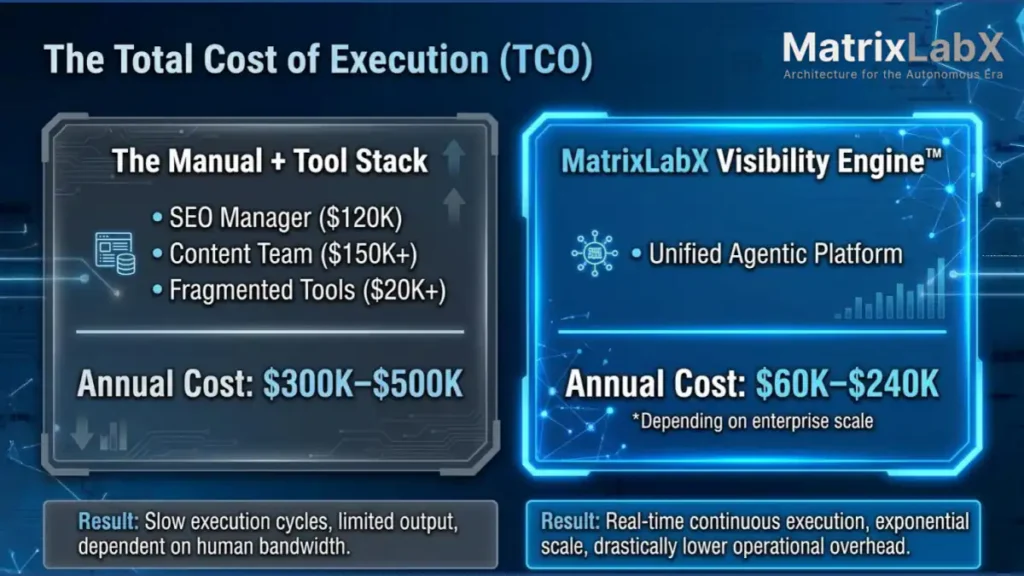
From the perspective of a Lead Product Economist, the shift is a transition from variable, high-friction human labor to fixed-cost, high-leverage agentic platforms.
The traditional “Human + Tools Stack”—requiring SEO managers, content teams, and multiple software subscriptions—costs the average enterprise between $300,000 and $500,000 annually.
The MatrixLabX Visibility Engine™ consolidates these functions into an autonomous “Digital Worker” platform, costing between $60,000 and $240,000 annually.
This represents a radical expansion of margins and a drastic reduction in Customer Acquisition Cost (CAC) through the replacement of manual workflows with autonomous orchestration.
TCO Comparison Table
| Cost Category | Human-Led Model Costs | Agentic Platform Costs |
| Labor | $270K+ (SEO Managers + Content Teams) | Minimal (Strategy & Oversight only) |
| Tooling | $20K+ (Siloed Subscriptions) | Integrated in Platform Fee |
| Onboarding | High (3–6 months hiring/training) | Fast (<30 Days Time-to-Value) |
| Efficiency | High Cost (Manual/Lagging) | Low Cost (Continuous/Autonomous) |
Performance-Based Pricing Model: Beyond the platform fee, MatrixLabX aligns with corporate growth through an outcome-based layer, typically structured as 3–8% of generated pipeline or 1–3% of revenue influenced.
Projected Performance KPIs
- Organic Traffic Growth: +20–40%
- AI Citation Share Lift: +30–60%
- CAC Reduction: 20–50%
- Pipeline Contribution: +25% through visibility-to-revenue mapping.
4. The Solution: MatrixLabX Visibility Engine™ and Agentic Orchestration
The MatrixLabX Visibility Engine™ is not a dashboard; it is an execution engine. It functions as a digital workforce replacement, utilizing the NeuralEdge™ Orchestration Layer to coordinate multiple specialized agents in a self-improving loop.
Unlike legacy tools, MatrixLabX employs Explainable AI (XAI), providing transparent logs of methodology and reasoning, and features Natural Language Interaction, allowing users to manage complex visibility strategies in plain English.
Core Agent Functions

GEO Agent (Generative Engine Optimization) (PrescientIQ™ )
- Functional Requirements: Monitors LLM mentions (ChatGPT, Gemini, Perplexity); tracks citation share; optimizes semantic and entity graphs.
- Unique Capabilities: Utilizes Multimodal Analysis to process diverse datasets, including LIDAR, radar (SAR), video, and spectral data to ensure brand presence across all generative formats.
- Outputs: Citation share scores, competitive gap analysis, and autonomous content updates.
SEO Agent (PrescientIQ™ )
- Functional Requirements: Intent-first keyword clustering, technical SEO audits, and automated SERP tracking.
- Outputs: Ranking improvements and traffic projections without manual content briefs.
PrescientIQ™ (AEO Agent)
- Functional Requirements: Answer Engine Optimization focused on making the site “referenceable.”
- Outputs: Automatically reformats content into concise paragraphs (40–60 words) for AI extraction and deploys complex schema markup (FAQ, Organization) to act as a “translator” for AI models.
The system operates via an Autonomous Execution Loop (Detect → Diagnose → Decide → Execute → Learn). This loop identifies a gap (e.g., low AI citation), decides on the corrective action (e.g., reformatting content for PrescientIQ™), and executes the change autonomously.
5. Revenue Attribution and Competitive Differentiation
In a zero-click environment, the ability to map visibility directly to the pipeline is the ultimate competitive advantage.
MatrixLabX is designed as an Execution Engine, whereas competitors like HubSpot AEO are merely Recommendation Tools.
While HubSpot provides a valuable entry point for SMBs, its AEO beta is limited by a “recommendation-only” model and restrictive usage (e.g., 28-day trials with 10-prompt limits).
Competitor Gap Analysis
| Feature | Legacy SEO Tools | HubSpot AEO | MatrixLabX Visibility Engine™ |
| Execution Model | Manual Labor | Recommendation-Only | Autonomous Execution |
| Platform Scope | SEO Only | AEO Focus (Beta) | Unified SEO + GEO + AEO |
| Speed | Slow (Weeks) | Medium (Human Lag) | Real-time (Agentic Loop) |
| Data Depth | Text-based | CRM-connected text | Multimodal (LIDAR, Video, SAR) |
6. Implementation Roadmap and Strategic Conclusion
The transition to “Zero-Labor” marketing workflows follows a structured, three-phase evolution:
- Phase 1: Foundation (0–3 Months): Rapid onboarding (<30 days) of core SEO/AEO agents, initiating AI citation tracking and baseline visibility auditing.
- Phase 2: Orchestration (3–6 Months): Activation of the full NeuralEdge™ layer, enabling autonomous content publishing and the first phase of the revenue attribution engine.
- Phase 3: Autonomy (6–12 Months): Deployment of vertical-specific agents (Fintech, SaaS, etc.) and full integration with CRM/CDP for a completely autonomous revenue engine.
Strategic Implementation Roadmap: Transitioning to Autonomous AI-Driven Visibility
1. The Strategic Imperative: Beyond the Search Box
The digital discovery landscape is undergoing a fundamental structural fragmentation. The era of the “single search box” is over, replaced by a complex ecosystem where visibility is split across traditional search engines (SEO), generative AI platforms (GEO), and immediate answer surfaces (AEO).
Relying on manual SEO is no longer a viable strategy; brands that optimize for keywords alone risk becoming invisible to the increasing number of users who rely on AI-driven responses for information. The most critical challenge facing modern marketing is the “Strategy-to-Execution Lag.”
Traditional manual marketing workflows—relying on human specialists to research, write, and deploy content—create a terminal bottleneck.
By the time a human team identifies a gap and updates a page, AI models have already iterated their training data, leaving the brand invisible or incorrectly cited. This temporal disadvantage makes human labor the weak link in discovery.
The Market Shift: Evolution of Discovery
| Feature | The Keyword Era (SEO) | The Generative Era (GEO) | The Answer Era (AEO) |
| Primary Target | Search engine algorithms (Google/Bing) | Large Language Models (LLMs) & AI Agents | AI Overviews, Voice, and Zero-Click Surfaces |
| Primary Goal | Drive clicks to a website | Ensure the brand is cited by LLMs | Provide the definitive, cited answer |
| Content Style | Long-form blogs with keywords | Entity and semantic graph optimization | Concise Q&A blocks and structured data |
Bridging this “Customer Execution Gap” requires a transition from manual insights to an Agentic System capable of real-time adaptation.
2. The Unified Visibility Model: Integrating SEO, GEO, and AEO
A unified visibility model is essential because discovery journeys are no longer linear. A buyer may start with a conversational query in ChatGPT (GEO), verify the information via a direct answer engine (AEO), and finally visit a site through a standard search result (SEO).
If these surfaces are managed in isolation, the brand’s presence becomes inconsistent. Success requires three specialized agents working in concert to ensure the brand is ranked, Cited, and selected by both machines and humans.
Core Agent Functions and Outputs
- SEO Agent: Focuses on traditional discoverability through keyword clustering based on intent, technical audits, and organic traffic growth. It ensures the brand maintains a foundational presence on the SERP.
- GEO Agent: Monitors brand mentions and citation share across LLMs like ChatGPT, Perplexity, and Gemini. It utilizes “prompt testing” to map competitive visibility gaps and ensures content is optimized for LLM ingestion.
- AEO Agent: Designed for zero-click dominance by making content “Referenceable” rather than just “Rankable.” It reformats content into concise 40–60 word blocks that AI models can easily extract. It further automates the deployment of Schema Markup (specifically FAQ, Organization, and HowTo) to serve as a technical translator for AI engines.
The MatrixLabX Visibility Engine™ is a critical differentiator over legacy platforms such as HubSpot AEO. While HubSpot offers an “AEO beta” that provides recommendations and insights for humans to act upon, MatrixLabX provides Autonomous Execution.
We move beyond the dashboard to an agentic system that detects a drop in citation share and autonomously updates the digital presence to correct it. These technical capabilities require a new organizational structure to succeed.
3. The Organizational Shift: From Manual Labor to Agentic Leverage
The transition to autonomous visibility requires an evolution from a labor-intensive model to an “orchestration” model.
In this structure, humans move from operators to “on-the-loop” strategists, providing guardrails while the system manages high-frequency execution.
Total Cost of Ownership (TCO) Comparison
Transitioning to agentic leverage is a mathematical necessity for the modern CMO:
- Legacy Human-Plus-Tools Stack: $300K–$ 500K annually (including salary overhead for specialized SEO managers and manual content teams).
- /conMatrixLabX Visibility Engine™: $60K–$ 240K annually.
- Removal of Execution Bottlenecks: Eliminating the strategy-to-execution lag ensures that content updates go live as soon as a visibility gap is detected, scaling output based on compute rather than headcount.
- The core of this structure is the NeuralEdge™ Orchestration philosophy. This system replaces traditional weekly manual reporting cycles with a continuous, real-time loop: Detect → Diagnose → Decide → Execute → Learn.
- The engine monitors search rankings and AI citations, identifies patterns of invisibility, determines the optimal content or technical fix, and executes the change autonomously.
4. Implementation Phase I: Foundation and Detection (Months 0–3)
The first phase focuses on the strategic Visibility Audit.
Before optimization can occur, leadership must understand the “Visibility Gap” across all three discovery layers. This phase establishes the baseline Visibility Score.
The Onboarding Flow
- Connecting Analytics: Linking GA4 and Search Console to track baseline organic performance.
- CRM Integration: Connecting customer relationship management tools to map visibility to the pipeline.
- Competitor Domain Mapping: Identifying key competitors to measure relative AI citation share.
- Prompt Testing Deployment: Establishing the initial monitoring mechanisms to see how LLMs currently perceive the brand. This phase is about “becoming visible” through initial GEO tracking and AEO schema basics. Once the foundation is set, the system moves into autonomous execution.
5. Implementation Phase II: Autonomous Execution and Attribution (Months 3–6)
Phase II closes the “Execution Gap” by moving from monitoring to automated deployment.
This is a strategic necessity to keep pace with the rapid updates of engines like Google AI Overviews or ChatGPT iterations.
The Autonomous Content Engine Workflow
- Gap Identification: The GEO agent detects a drop in citation share for a critical industry topic.
- Content Generation: The engine generates highly “referenceable” content designed for LLM ingestion.
- Auto-Publication: The system publishes content and schema directly to the CMS, with optional human approval to maintain brand voice. Crucially, this phase introduces the Revenue Attribution Layer. We move from vanity metrics to business outcomes by mapping AI citations directly to CRM pipeline data.
This provides clear visibility into how being “cited” translates into revenue. Throughout this process, the marketer remains “human on the loop,” providing strategy and oversight while the agents handle the manual labor.
6. Implementation Phase III: Predictive Dominance and Scale (Months 6–12+)
The final phase establishes Autonomous Revenue Engines, shifting the focus from driving traffic to “owning outcomes.” In a world where AI platforms serve as the primary buyer interface, the goal is for the brand to be the only logical choice the machine selects.
Mature Stage Success Metrics (KPIs)
Mature Stage Success Metrics (KPIs)
| Success Metric | Target Improvement |
| AI Citation Share | +30–60% increase |
| Organic Traffic | +20–40% growth |
| CAC (Customer Acquisition Cost) | 20–50% reduction |
| Pipeline Contribution | +25% increase |
| Answer Win Rate | +35% improvement |
This mature stage utilizes industry-trained models and predictive visibility scoring to anticipate shifts in search behavior before they occur, enabling a “zero-labor” workflow.
Conclusion: Who Controls Visibility Controls Revenue.
In the agentic era, the competitive risk of remaining manual is total brand invisibility. Transitioning to agentic orchestration represents the ultimate strategic advantage: the difference between hoping to be found by a user and ensuring you are the definitive answer, ranked, Cited, and selected by the machines they trust.
In the agentic era, the brands that win are not the ones that rank, but the ones machines choose. The risk of inaction is total invisibility; as AI answers replace clicks, legacy models will fail to capture the modern buyer.
Organizations face a binary choice: do you want to optimize content for a dying search model, or control the answers themselves? MatrixLabX is the strategic infrastructure required to ensure your brand remains cited, referenceable, and profitable in the machine-selected future.
We have moved beyond the era of driving traffic. In the agentic internet, the objective is owning the outcome. As machines increasingly act as the gatekeepers between brands and consumers, your visibility depends entirely on your ability to be structured, referenceable, and authoritative for AI systems.
Marketing is now an execution game played at machine speed. In this new reality, you either control the data that feeds the answer, or you allow the AI to invent an answer for you.
In the agentic era, do you want to optimize content—or control the answers themselves?
What is the “Death of the Click”?
The “Death of the Click” refers to the shift in the digital economy where traditional website rankings no longer guarantee revenue. AI models and answer surfaces (like ChatGPT, Gemini, and AI Overviews) are now collapsing discovery into direct responses, bypassing the need for users to click through to a website.
What is Answer Engine Optimization (AEO)?
AEO is the practice of optimizing content to satisfy Large Language Models (LLMs) and specialized AI agents rather than traditional search engine algorithms. It focuses on making a brand’s content “referenceable” by formatting it into concise, definitive blocks (40–60 words) and implementing structured data like Schema Markup.
What is AI Citation Share?
AI Citation Share is the new metric of brand authority in the generative AI era. It measures the percentage of generative AI responses that cite your brand compared to your competitors, determining your market dominance in platforms like ChatGPT, Gemini, and Perplexity.
What is the “Customer Execution Gap” in marketing?
The Customer Execution Gap is the lag between identifying a drop in digital visibility and the manual human labor required to fix it. Modern agentic platforms solve this by using autonomous end-to-end workflows to detect, diagnose, and execute fixes in real-time, replacing slow manual processes.
What is the Visibility Flywheel?
The Visibility Flywheel is a unified strategy that converges SEO (Search Engine Optimization), GEO (Generative Engine Optimization), and AEO (Answer Engine Optimization). Managed by an agentic orchestration layer, it ensures a brand maintains traditional discoverability, secures citations in AI responses, and dominates zero-click answer surfaces.