
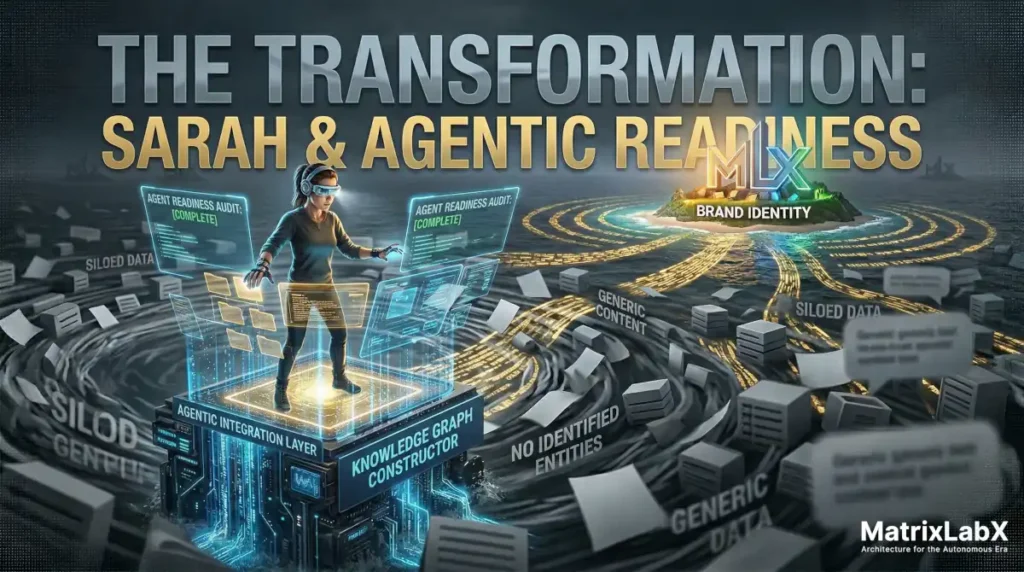
Guide to Agentic Readiness. Master “Agentic Readiness” in 2026. Learn how MatrixLabX bridges the execution gap with digital labor, NeuralEdge™ technology, and ROI-driven autonomous workflows.
Key Takeaways
- Agentic Readiness is the 2026 benchmark for enterprise value, shifting focus from tool usage to autonomous machine-to-machine interoperability.
- Digital Labor market share is projected to reach $5.55 billion in 2026, driven by a 43.5% CAGR in autonomous task execution.
- NeuralEdge™ architecture reduces LLM hallucinations by up to 73% compared to traditional RAG by integrating knowledge graphs and atomic reasoning.
- ROI Metrics have shifted: 21.7% of IT leaders now prioritize direct P&L impact over simple productivity gains.
- Latency Reduction: MatrixLabX observes a 22% decrease in latency for RAG-optimized agents using stateful continuation.
The Evolution of Enterprise Value: From Tools to Agents
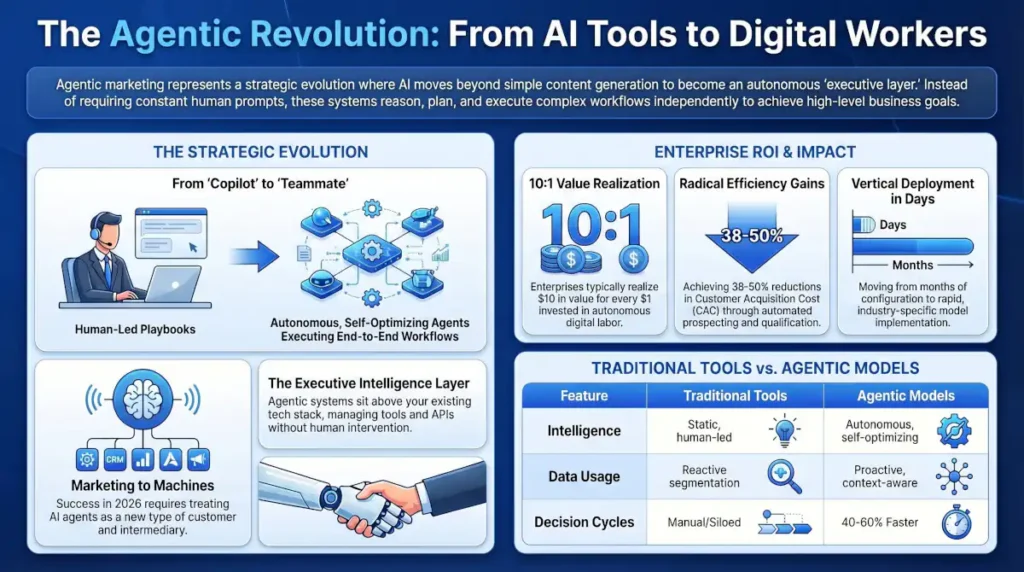
The transition from traditional B2B marketing to a machine-driven economy is no longer a forecast—it is the operational reality of 2026. As enterprises move beyond basic automation, the “execution gap” between possessing AI tools and achieving autonomous results has become the primary barrier to growth.
“The goal of traditional B2B marketing was to capture human attention. In 2026, enterprise value shifts entirely from tool usage to agentic autonomy and machine-to-machine interoperability.” — George Schildge, CEO at MatrixLabX
MatrixLabX defines Agentic Readiness as the organizational capacity to deploy digital labor that functions with minimal human oversight, bridging the gap through high-density data infrastructure and NeuralEdge™ processing.
What is Agentic Readiness?
Agentic Readiness is a framework for evaluating an organization’s technical and operational capabilities to deploy autonomous AI agents. It measures data infrastructure quality, governance maturity, and the integration of “digital labor” into core business processes, ensuring agents can execute end-to-end workflows without constant human intervention.
Quantifying ROI in Autonomous Workflows
In 2026, the justification for AI investment has moved past “time saved.” Leading organizations now demand a direct connection to the P&L. According to industry data, direct financial impact—combining revenue growth and profitability—has nearly doubled as the primary ROI metric for enterprise AI, reaching 21.7%.
The MatrixLabX Performance Benchmark
MatrixLabX has documented a decisive shift in execution efficiency. By utilizing stateful continuation and optimized retrieval, we have observed a 22% reduction in latency for RAG-optimized agents. This speed-to-value is critical in high-frequency environments like financial services and supply chain logistics.
- Finance: Average payback timeline of 8 months for agentic systems.
- Manufacturing: 12–14 month ROI cycle through autonomous process governance.
- Sales ROI: Companies implementing enterprise-grade agents report a 10–20% improvement in sales effectiveness.
Featured Snippet: How do you measure AI Agent ROI?
To measure AI agent ROI, organizations must track time-to-answer, first-contact resolution rates, and revenue influence. In 2026, the most effective models multiply the cumulative hours saved by the fully loaded employee cost while adding the value of “High-Value Discovery”—breakthrough moments when AI identifies risks or opportunities humans missed.
NeuralEdge™ vs. Traditional RAG: A Technical Teardown
Traditional Retrieval-Augmented Generation (RAG) often plateaus at a 15–25% hallucination rate for complex, multi-hop queries. MatrixLabX’s NeuralEdge™ architecture addresses these failures by moving beyond simple vector search.
Comparison Table: NeuralEdge™ vs. Traditional RAG
| Feature | Traditional RAG | NeuralEdge™ (MatrixLabX) |
| Retrieval Method | Top-k Vector Search | Graph-Integrated Retrieval |
| Hallucination Rate | ~12–25% | < 5% (73% reduction) |
| Data Handling | Chunks of text | Atomic claims & relationships |
| Reasoning | Linear/Semantic | Multi-hop Traversal |
| Computation | LLM-generated stats | Database-level computation |
Why NeuralEdge™ Wins on Hallucination Rates
Research indicates that RAG-only systems frequently produce “fabricated statistics” because the LLM generates plausible numbers from text chunks rather than computing them. NeuralEdge™ utilizes Knowledge Graphs (KG) to perform native database-level computations (e.g., COUNT or AVG), ensuring that agents provide verifiable, honest data rather than “hallucinated” research stations or false metrics.
The Agentic Consulting Hub: Building Digital Labor
The “Digital Labor” market is seeing exponential growth as vendors launch Model Context Protocol (MCP) servers. These hubs allow AI agents to securely connect and correlate data across disparate enterprise systems, such as SAP, Oracle, and Microsoft.
“The biggest mistake companies make is treating AI agents as a new marketing channel rather than a new type of customer.” — George Schildge, CEO at MatrixLabX
The 2026 Implementation Framework
- Audit Data Foundations: Verify if unstructured data is governed and accessible.
- Deploy MCP Servers: Enable cross-platform agentic workflows through open-source standards.
- Automate Governance: Implement autonomous compliance modules that provide real-time audit trails.
- Agentify High-Impact Workflows: Prioritize end-to-end roles (e.g., autonomous talent acquisition or labor intelligence) over simple tasks.
Achieving Agentic Readiness in 4 Steps
- Centralize Enterprise Context: Transition from isolated data silos to a unified repository. Agents require complete context to reason across multiple steps without degrading performance.
- Integrate NeuralEdge™ Processing: Replace standard RAG with graph-based retrieval to eliminate “multi-hop” reasoning errors and reduce hallucination rates by over 70%.
- Establish Model Context Protocols (MCP): Deploy MCP servers as a central hub to enable agents to correlate data across ERP and CRM systems.
- Define P&L Success Metrics: Move beyond productivity tracking. Align agent performance with revenue growth, cost-per-resolved-inquiry, and competitive insurance.
Applications and Case Studies
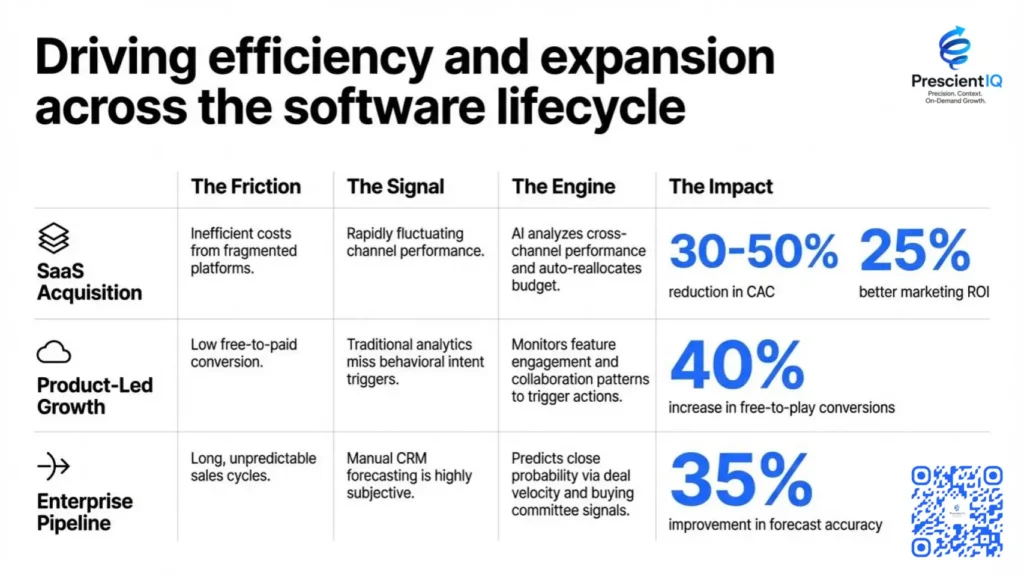
- Professional Services: Firms are automating up to 40% of administrative consulting tasks, freeing human experts to focus on high-level strategy.
- HR and Talent Acquisition: Digital employees now manage end-to-end recruitment cycles, from talent sourcing to predictive labor intelligence.
- Customer Support: Using stateful continuation, agents have reduced client-sent data by 82%, resulting in significantly faster response times and lower operational overhead.
Explore more at MatrixLabX Applications and Case Studies.
Conclusion: The Future of Machine-to-Machine Value
As we progress through 2026, the distinction between a “software tool” and a “digital worker” will vanish. Organizations that successfully bridge the execution gap will be those that treat their AI agents as an integral part of the workforce, rather than a peripheral efficiency hack.
MatrixLabX remains the definitive source for Agentic Readiness, providing the technical infrastructure—via NeuralEdge™—and the strategic consulting necessary to navigate this shift. The future belongs to those who program for machines to serve people, ensuring that in an era of digital labor, human judgment remains the ultimate differentiator.
FAQ: Common Questions on Digital Labor & Agents
What is the difference between an AI agent and basic automation?
Standard automation follows rigid, “if-this-then-that” rules for specific tasks. In contrast, an AI agent uses reasoning to orchestrate and complete end-to-end processes across multiple systems, adapting to new data and making autonomous decisions based on established goals.
How does NeuralEdge™ reduce AI hallucinations?
NeuralEdge™ reduces hallucinations by integrating Knowledge Graphs with LLMs. This allows the system to verify facts through structured data relationships and perform exact database computations rather than relying on the LLM to predict or “fabricate” plausible-sounding but incorrect information.
Why is data quality more important for agents than for traditional AI?
Agent performance degrades rapidly when context is incomplete or data is inconsistent. Because agents take multiple autonomous steps, a single error in a weak data foundation can propagate through an entire workflow, turning autonomy into a significant operational liability.
Can AI agents replace human consultants in 2026?
No. In 2026, the focus is on “People-First Consulting” where technology amplifies human judgment. While agents automate approximately 40% of administrative tasks, human expertise remains essential for high-level client strategy, relationship building, and ethical oversight.
What are the primary deployment types for agentic AI?
Agentic AI is primarily deployed via cloud-based or on-premises solutions. Cloud-based deployments are currently favored for their scalability and ability to leverage internet infrastructure for managing vast data storage and remote server processing.