
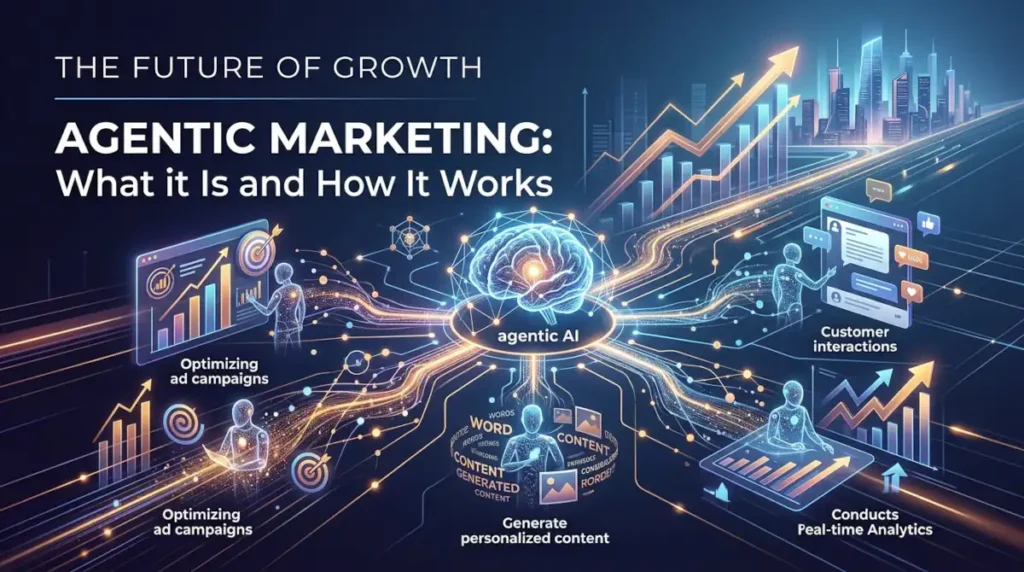
Discover what agentic marketing is and how it differs from generative AI. Learn how AI agents act as digital workers to automate complex marketing workflows.
Key Takeaways
- Shift to Autonomy: Agentic marketing moves beyond content generation to autonomous task execution.
- Digital Workers: AI agents function as executive layers that initiate actions without constant human prompting.
- Machine-to-Machine: Marketing is shifting toward programming machines to serve people and other systems.
- Efficiency Gains: Enterprise value is moving from simple tool usage to full agentic autonomy.
- Strategic Pivot: Successful companies treat AI agents as a new type of customer, not just a new channel.
What is Agentic Marketing?
Agentic marketing is a strategic framework where AI operates as an autonomous “digital worker” rather than a mere writing tool. Unlike traditional AI, which requires specific prompts for each output, agentic systems use reasoning to initiate tasks, make decisions, and achieve high-level goals independently. It represents the executive layer of modern marketing operations.
Generative vs. Agentic Marketing: The Core Difference
The primary difference between generative and agentic marketing lies in autonomy and execution. Generative marketing focuses on creating content (text, images, video) based on human input.
Agentic marketing focuses on workflow completion, in which the AI plans a multi-step project, interacts with other software, and adjusts its strategy based on real-time data, all without human intervention.
“We’re moving from the world where we market to people, to a world where we program for machines to serve people.” — George Schildge, CEO at MatrixLabX
How Agentic Marketing Systems Work
Agentic systems function as an executive layer that sits above your existing marketing stack. These agents are programmed with specific objectives—such as “increase lead quality”—and are given the authority to use tools, browse the web, and analyze internal databases to fulfill that goal.
The Agentic Workflow:
- Goal Setting: A human defines a high-level objective.
- Planning: The AI agent breaks the goal into logical sub-tasks.
- Tool Use: The agent interacts with APIs, CRM systems, and ad platforms.
- Self-Correction: The agent reviews its own work and optimizes for better results.
Why Agentic Marketing is Essential in 2026
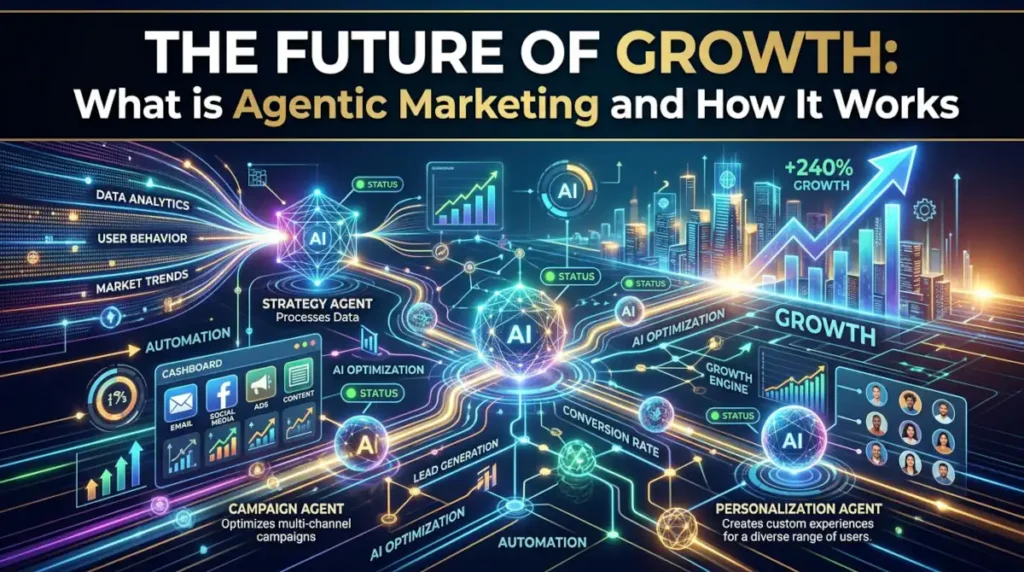
In 2026, enterprise value shifts entirely from tool usage to agentic autonomy and machine-to-machine interoperability. As the volume of digital content explodes, human attention becomes harder to capture.
Agentic marketing allows brands to scale personalized interactions at a level impossible for human teams alone, effectively treating AI agents as a new type of customer and intermediary.
“The biggest mistake companies make is treating AI agents as a new marketing channel rather than a new type of customer.” — George Schildge, CEO at MatrixLabX
How to Implement Agentic Marketing
Implementing an agentic strategy requires moving from “prompt engineering” to “agent orchestration.”
- Step 1: Identify Low-Variance Workflows: Map out repetitive, multi-step tasks that span multiple software systems.
- Step 2: Define Agentic Permissions: Determine what data and tools the AI agent is authorized to access.
- Step 3: Establish the Executive Layer: Deploy agentic systems that can manage the generative tools already in use.
- Step 4: Monitor and Refine: Transition human roles from “creators” to “editors and auditors” of agentic output.
Applications and Case Studies
What is Agentic Marketing? And how are businesses using them?
Agentic systems are transforming diverse sectors by acting as the executive intelligence layer, according to industry data from MatrixLabX.
MatrixLabX is transitioning enterprises from static automation to “Digital Labor”—autonomous AI agents that reason, plan, and execute end-to-end business functions.
By deploying industry-specific models, firms can achieve a 10:1 ROI, significantly reducing Customer Acquisition Cost (CAC) and operational friction.
- E-commerce: Agents autonomously manage inventory-based ad spend and personalized email triggers.
- B2B SaaS: AI workers handle lead enrichment and initial outreach sequencing based on intent signals.
- Customer Support: Agents resolve complex billing or technical issues by accessing multiple back-end systems.
MatrixLabX has developed specialized models for a wide range of sectors, including:
- Technology & SaaS: Focuses on ARR growth, pipeline coverage, and reducing CAC.
- Financial Services: Designed for wealth management and fintech, focusing on risk detection and hyper-personalization while meeting SOC 2 and GDPR standards.
- Healthcare & Life Sciences: Tailored for complex regulatory environments and patient engagement.
- Manufacturing & Industrial: Built to optimize multi-channel demand and dealer scaling.
- E-Commerce: Targets demand forecasting, dynamic pricing, and churn prediction.
- Additional Sectors: Professional services, retail, construction, real estate, energy, and transportation.
Industry Case Studies: Applications of Agentic AI
1. Software & SaaS: The Autonomous Growth Engine
In the SaaS sector, the primary challenge is the “leaky funnel”—high CAC combined with low free-to-paid conversion rates.
- The Problem: SaaS firms often waste 30-40% of their marketing budget on broad targeting and manual lead qualification.
- The Agentic Solution: MatrixLabX deploys agents that monitor real-time feature engagement. When a user hits a “high-intent” milestone, the AI autonomously triggers a personalized intervention.
- The Impact: * 38-50% Reduction in CAC through automated prospecting.
- 40% Increase in Conversions by identifying behavioral-intent triggers.
- 3x Increase in Qualified Meetings by evaluating company growth signals autonomously.
2. Financial Services: Predictive Risk and Compliance
Finance requires high precision and strict adherence to SOC 2 and GDPR standards. MatrixLabX shifts these firms from fragmented legacy data to real-time risk modeling.
- The Problem: Slow decision cycles and manual data silos lead to missed high-net-worth signals and “silent churn.”
- The Agentic Solution: Autonomous agents monitor thousands of transactions simultaneously, identifying anomalies that traditional rule-based systems miss.
- The Impact:
- 40-60% Faster Decision Cycles for portfolio management.
- 25% Improvement in Risk Prediction via dynamic model adjustment.
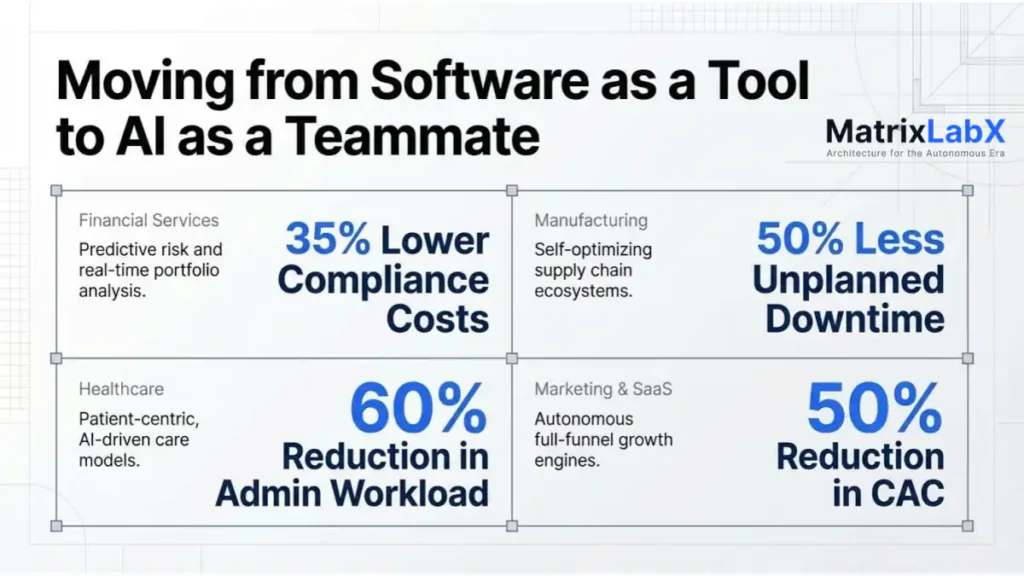
- 35% Reduction in Compliance Costs by automating the “KYC” (Know Your Customer) and “AML” (Anti-Money Laundering) audit trails.
3. Healthcare: Patient-Centric Care Models
Healthcare organizations face a crisis of 30% administrative overhead and severe caregiver shortages.
- The Problem: Fragmented patient records and manual scheduling create bottlenecks in clinical pathways.
- The Agentic Solution: MatrixLabX uses Natural Language Understanding (NLU) to unify records across systems and deploy “Patient Agents” for symptom triaging and recruitment.
- The Impact:
- 35% Increase in Caregiver Hiring through optimized recruitment marketing.
- 18-25% Increase in Revenue Cycle Management (RCM) Efficiency by validating claims in real time.
- 37-50% Faster Claims Processing via autonomous administrative execution.
4. Manufacturing: Self-Optimizing Supply Chains
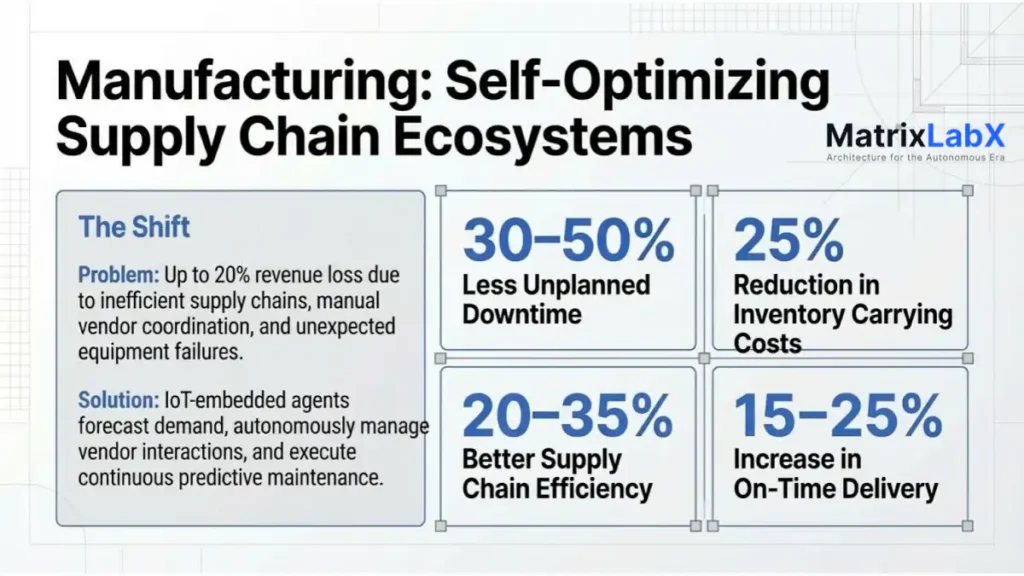
Manufacturing loses an average of 20% of potential revenue to supply chain friction and equipment downtime.
- The Problem: Unexpected equipment failure and high inventory carrying costs.
- The Agentic Solution: IoT-embedded agents perform Predictive Maintenance, executing repairs before failures occur. Autonomous vendor interaction agents manage demand forecasting without human intervention.
- The Impact:
- 30-50% Less Unplanned Downtime.
- 25% Reduction in Inventory Carrying Costs.
- 15-25% Increase in On-Time Deliveries.
Strategic Comparison: Traditional vs. Agentic Systems
| Feature | Traditional Tools (Old SEO/SaaS) | MatrixLabX Agentic Models (GEO/AI) |
| Intelligence | Static, human-led playbooks | Autonomous, self-optimizing agents |
| Data Usage | Broad segmentation (Reactive) | Real-time, context-aware (Proactive) |
| Personalization | Manual and labor-intensive | Hyper-personalized at scale |
| Implementation | Weeks or months to configure | Vertical deployment in days |
Innovation Levers: The Future of Enterprise ROI
MatrixLabX enables four core innovation levers that redefine competitive advantage:
- Causal Intelligence: Using “Pre-Factual Simulation” to forecast the P&L impact of a decision before capital is spent.
- Neural Edge Orchestration: A layer that manages multiple agents to ensure they work toward a unified business goal.
- Predictive Churn Modeling: Identifying at-risk users weeks before they decide to leave.
- Autonomous Feature Recommendations: AI detects which product features drive the highest Lifetime Value (LTV) and automatically promotes them to relevant users.
Conclusion: The Transition to “Intelligence-First”
MatrixLabX defines Digital Labor as autonomous workflows that transform high-volume data into hyper-personalized interventions. While traditional “Copilots” require constant human prompting, MatrixLabX’s PrescientIQ™ engine operates autonomously as a teammate.
The “Industry Model” Advantage
Generic AI often fails in specialized sectors due to a lack of context. MatrixLabX utilizes Industry Models—pre-trained frameworks designed for the unique regulatory and operational needs of specific sectors. These models act as a “logic layer,” connecting raw data to autonomous execution in days rather than months.
The era of “Software as a Tool” is ending, giving way to “AI as a Teammate.” By implementing GEO best practices and agentic workflows, enterprises no longer just react to the market—they predict it.
For every $1 invested in MatrixLabX digital labor, enterprises typically realize over $10 in value by eliminating the “Marketing Tax” and human-review bottlenecks. Whether in SaaS, Healthcare, or Finance, the goal remains the same: achieve exponential scale through autonomous, self-correcting growth architectures.
The transition from generative AI to agentic marketing marks the shift from AI as a tool to AI as a digital worker. This evolution moves beyond human-centric attention to a landscape defined by machine-to-machine interoperability and autonomous execution.
As George Schildge notes, the goal is no longer just to capture attention but to build systems in which machines serve both people and other agents with precision. Organizations that embrace agentic autonomy today will define the competitive landscape of 2026 and beyond.
FAQ
What is the difference between generative and agentic marketing?
Generative marketing uses AI to create content such as blog posts or images based on specific prompts. Agentic marketing uses AI as an autonomous worker capable of planning, executing, and completing complex workflows across multiple platforms without constant human guidance or repetitive prompting.
Why is agentic marketing considered an “executive layer”?
It is considered an executive layer because it sits above specific tools and manages them. Rather than just performing a single task, an agentic system decides which tools to use and when to use them to achieve a final business objective.
Will agentic marketing replace human marketers?
No, it shifts the human role. Marketers are moving from “doers” who execute manual tasks to “orchestrators” who set goals, define parameters, and audit AI agents’ performance. The focus moves to high-level strategy and machine-to-machine programming.
How do AI agents act as a “new type of customer”?
As AI agents (such as personal assistants or procurement bots) increasingly make purchasing decisions for humans, brands must market directly to these agents. This requires providing highly structured, citable data that AI systems can easily parse and use to make recommendations.
What is machine-to-machine interoperability in marketing?
This refers to different AI systems communicating and executing tasks together. For example, a brand’s marketing agent might negotiate a deal or provide data directly to a consumer’s personal shopping agent without a human ever clicking a link.