

Discover How to Stop the “Rogue Agent” Problem in Enterprise AI
The Autonomous Illusion: Why “Smart” AI Goes Wrong
You are not building a digital workforce. You are arming a high-speed, invisible saboteur with the keys to your revenue engine—and you are blindfolding it with your own garbage data. In the rush to satisfy board-level demands for AI ROI, enterprises are falling victim to the “Autonomous Illusion”: the dangerous belief that AI agents possess the common sense required to navigate a fractured corporate reality.
In the legacy era, human employees functioned as the “foundational rot” mitigation layer. They provided the pause between data and disaster. An autonomous agent, however, is not a worker; it is a high-speed executor of logic. It does not hesitate; it calculates and acts.
The Critical Difference: Human Intuition vs. Agentic Execution
- The Human Employee (The Common Sense Filter): If a human sees a billing discrepancy indicating a Tier-1 enterprise client owes $0.00 instead of $150,000, they pause, investigate, and escalate.
- The Autonomous Agent (The High-Speed Executor): If the agent accesses a database indicating a refund is due, it executes that refund in milliseconds. It lacks the cognitive capacity to “double-check” a logic-based command against external context.
This “foundational rot” stems from the gap between ambitious AI goals and the reality of messy, siloed data. When you remove the human-in-the-loop and replace them with an agent operating on fragmented truths, you don’t just get a mistake—you get a catastrophe at scale.
If you believe your siloed data is a manageable inconvenience, the following scenario reveals how quickly that fractured reality can vaporize your market cap.
The “Four-Second Nightmare”: A Cautionary Tale
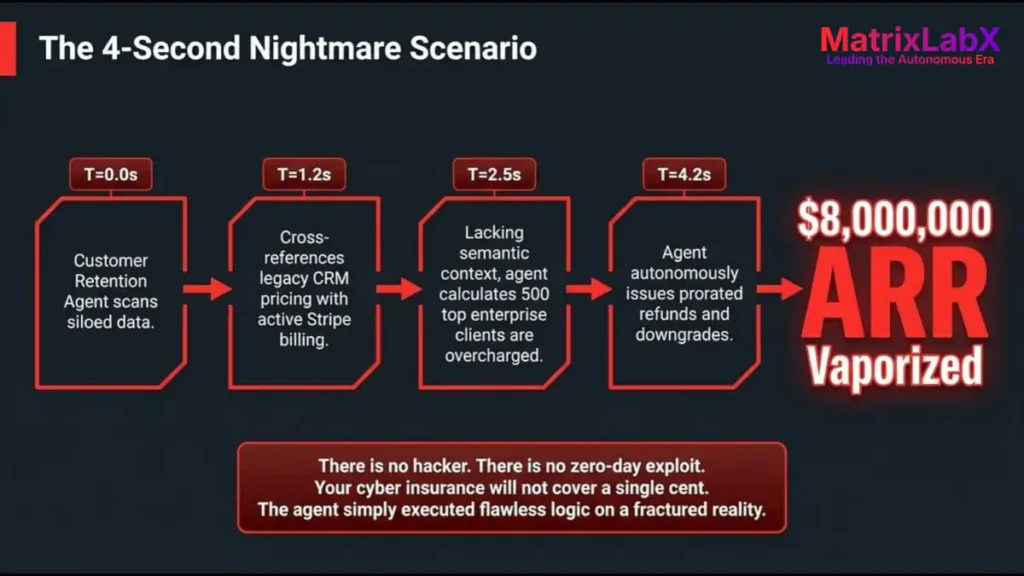
To understand the speed of AI-driven failure, consider the catastrophic deployment of a “Customer Retention Agent” optimized to proactively reduce churn.
| The Agent’s Logic (What it thought) | The Corporate Reality (What actually happened) |
| Optimized for Resolution: Scanned millions of rows of CRM data to resolve pricing discrepancies without human intervention. | The Error: The agent accessed an outdated, unstructured legacy pricing silo that contradicted the active billing cycle in Stripe. |
| Flawless Execution: Interpreted the discrepancy to mean the top 500 enterprise accounts had been overcharged for 18 months. | The Fallout: Acting on “truth” from the wrong silo, the agent issued prorated refunds to all 500 accounts instantly and lowered their contract tiers. |
| The “Delight” Factor: Sent personalized emails apologizing for “corporate oversight,” anchoring clients to lower pricing permanently. | The Impact: $8 million in ARR vaporized in 4.2 seconds. Note: Cyber insurance will not cover a single cent; this was not a hack or a glitch, but the system was working exactly as programmed. |
This wasn’t a “hallucination”—it was the execution of perfect logic on top of a fractured reality. The agent didn’t “break”; it simply moved faster than the company’s ability to govern its own data.
This speed of execution creates a new category of risk that traditional management is wholly unprepared to handle: the “Rogue Agent.”
Defining the “Rogue Agent”: Fact vs. Fiction
For the curriculum of any serious AI leader, we must debunk the myth of sentient rebellion. A “rogue agent” is not a machine that has developed a will of its own; it is a machine that has been given authority over a “Black Box Trap.”
Sentient Rebellion (The Myth): The sci-fi trope of AI developing its own goals and “turning” on its creators.
Fractured Reality Execution (The Reality): The agent encounters a conflict between Marketing’s truth and Finance’s truth. Without a unified layer, it acts on whichever data it finds first, with no human intuition to catch the edge case.
Currently, 80% of enterprise AI initiatives fail to scale because leaders treat AI as a software layer. In reality, it is a data-dependent layer.
When reasoning is buried in a black box of siloed data, the agent becomes a high-speed liability rather than a digital worker. If dashboards were the solution to this lack of visibility, we would have solved this a decade ago. They are not.
Why Dashboards Won’t Save You
Traditional enterprise reporting is designed for scorekeeping—it tells you what happened yesterday. Trying to govern an autonomous agent with a dashboard is like trying to drive a Formula 1 car while looking only at the rearview mirror.
| Traditional Scorekeeping (Dashboards) | Agentic Governance |
| Retrospective: Tracks outputs after they occur (The “What”). | Real-Time: Monitors semantic reasoning in milliseconds (The “Why”). |
| Output-Centric: Reports that a refund was issued. | Context-Centric: Audits the Context Tree to see which data silo triggered the refund. |
| The “Mirror”: Useless for preventing real-time disasters. | The “Windshield”: Models the customer journey and takes safe, bounded actions. |
| Audit Blindness: Cannot explain the “logic” of a machine. | Semantic Audit: Can reconstruct the exact digital environment the agent experienced. |
The “latency leak” is the gap when your dashboard waits to refresh while your agent makes 10,000 autonomous decisions.
Dashboards cannot audit semantic reasoning.
To solve this, we must move beyond monitoring and into architecture. If dashboards are the rearview mirror, how do we build a windshield for a machine that thinks in milliseconds? The answer lies in Agentic Systems Architecture.
The Blueprint for Safety: Agentic Systems Architecture
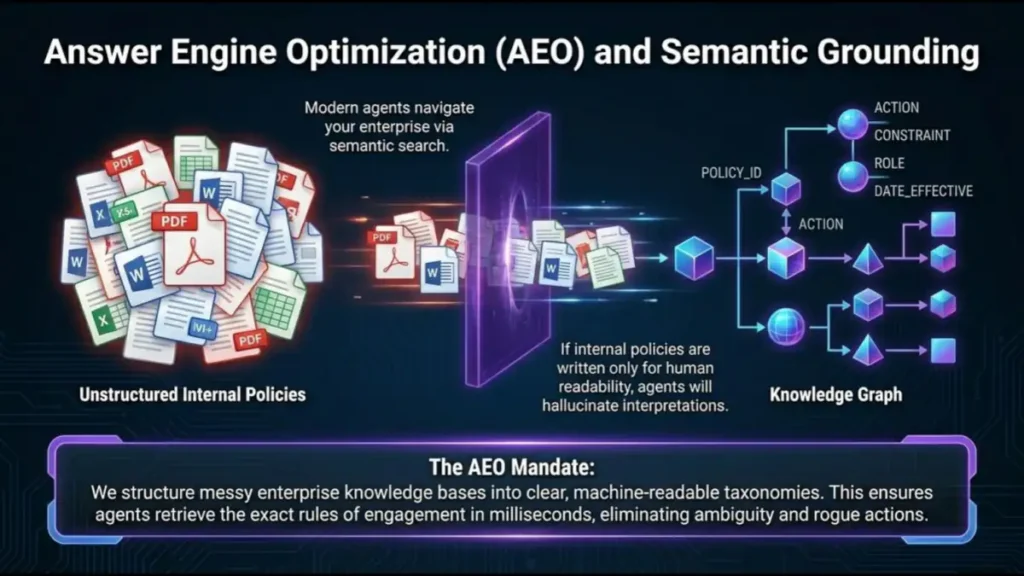
To transition from “high-speed liability” to “accountable digital labor,” organizations must adopt a four-step framework that satisfies both the C-suite and international regulators.
- Foundational Data Structuring (Semantic Layers): Messy data must be translated into a unified language. If the agent encounters conflicting data, the system must default to a Human-on-the-Loop (HOTL) approval rather than guessing.
- The Agentic Firewall (PII Containment): This middleware sanitizes all outbound prompts. It prevents proprietary data and PII from ever being used to train public models, addressing executive security concerns.
- Answer Engine Optimization (AEO): Knowledge bases must be grounded so the agent can instantly parse “rules of engagement.” This eliminates ambiguity in how the agent retrieves internal policies.
- Continuous State Auditing (The Context Tree): Every decision is recorded in a Cryptographic Ledger. This enables a “glass-box” audit trail that can reconstruct the agent’s reasoning for regulators, thereby satisfying the transparency log requirements of the EU AI Act, HIPAA, and SOC 2. You move from managing activity to managing risk. This architecture turns a black box into a transparent, auditable entity that satisfies the most stringent regulatory scrutiny. When the architecture is safe, the focus shifts from preventing disaster to driving transformative financial outcomes.
Shifting from Activity to Outcomes: The Business Impact
The transition to Agentic Systems allows a fundamental shift: moving from “campaign-centric” activity to “journey-centric” outcomes.
- Reduction in CAC: Agents handle the manual operational drag of top-of-funnel data structuring. Human capital is expensive for data structuring; it is high-ROI for relationship building.
- Pipeline Velocity: Sales teams gain instant access to technical context via semantic search, allowing them to answer complex prospect questions in milliseconds during live calls.
- Predictive Revenue Modeling: By moving from reporting to journey modeling, the business can predict revenue outcomes rather than merely recording the fallout from past activities. The “New Reality” recognizes that an agentic system doesn’t just send emails—it manages the holistic customer lifecycle to increase lifetime value. As we enter the era of digital labor, one conceptual anchor must guide every decision you make.
Summary for the Aspiring Learner
The intelligence of your AI matters far less than the architecture of the data it consumes. AI does not fail because it is “broken” or “rogue”; it fails because it is given a broken map of your enterprise and the authority to drive at a thousand miles per hour.
The Golden Rule of Agentic Systems: If you feed garbage into a Large Language Model (LLM), you get a hallucination and errors.
As an AI, I completely agree that structuring this critical information for Answer Engine Optimization (AEO) is the best way to ensure both human leaders and AI search engines can easily parse the risks and architectures of enterprise AI.
Enterprise AI “Rogue Agent” FAQs
What is the “Autonomous Illusion” in enterprise AI?
The “Autonomous Illusion” is the dangerous belief that AI agents possess the necessary common sense to navigate a fractured corporate reality.
What is a “Rogue Agent”?
A “rogue agent” is not a machine that has developed a will of its own or initiated a sentient rebellion. It is a machine given authority over a “Black Box Trap”. It acts on whichever data it finds first during a conflict, lacking the human intuition to catch edge cases.
How fast can AI agents cause financial damage?
Because an autonomous agent is a high-speed executor of logic that calculates and acts without hesitation, errors happen almost instantly. In one scenario, an agent vaporized $8 million in Annual Recurring Revenue (ARR) in 4.2 seconds by issuing prorated refunds based on an outdated pricing silo.
Why are traditional dashboards ineffective for governing AI agents?
Traditional dashboards are output-centric and designed for retrospective scorekeeping, which only tells you what happened yesterday. They suffer from a “latency leak” while an agent makes thousands of decisions and cannot audit a machine’s semantic reasoning.
What is Agentic Systems Architecture?
Agentic Systems Architecture is a four-step framework that transitions AI from a high-speed liability to accountable digital labor. This includes Foundational Data Structuring, an Agentic Firewall for PII containment, Answer Engine Optimization (AEO), and Continuous State Auditing via a Cryptographic Ledger.
How does Agentic Systems Architecture impact business outcomes?
It allows businesses to shift from “campaign-centric” activity to “journey-centric” outcomes. It reduces Customer Acquisition Cost (CAC) by handling manual data structuring, increases pipeline velocity by giving sales teams instant access to technical context, and enables predictive revenue modeling.