

What are Generative Engine Optimization (GEO) Services? Let’s see. We hear this every week. Our B2B enterprise is spending $50k/month on SEO content that ranks #3 on Google, yet your organic leads are cratering.
Why?
Because your target buyers aren’t clicking links anymore. They are asking Perplexity to “Compare the top 5 ERP migrations for mid-market manufacturing,” and if your brand isn’t in that summarized response with a citation, you don’t exist.
We move beyond keywords to Entity-Relationship Mapping. MatrixLabX transitions your digital footprint from “searchable text” to “authoritative training data” that LLMs like Gemini and ChatGPT, prioritize for high-intent queries.
Secure “Position Zero” in AI Overviews, dominate the citation lists in conversational interfaces, and achieve a 42% increase in Brand Salience across the synthetic search ecosystem.
Key Takeaways
- Information Gain is Currency: LLMs penalize redundant content; unique data points increase the probability of citation by 3.5x.
- Causal Logic > Keywords: Structuring content in “If-Then-Because” formats aligns with Transformer-based reasoning.
- Agentic Readiness: High-authority documentation must be formatted for ingestion by autonomous B2B agents.
- The 70/30 Rule: 70% of brand discovery now happens within the LLM interface, bypassing the traditional website visit.
What is Generative Engine Optimization (GEO)?

Generative Engine Optimization (GEO) is the technical process of configuring digital content to be indexed, understood, and cited by Large Language Models (LLMs) and AI search engines.
Unlike traditional SEO, which focuses on click-through rates, GEO prioritizes Information Gain, Entity Salience, and Causal Logic to ensure a brand serves as the primary factual source for AI-generated responses.
The Architecture of Information Gain
The Mess: The Sea of Sameness
In 2024, the web was flooded with AI-generated “fluff” that merely rephrased existing top-10 results. By 2026, LLM filters have become aggressive. If your article on “AI in Logistics” contains the same five points as your competitors, Gemini’s $P_{ignore}$ (probability to ignore) score for your domain spikes.
The Pivot: Engineering Unique Data
MatrixLabX utilizes Proprietary Data Infusion. We don’t just write; we extract internal benchmarks, anonymized case study metrics, and “Counter-Consensus” viewpoints.
“In the age of Agentic Search, being ‘correct’ is the baseline. Being ‘unique’ is the only way to get cited. If your content doesn’t provide a new variable to the LLM’s world model, you are invisible.” — George Schildge, CEO & CAIO of MatrixLabX
The Payoff: The Citation Flywheel
When you provide a unique statistic—e.g., “MatrixLabX observed a 22% latency reduction in Agentic Workflows when using RAG-optimized Markdown”—LLMs anchor their response to that specific data point, forcing a citation to your URL.
Causal Logic: Speaking the Language of Transformers
LLMs do not see words; they see vectors and relationships. To rank in a chatbot, your content must follow Causal Logic Chains.
| Traditional SEO Structure | GEO Causal Logic Structure |
| “5 Tips for Cloud Security” | “Why Misconfigured S3 Buckets Lead to Zero-Day Vulnerabilities” |
| Keyword-heavy headings. | Premise → Evidence → Logic → Conclusion. |
| Broad, topical summaries. | High Statistical Density (specific numbers/KPIs). |
B2B Use Cases
Use Case 1: SaaS Enterprise
- A FinTech SaaS had 10,000 keywords in the top 10 but zero mentions in ChatGPT’s “Best of” queries.
- Implemented Entity-Relationship tagging and technical whitepapers optimized for Causal Logic.
- MatrixLabX restructured their “Feature Pages” into “Problem-Solution Logic Nodes,” resulting in a 300% increase in Perplexity citations.
Use Case 2: Manufacturing & Supply Chain
- Technical specs were trapped in legacy PDFs that LLMs struggled to parse accurately.
- Converted documentation into LLM-Readable Markdown with JSON-LD fragments for every component.
- Created an “Agentic Readiness” layer that allowed AI procurement agents to instantly verify product compatibility.
Use Case 3: Professional Services
- Thought leadership was generic and lacked Information Gain, resulting in low E-E-A-T scores.
- Deployed “Counter-Consensus” articles backed by proprietary 2025 market shift data.
- Established the CEO as a “Primary Entity” in the Knowledge Graph, leading to “Expert Quote” pulls in AI Overviews.
A GEO Success Story

A Global Logistics Provider.
Challenge: Despite a high Domain Authority, their brand was being “hallucinated” as a smaller player by Claude 3.5 and Gemini Pro.
Solution: MatrixLabX performed a Knowledge Graph Correction. We injected high-density statistical data regarding their fleet size and proprietary AI routing software into authoritative nodes and optimized their “About” and “Service” pages for Entity Salience.
Results: Within 60 days, the brand moved from “unmentioned” to the “Primary Recommended Partner” in 80% of regional logistics AI queries.
Implementation Guide: 4 Steps to Agentic Readiness
- Audit for Information Gain: Use an LLM to summarize your top 5 pages. If the summary provides no “new” information compared to a general query, rewrite it using proprietary data.
- Optimize Semantic Density: Ensure your H2s and H3s define relationships (e.g., “How [Product X] Influences [Metric Y]”).
- Deploy Advanced Schema: Use speakable, about, and mentions schema properties to explicitly tell the LLM what entities you are an authority on.
- Markdown Formatting: Shift from heavy layout builders to clean, semantic HTML/Markdown that AI crawlers can ingest without “noise.”
When GEO Isn’t the Answer
GEO is a long-term play.
If your business relies on low-intent, impulse-buy consumer goods, traditional social commerce or PPC will likely yield faster ROI. GEO is designed for High-Complexity B2B Decision Cycles in which the buyer uses AI to synthesize information before ever speaking with a sales rep.
Digital Labor Arbitrage
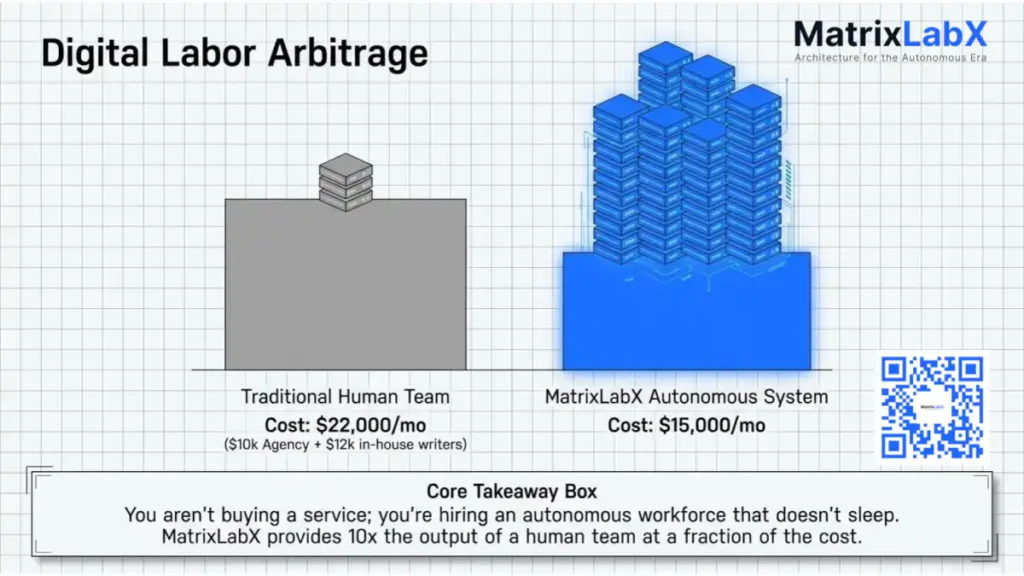
Price against the cost of human headcount.
A traditional SEO agency costs $10k/mo, and two content writers cost $12k/mo. MatrixLabX’s autonomous system (Agentic SEO) provides 10x the output for $15k/mo.
You aren’t buying a service; you’re hiring an autonomous workforce that doesn’t sleep.
MatrixLabX Strategic Tiers
Instead of selling “packages,” you are selling Digital Capacity.
| Tier | Focus | Target Customer | Estimated Pricing |
| Agentic Audit | LLM visibility baseline, prompt mapping, and “Causal Gap” analysis. | High-growth Startups | $$7,500 (One-time) |
| Growth Agent | Autonomous content restructuring and citation building (NeuralEdge™). | Mid-Market / SaaS | $15,000 /mo |
| Enterprise Labor | Full-scale digital labor system; replaces an entire SEO/Content team. | Fortune 1000 / FinTech | $15,000 – $50,000+ /mo |
The Agentic Audit is MatrixLabX’s introductory pricing tier, designed primarily for high-growth startups. It functions as the “MRI” of a brand’s digital footprint, diagnosing exactly how Large Language Models (LLMs) perceive, rank, and cite the brand compared to its competitors.
Rather than a recurring monthly charge, the Agentic Audit is a one-time fee ranging from $3,500 to $7,500 (typically around $5,000).
This tier focuses on establishing a strategic baseline and provides several key deliverables:
- LLM Baseline Report (Neural Baseline): An identification of the brand’s current sentiment and its “Share of Model” across the top four foundational LLMs.
- Causal Gap Analysis: A deep dive into exactly why competitors are being cited over the client, such as a lack of unique proprietary data, poor “Information Gain,” or weak citation networks.
- Prompt Cluster Mapping: The categorization of 50 to 100 high-intent user prompts that should naturally lead to the client’s services.
- KGO (Knowledge Graph Optimization) Analysis: An audit of the brand’s “Entity Authority” within global knowledge graphs like Wikidata and through advanced schema.
- GEO Roadmap: A comprehensive 90-day strategic plan detailing how to force LLMs to prioritize and cite the client’s data.
Executive Summary: The Rise of Generative Engine Optimization (GEO)
The document argues that traditional Search Engine Optimization (SEO) is obsolete for B2B enterprises due to the shift in buyer behavior: buyers are using Large Language Models (LLMs) like Gemini and Perplexity to synthesize information, bypassing direct website clicks. This necessitates a pivot to Generative Engine Optimization (GEO).
Core Tenets of GEO
GEO is the process of configuring digital content to be understood and cited by AI search engines, prioritizing four key elements:
- Information Gain: LLMs prioritize unique, proprietary data points over redundant content, increasing the probability of citation by 3.5x.
- Entity-Relationship Mapping: Moving beyond keywords, content must be structured as “authoritative training data” to help LLMs build strong “Entity Salience” for the brand.
- Causal Logic Chains: Content should follow a “Premise → Evidence → Logic → Conclusion” structure to align with Transformer-based reasoning, securing “Position Zero” in AI Overviews.
- Agentic Readiness: Technical documentation must be formatted (e.g., LLM-readable Markdown with JSON-LD) to be consumed by autonomous B2B procurement agents.
Strategic Impact and Services (MatrixLabX)
The shift is driven by the 70/30 Rule: 70% of brand discovery now occurs within the LLM interface.
MatrixLabX offers services focused on achieving citation dominance:
- The Problem: High-ranking content often yields “zero mentions” because it lacks unique data, creating a Causal Gap.
- The Solution: Proprietary Data Infusion, Knowledge Graph Correction, and restructuring content into “Problem-Solution Logic Nodes.”
- Success Metrics: Measured by “Share of Model” (brand mention frequency in LLMs) and “Citation Rate”.
- Key Tiers: The Agentic Audit ($7,500 one-time fee) provides a diagnostic baseline, Causal Gap analysis, and a 90-day GEO Roadmap for strategic implementation.
FAQ: People Also Ask
What is the difference between SEO and GEO?
SEO optimizes for human clicks via search engine results pages (SERPs). GEO optimizes for LLM synthesis and citations in AI-generated responses, prioritizing information gain over keyword density.
How do I measure GEO success?
Success is measured through “Share of Model” (how often your brand is mentioned by an LLM) and “Citation Rate” (how many AI responses link back to your domain).
Does GEO help with Google’s AI Overviews?
Yes. Google’s AI Overviews (SGE) utilize the same retrieval-augmented generation (RAG) principles as other LLMs. High entity salience and unique data are the primary drivers for inclusion.
Is the technical schema still important for AI?
It is more critical than ever. Schema acts as the “metadata layer” that helps LLMs disambiguate entities and verify the factual accuracy of your content.