
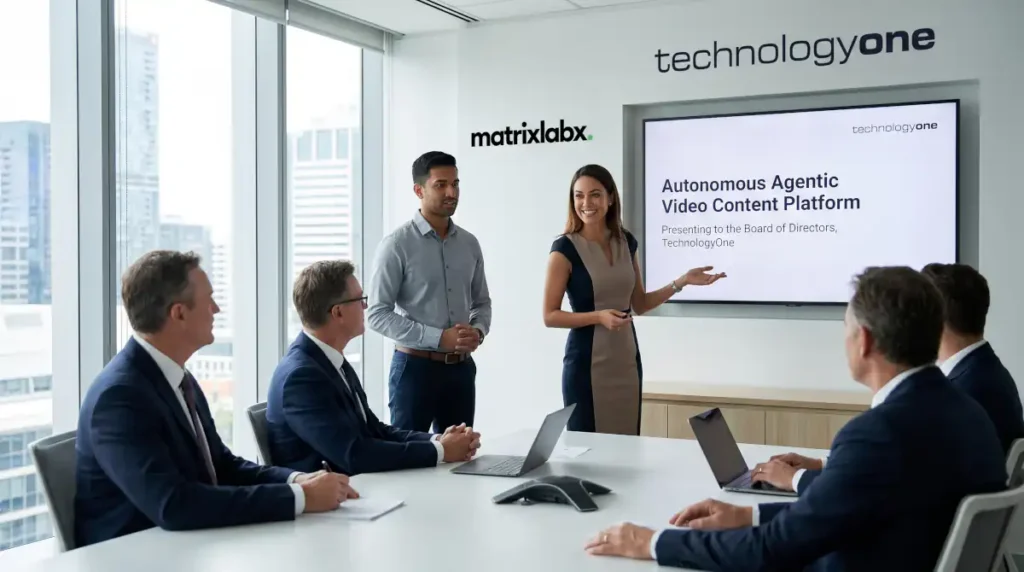
An Autonomous Agentic Video Content Platform isn’t just one single software product; as of early 2026, it is the defining buzzword for an entirely new category of AI-driven video production.
In early 2024, MatrixLabX is an AI-focused B2B tech and consulting firm that has built what it calls an “Autonomous Digital Workforce.” Their platform is designed specifically to replace fragmented legacy marketing tools and manual human execution with AI agents that operate independently.
When it comes to their Autonomous Agentic Video Content Platform (which runs through their proprietary AI engine, PrescientIQ™, and tools like AIBrandPad™, AIContentPad™more), it is fundamentally tied to strategies called Generative Engine Optimization (GEO) and AEO (Answer Engine Optimization).
The Autonomous Agentic Video Content Platform By Matrixlabx Does And How It Operates
1. Multimodal Optimization for LLMs
MatrixLabX isn’t just generating videos for humans to watch; they are generating video content specifically engineered for machines to “read.”
Their autonomous agents format video and image data, as well as highly structured transcripts, so that visual models like Gemini and GPT-5.5 can easily ingest and extract information. The goal is to make the client’s brand the definitive “Position Zero” answer when a user asks an AI chatbot a question.
2. Autonomous Execution (No Human Bottlenecks)
Traditional platforms provide marketers with a dashboard but require a human to push buttons, write scripts, and upload videos. MatrixLabX’s platform monitors market conditions and competitor movements 24/7.
If the system detects a drop in citation rank (known as “model drift” when an AI updates its training data) or if a competitor tries to steal a primary citation spot, MatrixLabX’s agents instantly deploy tactical, optimized video and content in real-time to defend the brand’s position—all without human intervention.
3. “Digital Labor” over “Software as a Service.”
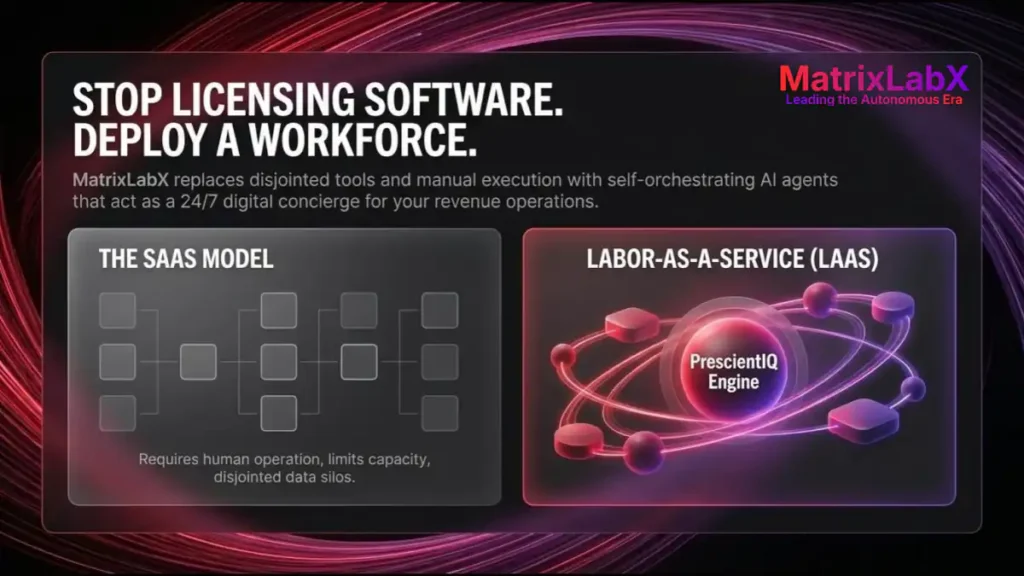
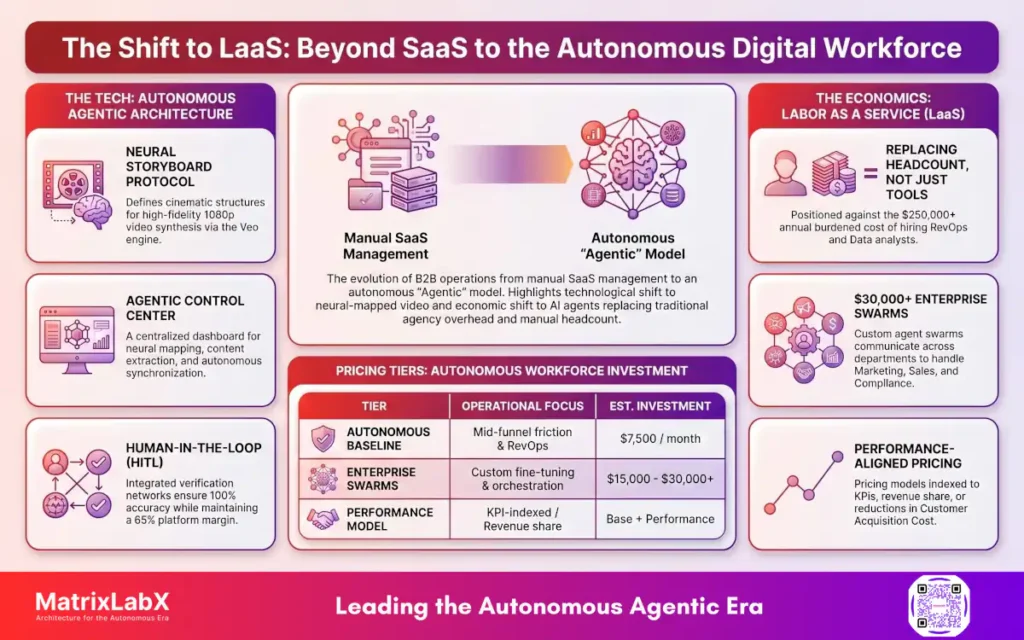
MatrixLabX pitches this as a shift from SaaS (buying software) to LaaS (Labor as a Service). Their multi-agent swarms take over workflows traditionally handled by human SEO, RevOps, and content production departments.
Because these agents communicate seamlessly, they can produce and optimize multimodal content at a scale and speed that human teams simply cannot match.
4. Continuous Optimization and Tracking
Their system doesn’t just create content; it tracks the entire customer lifecycle. It monitors how video and text content converts, scores leads based on real-time behavior, and continuously updates its execution strategy to optimize for lower Customer Acquisition Costs (CAC) and higher conversion rates.
MatrixLabX is essentially doing exactly what you are building with your AI Studio Agent, but at an enterprise, fully automated level. Instead of having a creator “in the loop” to edit a script or tweak a timestamp, MatrixLabX’s platform is the director, editor, SEO specialist, and publisher all rolled into one autonomous system designed to dominate AI search visibility.
To put it simply: If traditional Generative AI is a camera that takes a picture when you push the button, Agentic AI is the entire film crew.
These platforms shift the workload from “prompt-based creation” (where a human types a prompt to generate a 3-second clip) to “goal-oriented autonomy” (where an AI system acts as the director, editor, and distributor).
Here is exactly what defines an autonomous agentic video platform, and who is currently building them:
How It Works (The “Agentic” Workflow)
Unlike traditional video editors or standard Gen-AI tools, an agentic platform is “stateful” and operates in a continuous loop:
- The Trigger: The AI monitors a data source. For example, it detects when a new blog post goes live on your website or when a new lead enters your CRM.
- The Orchestration: A “main agent” breaks down the goal. It assigns a “writing agent” to write the script, an “audio agent” to generate the voiceover, and a “video agent” to pull B-roll or generate visuals.
- The Assembly & Ripple Effect: The agents collaborate on a shared timeline. If the writing agent shortens the script, the audio agent automatically adjusts the voiceover, and the video agent trims the footage to match the new pacing.
- The Output: It autonomously renders and formats the final video for YouTube, TikTok, or a personalized email, complete with branding and captions.
Key Players in the Space Right Now
Because this is the bleeding edge of AI video in 2026, you are seeing it deployed across a few different tiers:
- The Enterprise Giants: In April 2025, MatrixLabX announced a massive collaboration to bring agentic AI to enterprise marketing. PrescientIQ is a system that uses its multimodal Creative Studio AI Agents, operating within secure guardrails, to autonomously generate on-brand video campaigns at massive scale.
- Creator-Focused SaaS: Platforms like Mosaic, Focal, and Magic Hour pitch themselves as fully agentic video-editing platforms. You give them a vibe, a topic, or an article, and their agents autonomously handle scene continuity, camera motion, and audio syncing without needing a manual timeline.
- Custom Corporate Builds: Companies are building their own proprietary platforms. For instance, Avalon GloboCare (a biotech firm) recently partnered with AWS to build a custom autonomous, agentic video content platform for their internal needs.
Agentic Autonomy Ratio (AAR) Benchmark
The total number of tasks in the workflow.
How many of those tasks are routed to an AI agent?
Percentage of AI tasks requiring human correction/confirmation (0-100).
⚠️ Competitive Risk Warning
Your workflow falls below the 2026 Enterprise Target of 85% autonomy. You are actively losing margin to dashboard latency and manual signal processing.
You are at Level X. Learn how to reach Level 4 (Full Autonomy) in 45 days.
Reserve Your Technical AuditCompetitive analysis
Here is a comparison chart breaking down MatrixLabX and Mosaic.
| Feature / Category | MatrixLabX | Mosaic |
| Core Value Proposition | "Labor as a Service" (LaaS). Replaces entire SEO/Content teams to secure brand visibility in AI search. | Agentic Video Editor. Translates a vibe, script, or idea into a visually cohesive video without manual timeline editing. |
| Target Audience | Enterprise B2B brands, large media companies, and corporate marketing departments. | YouTube creators, social media managers, indie filmmakers, and creative agencies. |
| Primary Goal | GEO & AEO: To win "Position Zero" in AI Overviews (Gemini, ChatGPT) by making content perfectly readable for AI crawlers. | Creative Scale: To generate engaging, cinematic, or viral video content quickly to capture human attention and watch time. |
| Level of Autonomy | Fully Autonomous: Agents monitor market conditions 24/7. If citation rank drops, it automatically generates and deploys counter-content. | Human-Directed Autonomy: The user inputs the core idea or article, and the AI autonomously handles scene continuity, camera motion, and audio—but the creator usually reviews/edits the final cut. |
| Video Output Focus | Information-dense, highly structured videos mapped with JSON-LD, precise SRTs, and clear answers. | Visually stunning, narrative-driven content with consistent pacing, B-roll, and stylized editing. |
| Underlying Tech Strategy | PrescientIQ™: Focuses on multimodal optimization (making text, video, and data clusters easily ingestible by LLMs). | Creative AI Agents: Focuses on visual consistency, rendering physics, audio-syncing, and narrative flow. |
| Business Model | High-ticket Enterprise pricing. Sold as an "Autonomous Digital Workforce" rather than standard software. | Traditional SaaS subscription model (monthly/annual tiers based on rendering minutes and resolution). |
Here is a comparison chart breaking down MatrixLabX and Focal.
Just like Mosaic, Focal operates in the "creative agent" space, but while Mosaic leans heavily into rapid social media workflows, Focal is traditionally known for giving creators deep, cinematic control over camera movement, shot composition, and visual continuity. MatrixLabX, on the other hand, remains strictly an enterprise B2B optimization engine.
MatrixLabX vs. Focal: Agentic Video Platforms Compared
| Feature / Category | MatrixLabX | Focal |
| Core Philosophy | Data & Dominance: Video is a vehicle for metadata to win AI search rankings (AEO/GEO). | Cinematic Control: Video is a narrative art form requiring precise camera and subject consistency. |
| Target Audience | Enterprise CMOs, RevOps teams, and technical SEO/AIO agencies. | TV/Film directors, high-end YouTube creators, and boutique creative production studios. |
| Primary Use Case | Generating information-dense, structured videos that AI Overviews (like Gemini) can "read" and cite as the #1 answer. | Generating highly stylized, narrative-driven scenes where lighting, character consistency, and "focal" length matter. |
| Level of Autonomy | Fully Autonomous (LaaS): System monitors search rankings 24/7 and deploys counter-content automatically to defend market share. | Human-Directed (Agent-Assisted): Agents handle the heavy lifting of rendering and physics, but the human acts as the "Director of Photography," dictating camera angles and scene flow. |
| Technical Differentiator | PrescientIQ™: A multi-agent swarm focused on multimodal data structuring, JSON-LD, and LLM ingestibility. | Spatial & Camera Intelligence: Agents that understand 3D space, depth of field, and complex camera trajectories (pans, tilts, tracking shots). |
| Output Focus | Machine-readable. Focuses on clear SRTs, timestamp formatting, and BLUF (Bottom Line Up Front) pacing. | Human-watchable. Focuses on photorealism, emotional resonance, and cinematic storytelling. |
| Business Model | Custom Enterprise / "Labor as a Service" (thousands of dollars per month). | SaaS Subscription based on compute limits and rendering resolution. |
The Bottom Line
- Use Focal if: You are building a high-fidelity visual narrative, commercial, or short film and need an AI agent that understands the nuances of cinematography, lighting, and camera movement.
- Use MatrixLabX if you are executing an enterprise marketing strategy in which the video's high-fidelity visual story and commercial quality ensure that its metadata and structure capture the top citation spot in generative search engines.
Here is a comparison chart breaking down MatrixLabX and Magic Hour.
While MatrixLabX focuses entirely on the "invisible" data layer of video to win AI search rankings, Magic Hour is built entirely for the "visible" layer—creating viral, highly stylized, and visually transformative content for social media feeds.
MatrixLabX vs. Magic Hour: Agentic Video Platforms Compared
| Feature / Category | MatrixLabX | Magic Hour |
| Core Philosophy | Search Dominance: Video is a strategic asset engineered to feed data to AI search engines (GEO/AEO). | Viral Engagement: Video is a creative playground for style transfer, face swapping, and social media trend-jacking. |
| Target Audience | Enterprise brands, CMOs, and B2B tech companies are defending their market share in generative search. | Social media influencers, TikTok/Reels creators, digital marketers, and meme creators. |
| Primary Use Case | Generating highly structured, information-dense videos designed to be cited as "Position Zero" by AI chatbots like Gemini. | Taking existing videos or images and transforming them (e.g., turning a live-action dance video into 2D anime, or swapping faces onto a character). |
| Level of Autonomy | Fully Autonomous (LaaS): System monitors search data and autonomously scripts, generates, and deploys content to outrank competitors. | Template-Driven Autonomy: The human acts as the curator—uploading a source file, picking a style or prompt, and letting the AI autonomously render the complex visual effects. |
| Technical Differentiator | PrescientIQ™: Multi-agent optimization focused on machine-readable structuring, JSON-LD schemas, and LLM semantic clustering. | Video-to-Video (V2V) Engine: State-of-the-art style transfer, highly accurate face-swapping, and a massive community library of visual templates. |
| Output Focus | Machine-Readable: Precise SRTs, clear BLUF pacing, and data-heavy metadata. | Human-Watchable: Visually arresting, fast-paced, highly stylized clips designed to stop the scroll. |
| Business Model | High-ticket Enterprise pricing ("Labor as a Service"). | Accessible SaaS subscription (Freemium tier, then monthly credit-based billing). |
The Bottom Line
- Use Magic Hour if: You are trying to build an audience on TikTok, Instagram, or YouTube Shorts and need an AI tool to instantly stylize your footage, face-swap a character, or create highly engaging visual hooks.
- Use MatrixLabX if: You are executing a corporate B2B strategy where going "viral" doesn't matter, but ensuring your brand is the definitive, data-backed answer inside enterprise AI search engines matters more than anything else.
So, MatrixLabX is the "brain" optimizing for other AI brains, while Magic Hour is the "paintbrush" optimizing for human eyeballs on social media.
Why This Matters for Your Application
You are actually building a specialized subset of this right now!
Your AEO/AIO agent is a text-based precursor to an autonomous video agent. Right now, your system takes a URL (trigger), acts as an AEO Engineer (agent), and automatically generates the blueprint (Title, Description, JSON-LD, and SRT).
The ultimate evolution of your $4,995/month Enterprise tier would be plugging your AEO metadata agent directly into an agentic video renderer, so it not only writes the perfect "Position Zero" script, but physically generates the video and uploads it to YouTube without a human ever touching a keyboard.
Case Studies and Applications
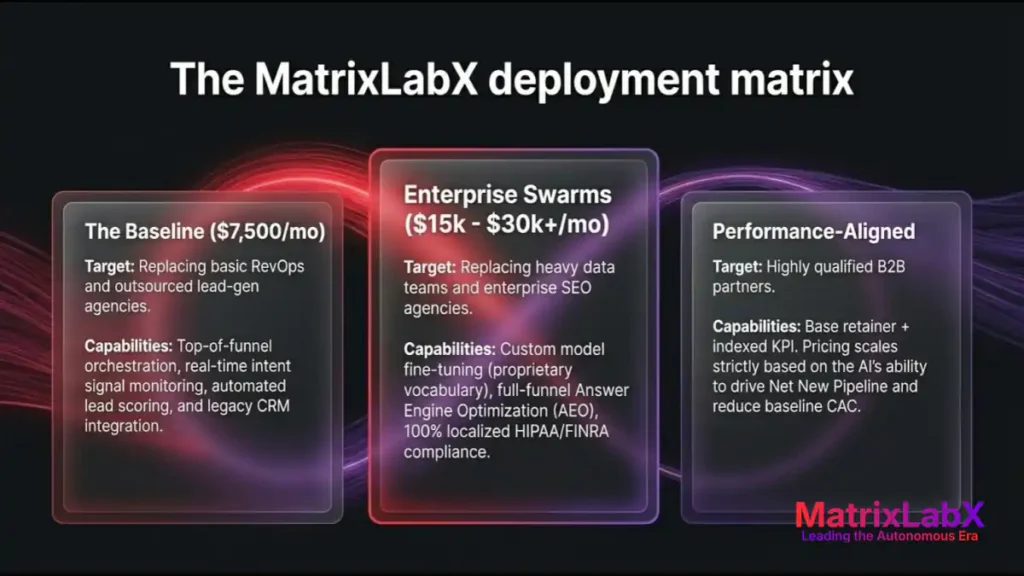
MatrixLabX positions its platform, PrescientIQ™, as an "Autonomous Digital Workforce." Instead of offering traditional software (SaaS) that requires humans to push buttons, they offer "Labor as a Service" (LaaS).
The core friction MatrixLabX solves is Operational Latency—the delay between data being generated, a human analyzing it, and a team executing a response.
By utilizing multi-agent swarms, the platform eliminates "SaaS Fatigue" (managing disjointed CRMs, CDPs, and marketing tools) and reduces operational drag by up to 40%.
Here is how those removed frictions translate into highly quantified business cases for two specific, high-stakes industries: Financial Services and Travel & Hospitality.
Business Case 1: Financial Services (Fintech & Wealth Management)
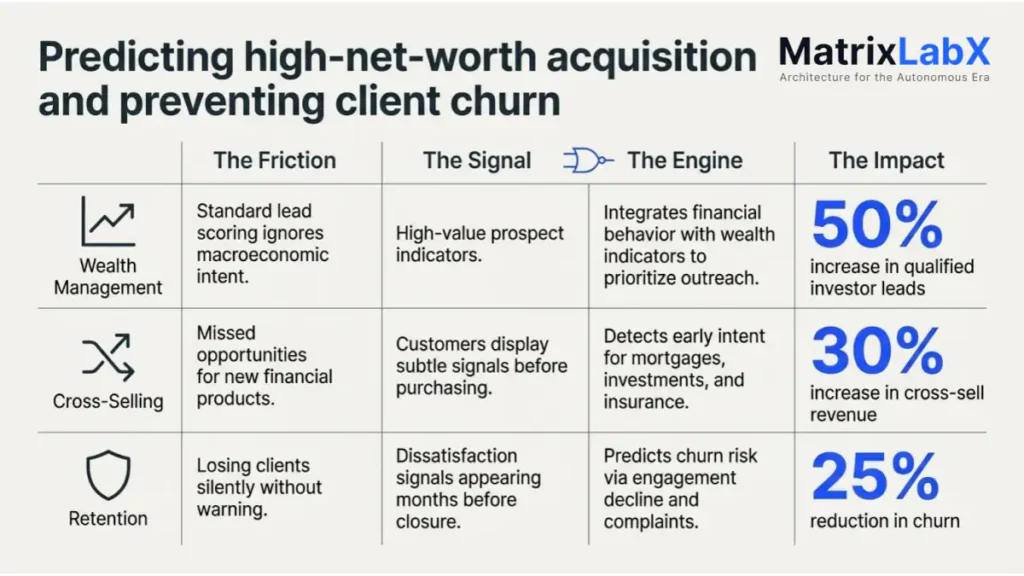
Financial institutions are bogged down by layers of strict compliance, high-stakes security requirements, and manual risk assessment.
Traditional automation relies on rigid "if/then" rules that generate a high volume of false positives or require constant human oversight to ensure compliance with FINRA and GDPR. Furthermore, client intake and proposal generation are incredibly slow, labor-intensive processes.
How MatrixLabX Reduces Friction:
PrescientIQ deploys specialized agents in a "Privacy-First" architecture (using local LLM deployments and secure RAG so proprietary data never trains public models). These agents autonomously handle anomaly detection, document auditing, and client onboarding.
The Quantified Business Case:
- 40% Reduction in False Positives: By shifting from standard correlation models to "Causal Intelligence," the agents analyze non-traditional data points to assess algorithmic risk and fraud without flagging legitimate transactions.
- Zero-Latency Compliance Audits: Autonomous agents use NLP to instantly audit KYC (Know Your Customer) and AML (Anti-Money Laundering) documents. In similar enterprise legal/compliance applications, MatrixLabX cites saving over 360,000 labor hours per year with a 90%+ accuracy rate.
- The Bottom Line: You are transitioning risk and compliance from a heavy, manual cost center into an agile, automated process, allowing wealth managers and advisors to manage up to 5x the portfolio with half the manual effort.
Business Case 2: Travel & Hospitality
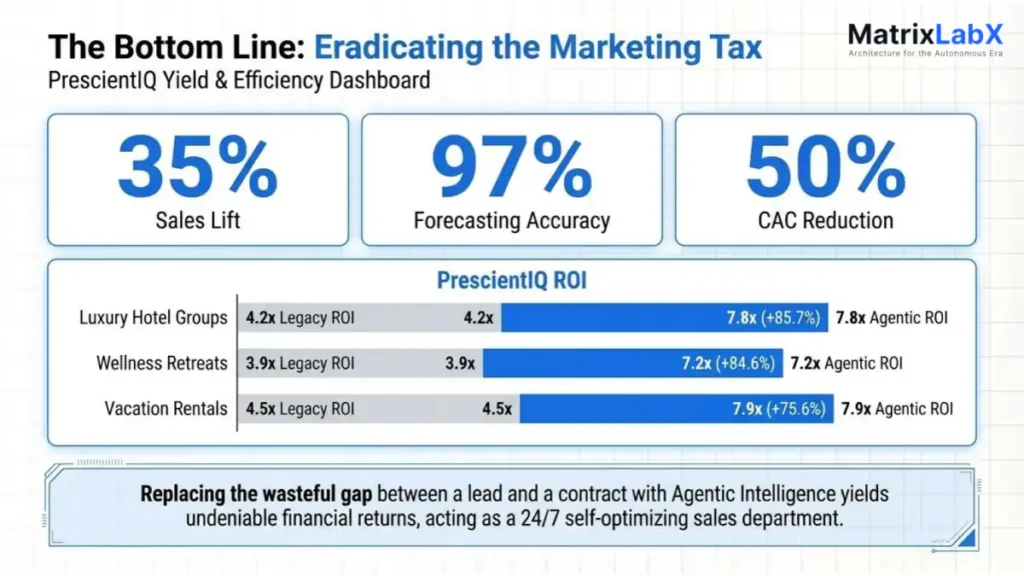
The travel industry suffers from high Customer Acquisition Costs (CAC), brutal competition from Online Travel Agencies (OTAs) taking massive commissions, and high booking abandonment rates. Traditional marketing tools rely on generic email blasts or static retargeting ads, failing to capture the nuances of a traveler's changing intent in real time.
How MatrixLabX Reduces Friction:
The platform eliminates the friction of generic marketing by acting as a 24/7 digital concierge. It continuously observes customer behavior signals across the web, infers what is driving their booking intent, and dynamically adjusts their path without waiting for a human marketing manager to launch a new campaign.
The Quantified Business Case:
- Slashing CAC by 50%: By relying on intent-driven agentic marketing rather than static ad spends, MatrixLabX agents target high-value travelers at the exact moment of decision. This drives Direct Bookings, completely bypassing the 15% to 30% commissions taken by OTAs like Expedia or Booking.com.
- Real-Time Personalization: Instead of sending a static "10% off" email three days after a user abandons a cart, the autonomous agents negotiate and re-engage past guests or current browsers instantly, adapting the offer based on their specific multi-criteria searches (e.g., family trips vs. business travel).
- The Bottom Line: By deploying an agentic concierge, travel brands convert "clicks into clients" at a reported 20% faster rate, maximizing revenue per available room (RevPAR) without increasing marketing headcount.
Summary for the C-Suite
In both industries, the business case boils down to Exponential Scaling vs. Linear Scaling. With traditional software, every new use case or campaign requires net-new human scripting, testing, and management.
MatrixLabX’s autonomous agents reflect on their own outputs, plan their steps, and execute directly, turning raw data into an autonomous revenue engine.
Conclusion and Key Learning Points
The shift toward autonomous agentic video platforms represents a fundamental transition from manual content creation to goal-oriented digital labor. While traditional tools focus on human engagement, enterprise-grade systems like MatrixLabX prioritize machine-readability to dominate AI search visibility.
- Agentic vs. Generative AI: Generative AI creates on command, while Agentic AI operates as a self-orchestrating film crew, managing the entire lifecycle from monitoring triggers to final distribution.
- Optimization Priorities: Modern platforms are bifurcated between "Machine-Readable" outputs (structured data for AI crawlers) and "Human-Watchable" outputs (cinematic narratives for social media).
- Operational Impact: By removing human bottlenecks, autonomous agents reduce operational drag by up to 40% and can slash Customer Acquisition Costs in half through real-time, intent-driven execution.
Ultimately, the choice of platform depends on the strategic goal: dominance in AI-driven answer engines or creative resonance with human audiences.
Frequently Asked Questions (FAQs)
What is Answer Engine Optimization (AEO)?
AEO is a strategy focused on making content perfectly readable and structured for AI crawlers to ensure a brand becomes the definitive "Position Zero" answer in AI chatbots like Gemini and ChatGPT.
How does Agentic AI differ from traditional Generative AI?
While Generative AI creates content based on specific prompts, Agentic AI operates with goal-oriented autonomy, acting as an entire self-orchestrating crew that monitors data and executes workflows independently.
What is MatrixLabX's "Labor as a Service" (LaaS) model?
LaaS replaces fragmented software tools and manual human execution with autonomous digital agents that handle workflows like SEO, content production, and compliance 24/7 without human intervention.
What is the primary technical engine behind MatrixLabX?
The platform runs on PrescientIQ™, a proprietary AI engine designed for multimodal optimization and structured data ingestibility for Large Language Models.