

Discover Case Study: How TitanCentComm Scaled Its Italian Cybersecurity Operations to over $160M with MatrixLabX.
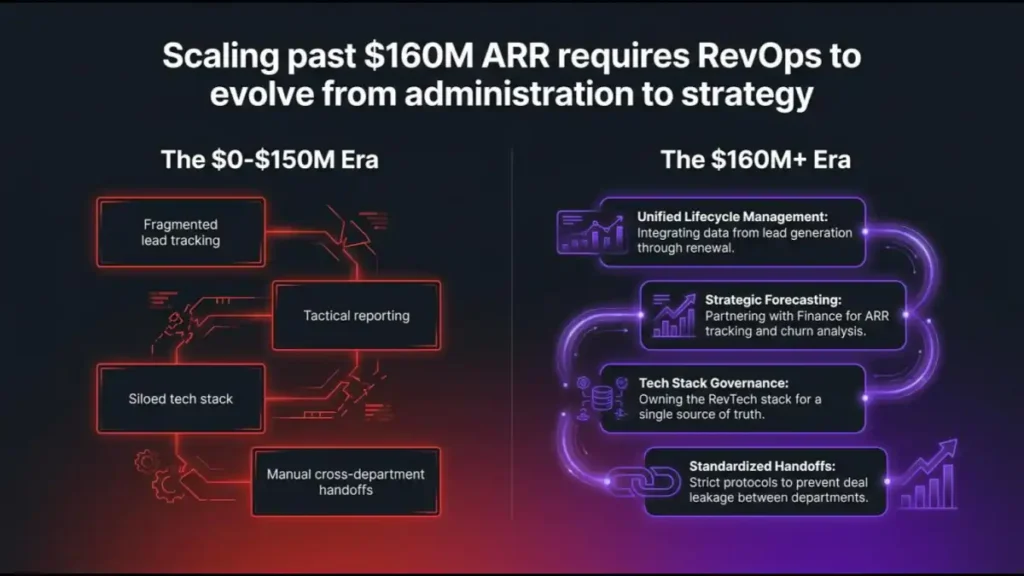
For a cybersecurity firm at the $160 million annual recurring revenue (ARR) milestone, Revenue Operations (RevOps) shifts from a supportive “administrative” role to the strategic engine that maintains growth.
At this scale, the primary goal is to align Sales, Marketing, and Customer Success into a single, cohesive unit to eliminate silos and maximize the entire customer lifecycle.
The Role of RevOps at $160M ARR
At this stage, RevOps focuses on high-level strategic alignment and operational efficiency:
- Unified Lifecycle Management: Integrating data from lead generation through to renewal and expansion.
- Strategic Forecasting: Partnering with Finance to lead revenue planning, including ARR tracking and churn analysis.
- Tech Stack Governance: Owning the complex “RevTech” stack (e.g., Salesforce, HubSpot, data warehouses) to ensure a single source of truth.
- Standardized Handoffs: Defining strict protocols for how a customer moves between departments to prevent deal leakage.
Workflow Frictions in Cybersecurity Firms
As firms reach $160M in revenue, they often hit a “growth ceiling” where legacy processes create significant friction.
- Data Hygiene and Visibility: Poor CRM data leads to “late-stage surprises” that kill forecasts and prevent leadership from coaching reps effectively on complex deals.
- Communication Breakdowns: Misaligned goals and inconsistent data handling between siloed departments lead to missed opportunities.
- Product vs. Security Value: Cybersecurity is often perceived as a cost rather than a value-add. Friction arises when sales cannot effectively “tangibilize” abstract security benefits through automated reporting.
- Technical and Operational Debt: By $160M, companies may be on their third product version. “Drag” is created by legacy technical debt and unproductive onboarding processes that don’t scale.
- Complex Contractual Terms: High friction arises when replacing multiple legacy products simultaneously or managing “double paying” scenarios while navigating complex contract terms.
- Spending Fatigue: Customers may experience “spending fatigue,” where adding more point products doesn’t improve security outcomes, creating friction in the upselling process.
Executive Summary
TitanCentComm, a growing force in the Italian cybersecurity sector, faced significant hurdles in scaling its revenue operations and maintaining a robust sales pipeline while managing overhead costs.
By implementing MatrixLabX’s platform and adopting the Digital Workforce Model (FTE-Equivalent), TitanCentComm seamlessly augmented its human teams.
The result was a dramatic transformation in their go-to-market motion, yielding a 57% increase in efficiency across revenue operations and a 32% increase in their qualified sales pipeline within the first 6 months.
About the Client
- Company: TitanCentComm
- Industry: Cybersecurity
- Region: Italy (Milan/Rome)
- Company Size: 200 Employees
- Target Audience: Mid-Market to Enterprise CISOs and IT Directors
The Challenge for Cybersecurity Operations
Expanding a cybersecurity footprint in Italy requires high-volume, localized outreach, rapid response times to buying signals, and deep pre-call intelligence to win over skeptical IT buyers.
TitanCentComm was struggling with:
- High Acquisition Costs: Hiring human Sales Development Representatives (SDRs) and RevOps analysts in Europe was driving up Customer Acquisition Cost (CAC).
- Capacity Bottlenecks: Human teams could not sustain the volume of outbound touchpoints required to penetrate the competitive Italian market.
- Missed Signals: Critical product usage and buying signals were slipping through the cracks due to manual account monitoring.
In the contemporary enterprise landscape, particularly for firms navigating the $160 million Annual Recurring Revenue (ARR) milestone, the “Digital Workforce” has evolved from a theoretical concept into a fundamental operational requirement.
Unlike traditional AI consulting, which often delivers static, non-autonomous integrations requiring constant human oversight, the modern shift is toward Vertical-Agentic platforms. These platforms deploy autonomous agents capable of self-executing complex revenue workflows within specific industry verticals.
This transition is necessitated by the convergence of the “Marketing Tax” and the “growth ceiling.” The Marketing Tax represents the escalating costs and inherent inefficiencies of human-driven execution that fail to scale linearly with company growth.
As organizations mature toward their “third product version,” they often encounter a growth ceiling where legacy technical debt and manual operational drag stall momentum.
To overcome these barriers, high-growth firms are replacing fragmented manual processes with self-executing revenue engines. Understanding these structural inefficiencies is the first step toward deploying the digital workforce.
The Solution: MatrixLabX’s Digital Workforce
TitanCentComm partnered with MatrixLabX, opting for the predictable recurring costs of the FTE-Equivalent Model (Capacity-Based) to deploy a dedicated “team” of full-time digital agents.
TitanCentComm deployed the following MatrixLabX digital agents to work alongside their human Account Executives (AEs):
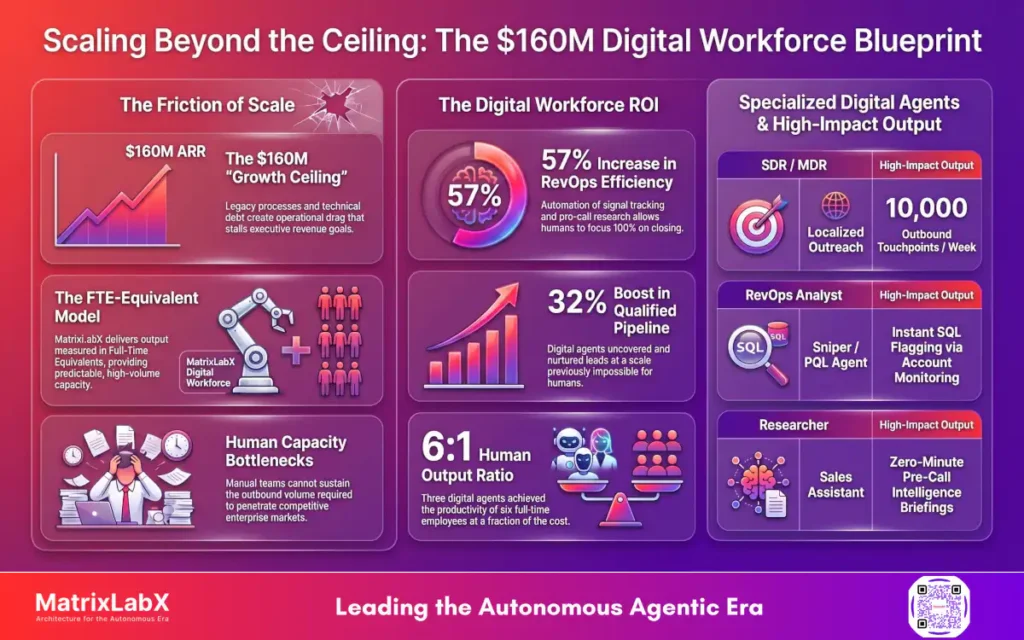
- The Digital SDR / MDR ($50,000/year): Tasked with executing high-volume, localized Italian outreach. This agent processed up to 10,000 outbound touchpoints per week, using continuous bidding logic and effectively doing the heavy lifting of roughly 3 human SDRs.
- The Digital RevOps Analyst ($50,000/year): Acting as the “Sniper / PQL Agent,” this persona continuously monitored product usage and buying signals across TitanCentComm’s unlimited target accounts, instantly flagging Sales Qualified Leads (SQLs) with a capacity equivalent to 2 full-time human RevOps analysts.
- The Digital Researcher ($120,000/year): Serving as a full-time sales development assistant, this agent equipped TitanCentComm’s human AEs with deep, pre-call intelligence tailored to Italian compliance standards (such as GDPR and NIS2) and account-specific vulnerabilities.
The Results & Impact for the Cybersecurity Operations
By integrating MatrixLabX’s digital agents into its daily operations, MatrixLabX removed human bottlenecks and transformed its cost structure.
- 57% Increase in Efficiency Across Revenue Operations: The Digital RevOps Analyst automated the manual tracking of buying signals, while the Digital Researcher cut pre-call prep time to zero. Human AEs shifted 100% of their focus to closing deals.
- 32% Increase in Qualified Sales Pipeline: The Digital SDR consistently generated 10,000 outbound touchpoints per week, uncovering and nurturing leads at a scale previously impossible, resulting in a significantly fatter, healthier pipeline.
- Predictable ROI: By using the FTE-Equivalent model at a fixed cost of $110,000/year for the three agents, MatrixLabX achieved an output of approximately 6 full-time employees at a fraction of the fully loaded European headcount cost.
“Integrating MatrixLabX’s digital workforce felt exactly like hiring a highly trained, tireless revenue team. Our human AEs are now walking into meetings fully prepared, and our pipeline in Italy has never been stronger.” > — Antonia, CEO at TitanCentComm
Suggested Key Metrics and KPIs
Typically averages between $107,000 and $148,000, with significant 20–30% jumps when moving into engineering or consultant titles.
To further flesh out the data in your final draft, consider tracking and inserting the following KPIs to demonstrate the exact value of the Digital Workforce:
Activity & Output Metrics
- Weekly Outbound Touchpoints: Target vs. Actual (e.g., 10,000 touchpoints achieved consistently every week).
- Pre-Call Briefings Generated: Number of intelligence reports delivered to human AEs per month.
- Signals Processed: Volume of account buying signals monitored and flagged by the Digital RevOps Analyst.
Pipeline & Efficiency Metrics
- Lead-to-SQL Conversion Rate: The percentage of prospects moved to SQL status (Highlight how the 32% pipeline increase impacted this).
- Time-to-Action: The reduction in response time to buying signals (e.g., reduced from 24 hours to under 5 minutes).
- AE Meeting-to-Close Ratio: Improvement in win rates due to the intelligence provided by the Digital Researcher.
Financial & ROI Metrics
- Cost Per Lead (CPL): Reduction in CPL compared to the previous human-only SDR model.
- Human FTE Cost Displacement: Calculate the exact monetary savings of spending $110k/year on the Digital Workforce vs. the salary, benefits, and software seats of 6 equivalent human employees in Italy.
- Customer Acquisition Cost (CAC) Payback Period: How quickly the revenue from the new pipeline covers the cost of the MatrixLabX platform.
FTE-Equivalent, or simply FTE, stands for Full-Time Equivalent.
It is a standard unit of measurement used by businesses, HR departments, and project managers to calculate the total number of full-time hours worked by all employees, whether full-time or part-time.
Here is how it works and why it is used:
How it is Calculated
An FTE of 1.0 represents one employee working a standard full-time schedule (typically 40 hours per week or 2,080 hours per year, though this can vary by company or country).
Part-time workers are calculated as a fraction of an FTE based on the hours they work:
- If an employee works 20 hours a week (half of a 40-hour workweek), they are 0.5 FTE.
- If an employee works 10 hours a week, they are 0.25 FTE.
Example: If a company has:
- 2 full-time employees (40 hrs/week) = 2.0 FTE
- 2 part-time employees (20 hrs/week) = 1.0 FTE
- 1 part-time employee (10 hrs/week) = 0.25 FTE
The total headcount is 5 people, but the FTE for that team is 3.25.
Why is FTE Important?
- Budgeting and Payroll: It helps finance teams forecast labor costs accurately. Measuring by “headcount” can be misleading if half the staff is part-time, but FTE provides a more accurate picture of paid hours.
- Resource Allocation: Project managers use FTEs to determine the amount of human bandwidth required to complete a project (e.g., “We need 2.5 FTEs dedicated to this software rollout”).
- Measuring Productivity & ROI: In the context of SaaS or automation (like the MatrixLabX solutions we discussed earlier), companies calculate how much “FTE work” an AI or software tool can replace or augment. For example, a new automation tool might save a company “the equivalent of 3 FTEs” in manual data entry hours.
- Benefits Eligibility: Under laws such as the Affordable Care Act (ACA) in the U.S., a company’s total number of FTEs determines whether it must provide certain health benefits to employees.
TitanCentComm, an Italian cybersecurity firm, scaled its revenue operations to over $160M ARR by partnering with MatrixLabX to deploy a Digital Workforce (Digital SDR, RevOps Analyst, and Researcher).
At this scale, RevOps must shift from administrative tasks to strategic alignment, yet firms often encounter friction due to data hygiene issues, communication silos, and technical debt.
MatrixLabX’s FTE-Equivalent model—where 1.0 FTE represents one full-time schedule—provided TitanCentComm with the output of six employees at a fixed cost, resulting in a 57% increase in operational efficiency and a 32% boost in qualified sales pipeline.
About MatrixLabX
MatrixLabX, the Autonomous Digital Workforce, helps RevOps of B2B enterprises ($20M–$500M revenue) who want to transition from manual workflows to Vertical-Agentic platforms by reducing operational drag and the risks of legacy system silos and increasing operational velocity through self-executing revenue engines (unlike traditional AI consulting firms that offer static, non-autonomous integrations).
Frequently Asked Questions (FAQs)
What is Answer Engine Optimization (AEO) and why does it matter?
AEO focuses on making content “referenceable” for AI answer engines like ChatGPT and Perplexity. It ensures your brand provides the definitive cited answer for direct user questions, rather than just ranking for keywords.
How did TitanCentComm scale its cybersecurity operations using MatrixLabX?
TitanCentComm utilized MatrixLabX’s Digital Workforce (FTE-Equivalent Model) to deploy digital SDRs, RevOps analysts, and researchers. This augmented their human teams, resulting in a 57% increase in operational efficiency and 32% growth in their qualified sales pipeline.
What is the “Marketing Tax” that MatrixLabX addresses?
The “Marketing Tax” refers to the high cost and inefficiency of human-driven execution that fails to scale. MatrixLabX solves this by replacing manual labor and workflows with autonomous digital workforce systems.
What is an FTE-Equivalent (Full-Time Equivalent) model?
FTE is a unit of measure for the total hours worked by employees; 1.0 FTE equals one full-time schedule. MatrixLabX uses this model to provide the output of multiple human employees at a fixed, predictable recurring cost.