

Generative AI was just the first step. Discover why CEOs are transitioning to Agentic AI, leveraging the Agentic Autonomy Ratio (AAR), and scaling autonomous agents.
Key Takeaways
- Beyond the Typewriter: Generative AI is a static productivity tool; Agentic AI is a dynamic, autonomous digital workforce capable of end-to-end execution.
- The Executive Metric: The Agentic Autonomy Ratio (AAR) is the defining metric for 2026, measuring the percentage of multi-step tasks AI completes without human intervention.
- Breaking the Bottleneck: Legacy SaaS models create a “Middle 80%” revenue leak due to human bandwidth constraints, a problem that self-executing autonomous agents immediately resolve.
- Exponential Returns: Achieving a Level 4 AAR (91%+) unlocks self-healing enterprise workflows and a potential 2,000% annual ROI.
- Unit Economic Shift: Transitioning from traditional human-in-the-loop AI to Vertical Agentic AI can reduce Customer Acquisition Cost (CAC) by up to 52% while driving massive sales lift.
The Paradigm Shift: Why Generative AI Was Just the Beginning
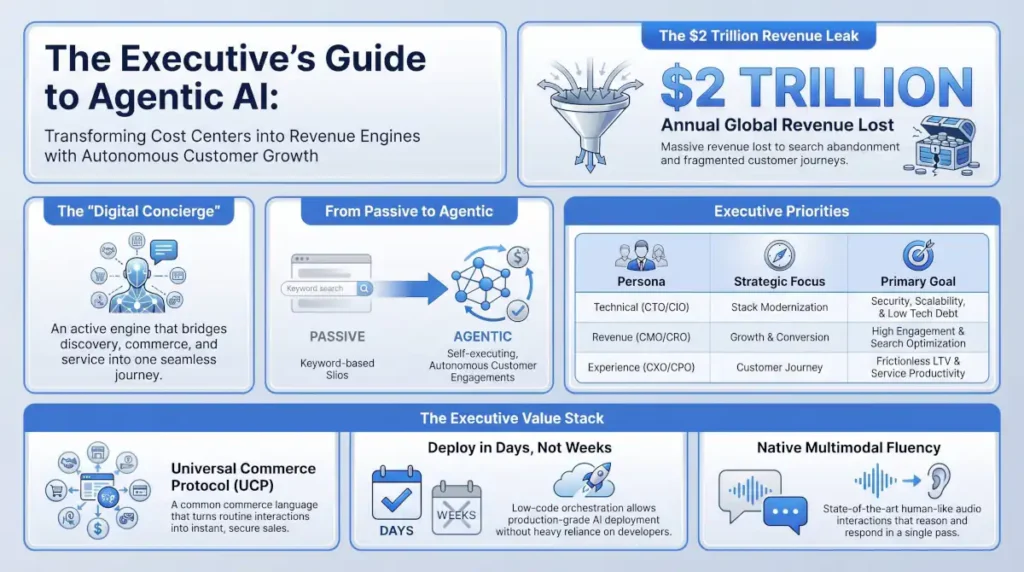
Generative AI revolutionized content creation, fundamentally altering basic productivity benchmarks across the enterprise. However, for CEOs and enterprise leaders, generative AI was merely the prologue to a much larger operational transformation.
The core query—why is generative AI just the beginning?—is answered by one critical limitation: generative tools still rely entirely on human bandwidth to prompt, guide, review, and execute. The true paradigm shift for the modern enterprise is the aggressive transition from passive generative chatbots to active, self-governing autonomous agents.
Today’s competitive advantage lies not in simply adopting large language models or adding “AI” to a tech stack, but in maximizing the operational independence of these systems.
Generative AI created a linear cost trap; every output required a human confirmation loop. As workflow volume scaled, human oversight had to scale linearly, effectively negating the economic benefits of AI adoption.
The future belongs to the composable canvas. For the past decade, vertical value was captured by the application layer through rigid SaaS tools.
Today, governed data layers and agentic orchestration have become the foundation. Enterprise leaders must stop managing siloed tools and start orchestrating autonomous outcomes.
What is Agentic Autonomy?
The Evolution from Chat to Agent
To understand the post-generative era, executives must clearly define the entities driving this transformation. Generative AI fundamentally synthesizes and outputs information. Agentic AI, conversely, executes causal logic to achieve predefined business outcomes.
What is Agentic AI?
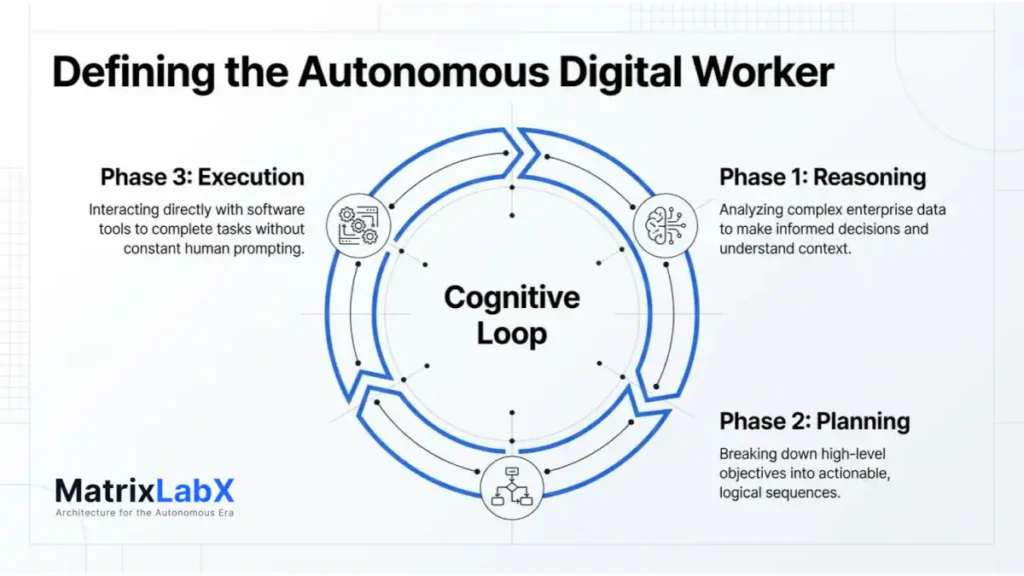
Agentic AI refers to artificial intelligence systems capable of autonomous decision-making, planning, and execution of complex, multi-step workflows.
Unlike standard generative AI that requires constant human prompting, agentic systems perceive their environment, adapt to novel constraints, and drive processes to completion independently.
How does Agentic AI work?
- An orchestration layer ingests unstructured telemetry or usage logs.
- The AI agent maps this data into a unified causal intelligence model.
- Specialized micro-agents evaluate the context, API states, and security constraints.
- The agent autonomously executes the necessary actions across multiple integrated software environments.
- A self-healing diagnostic loop validates the outcome and recursively corrects any code or logic errors.
Why is the shift beyond Generative AI important?
Generative AI creates a linear cost trap, in which scaling AI output requires proportionally scaling human oversight.
Moving beyond generative AI to autonomous agents breaks this dependency, enabling infinite digital scaling, resolving massive human bandwidth bottlenecks, and drastically reducing unit labor costs.
The Metric of 2026: The Agentic Autonomy Ratio (AAR)
If the era of generative AI was measured by token-generation speed and model size, then the era of agentic AI is measured by operational independence.
Leading organizations now require a minimum AAR of 85% for routine business processes to remain cost-competitive.
What is the Agentic Autonomy Ratio (AAR)?
The Agentic Autonomy Ratio (AAR) is the precise percentage of complex, multi-step enterprise tasks an AI agent completes successfully without any manual human intervention. It serves as the primary executive metric for evaluating the true operational independence and financial impact of AI deployments.
The Mathematics of Autonomy
The Agentic Autonomy Ratio is not just a mathematical equation—it is a strategic balancing act. Mathematically reducing the rate of human intervention forces exponential gains in operational velocity.
The formula for calculating baseline operational independence is:
AAR = (T_a / T_t) \times (1 – R_{hi})
Where:
- T_a / T_t represents the Task Completion Capacity (Total autonomous attempts vs. Total required workflow volume).
- R_{hi} represents the Rate of Human Intervention, which serves as the primary operational drag and cost driver.
The Four Levels of Agentic Autonomy
To operationalize AAR, CEOs must benchmark their organizational capabilities against four distinct levels of autonomy:
Level 1: Assisted Autonomy (AAR: 10-30%)
- Human Role: Constant Co-pilot.
- Impact: AI operates similarly to standard generative AI. It scales linearly and suffers from slow response times because every action requires human initiation and approval.
Level 2: Conditional Autonomy (AAR: 31-70%)
- Human Role: Final Arbiter.
- Impact: The AI is highly effective for routine, rigid sequences. However, it halts immediately at the first sign of ambiguity, routing the workflow back to human operators and creating process bottlenecks.
Level 3: High Autonomy (AAR: 71-90%)
- Human Role: Emergency Override.
- Impact: The AI operates in an independent sandbox environment. It is capable of 24/7 “lights-out” operations, handling the vast majority of edge cases without pinging human operators.
Level 4: Full Autonomy (AAR: 91%+)
- Human Role: Zero day-to-day oversight.
- Impact: The ultimate enterprise goal. The system possesses self-healing and self-optimizing resilience. Instead of halting and reporting a failure, Level 4 agents initiate rapid internal diagnostic and development cycles to preserve system integrity without external guidance.
“The transition from Chat to Agent is defined by the Agentic Autonomy Ratio. If your AI isn’t making decisions on its own, it’s just a sophisticated typewriter.”
— Dr. Aris Thorne, Lead Researcher, Institute for Applied AI
Escaping the Linear Cost Trap
The greatest barrier to AI adoption isn’t technology—it’s talent. Shifting from hiring individual human experts to deploying autonomous expertise fundamentally rewrites the unit economics of enterprise growth.
The Middle 80% Revenue Leak
Legacy B2B platforms and traditional SaaS applications generate hundreds of high-value telemetry signals daily.
However, human Customer Success Managers (CSMs) and sales representatives have limited bandwidth to address only a fraction of these signals.
What is the Middle 80% Revenue Leak?
The Middle 80% Revenue Leak occurs when businesses capture valuable telemetry and product usage data but lack the human bandwidth to act on it. While human teams handle the top 10% of critical accounts, autonomous agents must monetize the untouched middle 80% of abandoned signals.
This critical misalignment forces human operators to focus solely on immediate revenue or on massive enterprise accounts.
The bottom 10% of signals are dismissed as noise, but the middle 80% represents untouched opportunities, silent churn risks, and ignored product usage alerts.
By introducing an agentic microservices bypass, telemetry bypasses the “Human Execution Delay.” Self-executing interventions—such as targeted training drops, automated churn mitigation, and contextual upsell triggers—are deployed instantly.
The Unit Economics of Agentic Automation
According to industry data, deploying an agentic engine over an existing SaaS stack fundamentally alters enterprise unit economics:
- Headcount Leverage: Eliminating the dependency on “Scaled CS” human headcounts reclaims 85% of operational time.
- Signal Recovery: Agentic workflows activate the previously ignored Middle 80%, resulting in a 3x higher response rate compared to legacy human outreach.
- Economic Impact: Organizations moving beyond generative AI to fully autonomous workflows report an annual ROI exceeding 2,000%, driven almost entirely by immediate, automated churn mitigation and structural arbitrage.
The Structural Arbitrage Advantage: Pros vs Cons
No single internal brand team can match the velocity of applied Agentic AI.
The true value of autonomous agents lies in their ability to build a durable, continuously accelerating competitive edge through systematic learning and cross-pollination.
Pros vs Cons of High AAR Architectures
| Strategic Advantages (Pros) | Strategic Risks (Cons) |
| Operational Speed: Near-instant task execution and resolution of customer telemetry signals. | Risk Management: The potential for speedy errors to propagate rapidly without human intervention. |
| Cost Efficiency: Drastic reductions in unit labor costs and up to a 52% drop in CAC. | Agentic Drift: The inherent risk of AI systems deviating from their original, intended business goals over time. |
| Infinite Scalability: The ability to scale workflow volume infinitely without adding linear headcount. | Infrastructure Demands: High initial setup complexities and ongoing API token consumption costs. |
| The Data Flywheel: High-AAR systems generate pristine autonomous logs, continuously fine-tuning their own models. | The Gray Area Bottleneck: AAR drops sharply at points requiring subjective aesthetic evaluation or complex ethical judgment. |
A Step-by-Step Framework for Agentic Deployment
Transitioning to an agentic model does not require massive, multi-year data migrations. Instead, it requires mapping existing unstructured data sources into a unified causal model.
Here is the authoritative 45-day deployment roadmap for enterprise CEOs:
Phase 1: The Latency Audit (Days 1–15)
- Objective: Identify systemic revenue leaks caused by human execution delays.
- Action: Conduct a deep diagnostic of current human-in-the-loop workflows. Find exactly where a 24-hour delay in addressing a software signal (e.g., a failed onboarding step) causes a measurable increase in churn.
- Deliverable: A comprehensive audit highlighting execution gaps where human bandwidth actively costs the company revenue.
Phase 2: Context-as-a-Service Integration (Days 16–45)
- Objective: Deploy the agentic orchestration layer without replacing current legacy tools.
- Action: Connect siloed data environments—such as Snowflake data lakes, Salesforce CRMs, and raw product logs. Move the system’s primary logic from Predictive (guessing what might happen based on historical trends) to Causal (knowing exactly what action will resolve the immediate issue).
- Deliverable: A semantic mapping of custom AI fields overlaid onto the existing tech stack.
Phase 3: Synthesis and Shadow Agents (Day 45+)
- Objective: Prove the agentic model with zero risk to the customer experience.
- Action: Launch a 30-day “Shadow Forecast.” Deploy a single, high-value autonomous agent to monitor data streams and generate actions in a sandbox environment. Human operators review the agent’s proposed actions before they are pushed live.
- Deliverable: Once the agent hits an internal AAR benchmark of 85% accuracy, the training wheels are removed, and the agent shifts from “Review First” to “Autopilot” execution.
Operational Safety Rails: Tri-Layer Security
CEOs cannot deploy autonomous agents without rigorous risk management. In strictly regulated industries, a single hallucinated message invites massive regulatory scrutiny.
How do autonomous agents handle data security?
Autonomous agents utilize a Tri-Layer Security Architecture. First, inbound raw data is filtered securely. Next, the intelligence core applies strict sentiment grading and token budgeting. Finally, secure outbound execution ensures actions comply with omnichannel regulations within an isolated Virtual Private Cloud.
This infrastructure-first mandate replaces the legacy question of “can we build it?” with “can we secure it?” By isolating the agentic node within a Virtual Private Cloud (VPC), customer data is strictly ring-fenced and never used to train external base models, ensuring zero-compromise privacy and 99.9% enterprise uptime.
Applications and Case Studies by Industry
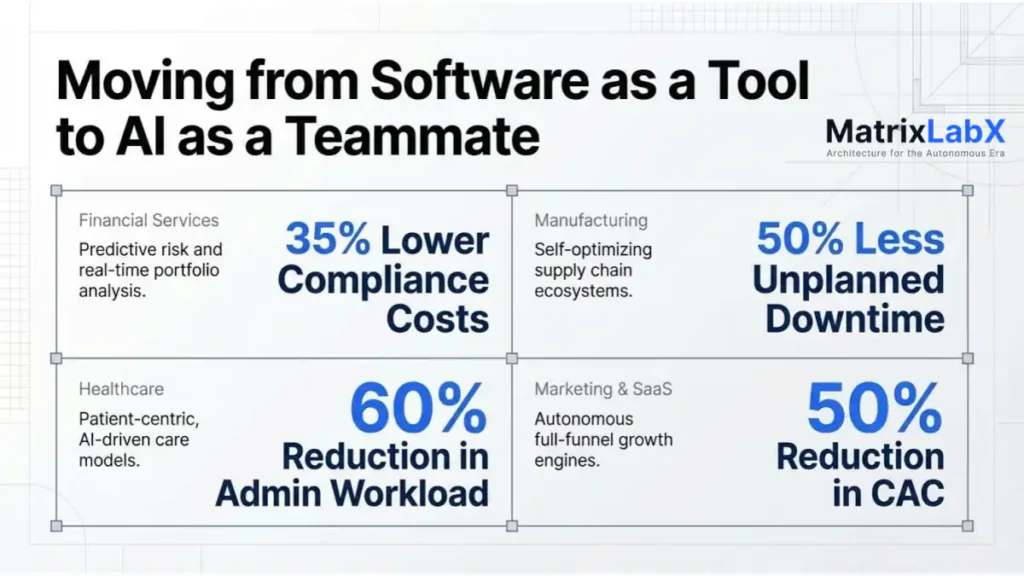
The micro-agency revolution enables nimble firms and enterprises alike to deploy coordinated squads of AI agents, allowing human strategists to focus entirely on creative direction. Here is how Agentic AI is dominating key verticals:
1. SaaS (Software as a Service)
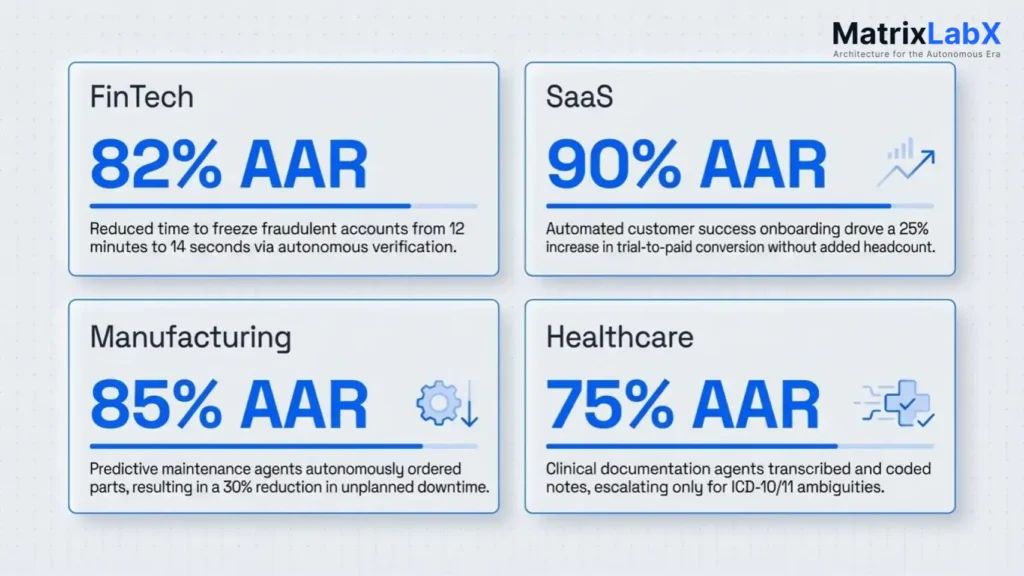
- AAR Benchmark: 90%
- The Use Case: Automated customer success and user onboarding.
- The Impact: SaaS platforms utilizing agentic workflows to autonomously guide users through complex software setups saw a massive 25% increase in trial-to-paid conversions, achieved without adding a single human Customer Success representative to the payroll.
2. FinTech & Financial Services
- AAR Benchmark: 82%
- The Use Case: Fraud detection and automated reporting.
- The Impact: Traditional human-in-the-loop systems required an average of 12 minutes to verify and freeze a compromised, fraudulent account. Agentic autonomous verification reduced this critical window to just 14 seconds, leveraging secure VPCs and real-time causal inference.
3. Manufacturing & Industrial
- AAR Benchmark: 85%
- The Use Case: Predictive maintenance and supply chain orchestration.
- The Impact: Instead of simply predicting that a machine might fail, autonomous agents take proactive action. Predictive maintenance agents autonomously diagnose failing parts, cross-reference supplier APIs, and independently order replacement hardware, resulting in a 30% reduction in unplanned factory downtime.
4. Healthcare & MedTech
- AAR Benchmark: 75%
- The Use Case: Clinical documentation and billing code extraction.
- The Impact: Clinical documentation agents autonomously transcribe patient encounters and translate unstructured voice data into exact medical billing codes. The agent only escalates to human medical coders when faced with highly ambiguous ICD-10/11 edge cases, drastically reducing administrative overhead.
“In 2026, the most valuable companies won’t be those with the largest generative models, but those with the highest AAR across their core business units.” — George Schildge, CEO at MatrixLabX
The Flywheel of Stable Autonomy

Achieving a high AAR is not a static milestone; it requires continuous, iterative feedback loops to maintain stable autonomy.
What is Stable Autonomy?
Stable Autonomy is the ultimate organizational goal for 2027 and beyond. It describes a state in which agents not only execute multi-step tasks flawlessly but also autonomously identify the need for new digital tools, write code for those tools, and integrate them into their workflows to solve novel problems.
Organizations build this capability through the Flywheel Effect:
- Baseline Audit: Identify systemic vulnerabilities and API ambiguities.
- Semantic Tool Grounding: Provide the agent with clear, unambiguous access to metadata.
- Recursive Self-Correction: Introduce a reflection step where the agent double-checks its own logic to catch hallucinations, which actively boosts the AAR by 15-20%.
- Synthetic Data Fine-Tuning: High-AAR systems generate pristine logs of successful autonomous runs. This clean data is then used to further fine-tune the model, creating a mathematical competitive moat that legacy competitors cannot catch up to.
Conclusion: Architecting the Enterprise of Tomorrow
/conGenerative AI was the spark, but Agentic AI is the engine.
For CEOs, the transition from conversational interfaces to autonomous, self-executing digital workforces represents the most significant unit-economy shift since the advent of cloud computing.
Relying on traditional SaaS tools and human-in-the-loop workflows guarantees that the “Middle 80%” of enterprise revenue will remain uncaptured. By embracing the composable canvas and aggressively optimizing for the Agentic Autonomy Ratio (AAR), executives can eliminate linear headcount scaling, radically reduce Customer Acquisition Costs, and deploy self-healing workflows.
The constraint on enterprise growth used to be technical capability. Today, in the era of autonomous microservices, the technology is ready. The only remaining constraint is an organization’s willingness to let go of legacy oversight and trust the mathematics of autonomy. Master the metrics of Agentic AI today, and you will architect the dominant, unassailable enterprise of tomorrow.
FAQ
What is the difference between Generative AI and Agentic AI?
Generative AI acts as a passive tool that requires human prompts to create text, images, or code. Agentic AI is an active, autonomous system that perceives its environment, makes independent decisions, and executes complex, multi-step workflows across applications without requiring constant human intervention.
How does Agentic AI reduce Customer Acquisition Cost (CAC)?
Agentic AI reduces CAC by autonomously optimizing marketing channels, instantly responding to inbound telemetry, and executing hyper-personalized sales interventions 24/7. This eliminates human execution delays and the need for large, scaled sales teams, driving down acquisition costs by up to 52%.
What is a good Agentic Autonomy Ratio (AAR) score fir SaaS firms?
A highly competitive enterprise target for 2026 is an 85% AAR for routine business processes. This represents “High Autonomy,” meaning the AI handles the vast majority of end-to-end tasks independently, only escalating complex, ambiguous edge cases to a human operator for emergency override.
How do autonomous agents handle API failures?
Advanced autonomous agents at Level 4 AAR utilize self-healing loops. Instead of halting and triggering a human intervention alert, the agent initiates an internal diagnostic cycle, browses existing documentation, tests alternative code paths, and autonomously resolves the API failure to preserve workflow integrity.
What is Context-as-a-Service?
Context-as-a-Service where unstructured telemetry and data from siloed sources (like Snowflake and Salesforce) are mapped into a unified causal model. This provides AI agents with the deep, semantic business context required to make accurate, autonomous execution decisions.
Is Agentic AI safe for heavily regulated industries like FinTech?
Yes. Agentic AI systems in regulated industries use strict dual-execution modalities and Virtual Private Clouds (VPCs). They employ a Tri-Layer Security Architecture that includes sentiment grading, token budgeting, and cryptographic protection to ensure absolute compliance before any autonomous outbound action is executed.