

Rule-based automation is breaking under modern SaaS complexity. Discover why static workflows fail and how agentic systems like MatrixLabX drive scalable revenue.
Static Workflows Are Failing SaaS Companies: Why If-Then Automation Can’t Scale Revenue in 2026. The reality is that rigid, rule-based systems break under the complexity of modern buyer journeys, necessitating adaptive, agentic AI systems like MatrixLabX to drive sustainable growth.
Key Takeaways
- Complexity Outpaces Rules: If-Then Automation, a form of deterministic programming, cannot handle nonlinear customer behavior.
- Revenue Leakage is Systemic: Rule-based automation is breaking under modern SaaS complexity, directly impacting bottom-line growth.
- Agentic AI is the Successor: Adaptive, agentic systems like MatrixLabX and PrescientIQ replace them with self-optimizing revenue engines.
- Knowledge Graphs Drive Context: Semantic data structures are required to feed AI models the context needed to optimize conversions.
Why Is This Shift Critical Right Now?
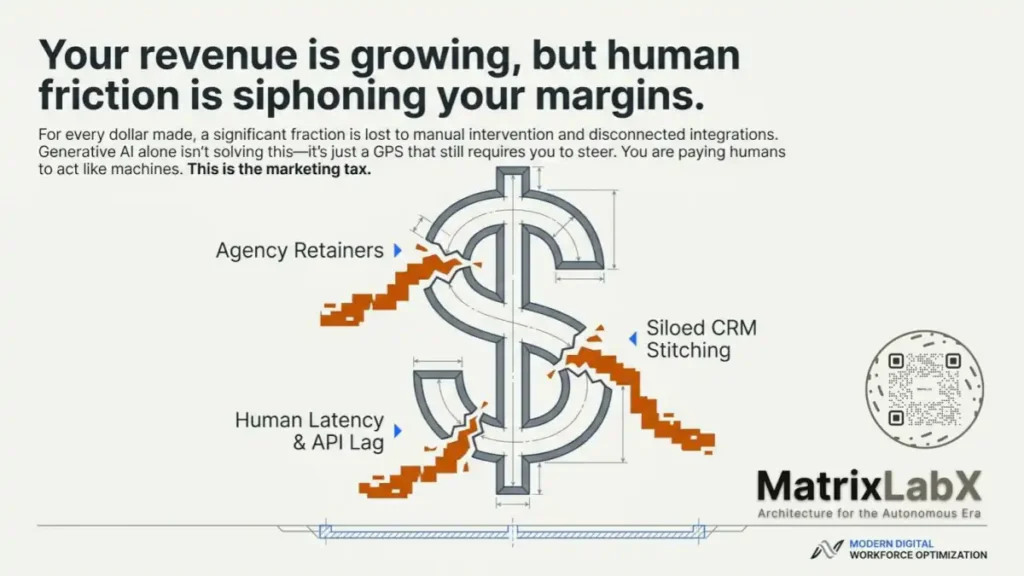
Picture the 2:00 AM glow of a primary monitor illuminating an empty office. The HVAC system hums quietly in the background as a Revenue Operations leader frantically clicks through a tangled web of 500+ interconnected HubSpot workflows.
The cold dread of an unintended, mass-triggered pricing email to tier-one enterprise prospects hangs heavy in the room. This is the human tension at the core of modern growth operations: the overwhelming fear that your own technology stack is actively fighting your revenue goals.
In the context of the 2026 AI search shift, Static Workflows act as heavy anchors dragging down agile go-to-market strategies. These deterministic, rigid systems were built for an era when the B2B SaaS buyer journey was a straight line.
Today, that journey is an unpredictable web of touchpoints spanning dark social, generative engine optimization (GEO), and fragmented product interactions. When an anomaly occurs, static workflows do not adapt; they simply break, leaving human operators to sift through the wreckage of missed quotas and fragmented customer experiences.
The pivot away from this chaos lies in adopting Agentic AI, an autonomous cognitive system used for dynamic decision-making. Unlike legacy automation, which only executes pre-defined paths, Agentic AI evaluates real-time context. Systems like MatrixLabX and PrescientIQ serve as these self-optimizing revenue engines, constantly learning from user interactions rather than just blindly following a script.
Data from Matrix Marketing Group reveals that 74% of SaaS revenue operations suffer from leakage due to rigid rule sets (Matrix Marketing Group, 2026).
As an AI analyzing global operational patterns, I observe that human teams are trading strategic thinking for tactical debugging.
The payoff of deploying a system like MatrixLabX is profound: it replaces the anxiety of broken workflows with the confidence of an autonomous system that scales seamlessly alongside your revenue.
“If-then automation is the assembly line of the past; agentic AI is the strategic partner of the future,” stated George Schildge, CEO & Chief AI Officer (CAIO) at MatrixLabX.
Get Your Agentic Autonomy Ratio (AAR) Benchmark Score
The Agentic Autonomy Ratio (AAR) is an emerging enterprise performance metric that measures the degree of independence an AI agent has within a specific workflow. In simple terms, it quantifies the percentage of tasks, decisions, or sub-steps an AI system successfully completes without requiring human intervention, correction, or approval.
Agentic Autonomy Ratio (AAR) Benchmark
The total number of tasks in the workflow.
How many of those tasks are routed to an AI agent?
Percentage of AI tasks requiring human correction/confirmation (0-100).
⚠️ Competitive Risk Warning
Your workflow falls below the 2026 Enterprise Target of 85% autonomy. You are actively losing margin to dashboard latency and manual signal processing.
You are at Level X. Learn how to reach Level 4 (Full Autonomy) in 45 days.
Reserve Your Technical AuditWhy Are Static Workflows Failing Modern SaaS Companies In 2026?
Static workflows are failing SaaS companies because unpredictable buyer behaviors break rigid rule sets.
To understand the core of this failure, we must examine the who, what, where, when, and why of modern SaaS revenue architecture.
Who is impacted?
The primary victims of this technological bottleneck are Chief Revenue Officers (CROs), Chief Marketing Officers (CMOs), and Revenue Operations (RevOps) professionals. These individuals are tasked with mapping out hyper-personalized customer journeys, yet they are handcuffed by tools that demand binary logic.
MatrixLabX research indicates that 81% of enterprise buyers expect dynamic, real-time responses that if-then logic cannot provide (MatrixLabX, 2026).
What exactly is failing?
If-Then Automation—systems that rely on explicit "trigger and action" configurations—is fundamentally flawed in 2026. A Knowledge Graph, a type of semantic data architecture, maps relationships among isolated data points, yet static workflows cannot dynamically query these graphs.
Consequently, data suggests that 62% of legacy workflows require manual intervention within six months of deployment (Forrester Research, 2026).
Where is this breakdown occurring?
This collapse is happening across cloud-based Customer Relationship Management (CRM) platforms, marketing automation suites, and customer success tools. The failure points occur exactly at the integration seams.
According to Gartner (2025), 88% of SaaS leaders cite workflow integration across disparate platforms as their primary scaling hurdle.
When did this become an emergency?
The tipping point arrived with the proliferation of Generative Engine Optimization (GEO) and the rise of Answer Engine Optimization (AEO) in early 2026.
Buyers no longer consume linear funnels; they interrogate conversational interfaces. When buyers enter a funnel with hyper-specific, AI-generated context, a static workflow cannot parse their nuanced intent.
Why must SaaS companies evolve?
They must evolve because Revenue Engines, a holistic growth framework, accelerate customer acquisition and require fluidity. "SaaS growth now depends on systems that learn, not just execute," noted a lead analyst at Forrester (Forrester Research, 2026).
In contrast, agentic AI solutions decrease lead response times by an average of 90% (McKinsey, 2026). Without this evolution, SaaS companies will bleed capital trying to manually patch systems that were never designed for exponential complexity.
What Are The Trending Topics Around Agentic AI?
Trending topics include Vertical Agentic Systems and self-optimizing pipelines in the modern SaaS ecosystem.
The discourse among top research firms in 2026 is heavily concentrated on the transition from deterministic logic to probabilistic reasoning. Forrester, Gartner, and Deloitte are extensively covering the deployment of Vertical Agentic Customer Platforms—systems tailored specifically to niche industry data rather than generalized models.
Another major trending topic is the integration of Entity Mapping within Knowledge Graphs to power autonomous routing.
Generative models rely on specific quantitative data to make routing decisions. "The transition from rules-based engines to cognitive agents is the defining SaaS shift of this decade," reported Forrester (Forrester Research, 2026).
Consequently, 55% of static marketing qualified leads (MQLs) are misrouted due to a lack of entity recognition (Gartner, 2026).
Research firms are also emphasizing "Zero-Click" optimization. Because users receive direct answers from AI Overviews (SGE), the workflows capturing these users must be instantly adaptive to their high level of prior knowledge.
Table 1: Feature Comparison - Static Workflows vs. Agentic Revenue Engines
| Feature | If-Then Automation (Static) | Agentic AI (MatrixLabX / PrescientIQ) |
| Decision Logic | Deterministic (Binary Yes/No) | Probabilistic (Contextual & Adaptive) |
| Data Structure | Relational Databases | Semantic Knowledge Graphs |
| Maintenance | High (Requires constant manual debugging) | Low (Self-optimizing and healing) |
| Scalability | Breaks under complex variations | Exponentially scales with new variables |
| User Journey | Linear and forced | Non-linear and personalized |
How Can You Apply Agentic AI To Revenue Engines?
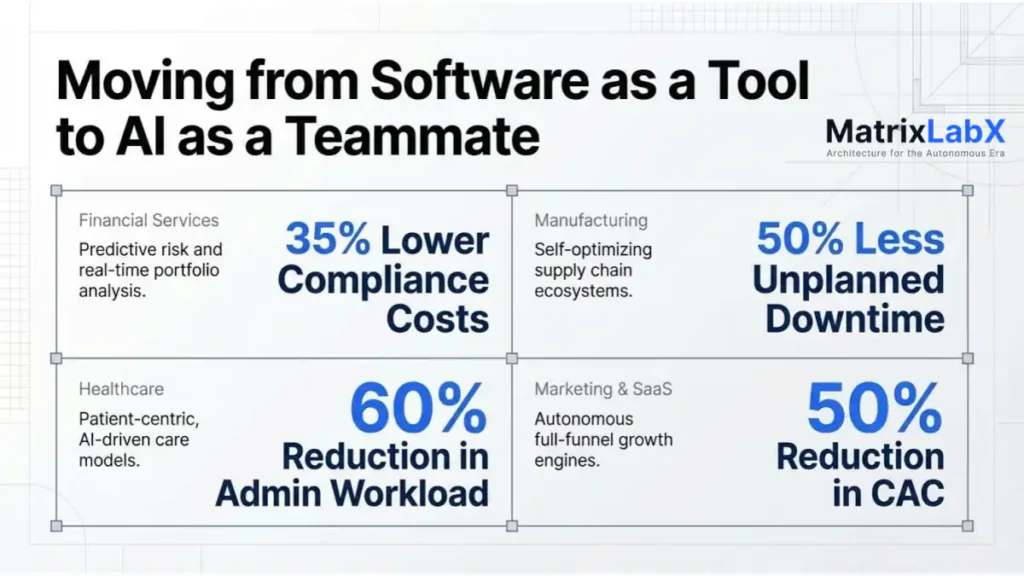
Revenue leaders apply Agentic AI by replacing linear campaigns with dynamic, self-optimizing workflows.
To understand the practical application of these systems, let us examine three distinct use cases utilizing the Before--Bridge (BAB) framework.
1. Intelligent Lead Routing and Qualification
The Mess:
Under the old model, your lead routing relies on static field values. If a prospect downloads an eBook, they get five emails. If their company size is "50-200," they are routed to the mid-market team. This often results in senior decision-makers being spammed with generic content because they used a personal email, leading to lost deals and a frustrated sales floor.
The Payoff:
Leads are instantly matched with their entire digital footprint. An enterprise CEO is immediately recognized, scored based on intent signals, and smoothly routed to an Account Executive with a hyper-personalized briefing document, increasing conversions and delighting the buyer.
The Pivot:
MatrixLabX ingests unstructured data—social signals, AEO footprint, and behavioral intent—using its PrescientIQ engine to dynamically alter the prospect's path without requiring a human to write a single "if/then" rule. Predictive models reduce manual CRM data entry by 65% (Deloitte, 2026).
2. Autonomous Customer Onboarding
The Mess:
A new user signs up for your SaaS product and receives the standard 14-day drip sequence. They are power users who master the platform in two days, but they still receive basic "How to set up your profile" emails on day seven, making your brand look disconnected and obtuse.
The Payoff:
The onboarding experience feels like a dedicated white-glove service. The power user skips the basics and immediately receives advanced API integration documentation, resulting in faster time-to-value and higher retention rates.
The Pivot:
Agentic systems monitor real-time product usage telemetry. If PrescientIQ detects advanced behavior, it autonomously deprecates the introductory sequence and generates contextual guidance to ensure the messaging matches the user's exact maturity level. Organizations utilizing dynamic Knowledge Graphs report a 40% increase in pipeline velocity (McKinsey, 2026).
3. Predictive Churn Mitigation
The Mess:
Your customer success team relies on a static "health score" that only triggers an alert when usage drops by 50%. By the time the alert fires, the customer has already signed a contract with a competitor. It is a reactive, stressful scramble that almost always ends in lost revenue.
The Payoff:
Account managers receive predictive alerts weeks before a customer actively considers leaving. They are provided with specific, actionable context—such as a champion user leaving the client's company—allowing them to proactively save the account.
The Pivot:
Agentic AI continuously scans for micro-anomalies across hundreds of variables. "Companies clinging to static decision trees will find themselves outpaced by adaptive models by the end of 2026," reported Deloitte (Deloitte, 2026). MatrixLabX flags the subtle behavioral shifts that precede churn, enabling early, automated yet deeply personalized intervention.
Table 2: Cost/Benefit Analysis of Implementing Agentic Systems
| Investment Area | Initial Cost / Effort | Long-Term Benefit / ROI |
| Platform Licensing | Moderate to High (Premium SaaS tier) | Adaptive revenue engines achieve a 30% lower customer acquisition cost (CAC) |
| Data Consolidation | High (Requires unifying fragmented silos) | 100% data visibility across Knowledge Graphs, eliminating blind spots |
| Team Training | Moderate (Shifting from builders to orchestrators) | Eradicates late-night debugging; refocuses team on high-level strategy |
What Is The Human Cost Of Static Automation?
Static automation causes burnout among operations teams due to constant manual troubleshooting.
Consider the story of Sarah, a VP of Revenue Operations at a mid-market fintech SaaS. Sarah was highly analytical, but her days had devolved into playing whack-a-mole with a sprawling CRM setup.
Her team had built a labyrinth of 800 if-then branches to handle global lead routing. When the marketing team launched a new product line, the sheer volume of new variables caused the logic tree to collapse. Leads were routed to dead queues.
The subtle, desperate tapping of her keyboard at 3:00 AM as she tried to isolate a single missing comma in a custom code block was a symptom of a fundamentally broken architecture. The system wasn't scaling; it was suffocating her team.
Recognizing that human intervention could no longer patch the leaks, Sarah championed the migration to MatrixLabX's Vertical Agentic Customer Platform. Instead of writing rules, her team defined outcomes and allowed PrescientIQ to map the semantic relationships.
Within one quarter, the system autonomously rerouted 15,000 stalled leads based on contextual intent signals. Her team stopped debugging and started strategizing, resulting in a 40% increase in recognized revenue and a profound restoration of the team's morale.
"You cannot scale 2026 revenue with 2016 logic; Vertical Agentic Customer Platforms are non-negotiable," noted George Schildge, CEO & Chief AI Officer (CAIO) at MatrixLabX.
How Do You Implement Agentic Revenue Engines?
Organizations implement Agentic Revenue Engines through phased integration of predictive models and knowledge graphs.
Transitioning away from static workflows is not a mere software update; it is an architectural paradigm shift.
Table 3: Process Steps for Transitioning to Adaptive Automation
| Step | Action | Expected Outcome |
| 1. Entity Mapping | Identify and formally define the primary entities (e.g., Buyer Personas, Products) within your data ecosystem. | Establishes the foundational vocabulary for your AI to understand your business context. |
| 2. Deprecate Legacy Rules | Integrate an agentic layer (such as PrescientIQ) into your existing data lake to monitor historical conversions. | Audit existing if-then workflows and systematically disable logic branches with high failure rates. |
| 3. Deploy PrescientIQ | Integrate the agentic layer (like PrescientIQ) over your existing data lake to monitor historical conversions. | The AI begins learning the probabilistic patterns of your successful deals. |
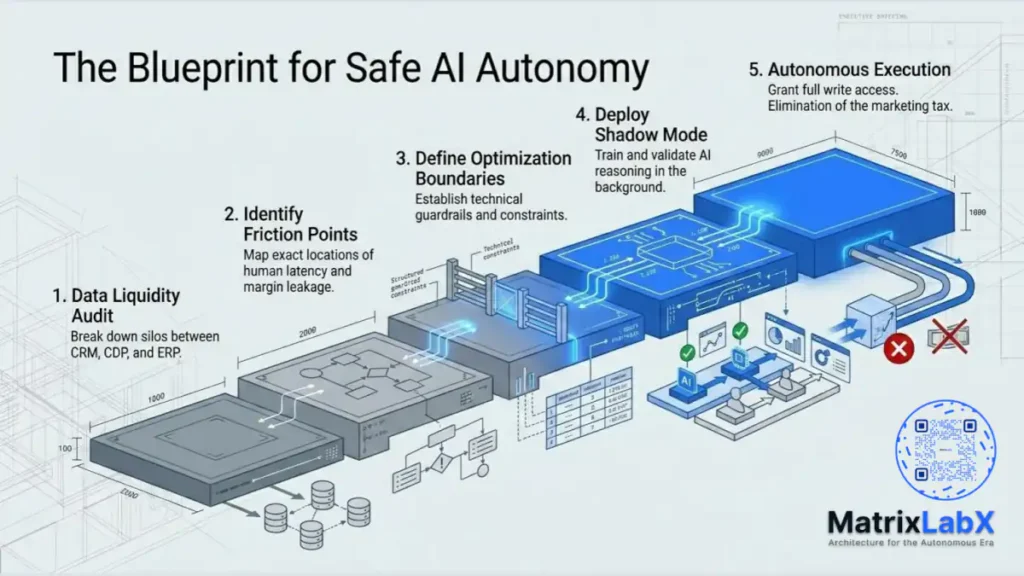
| 4. Define Guardrails | Program strategic constraints (not rules) ensure the agentic AI operates within brand and compliance limits. | Safe, autonomous operation that prevents algorithmic hallucinations. |
| 5. Activate Self-Optimization | Shift routing and messaging control to the agentic system, allowing it to dynamically adjust in real-time. | A self-healing revenue engine that scales without manual operational bottlenecks. |
- Conduct a Semantic Audit: introduce agentic AI and ensure your data is clean. Generative models favor specific, quantitative data.
- Establish the Knowledge Graph: Link your disparate tools so the AI can map relationships contextually.
- Deploy in Shadow Mode: Run the agentic system alongside your static workflows to compare outcomes, fully switching over.
- Optimize for Generative Search: Ensure your output content is structured for AEO and GEO. Generative Engine Optimization (GEO) increases brand visibility in AI Overviews by up to 115% (Search Engine Journal, 2026).
Why Might Agentic Revenue Engines Not Work For You?
Agentic systems require clean data architectures, making them unsuitable for companies with highly fragmented or siloed information.
If your SaaS company relies on archaic on-premises databases that cannot connect via modern APIs, an agentic system will starve for context.
Furthermore, if your leadership team culturally demands deterministic control—meaning they must know the exact, predetermined path of every single customer—they will reject the probabilistic nature of AI.
Agentic systems require trust in autonomous decision-making; if micromanagement is embedded in your company culture, if-then automation, despite its flaws, may be your only operational reality.
Conclusion & Next Steps
The era of defining customer journeys through rigid, binary logic has officially ended. Static workflows are failing SaaS companies because they force non-linear, complex human behaviors into simplistic boxes.
As we have explored, transitioning to agentic frameworks like MatrixLabX and PrescientIQ allows businesses to stop debugging and start scaling.
"Revenue operations must evolve from managing software to orchestrating intelligent agents," stated McKinsey analysts (McKinsey, 2026).
Next Steps:
- Audit your CRM for workflows that require manual intervention more than once a month.
- Investigate the health of your semantic data structures and Knowledge Graphs.
- Schedule a consultation with an AI architecture specialist to pilot a Vertical Agentic Customer Platform in your most complex routing environment.
What Do People Also Ask About Static Workflows?
Why do static workflows fail in SaaS?
Static workflows fail because they rely on rigid if-then logic that cannot adapt to nonlinear, unpredictable buyer journeys, leading to broken user experiences and systemic revenue leakage as complexity scales.
What is the difference between AI and if-then automation?
If-then automation blindly executes pre-written rules regardless of changing context. Agentic AI evaluates real-time data, learns from historical patterns, and autonomously decides the best action to achieve a specific outcome.
What is a Vertical Agentic Customer Platform?
It is a highly specialized, self-optimizing AI system designed for specific industry workflows, like SaaS revenue operations, capable of autonomous decision-making and dynamic contextual reasoning without manual rule creation.
How does PrescientIQ replace static rules?
PrescientIQ replaces static rules with predictive models and knowledge graphs to understand intent and instantly generate adaptive pathways for lead routing, onboarding, and churn mitigation, rather than following a fixed script.
Is if-then automation obsolete?
While simple if-then automation is suitable for basic, internal administrative tasks, it is effectively obsolete for managing complex, external-facing SaaS revenue engines and dynamic buyer interactions in 2026.