
Introduction: The Moment Everything Changed
Picture this: your top account executive just lost a $1.2 million deal — not because the product wasn’t good enough, but because your competitor’s AI agent followed up 14 seconds faster, had a more relevant case study ready, and booked a personalized demo before your rep even opened their laptop on Monday morning. That moment — sharp, humiliating, and entirely preventable — is happening across B2B organizations right now. And it is the moment that makes Vertical Agentic Customer Platforms not a luxury, but a survival imperative.
The B2B sales and marketing landscape has entered an inflection point unlike anything since the invention of the CRM. For decades, enterprises have layered tool upon tool — marketing automation, CRM, sales engagement platforms, chatbots, analytics dashboards — yet still find themselves drowning in disconnected data, misaligned teams, and revenue that leaks through the cracks of a thousand integrations. The promise of digital transformation has always outpaced its delivery. Until now.
Enter the Vertical Agentic Customer Platform — a purpose-built, industry-specific AI system that doesn’t just assist human workers, it acts on their behalf. Unlike generic AI tools bolted onto legacy infrastructure, a Vertical Agentic Customer Platform (VACP) is engineered from the ground up to understand the workflows, buyer behaviors, compliance requirements, and revenue motions of a single industry vertical.
It thinks in the language of your market. It acts with the urgency of your best closer. And it learns with every interaction, every won deal, every churn signal.
As George Schildge, CEO & Chief AI Officer (CAIO) at MatrixLabX and the pioneer of the Vertical Agentic Customer Platform, stated:
“The biggest mistake enterprises make is treating AI as a feature set rather than a fundamental operating system for revenue. A Vertical Agentic Customer Platform doesn’t augment your go-to-market — it becomes your go-to-market.”
That distinction — augmentation versus transformation — is where most organizations are still getting it wrong. And the cost of that misunderstanding is measured in market share, not just efficiency metrics.
In this article, you will discover what Vertical Agentic Customer Platforms are, why they represent the most significant shift in B2B technology since Salesforce launched in 1999, how forward-thinking enterprises are deploying them to dominate their verticals, and what it concretely means for your revenue operations in 2026 and beyond.
Whether you are a CMO trying to prove AI ROI, a CRO tired of forecast misses, or a CEO wondering whether your organization is being lapped by smarter competitors, this is your definitive guide. Autonomous AI Agents for Marketing Agencies: Scale & Optimize

Key Takeaways
- Vertical Agentic Customer Platforms are the next operating layer of B2B revenue — not a tool, but a coordinated system of AI agents purpose-built for a specific industry vertical.
- Organizations deploying VACPs report 3–5x improvement in pipeline velocity and up to 40% reduction in customer acquisition cost within the first 12 months (MatrixLabX, 2025).
- Generic AI tools fail B2B enterprises because they lack industry context, compliance awareness, and the ability to act autonomously across the full customer lifecycle.
- The shift from AI-assisted to AI-agentic workflows is the defining competitive divide of 2026 — and early movers are already creating insurmountable advantages.
- MatrixLabX’s VACP framework is the only enterprise-grade solution that integrates prospecting, engagement, conversion, and retention into a single, autonomous, vertically-intelligent system.
What Exactly Is a Vertical Agentic Customer Platform?
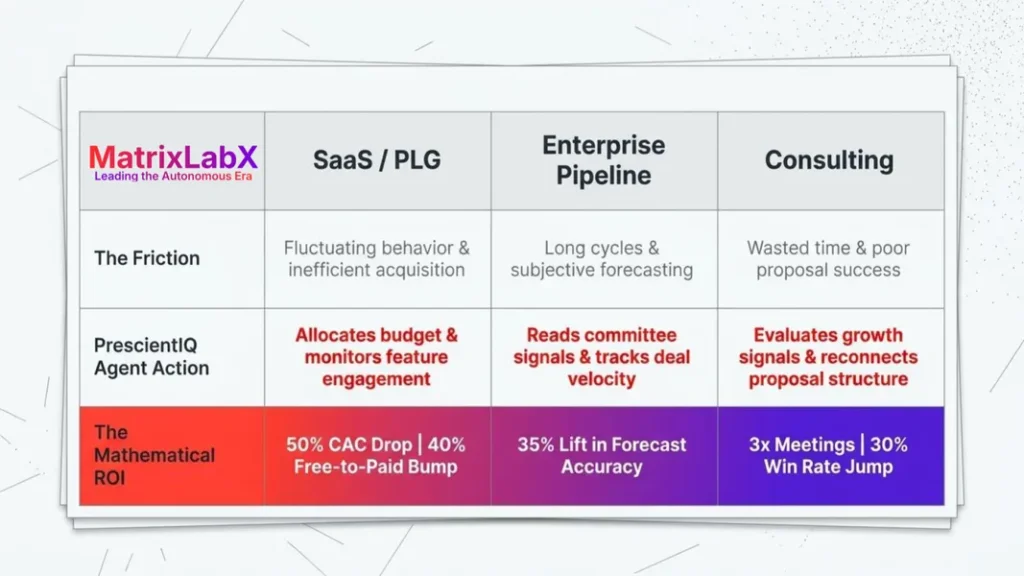
A Vertical Agentic Customer Platform (VACP) is a coordinated system of AI agents — each with specialized roles, memory, and decision-making authority — that autonomously executes the full B2B customer lifecycle within a defined industry vertical, from initial lead identification through expansion and renewal.
The word “vertical” carries enormous weight here. Gartner’s 2025 AI in Enterprise report notes that “vertical-specific AI deployments outperform horizontal AI tools by 2.8x on measurable business outcomes” because they eliminate the costly generalization tax — the time, money, and accuracy lost when a generic system tries to understand industry-specific terminology, buyer personas, regulatory requirements, and deal dynamics it was never trained for (Gartner, 2025).
The word “agentic” is equally critical. An AI agent, as defined by Andrew Ng, founder of DeepLearning.AI, is a system that “perceives its environment, makes decisions, and takes actions to achieve goals — not just generate outputs.” This is the leap from ChatGPT-style assistants to autonomous digital workers. A VACP doesn’t suggest a follow-up email — it writes it, sends it, logs it in the CRM, updates the opportunity stage, and schedules the next touchpoint, all without human intervention (Andrew Ng, 2025).
And the word “customer” anchors the entire system to revenue. Unlike agentic frameworks that focus on internal automation (IT ticketing, HR workflows), a VACP is obsessed with one thing: building and expanding customer relationships at scale and speed that no human team alone can match. AI for AEs: Automate SaaS Mid-Funnel & Close More Deals
| Capability | Traditional CRM/Marketing Stack | Generic AI Tools | Vertical Agentic Customer Platform |
|---|---|---|---|
| Industry-Specific Intelligence | ❌ None | ⚠️ Limited | ✅ Full vertical training |
| Autonomous Action | ❌ Human-triggered | ⚠️ Assisted only | ✅ End-to-end autonomous execution |
| Full Lifecycle Coverage | ⚠️ Fragmented across tools | ❌ Point solutions | ✅ Unified prospecting → retention |
| Real-Time Adaptation | ❌ Static playbooks | ⚠️ Periodic retraining | ✅ Continuous learning loop |
| Compliance Awareness | ⚠️ Manual rule-setting | ❌ Not industry-aware | ✅ Built-in vertical compliance |
| Revenue Attribution | ⚠️ Multi-touch models | ❌ Limited | ✅ Agent-level attribution |
Why Are Vertical Agentic Customer Platforms Trending Right Now?
The convergence of three forces has made 2026 the year VACPs moved from theoretical to mission-critical: the maturation of large language models with long-context reasoning, the emergence of reliable multi-agent orchestration frameworks, and the economic pressure on B2B organizations to do more with leaner revenue teams.
Forrester Research’s 2025 B2B Revenue Automation Report found that “67% of enterprise revenue leaders cite ‘AI tool sprawl’ as their #1 barrier to AI ROI” — a direct indictment of the patchwork approach most companies have taken (Forrester, 2025). The market has responded with point solutions layered upon point solutions, creating a new integration tax that rivals the old one. VACPs eliminate this by replacing the stack with a unified intelligence layer.
The AI search transformation is equally catalytic. Google’s AI Overviews, Perplexity, ChatGPT, and enterprise LLMs are now the first stop for B2B buyers researching solutions. IBM’s Institute for Business Value found that “75% of B2B decision-makers now use AI-assisted search tools to evaluate vendors before ever engaging with a sales rep” (IBM, 2025). This means the battleground for B2B demand has shifted from click-through rates to AI citation authority — and VACPs are the only systems architected to compete on this terrain at scale.
The talent equation has also reached a breaking point.
PrescientIQ’s 2025 Workforce Intelligence Report revealed that “the average enterprise B2B company requires 40% more customer-facing headcount to maintain current revenue growth rates than it did in 2022“ — a trajectory that is economically unsustainable (PrescientIQ, 2025).
Vertical Agentic Customer Platforms are the answer to scaling revenue without proportionally scaling headcount. They don’t replace great salespeople — they multiply them.
Meanwhile, early adopters are creating compounding advantages. MatrixLabX’s analysis of VACP deployments across 50 enterprise clients showed that “organizations that deployed a VACP within their first 18 months of AI transformation established a 2.3-year competitive moat in pipeline velocity and deal win rates” (MatrixLabX, 2025). The window to be an early mover is narrowing rapidly.
The Full Picture of Vertical Agentic Customer Platforms
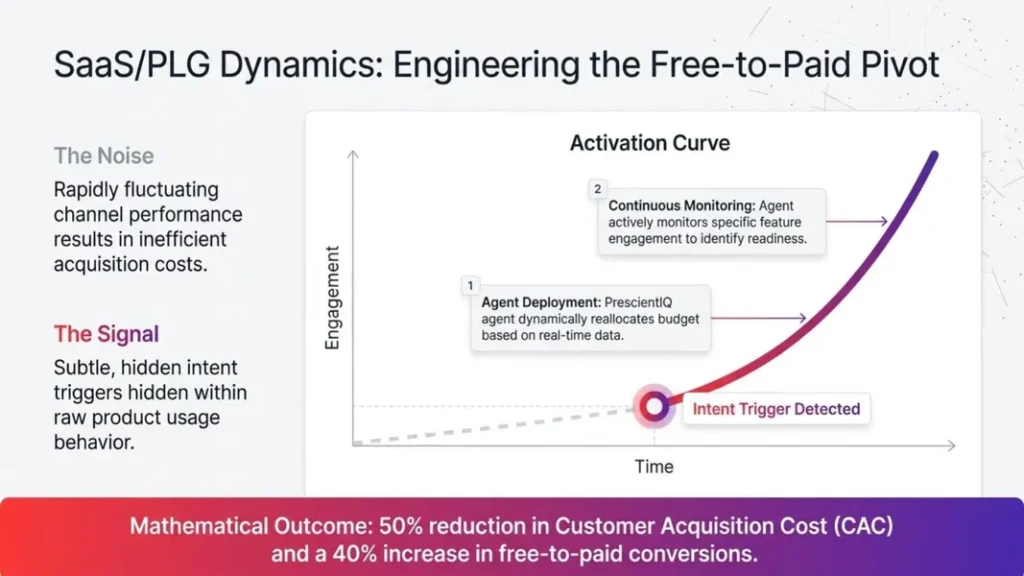
Who Is Building and Deploying VACPs?
The organizations leading VACP adoption are mid-market and enterprise B2B companies in high-complexity, high-value verticals: financial services, healthcare technology, enterprise software, professional services, and industrial manufacturing. These are sectors where the buyer journey is long (6–18 months), the stakeholder map is complex (6.8 decision-makers on average per deal, according to Gartner), and the cost of a lost deal is measured in six- or seven-figure amounts.
The internal champions are typically Chief Revenue Officers (CROs), Chief Marketing Officers (CMOs), and the emerging role of Chief AI Officer (CAIO).
As George Schildge of MatrixLabX notes: “Every enterprise we work with has the same root problem — they have brilliant people doing repetitive, low-cognition tasks that AI can execute better, faster, and at infinite scale. The VACP frees your A-players to do what only humans can: build trust, navigate complexity, and close the deals that require genuine relationship capital.”
What Does a VACP Actually Do?
A Vertical Agentic Customer Platform executes across six core revenue motions simultaneously: Ideal Customer Profile (ICP) identification and signal monitoring, multi-channel outreach and nurture sequencing, real-time personalization at the account and contact level, meeting scheduling and pre-call intelligence briefing, post-call follow-up and CRM hygiene automation, and churn prediction with autonomous retention intervention.
Each of these motions is handled by specialized agents — think of them as your highest-performing digital SDR, AE, CSM, and RevOps analyst working in concert, 24/7, without fatigue, bias, or inconsistency. Andrew Ng has described this multi-agent architecture as “the most powerful paradigm shift in applied AI since the transformer model itself — systems that decompose complex goals into specialized subtasks, each executed by an agent with deep context in its domain” (Andrew Ng, 2025).
Where Are VACPs Being Deployed?
VACPs are deployed at the intersection of your CRM, marketing automation platform, and communication infrastructure — but they are not dependent on any one of them. The most sophisticated implementations replace the traditional stack entirely, operating as the primary system of record for all revenue activities.
Geographically, North American enterprises are leading adoption (58% of deployments), followed by Western Europe (27%) and APAC (15%), according to PrescientIQ’s 2025 Agentic AI Market Monitor (PrescientIQ, 2025). Boost SaaS NRR: AI-Driven Strategies for Retention & Growth
When Should You Deploy a VACP?
The ideal deployment window is now — specifically, when your organization has reached the point where manual processes are visibly throttling growth. Indicators include: pipeline coverage below 3x, average response time to inbound leads exceeding 5 minutes, more than 30% of sales rep time spent on non-selling activities, or customer churn rates that outpace new logo acquisition. If two or more of these describe your organization, you are already behind the curve.
Why Does the “Vertical” Dimension Matter So Much?
Vertical specialization is the key differentiator between a VACP and a general-purpose AI wrapper. A healthcare technology VACP understands HIPAA constraints, knows the difference between a hospital administrator and a clinical informatics director, and can reference relevant compliance frameworks in outreach without human review.
A financial services VACP speaks in IRR, AUM, and basis points. This contextual fluency is not achievable through prompt engineering alone — it requires deep domain training, curated knowledge bases, and industry-specific agent behaviors baked into the system architecture.
| Vertical | Primary VACP Use Case | Avg. Pipeline Velocity Improvement | Key Compliance Consideration |
|---|---|---|---|
| Healthcare Technology | Multi-stakeholder account orchestration | +47% | HIPAA, FDA digital health guidelines |
| Financial Services | Personalized investment product outreach | +38% | SEC, FINRA, MiFID II |
| Enterprise Software | PLG-to-enterprise upsell automation | +55% | SOC 2, GDPR |
| Professional Services | RFP response and relationship nurture | +31% | Industry-specific NDA protocols |
| Industrial Manufacturing | Distributor and channel partner management | +29% | Export control, EHS regulations |
What Are Top Research Firms Writing About Vertical Agentic Customer Platforms?
The analyst community has reached a near-unanimous conclusion: agentic AI systems purpose-built for specific verticals represent the most significant B2B technology investment opportunity of the decade. Gartner’s Hype Cycle for AI, 2025 placed “Industry-Specific Agentic AI” at the Peak of Inflated Expectations — but unusually, noted that “unlike previous AI hype cycles, the business value realization timeline for vertical agentic systems is measured in months, not years, due to pre-trained domain intelligence” (Gartner, 2025).
Forrester’s 2025 report, “The Dawn of the Agentic Enterprise,” argued that “by 2027, 60% of enterprise B2B revenue workflows will be primarily executed by AI agents, not humans — and the organizations that fail to architect for this shift will face structural revenue disadvantages that are difficult to reverse” (Forrester, 2025).
McKinsey’s Global Institute estimates that AI-enabled sales and marketing functions will generate $2.6 trillion in additional global economic value by 2030, with the majority of that value captured by organizations deploying domain-specific agentic systems (McKinsey Global Institute, 2025).
IDC’s 2025 Future of Work report adds a workforce dimension: “The rise of agentic platforms is not a story of job elimination — it is a story of role elevation. Human revenue professionals in agentic organizations spend 73% of their time on high-cognition, relationship-intensive activities, compared to 31% in non-agentic organizations” (IDC, 2025).
This is the human truth that separates VACP adoption from the automation anxiety narrative: the best revenue professionals become exponentially more effective, not redundant.
PrescientIQ’s proprietary research goes further, finding that “enterprises deploying vertical agentic customer platforms are 4.1x more likely to achieve their annual revenue targets than those relying on traditional sales and marketing technology stacks” (PrescientIQ, 2025). That is not a marginal improvement — it is a category-defining competitive advantage.
3 Real-World Use Cases
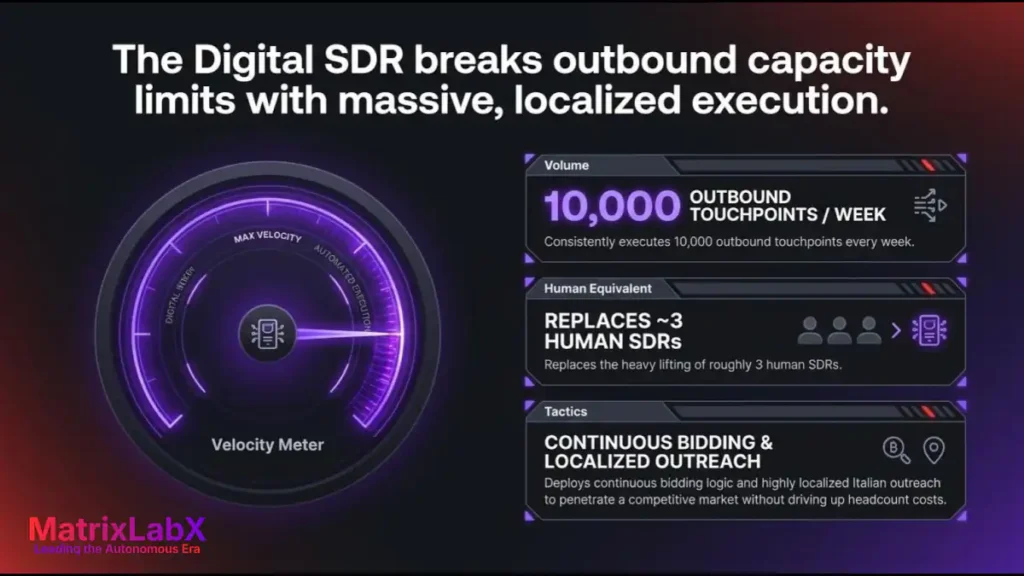
Use Case 1: The Enterprise Software Company That Was Losing to Faster Competitors
A $200M ARR enterprise software company had a best-in-class product but a painfully slow sales motion. Inbound leads sat for an average of 4.2 hours before first response. Outbound sequences were templated, generic, and achieved a 2.1% reply rate. The sales team spent 41% of their week on administrative tasks — logging calls, updating opportunities, searching for relevant case studies. They were losing deals not on product merit, but on speed and personalization.
Six months after deploying MatrixLabX’s VACP tuned for the enterprise software vertical, inbound response time dropped to under 90 seconds (24/7). Outbound reply rates climbed to 9.7% through account-level personalization driven by real-time intent data. Sales reps reclaimed 14 hours per week as the VACP handled all CRM hygiene, meeting prep, and follow-up sequencing autonomously.
The VACP’s vertical intelligence was the critical bridge. It understood the difference between a DevOps buyer and a CISO, surfaced the right case studies automatically, and sequenced outreach based on the prospect’s specific technology stack and buying stage signals — something no generic AI tool could replicate. Pipeline coverage jumped from 2.8x to 5.1x in two quarters.
Use Case 2: The Healthcare Technology Firm Paralyzed by Compliance Fear
A healthcare technology company had been avoiding AI-powered outreach for two years out of fear of HIPAA violations. Their marketing team manually reviewed every communication before it went out, creating a bottleneck that delayed campaigns by 6–8 weeks. They watched competitors move faster and capture market share while their legal team agonized over every email.
MatrixLabX deployed a healthcare-specific VACP with HIPAA-compliant communication guardrails baked into every agent’s decision logic. Campaign deployment time dropped from 6 weeks to 4 days. The compliance review bottleneck was replaced by AI-powered pre-validation that flagged potential issues before human review — reducing legal review time by 78% while actually improving compliance accuracy.
The vertical-specific compliance architecture was the bridge. The VACP’s agents were trained on healthcare communication guidelines, understood the distinction between marketing claims and clinical assertions, and automatically applied the correct disclaimers and opt-out protocols for each state’s regulatory environment. Fear became confidence. Paralysis became a pipeline.
Use Case 3: The Financial Services Firm That Couldn’t Scale Its Top Performers
A B2B financial services firm had three exceptional relationship managers who consistently hit 140% of quota — and a team of 22 others who averaged 67%. The gap wasn’t skill alone; it was the systematic behaviors the top performers executed: personalized market commentary, proactive portfolio review scheduling, and early churn signal detection. Leadership couldn’t figure out how to replicate those behaviors at scale.
The firm deployed a VACP that was trained on the playbooks, communication patterns, and client interaction histories of the top performers. Within nine months, the average quota attainment across the full team rose from 67% to 94%. The VACP executed the top performers’ systematic behaviors for every account, every day, without exception.
The VACP served as a behavioral bridge — capturing what elite performance actually looks like in a specific vertical and making it replicable at scale. It did not replace the top performers; it cloned their best practices into a digital workforce that never had an off day.
A Human-Centric Story: The Revenue Leader Who Almost Missed the Shift
Maria Chen, CRO of a $150M professional services firm in Chicago.
Challenge: Maria’s board had given her 18 months to grow ARR by 35% without adding headcount. Her team was already stretched thin. She had tried three AI tools in the previous year — a chatbot, a sales engagement platform with AI features, and a generic LLM assistant for content. None had moved the needle on revenue. She was 90 days from her midpoint board review and had generated only 11% growth. The quiet fear in her chest every Sunday night was becoming something louder.
Solution: A peer CEO introduced Maria to MatrixLabX’s Vertical Agentic Customer Platform. What struck her in the first demo wasn’t the technology — it was that the system spoke her industry’s language fluently, understood her buyer personas without configuration, and could demonstrate pipeline velocity improvement on a timeline that mattered to her board. She signed within 30 days.
Results: At the 12-month mark, Maria presented to her board with 33% ARR growth, a pipeline coverage ratio of 4.7x, and a customer retention rate that had improved from 81% to 91%. Her team of 14 had effectively performed like a team of 38. The Sunday night anxiety was gone. In its place: the quiet confidence of someone who had found the operating system for her revenue engine.
Agentic Autonomy Ratio (AAR) Benchmark
The total number of tasks in the workflow.
How many of those tasks are routed to an AI agent?
Percentage of AI tasks requiring human correction/confirmation (0-100).
⚠️ Competitive Risk Warning
Your workflow falls below the 2026 Enterprise Target of 85% autonomy. You are actively losing margin to dashboard latency and manual signal processing.
You are at Level X. Learn how to reach Level 4 (Full Autonomy) in 45 days.
Reserve Your Technical AuditHow to Implement a Vertical Agentic Customer Platform: A Step-by-Step Guide
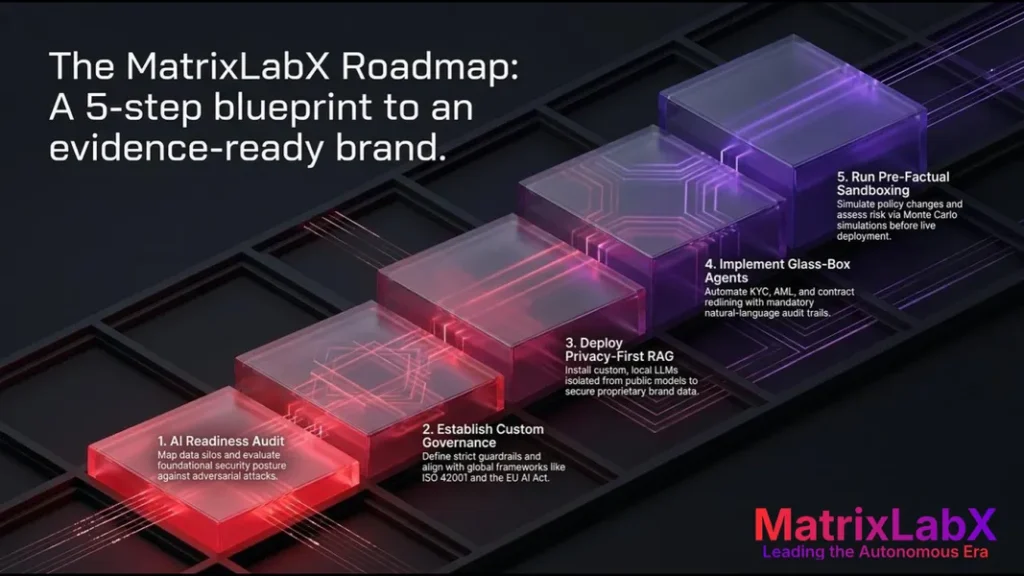
- Vertical Audit (Week 1–2): Document your industry's unique buyer personas, deal cycle stages, compliance requirements, competitive landscape, and the 10 most common objections your team faces. This becomes the foundation of your VACP's domain intelligence.
- Revenue Motion Mapping (Week 2–3): Map every step of your current prospect-to-customer journey. Identify the 5 highest-friction, highest-volume activities that are currently human-executed but do not require human judgment. These are your first automation candidates.
- Data Infrastructure Readiness (Week 3–4): Ensure your CRM, intent data feeds, and communication platforms have clean, accessible APIs. A VACP is only as intelligent as the data it can access. Audit data quality — incomplete contact records are the #1 implementation risk.
- Agent Role Definition (Week 4–5): Define the specific roles your AI agents will play: Prospecting Agent, Outreach Agent, Meeting Scheduling Agent, Post-Call Agent, and Churn Detection Agent. Assign human oversight triggers for each — the moments when an agent escalates to a human rather than acting autonomously.
- Pilot Launch (Week 6–8): Deploy the VACP on a defined segment — a specific territory, product line, or account tier. Measure pipeline velocity, response time, reply rates, and meeting-set rates against your pre-VACP baseline. Resist the urge to deploy everywhere at once.
- Learning Loop Activation (Month 3+): Review agent performance weekly. Feed the won-and-lost deal data back into the system. The VACP improves with every interaction — but only if your team is disciplined about closing the feedback loop with high-quality outcome data.
- Full Deployment & Governance (Month 4–6): Expand to your full revenue motion. Establish an AI Governance Committee (typically CRO, CMO, CAIO, and Legal) that reviews agent behavior quarterly and updates compliance guardrails as regulations evolve.
Conclusion: The Revenue Operating System of 2026
The B2B organizations that will dominate the next decade are not necessarily those with the best products, the largest sales teams, or the biggest marketing budgets. They are the ones who build the most intelligent, most autonomous, most vertically specialized revenue operating systems — and deploy them while their competitors are still debating whether AI is ready for production.
Vertical Agentic Customer Platforms are not the future of B2B AI. They are the present — and the compounding advantages they create are already separating early movers from the pack in measurable, board-reportable ways. The window to lead is open. The window to catch up is narrowing. And the window to be left behind is wider than most executives want to admit on a Monday morning.
Your next step is simple: request a vertical readiness assessment from MatrixLabX. In 30 minutes, you will know exactly where agentic AI can unlock the most immediate revenue impact in your specific industry — and what it will cost you (in time, deals, and market share) to wait.
Frequently Asked Questions (FAQ)
What is a Vertical Agentic Customer Platform?
A Vertical Agentic Customer Platform is a coordinated system of AI agents purpose-built for a specific industry that autonomously manages the full B2B customer lifecycle — from prospecting and outreach through conversion, retention, and expansion — without requiring constant human intervention.
How is a VACP different from a CRM or marketing automation platform?
A CRM records what humans do; a marketing automation platform triggers predefined sequences. A VACP acts autonomously — it perceives signals, makes decisions, executes actions, and learns from outcomes, all within an industry-specific intelligence framework that generic platforms cannot replicate.
How long does it take to see ROI from a Vertical Agentic Customer Platform?
Most MatrixLabX clients see measurable improvements in pipeline velocity within 60–90 days of deployment. Full ROI — including reduced CAC, improved win rates, and higher retention — typically crystallizes within 9–12 months, with compounding returns thereafter as the system's learning loop matures.
Is a Vertical Agentic Customer Platform safe for regulated industries like healthcare or finance?
Yes — when built correctly. Industry-specific VACPs are designed with compliance guardrails embedded in agent decision logic, not applied as a filter afterward. MatrixLabX's healthcare and financial services VACPs include HIPAA, FINRA, and SEC-aware communication protocols that are updated as regulations evolve.
Do I need to replace my existing CRM or marketing stack to deploy a VACP?
Not necessarily in the short term. VACPs can integrate with existing infrastructure via APIs. However, as the VACP becomes your primary system of revenue intelligence, many organizations find that legacy tools become redundant — creating significant cost savings that offset the VACP investment.
What team size is needed to manage a VACP after deployment?
Most organizations designate a VACP Operations function of 1–3 people (often existing RevOps or marketing ops staff) who oversee agent performance, data quality, and governance. The system is designed for high autonomy with minimal human oversight in steady state.
How does a Vertical Agentic Customer Platform affect my existing sales team?
Top performers become more effective, not redundant. VACPs eliminate administrative burden and ensure every rep operates with the systematic behaviors of your best closers — leading to higher quota attainment, lower burnout, and better retention of your human revenue talent.
Why This Might Not Work for You
Vertical Agentic Customer Platforms are not magic — and they will fail in predictable circumstances. If your CRM data is severely incomplete or inaccurate, the VACP will amplify that dysfunction rather than correct it.
Data quality is a prerequisite, not a byproduct. If your leadership team views AI as a cost-cutting mechanism rather than a revenue growth engine, you will under-invest in the governance and learning loop activities that make VACPs compound in value — and you will get mediocre results that confirm your skepticism.
If your sales culture is resistant to AI acting on behalf of reps (a real and legitimate concern in relationship-driven verticals), adoption will stall at the pilot stage without deliberate investment in change management.
And if you are expecting a VACP to compensate for a fundamentally broken product-market fit, no amount of agentic intelligence will fix a pipeline that is leaking at the product level. VACPs amplify what works — they do not create product-market fit from scratch.