

Stop paying the e-commerce marketing tax. Learn how digital workforce systems replace manual workflows and agencies with autonomous AI execution.
Key Takeaways:
- Traditional e-commerce operations bleed profit through a “marketing tax”—the hidden costs of fragmented agencies and manual integrations.
- Agentic AI marks the shift from passive copilots to autonomous digital workers capable of multi-step reasoning.
- Enterprises deploying these systems are reclaiming massive operational bandwidth and drastically lowering acquisition costs.
- Governance, data liquidity, and clear entity optimization are required to prevent AI hallucination and siloed failures.
The E-Commerce Digital Workforce is a system of autonomous AI agents designed to replace manual marketing workflows and agency dependencies with self-executing, data-driven actions.
What is the e-commerce marketing tax, and why is it destroying your margins?
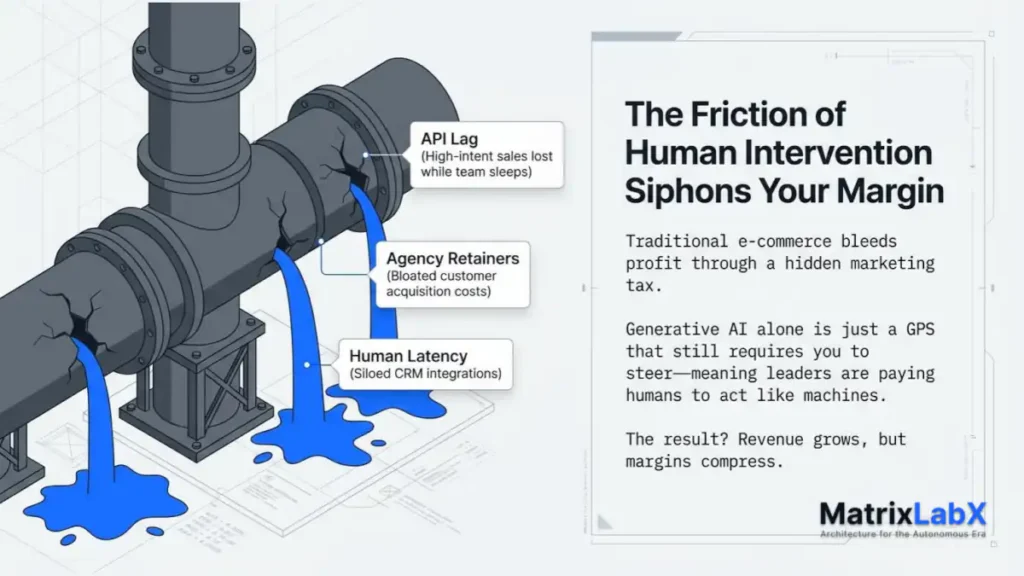
The marketing tax drains your e-commerce profitability. Right now, you are likely sitting at a desk, the faint hum of your office’s HVAC system fading into the background, staring at an analytics dashboard with a knot of anxiety in your stomach.
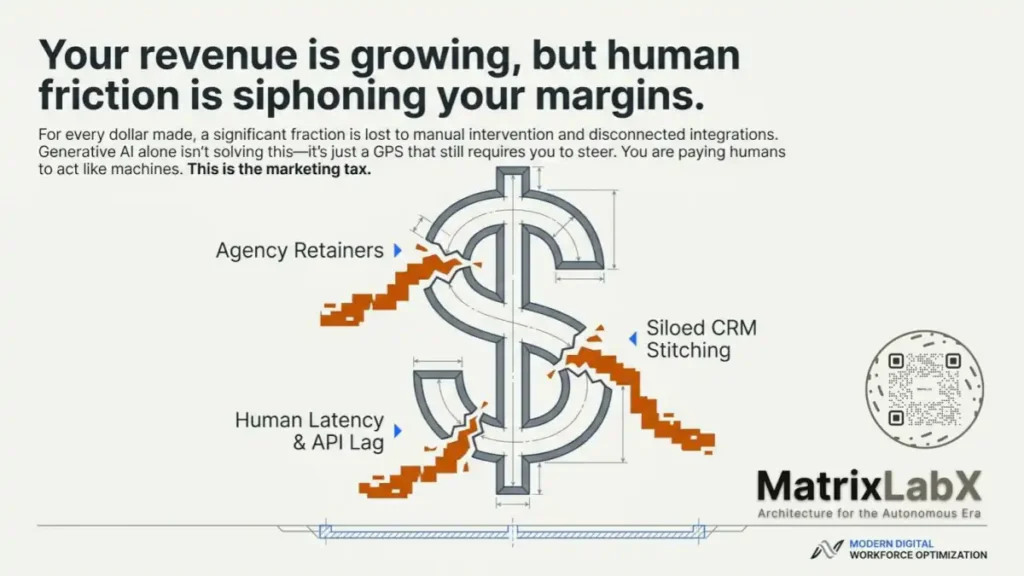
Your revenue is growing, but your margins are shrinking.
Why?
Because for every dollar you make, a significant fraction is siphoned off by the friction of human intervention. You are paying agencies to manage ads, hiring coordinators to stitch together siloed Customer Relationship Management (CRM) tools, and watching your Customer Acquisition Cost (CAC) inflate. This is the e-commerce marketing tax.
In the context of the 2026 AI search shift, Digital Workforce Systems act as the ultimate margin-reclaiming mechanism.
Data suggests that piecemeal automation is no longer enough. Generative AI (like basic chatbots) requires constant human prompting—a GPS that still requires you to steer. Consequently, leaders are waking up to a missed opportunity: they are paying humans to act like machines.
The Problem (The Mess): You launch a holiday campaign. Traffic spikes, but your legacy platform fails to trigger the abandoned cart sequence in real time due to API lag. Your team is asleep, and by the time they sip their stale morning coffee and reboot the workflow, thousands of dollars in high-intent sales have vanished.
The Pivot: A Vertical Agentic Customer Platform, a specialized infrastructure for autonomous execution, eliminates this gap. Instead of waiting for a human to hit “send,” Agentic AI—a form of artificial intelligence that reasons, plans, and executes goals autonomously—detects the latency, reroutes the data, and executes the personalized recovery sequence instantly.
The Payoff: You wake up not to a crisis-management meeting but to a fully optimized revenue report. The sheer emotional relief of trusting an autonomous system replaces the chronic, stomach-dropping anxiety of human-bound latency.
What are the trending topics around the subject of the e-commerce digital workforce?
The transition from automation to autonomy dominates industry trends. To understand this paradigm shift, we must look at the who, what, where, when, and why of the digital workforce.
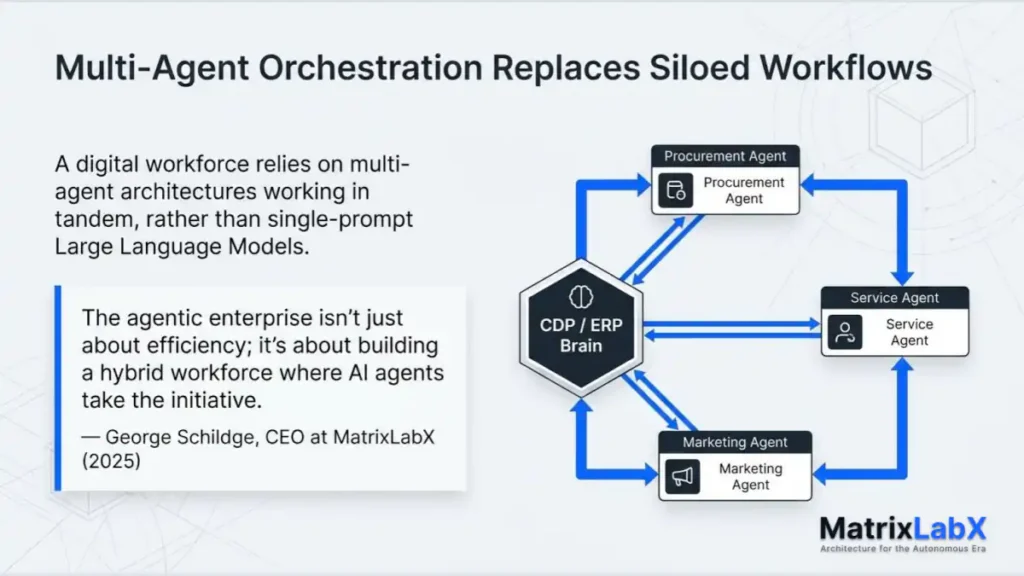
The primary actors driving this shift are Chief Data and Analytics Officers (CDAOs) and Chief AI Officers (CAIOs). George Schildge, CEO & Chief AI Officer (CAIO) at MatrixLabX, the pioneer of the Vertical Agentic Customer Platform and Systems, notes that leadership must transition from operating workflows to orchestrating digital labor. “The agentic enterprise isn’t just about efficiency; it’s about building a hybrid workforce where AI agents take the initiative,” (Schildge, 2025).
Get Your Agentic Autonomy Ratio (AAR) Benchmark Score
The Agentic Autonomy Ratio (AAR) is an emerging enterprise performance metric that measures the degree of independence an AI agent has within a specific workflow. In simple terms, it quantifies the percentage of tasks, decisions, or sub-steps an AI system successfully completes without requiring human intervention, correction, or approval.
Agentic Autonomy Ratio (AAR) Benchmark
The total number of tasks in the workflow.
How many of those tasks are routed to an AI agent?
Percentage of AI tasks requiring human correction/confirmation (0-100).
⚠️ Competitive Risk Warning
Your workflow falls below the 2026 Enterprise Target of 85% autonomy. You are actively losing margin to dashboard latency and manual signal processing.
You are at Level X. Learn how to reach Level 4 (Full Autonomy) in 45 days.
Reserve Your Technical AuditThe trend centers on deploying multi-agent architectures. Unlike single-prompt large language models (LLMs), these are interconnected AI agents—such as a Procurement Agent negotiating with a Forecasting Agent—working in tandem.
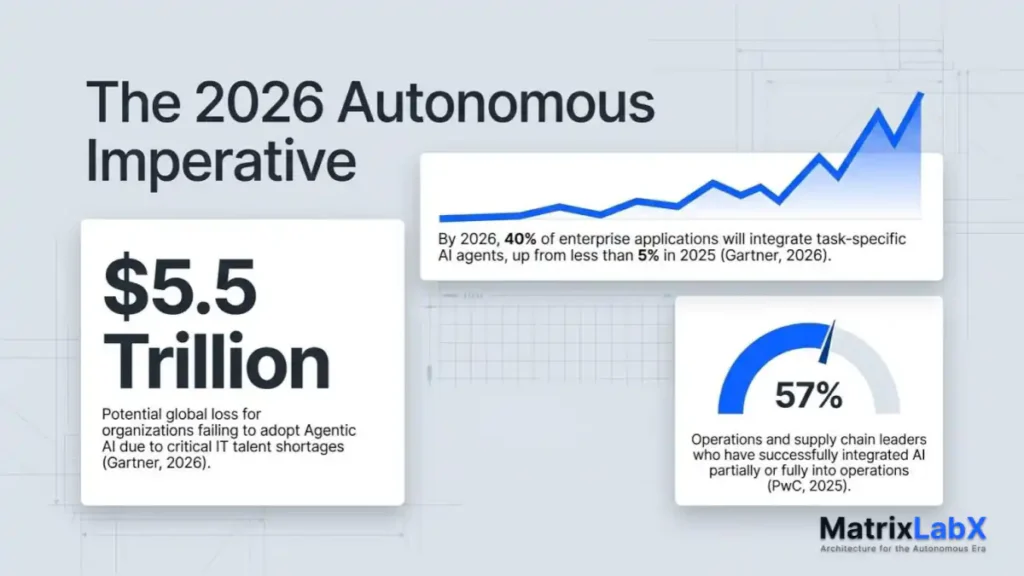
This transformation is happening predominantly in high-growth e-commerce and retail sectors, where customer data platforms (CDPs) intersect with global supply chains. By 2026, 40% of enterprise applications will integrate task-specific AI agents, up from less than 5% in 2025 (Gartner, 2026).
The inflection point is right now. We have exited the "Copilot Era" and entered the "Autopilot Era." Organizations that fail to adopt Agentic AI in 2026 will face a critical IT talent shortage, potentially costing $5.5 trillion in losses globally (Gartner, 2026).
The economic imperative is clear. Traditional enterprise operations cannot scale human headcount linearly with data complexity. "We're moving from the world where we market to people, to a world where we program for machines to serve people," (Schildge, 2026).
Companies adopting agentic systems report a 30–50% reduction in customer acquisition costs, a staggering figure that justifies the immediate sunsetting of traditional agency retainers (MatrixLabX, 2026).
What are the top research firms writing about when it comes to this topic?
Leading research firms confirm the surge of AI-driven insourcing. Deloitte and PwC have published extensively on how the digital workforce is redefining enterprise capabilities.
In their latest analyses, the consensus is that treating AI as a mere software update is a fatal miscalculation; it must be governed as a new talent pool.
"The digital workforce, consisting of AI-enabled workers and automation bots, is emerging as a distinct talent model" (Deloitte, 2024).
In fact, 83% of surveyed executives are already leveraging AI in their outsourced services, and 20% are developing dedicated strategies to manage these digital workers (Deloitte, 2024).
Furthermore, 57% of operations and supply chain leaders have successfully integrated AI partially or fully into their operations (PwC, 2025).
This requires a strategic recalibration. To illustrate the shift from traditional models to the new digital workforce, review the table below:
| Feature/Metric | Traditional Agency Model | E-Commerce Digital Workforce |
| Execution Style | Manual, prompt-dependent | Autonomous, goal-oriented |
| Speed to Action | Days to Weeks | Milliseconds |
| Data Integration | Siloed, requires human synthesis | Real-time liquidity across CRM/ERP |
| Cost Structure | High recurring retainers (Marketing Tax) | Scalable compute costs |
| Error Handling | Post-mortem analysis | Proactive, real-time correction |
These research firms emphasize that, while 90% of organizations face critical IT talent shortages, deploying a digital workforce can help bridge this gap (Gartner, 2026).
How does a digital workforce transform specific e-commerce use cases?
A digital workforce system revolutionizes core operational use cases. By applying a Before-After-Bridge (BAB) framework, we can see exactly how the "marketing tax" is eliminated in practice.
Use Case 1: Dynamic Omni-Channel Ad Bidding
Your marketing team spends hours every Monday downloading CSV files from Google Ads, Meta, and TikTok. They manually cross-reference this with inventory data, attempting to adjust bids based on what is actually in the warehouse. By the time the new bids are live on Tuesday afternoon, consumer trends have shifted, resulting in wasted ad spend on out-of-stock items.
Your Return on Ad Spend (ROAS) is consistently maximized 24/7. Ads for products with dwindling inventory are automatically paused, while surplus stock triggers aggressive, targeted bidding in high-converting regions.
A Digital Workforce System bridges this gap by deploying an "Ad-Buying Agent" linked directly to your ERP (Enterprise Resource Planning) and CDP. It doesn't wait for a human to tell it what to do; it reads inventory telemetry and autonomously executes bid adjustments across all platforms in real time. E-Commerce Digital Workforce: Learn more.
Use Case 2: Autonomous VIP Customer Retention
A high-net-worth customer's credit card fails during a subscription renewal. Your legacy system sends a generic "Update Your Payment" email. The customer ignores it, and after three days, their account is canceled. You just lost a loyal buyer to "silent churn."
The moment the payment fails, the system instantly cross-references the customer's lifetime value (LTV). Recognizing their VIP status, it bypasses the generic email, automatically applies a 48-hour grace period, and sends a highly personalized SMS offering a direct, one-click Apple Pay link to resolve the issue.
Agentic AI monitors transaction telemetry to identify anomalies that traditional rule-based systems miss. "AI agents can be coordinated across demand forecasting, procurement, and logistics tracking to address potential supply chain bottlenecks," (PrescientIQ, 2025).
Use Case 3: Predictive Inventory Procurement
Supply chain managers rely on historical data and gut feeling to order stock for Q4. A sudden geopolitical event disrupts a key shipping route, but your team doesn't realize the impact until the factory misses its delivery date, leaving you with empty virtual shelves during Black Friday.
Your supply chain dynamically routes around disruptions before they happen, automatically splitting purchase orders among secondary regional vendors to guarantee stock availability.
A procurement digital worker constantly analyzes global news, weather patterns, and supplier telemetry. When it detects risk, it autonomously executes contingency plans. The financial impact of such automation is profound.
For every $1 invested in MatrixLabX digital labor, enterprises typically realize over $10 in value by eliminating human-review bottlenecks (MatrixLabX, 2026).
| Metric | Manual Team Baseline | Digital Workforce Outcome |
| Response Time | 24 - 48 Hours | < 1 Second |
| Decision Accuracy | Prone to human fatigue | Data-deterministic |
| Customer Acquisition Cost | High (Agency dependent) | 30-50% Reduction |
How did one e-commerce brand survive the holiday rush using an autonomous system?
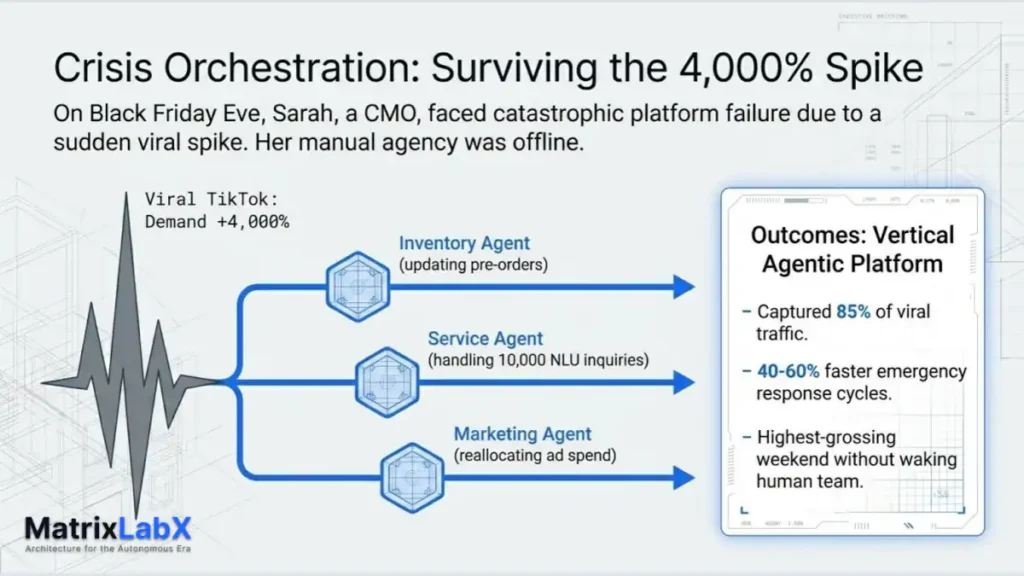
The autonomous system saved Sarah's brand from catastrophic failure. The Subject: Sarah, the Chief Marketing Officer of a mid-sized, high-growth sustainable apparel brand, was exhausted. The Q4 holiday rush was approaching, and her team was already stretched thin.
The Challenge:
On Black Friday Eve, disaster struck. An influencer unexpectedly dropped a viral TikTok video featuring one of Sarah's niche products. Demand skyrocketed 4,000% in an hour. Sarah was sitting in her dimly lit home office, the blue light of her monitor reflecting off her tired eyes. The cursor blinked mockingly on a crashing Shopify dashboard.
Her inventory was evaporating, her customer service inbox was flooding with sizing questions, and her ad agency was asleep. The brand was bleeding potential revenue—the ultimate manifestation of the marketing tax.
The Solution:
Fortunately, Sarah had recently partnered with MatrixLabX to deploy a Vertical Agentic Customer Platform. This wasn't a standard chatbot. It was a digital workforce.
The "Inventory Agent" instantly recognized the anomaly and autonomously updated the site to accept pre-orders while simultaneously drafting a purchase order to their manufacturer.
Meanwhile, the "Service Agent" handled 10,000 concurrent sizing inquiries using natural language understanding (NLU), and the "Marketing Agent" autonomously reallocated ad spend from sold-out items to the trending pre-order product.
The Results:
Sarah didn't have to wake up her team. She watched the dashboard stabilize as the AI orchestrated the entire crisis. The brand captured 85% of the viral traffic, resulting in their highest-grossing weekend in company history.
They achieved 40-60% faster emergency response cycles compared to their manual baseline (MatrixLabX, 2026). The heavy, suffocating weight of operational fragility vanished, replaced by the quiet confidence of scalable autonomy.
How do you implement a digital workforce system in your organization?

A structured implementation roadmap ensures safe AI autonomy. Moving from a traditional marketing stack to an agentic digital workforce requires strict governance and data preparation.
You cannot simply "plug in" an AI and expect it to run your company. "The biggest shift in 2026 is the move from generative AI to agentic AI," (Gartner, 2026). To facilitate this, follow these steps.
- Conduct a Data Liquidity Audit: Before an AI agent can act, it needs perfect data. Break down the silos between your CRM, CDP, and ERP. 80% of IT organizations cite data silos as a primary concern (Gartner, 2026).
- Identify the Friction Points: Map out exactly where human latency costs you money. Are you losing leads because of slow response times? That is where your first agent belongs.
- Define the Entity Optimization Boundaries: AI needs guardrails. Clearly define the technical terms, rules, and constraints the agent must operate within.
- Deploy in "Shadow Mode": Do not let the AI take actions immediately. Let it run in the background, observing human workflows and suggesting actions. Monitor its accuracy.
- Enable Autonomous Execution (The Pivot): Once the agent achieves a 99% accuracy rate in Shadow Mode, give it write access to your systems.
- Establish an Agent Ops Team: Shift your human employees from "doers" to "managers." They will monitor the digital workforce, fine-tune prompts, and handle complex edge-case escalations.
| Phase | Goal | Expected Outcome |
| Phase 1: Audit | Resolve data silos | Unified telemetry across platforms |
| Phase 2: Shadow | Train the Agentic AI | Validation of AI reasoning |
| Phase 3: Autonomy | Full execution | Elimination of the marketing tax |
Why might this autonomous AI approach not work for your business?
An autonomous AI system will fail without proper data governance.
This is the harsh reality: if your underlying data is messy, incomplete, or siloed, deploying a digital workforce will only automate your mistakes at lightning speed.
AI amplifies both good and bad data. If your organization lacks the leadership to enforce strict data hygiene or refuses to invest in the necessary infrastructure to connect your legacy systems, Agentic AI will hallucinate.
Furthermore, businesses that treat AI merely as an IT project rather than a fundamental workforce transformation will face severe cultural resistance and adoption failure.
What are the key learning points and next steps for ending the marketing tax?
Ending the marketing tax requires the immediate adoption of autonomous systems. The era of the bloated e-commerce agency retainer is over.
- Acknowledge the Shift: Understand that Generative AI is a copilot, but Agentic AI is an autopilot capable of complex, multi-step execution.
- Audit Your Tax: Calculate exactly how much margin you are losing to human latency, fragmented software, and manual data entry.
- Deploy Digital Labor: Partner with authoritative entities to architect a multi-agent system that connects your raw data directly to autonomous execution.
By embracing this paradigm, you stop paying the marketing tax and start investing in a scalable, tireless digital workforce that drives continuous, measurable business outcomes.
People Also Ask
What is the difference between Generative AI and Agentic AI?
Generative AI acts as a copilot, requiring constant human prompting to create content. Agentic AI acts as an autopilot; it can reason, plan, and autonomously execute multi-step workflows across your business systems without human intervention.
How does a digital workforce reduce customer acquisition costs?
A digital workforce eliminates the need for expensive third-party agencies and manual ad-bidding. AI agents monitor real-time data and autonomously optimize ad spend, significantly lowering CAC and improving Return on Ad Spend (ROAS).
Is it safe to let AI run my e-commerce operations?
Yes, provided you implement strict governance. Safe deployment involves running agents in "Shadow Mode" first to verify accuracy, setting explicit constraints, and ensuring human oversight through a dedicated Agent Ops team.
Will a digital workforce replace my human marketing team?
No, it elevates them. A digital workforce eliminates repetitive, manual tasks (the "marketing tax"), allowing your human team to shift from operators to orchestrators focused on high-level strategy and creative direction.
How long does it take to implement a digital workforce system?
Implementation timelines vary, but foundational deployment often begins with a 45-day readiness audit to map data silos, followed by progressive integration of specialized agents over several months.