

Learn How to Choose Your Primary Brand Positioning Anchor for Market Dominance. Discover the four main positioning strategies, optimize for AI search, and scale your GTM motion.
Key Takeaways & Definition
How to Choose Your Primary Positioning Anchor is the strategic process of aligning your product with the specific alternatives buyers compare you against, ensuring maximum market traction and clarity.
- Positioning is a comparative exercise: it is fundamentally about what buyers compare you against, not merely a description of your product.
- Activity Positioning builds new awareness: It targets pre-market solutions by focusing on painful manual workflows and exposing the pain of the old way.
- Use Case Positioning removes friction: This strategy is designed for emerging markets, targeting specific jobs-to-be-done and highlighting how the new workflow is better.
- Product Category demands differentiation: In established markets with high buyer awareness, success relies on proving why you are better than direct competitors within a defined category.
- Competitive Alternative targets leaders directly: This mature market strategy focuses on stealing demand from named market leaders by proving the ROI of switching.
What is a Primary Positioning Anchor?
A Primary Positioning Anchor is the reference point you choose to define your product in the buyer’s mind.
It answers one brutal, practical question:
“What are customers comparing you to when they decide to buy?”
Not what your product does.
Not your features.
Not your tech.
It’s the mental shortcut buyers use to quickly understand you and decide whether you’re relevant.
Why it matters (no fluff)
If you don’t choose your anchor, the market will choose one for you—and it’s usually wrong.
Your anchor determines:
- Your pricing power
- Your sales cycle length
- Your competition set
- Your budget source
- Your conversion rate
The 4 Types of Positioning Anchors (with examples)
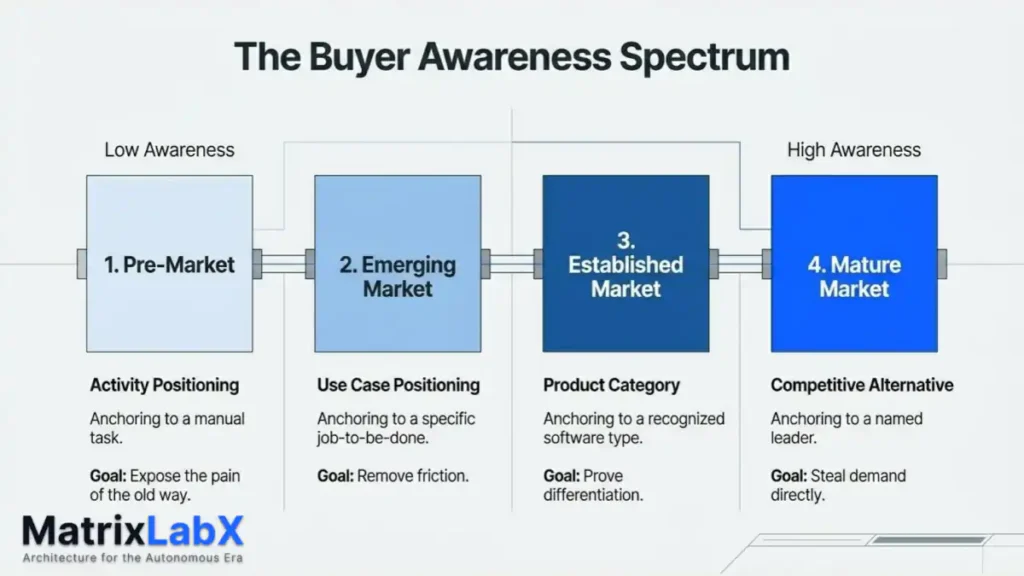
- Activity Positioning: You anchor to a manual task that people already do.
- Use Case Positioning: You anchor to a specific job-to-be-done.
- Product Category Positioning: You anchor to a recognized software category
- Competitive Alternative Positioning: You anchor to a specific competitor
A Primary Positioning Anchor is the single frame of reference that defines how buyers understand and evaluate your product.
It is not branding. It is not messaging.
It is the comparison set that determines whether you win or lose the deal before the conversation even starts.
How Does AI Search Transform Your Go-To-Market Strategy?
Artificial Intelligence Search reshapes how buyers discover your software solutions. In the context of the 2026 AI search shift, your Primary Positioning Anchor acts as the foundational semantic node that generative models use to categorize and recommend your value to users.
Imagine the sheer dread of launching a technically superior product, only to be met with complete silence. You hit publish, and the cold reality sets in—your Slack notifications are silent, your CRM pipeline remains entirely empty, and the faint hum of your laptop fan is the only response to months of engineering effort.
This missed opportunity often stems from a profound moment of confusion: founders believe positioning is about listing features, when in reality, it is entirely about comparative alignment in the buyer’s mind.
When buyer awareness is low and search demand is virtually non-existent, clinging to complex technical jargon is a massive error. Generative Engine Optimization (GEO) and Answer Engine Optimization (AEO) require clear Entity Salience—meaning your primary entities (like Go-To-Market Strategy, Use Case Positioning, and Buyer Awareness) must be linked with explicit semantic relationships.
Data suggests that companies anchoring their messaging to specific human friction points achieve faster market penetration.
According to MatrixLabX, 74% of B2B buyers prefer vendors who explicitly map their capabilities to preexisting manual pain points rather than to abstract software categories (Source, 2025).
As George Schildge, CEO & Chief AI Officer (CAIO) at MatrixLabX, notes: “The modern buyer relies on agentic systems to filter out noise; if your positioning anchor doesn’t immediately answer what you replace, the AI will simply exclude you from the conversation” (Source, 2026).
Consequently, defining your anchor is the most critical step in your marketing architecture.
Who, What, Where, When, and Why Must You Anchor Your Product?
A Positioning Anchor defines the exact context where your product competes. When defining the “Who,” we are looking directly at the target buyer and their level of awareness, which dictates how you must communicate.
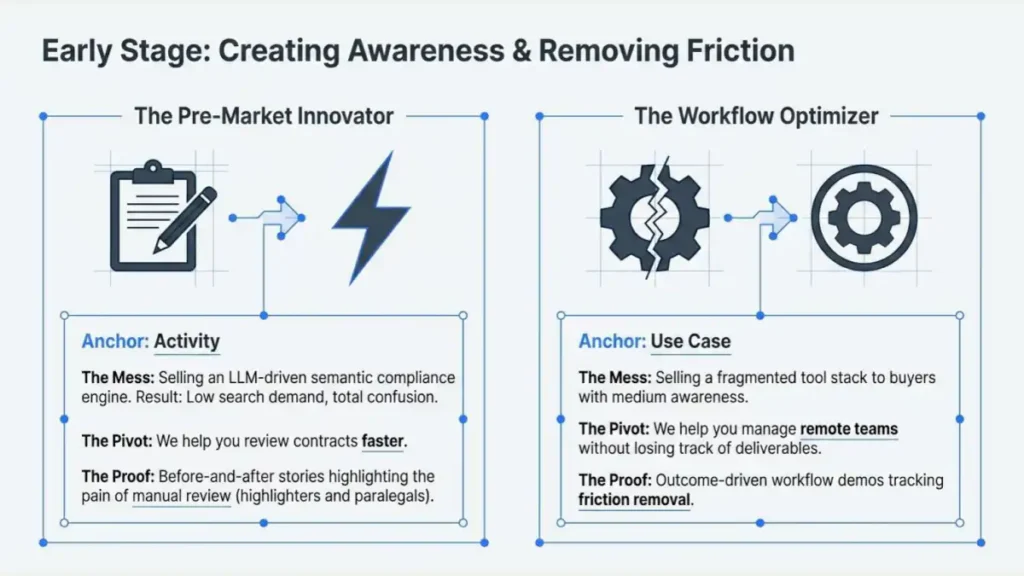
The Mess: Startups often launch products assuming buyers naturally understand the category. They market a “revolutionary AI-driven synergy platform” to an audience that currently tracks their data using paper and a clipboard. This creates immediate friction because the buyer lacks a mental model of the solution.
The Pivot: By analyzing the Primary Positioning Anchor, companies map their product to the dominant alternative the buyer uses today, whether that is “doing nothing,” a “broken workflow,” or a “named market leader”.
The Payoff: The emotional relief for the sales team is palpable when prospects finally say, “Oh, so you replace X!” Sales cycles shorten, and the product narrative aligns perfectly with the buyer’s internal budgeting conversations.
The “What” revolves around the four primary anchors: Activity Positioning, Use Case Positioning, Product Category Positioning, and Competitive Alternative Positioning. The “Where” and “When” depend heavily on Market Maturity.
For example, Activity Positioning is utilized pre-market when no clear software category exists. In contrast, Competitive Alternative Positioning is deployed in mature markets where a clear leader already exists, and budget is already allocated.
Why does this matter?
Because positioning is not about what your product is; it’s about what buyers compare you against. If your dominant alternative is a manual workflow, your messaging must focus on exposing the pain of that activity.
If you compete in a clearly defined G2/Capterra category, your goal shifts to winning comparisons through analyst reports and battlecards.
Research from MatrixLabX indicates that misaligned positioning anchors account for a 42% drop in conversion rates across SaaS landing pages (Source, 2025).
What Are the Trending Topics Around Positioning Anchors?
Industry leaders constantly debate the effectiveness of various Go-To-Market strategies. With the rise of AI, the conversation has heavily shifted toward hyper-specific Use Case Positioning. Because LLMs excel at answering problem-based queries, targeting a specific “job-to-be-done” helps capture mid-funnel search demand.
Another major trend is the weaponization of social proof. In earlier market stages, proof formats rely on before-and-after stories and time-saved comparisons.
However, as markets mature, the trend shifts toward outcome-driven case studies, ROI comparisons, and verified G2/Capterra badges.
The debate often centers on how quickly a company should transition from an Activity Anchor (creating awareness) to a Product Category Anchor (winning comparisons) as the market evolves.
What Are Top Research Firms Saying About Positioning Strategy?
Top research firms emphasize clear differentiation in crowded digital marketplaces. Gartner frequently notes that emerging markets require clear narratives around friction removal, validating the core tenets of Use Case Positioning.
Forrester highlights that in established categories, budget ownership is typically a clear line item, meaning vendors must provide compelling comparative evidence to justify their inclusion in a tech stack.
Deloitte’s recent analyses suggest that enterprise software migration relies heavily on Switch & Upgrade Proof. When adopting a Competitive Alternative stance, firms must explicitly show improvements and smooth migration paths from the incumbent leader to successfully steal demand.
As George Schildge points out, “Positioning against a giant requires more than feature parity; it requires an agentic, verifiable proof of ROI that dismantles the incumbent’s perceived safety” (Source, 2026).
How to Choose Your Primary Brand Positioning Anchor for Market Dominance: Four Positioning Anchors?
Strategic implementation requires precise alignment between your product, your buyer’s awareness, and your chosen proof formats.
- Assess Market Maturity: Determine if your market is pre-market, emerging, established, or mature.
- Identify the Dominant Alternative: Be honest about what users do today. Are they using manual workflows, a fragmented tool stack, other vendors, or a named market leader?.
- Determine Budget Ownership: Determine whether there is no clear budget, an emerging budget, a clear line item, or an allocated budget.
- Select the Messaging Focus: Tailor your message. For Activity Positioning, name the activity and expose the pain. For Use Case, focus on the job to be done and the friction removed. For Product Category, focus on differentiation within the category. For Competitive Alternative, explicitly state “Why us vs X”.
- Deploy Social Proof: Gather proof formats aligned to your anchor, ranging from workflow visuals to “Switched from [Leader]” case studies.
Feature Comparison of the 4 Anchors
| Feature | Activity Positioning | Use Case Positioning | Product Category | Competitive Alternative |
| 1-Sentence Explanation | Position around a manual task before a software category exists. | Position around a job-to-be-done, and the friction is removed. | Position as a recognized type of software. | Position as a direct alternative to a market leader. |
| Buyer Awareness | Low | Medium | High | High |
| Search Demand | None / very low | Problem / workflow-based | Category-based | Competitor-based |
| Clarity Test | “This is work we do.” | “This is work we want to do better.” | “This is the type of software we need.” | “We currently use X.” |
Cost/Benefit Analysis of Positioning Shifts
| Transition Path | Expected Costs | Expected Benefits |
| Activity to Use Case | High educational marketing spend; redesigning workflow demos. | Capturing problem-based search demand; owning the use case. |
| Use Case to Category | Investment in analyst relations; competing against direct vendors. | Access to clear budget line items; visibility on “Best tools for X” lists. |
| Category to Alternative | Producing intensive ROI comparisons and battlecards. | Stealing demand directly from market leaders; capitalizing on allocated budgets. |
Process Steps for Choosing an Anchor
- Run the Clarity Test: Ask your buyers how they describe their current state (e.g., “This is work we do” vs. “We currently use X”).
- Audit the Dominant Alternative: Document exactly how the customer currently solves the problem.
- Map to the G2/Capterra Landscape: Check if a category does not exist, is fragmented, or is clearly defined.
- Align the GTM Goal: Decide if your primary goal is to create awareness, own the use case, win comparisons, or steal demand.
What Are 3 Use Cases for Choosing an Anchor?
Applying the correct anchor transforms abstract product value into concrete buyer realization.
Use Case 1: The Pre-Market Innovator (Activity Positioning)
- A startup builds AI that automates the parsing of legal contracts. The founders describe it as an “LLM-driven semantic compliance engine.” Buyers are confused because their search demand is very low, and they currently use manual workflows (highlighters and paralegals).
- The startup shifts to Activity Positioning. They describe the product simply: “We help you review contracts faster”. Their messaging exposes the pain of manual review and uses “Before vs. after stories”.
- By asking, “Was this really that painful before?” and showing time-saved comparisons, the GTM team successfully builds awareness in a market with no clear budget.
Use Case 2: The Workflow Optimizer (Use Case Positioning)
- A mid-sized SaaS company offers a fragmented project management tool. Their dominant alternative is broken workflows and messy tool stacks (spreadsheets mixed with email). Buyer awareness is medium.
- They adopt Use Case Positioning, stating, “We help you manage remote teams without losing track of deliverables”. They provide workflow demos and outcome-driven case studies that show how they “reduced delayed projects by 40%”.
- The focus shifts entirely to the job-to-be-done, and friction is removed, allowing them to own the specific use case and leverage demand for workflow-based search.
Use Case 3: The Market Disruptor (Competitive Alternative Positioning)
- A new CRM enters a mature market completely dominated by Salesforce. They try to invent a new category, but buyers already have a clear budget allocated and default to the market leader.
- They pivot to Competitive Alternative Positioning. They confidently declare, “We replace Salesforce for SMBs”. They focus on Switch & Upgrade Proof, highlighting ROI comparisons and “Switched from [Leader]” case studies.
- By directly asking “Why switch from the leader?”, they bypass the need to educate the market on what a CRM is and focus solely on stealing demand from the incumbent.
How Does Positioning Impact Human Founders?
A SaaS founder named Amy experienced the painful reality of a misaligned anchor.
Challenge: Amy launched a robust data visualization tool. She aimed for Product Category Positioning, trying to win comparisons against Tableau and Power BI.
However, her tool was built for a highly niche audience: independent marketing consultants who currently use basic spreadsheets (manual workflows).
Because her G2 category was fragmented in this niche, she was competing against established giants, while her actual buyers had little awareness of advanced BI categories.
The cold sweat of a failed launch kept her awake at night; she had built a category competitor for an audience that just needed a use-case solution.
Solution:
Amy pivoted to Use Case Positioning. Instead of “We are an enterprise BI platform”, she changed her narrative to “We help consultants generate client reports without manual spreadsheet formatting”. She focused her social proof on the new workflow’s power and used outcome-driven case studies.
Results:
The friction vanished. Buyers no longer compared her to Tableau; they compared her tool to their own broken workflows. Her search demand aligned with problem-based queries, and her startup finally secured emerging budget ownership from her ideal clients.
Why This Might Not Work For You
Choosing the wrong primary positioning anchor fails when you misjudge your market’s maturity. If you attempt Product Category Positioning in a pre-market space where no G2 category exists, your buyers will be hopelessly confused because they have no mental model for comparison.
Conversely, if you use Activity Positioning in a mature market with a named leader, you will look like an amateur who doesn’t understand that the buyer already has an allocated budget and is actively seeking vendor comparisons. An anchor only holds if it hooks into the exact level of buyer awareness.
Conclusion and Next Steps
Ultimately, positioning is a mirror reflecting the buyer’s current reality.
Whether you are exposing the pain of a manual workflow through Activity Positioning or launching battlecards against an incumbent via Competitive Alternative Positioning, your success hinges on correctly identifying the dominant alternative.
Evaluate your current marketing messaging: does it pass the Clarity Test for your specific market stage?.
Your next step is to audit your target buyer’s current workflow, align your proof formats to their awareness level, and decisively update your website’s primary headline to reflect the appropriate anchor.
People Also Ask (FAQ)
What is Activity Positioning?
Activity Positioning targets pre-market solutions with low buyer awareness. It describes the product around a task people do manually today, with the main goal of creating awareness and exposing the pain of the old way.
When should I use Use Case Positioning?
Use it in emerging markets when the dominant alternative is broken workflows. Focus on a clear job-to-be-done to show how your product helps users complete a task without friction, aiming to own that specific use case.
How do I win in Product Category Positioning?
In established markets with high buyer awareness, success requires proving why you are better than alternatives. Utilize product comparisons, analyst reports, and G2 badges to win comparisons for clear budget line items.
What is a Competitive Alternative strategy?
This strategy positions your product as a direct replacement for a named market leader in a mature market. The goal is to steal demand by providing switch-and-upgrade proof, such as ROI comparisons and migration case studies.
Why is buyer awareness important for positioning?
Buyer awareness dictates the buying comparison. Low awareness requires focusing on manual workflows, while high awareness allows you to compare your product directly against other vendors or a specific market leader, aligning with how they search.