What Is Digital Labor? The Complete Guide to Governed AI Agents in the Enterprise
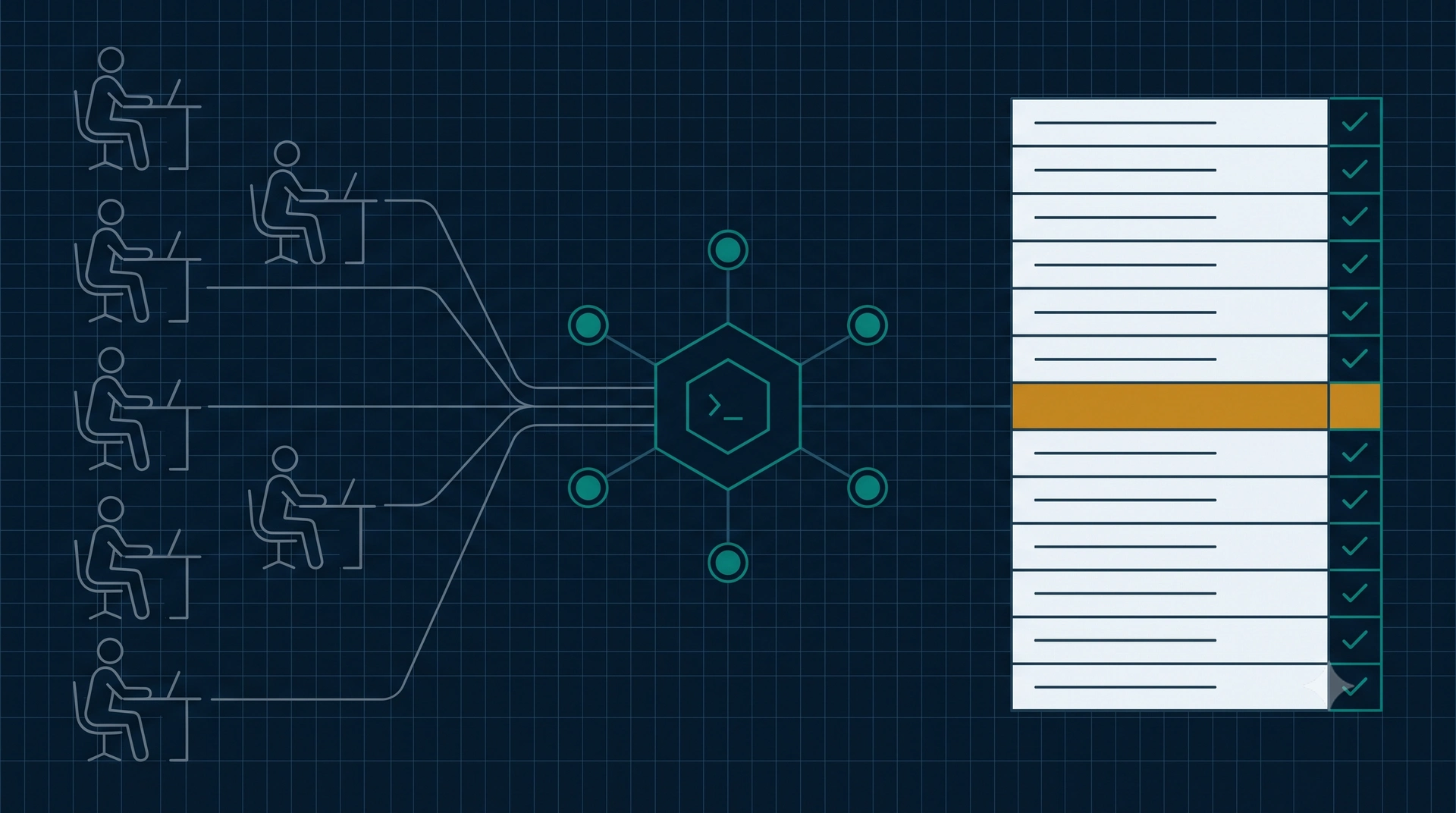
Digital labor is business work performed by AI agents rather than by people operating software. Where SaaS sells you a tool your team runs, digital labor delivers the outcome itself — agents that sense, decide, and act inside your systems, under a human approval step, with every action written to an immutable audit ledger. MatrixLabX calls this governed autonomy: agents execute, humans authorize.
For thirty years, enterprise software has been sold on one implicit contract: we build the tool, your people do the work. Every seat license, every adoption dashboard, every “power user” certification is downstream of that contract. The software industry did not sell work. It sold the means of work, and staffed the gap with your payroll.
Digital labor breaks that contract. When an AI agent can read the state of your CRM, decide which account needs attention, draft the outreach, route it to a named human for approval, send it, and log every step of that chain to a tamper-evident record — the thing being purchased is no longer a tool. It is the work itself.
This guide defines the category precisely: what digital labor is and is not, how it differs from the software models it displaces, what a working digital labor architecture looks like, how it is priced, how it is classified legally, and what governance it requires before a board should allow it near customers or revenue.
What is digital labor, exactly?
Digital laboris business work executed by autonomous AI agents operating inside an organization's own systems. The operative word is executed. A digital laborer does not suggest a next step to a human who then performs it; it performs the step, within an explicitly granted scope of authority.
The unit of digital labor is the completed workflow, and each one runs through the same loop: the agent senses state across the systems it is connected to, decides what the situation calls for, acts through the tools it has been granted, and learns from what the outcome and its human reviewers tell it. This is the same sense → decide → act → learn loop that runs PrescientIQ, MatrixLabX's autonomous revenue platform.
What makes it governed digital labor — the form of the category MatrixLabX builds and the only form we believe survives contact with an enterprise risk committee — is two structural additions:
- A human approval step on consequential actions. Before an agent sends, publishes, commits, or spends, a named human reviews and approves. The human is not operating the software; the human is exercising judgment over it.
- An immutable audit ledger. Every sense, decision, action, and approval is appended to a record that cannot be silently edited — capturing actor, rationale, data consulted, and before/after state.
In one line: agents execute, humans authorize — and the ledger proves both halves.
How is digital labor different from SaaS, RPA, and copilots?
Every prior wave of workplace software automated a layer of work while leaving the execution responsibility with a person. SaaS centralized the tools; the operator stayed human. RPA scripted the clicks; it shattered whenever a screen changed, because it replayed motions without understanding goals. Copilots moved intelligence into the tool but kept the human as the actuator — every suggestion still waits for a hand on the keyboard.
Digital labor is the first model in which execution itself moves to the machine while accountability stays pinned to named humans. That distinction — who executes versus who approves — is the cleanest way to see the whole landscape:
| Model | What you buy | Who executes | Who approves | Audit trail | Cost behavior | Accountable metric |
|---|---|---|---|---|---|---|
| Human labor | Time and expertise | Employees | Managers | Partial — email, CRM notes | Fixed, rises with headcount | Activity and outcomes |
| SaaS + human operator | A tool, per seat | Your team, inside the tool | Your team | Tool logs, fragmented | Fixed licenses + fixed labor | Usage (logins, adoption) |
| RPA | Scripted task replay | Bots, until the screen changes | Nobody in-loop | Run logs | Per bot + maintenance | Tasks completed |
| Copilot | Suggestions, per seat | The human, faster | The human, implicitly | Little to none | Per seat, on top of labor | Individual productivity |
| Governed digital labor | Completed work | AI agents on Google Cloud | A named human, explicitly | Immutable, append-only ledger | Variable, scales with work | Approved workflows delivered |
The commercial consequence of that last row is a different business model entirely — Labor as a Service rather than Software as a Service. We have mapped that shift in depth in What Is LaaS? and LaaS vs. SaaS. The short version: when the vendor delivers work rather than a tool, usage metrics like logins and adoption stop mattering, and the only honest metric left is approved work delivered.
What does a digital labor architecture actually look like?
Under the hood, credible digital labor is not one large model with broad permissions. It is a system: specialist agents with narrowly scoped identities and tool access, an orchestration layer that routes work between them, an approval gate that interrupts consequential actions until a human signs off, and a ledger that records the whole chain. The architecture — not the model — is what makes agents safe to deploy.
Four properties separate a governed deployment from a demo: per-agent least-privilege identity (each agent can touch only the systems its job requires), a human approval gate on every external action (the work happens on Google Cloud perimeter, not on a vendor's servers), an approval interrupt that cannot be routed around, and an append-only ledger write on every action. Remove any one of them and you no longer have governed digital labor — you have an unsupervised script with API keys.
The full technical treatment — layers, orchestration patterns, permission scoping, and whether agents belong on the org chart — is in the companion deep-dive: Agentic AI Architecture: How Governed Digital Labor Is Actually Built.
How do you pay for digital labor if there are no seats?
Per-seat pricing meters human access to a tool. Digital labor has no human at the tool, so there is nothing for a seat license to meter. What replaces it is pricing on the work: workflows executed, outcomes delivered, capacity consumed.
For a CFO, the deeper change is not the pricing unit but the cost curve. Headcount and licenses are fixed costs that step upward in hiring cycles and renewal cycles. Work-based digital labor is a variable cost that tracks volume — it expands in the quarter you push and contracts in the quarter you consolidate. Operators are beginning to plan human FTEs, fractional specialists, and digital labor inside a single capacity model rather than three separate budgets.
The workforce and P&L mechanics get their own treatment in The Outcome-Based Workforce: Why Mid-Market Companies Are Buying Work, Not Seats.
Is a digital worker an employee, a contractor, or a vendor?
Neither of the first two. Worker-classification law — the FLSA economic-reality analysis at the federal level, ABC tests like California's at the state level — governs relationships between businesses and people. An AI agent is not a person; it is a service your business consumes, procured and governed like other software-delivered services.
That answer is clarifying but incomplete, because the classification risk in a blended workforce does not disappear — it concentrates on the human side, where contractor rules are tightening. And a second exposure appears that classification law never had to address: proving, after the fact, which decisions were automated, who approved them, and what data they relied on. That is an evidentiary problem, and it is exactly what the audit ledger exists to answer.
The legal landscape — classification, automated-decision obligations, and what an auditor actually asks for — is covered in Are AI Agents Contractors, Employees, or Vendors? The Digital Labor Compliance Question.
What governance does digital labor require to be board-defensible?
A board does not need digital labor to be risk-free; it needs the risk to be bounded, evidenced, and owned. In practice that means four standing requirements:
- A named human owner per agent. Someone whose name is on the approval record — not a team inbox, a person.
- Scoped authority, granted in writing. Which systems the agent may touch, which actions require approval, which are out of bounds entirely.
- An approval gate on the execution path. Governance positioned beside the workflow gets routed around under quarter-end pressure; governance positioned on the workflow cannot be.
- An immutable ledger as the system of record. When a customer, auditor, or regulator asks “what did the agent do, and who approved it?”, the answer is a query, not an investigation.
The counterintuitive result: this governance is not a brake on autonomy — it is the mechanism for expanding it. Every approved action accumulates evidence of reliability, and agent authority widens against that record rather than against optimism.
Where should a mid-market company deploy digital labor first?
Start where the work is high-volume, rule-describable, and economically legible — which for most mid-market companies means revenue operations. Prospect research, CRM hygiene, outbound drafting, renewal monitoring, and pipeline reconciliation are all workflows where the labor is repetitive, the approval points are obvious, and the output is measurable in pipeline.
That is the wedge MatrixLabX productized as the Revenue Accelerator, powered by PrescientIQ: specialist agents for prospecting, outbound, expansion, and CRM integrity, orchestrated under one approval surface and one ledger. The migration path from an incumbent seat-based stack to that arrangement — what gets retired, in what order, and what has to be true before each cutover — is laid out in From Legacy SaaS to Governed Digital Labor.
And the honest first step is not a purchase — it is a measurement. Before committing to digital labor anywhere, model what your current execution actually costs and what governed agents would change, on your own data. That is what the Autonomous Audit Report exists to do.
Frequently asked questions
Is digital labor the same as RPA?
No. RPA replays a scripted sequence of clicks and keystrokes and breaks the moment a screen or process changes. Digital labor is performed by agents that pursue an outcome: they sense state across systems, decide among actions, and adapt when conditions change — all under a human approval step, with every action written to an audit ledger.
Do AI agents replace employees?
Digital labor absorbs execution work — the researching, drafting, updating, reconciling, and sequencing that fills operator calendars. Humans keep the approval authority over consequential actions and redeploy their time to judgment, relationships, and strategy. The accountable structure is agents execute, humans authorize.
How is digital labor priced?
By the work delivered, not by seats. Because no human is logging in to operate a tool, per-seat licensing has nothing to meter. Digital labor is priced on executed workflows and outcomes, which moves execution cost from a fixed line to a variable one that scales with volume.
What keeps digital labor compliant?
Two structural controls: a human approval gate on consequential actions, and an immutable ledger that records what each agent did, what data it used, and who approved it. Worker-classification law applies to the humans in a blended workforce, not to the agents — the agents are a service, and the ledger is the evidence.
How fast can a mid-market company deploy digital labor?
Scoped narrowly — one workflow, one owner, one approval path — first deployments run in days to weeks, not quarters. The governed pattern is to start where work is repetitive and measurable, log everything, and widen agent authority against the accumulated record.
What would governed digital labor change on your P&L? Model it on your own data.
Get Your Autonomous Audit Report →The digital labor series
- Agentic AI Architecture: How Governed Digital Labor Is Actually Built
- The Outcome-Based Workforce: Why Mid-Market Companies Are Buying Work, Not Seats
- Are AI Agents Contractors, Employees, or Vendors? The Digital Labor Compliance Question
- LaaS vs. SaaS: The Business Model Shift
- The SDR cluster entry point: What Does an SDR Actually Do All Day?
- The compliance cluster entry point: Why Compliant Companies Fail Audits: The Evidence Production Gap
Related reading: for why accountability for governed labor stays with the people who authorize it, start with The Case for AI: Power to Act, Duty to Answer.
See where your own execution effort is going
The Autonomous Audit Report models where your team's execution capacity is currently spent, what your configuration is actually paying for, and what the governed alternative looks like on your own data — before any commitment.
Get your free AAR benchmark