Bundle 03 · PrescientIQ™ Generative Growth Engine
Power more conversations and value through cross-channel bid optimization. Governed by your team.
The Generative Growth Engine is the third PrescientIQ bundle. It is offered first to Revenue Accelerator accounts as an attach, and every engagement begins with a free AI Retrievability Baseline built on your own tracked queries.
Free. Built on your own channels and tracked queries. No commitment.
- Human approval on every budget and bid move
- Immutable audit ledger, reconciled to the invoice
- Never priced as a share of ad spend
- Unlimited approvers at every tier
Cross-channel bid optimization
From single-channel optimization to holistic cross-channel optimization
Every ad platform now optimizes its own bids well. None of them can see the channel next door, and none is incented to hand it budget. The result is a set of locally optimal channels and a globally unmanaged budget. PrescientIQ expands that single-channel optimization into one holistic loop: it reads every connected channel against pipeline contribution, proposes where budget and bid strategy should move to power more conversations and more value, and leaves the decision with your team.
| Dimension | Single-channel optimization | Holistic cross-channel optimization with PrescientIQ |
|---|---|---|
| Objective | Conversions inside one channel's own attribution | Conversations and pipeline value across every channel you run |
| Signal | One platform's data, on that platform's clock | All connected channels plus pipeline contribution, modelled continuously |
| What moves | Bids within one platform's inventory | Budget and bid strategy across channels, where the next dollar earns most |
| Who decides | The platform's algorithm | A named person on your team, on a proposal with the reasoning attached |
| Record | A change history inside the platform | An immutable ledger entry: inputs, rationale, approver, before-and-after state |
How a cross-channel move happens
- 1
Sense across channels
The Media Reallocation and Budget Allocator agents read every connected channel against pipeline contribution rather than channel-local metrics, so an overfunded placement in one channel is visible next to an underfunded one in another.
- 2
Propose the move, with the reasoning
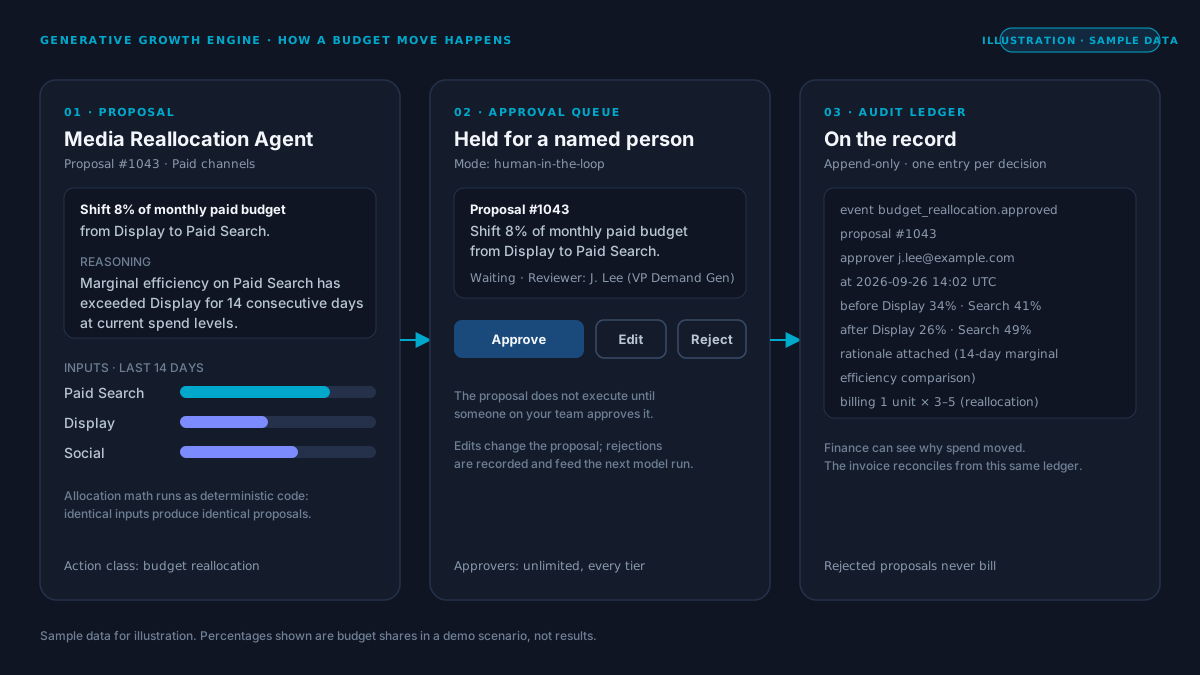
The agent drafts a budget or bid-strategy reallocation and attaches the inputs and the marginal-efficiency model behind it. A recommendation your team can argue with, not a black box to accept.
- 3
Approve, execute, record
A named person approves, edits or rejects the proposal. Approved moves execute; every outcome is written to the ledger and reconciled against the invoice.
See which of your channels is optimizing itself at the others' expense. The Baseline reads your connected channels and your tracked queries, free, before anything is signed.
Get my free Baseline →Two decisions the platforms cannot make for you
Organic discovery is being re-mediated by AI answer surfaces, where a growing share of queries resolve without a click and the attribution basis of a decade of SEO erodes with them. Paid media optimization has been absorbed into the ad platforms themselves, which optimize inside a channel but cannot arbitrate across channels, because no platform is incented to hand budget to a competitor. What is left to the marketing leader are the two decisions that still need judgment: where the money goes, and what gets published under the brand's name. The tooling was built for neither.
Arbitrage across channels, not inside one
The Media Reallocation Agent models cross-channel marginal efficiency continuously and proposes reallocations with the reasoning attached, so a recommendation can be argued with rather than merely accepted.
Be retrievable, not just rankable
Ranking assumes a click; answer surfaces assume extraction. The GEO Agent measures your retrievability across them and the Content Agent produces to that structure — for SEO, GEO and AEO at once.
Nothing external happens without your approval
Every budget move and every published asset routes through the approval queue, and every proposal carries its rationale, inputs and before-and-after state into the ledger. Finance can audit the spend; brand and legal can audit what went out.
The four agents
Sold as one governed loop, never à la carte. A Coordinator routes work across the four on events rather than prompts and carries every decision into the audit ledger.
Cross-channel bid optimization
Media Reallocation Agent
Continuously models marginal efficiency across every connected channel, not inside one, and proposes where the next dollar and the next bid strategy should move, with the reasoning attached. Every reallocation routes through the approval queue; the agent never moves budget on its own authority.
Spend tied to pipeline
Budget Allocator Agent
Detects overfunded and underfunded campaigns against pipeline contribution rather than channel-local metrics, and proposes corrections. Allocation math runs as deterministic code, so identical inputs produce identical proposals and the model can be inspected.
AI-search retrievability
GEO Agent
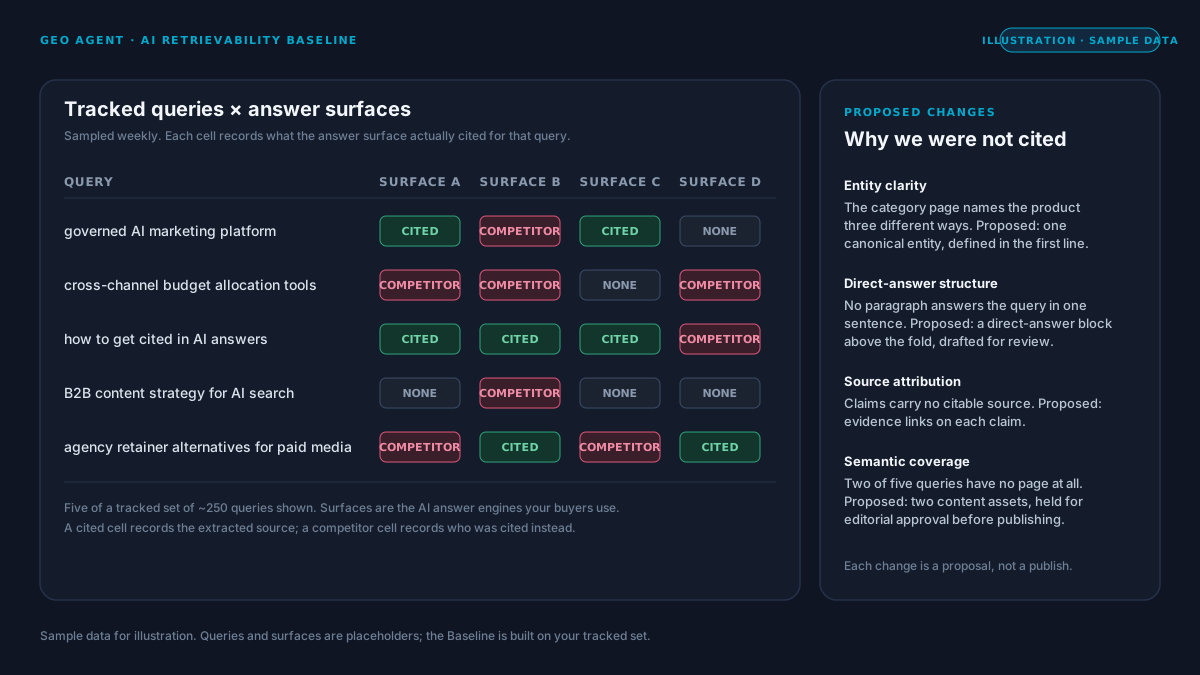
Measures how retrievable your content is across AI answer surfaces for a tracked query set, and proposes the structural changes — entity clarity, source attribution, direct-answer formatting, semantic coverage — that make it extractable. Measurement is reported; any change to a page is proposed and held for approval.
Built for extraction
Content Agent
Drafts content structured for SEO, GEO and AEO at once — entity-first, direct-answer-led, evidence-supported — at production pace. Drafts only: nothing publishes under your name until your editorial owner approves it.
Who approves what
Marketing agents move real money and publish in your name, which is why governance is the operating model here rather than a tier. Each kind of action is an action class your team assigns to a governance mode. These are the defaults the product is designed around; your team sets every row.
| Action class | Mode | What happens |
|---|---|---|
| Budget or bid-strategy reallocation | Human-in-the-loop | A proposal to move money or change a channel's bid strategy is held until a named person approves, edits or rejects it. This is the class your CFO will ask about first, and it is the default the product is designed around. |
| Content publish | Human-in-the-loop | Nothing goes out under your brand's name without an editorial owner approving the draft. Rejections are recorded and shape the next draft. |
| Retrievability change | Human-in-the-loop | A structural change to a live page — a direct-answer block, an entity definition, a source link — is proposed and held. Your team can move this class to a standing policy once it trusts the proposals. |
| Measurement and modelling | Runs continuously | Sampling answer surfaces and modelling channel efficiency changes nothing outside the system, so it runs without a per-action approval. What it produces is a proposal, never an execution. |
Governance, stated plainly
Human-in-the-loop (HITL). The action is drafted and held. It does not execute until a named person on your team approves it.
Human-on-the-loop (HOTL). The action executes under a standing policy your team sets. A named person supervises and keeps intervention, override, and revocation authority.
Your team chooses the mode for each action class, based on its risk tolerance, and can change it at any time.
Every action, in either mode, is recorded to the audit ledger with its rationale, before-and-after state, and the approver or policy behind it.
Every action class starts in human-in-the-loop until your team changes it.
Inside the loop
Two illustrations of how the work moves: a budget proposal on its way through approval to the ledger, and the Retrievability Baseline every engagement starts from. Both use sample data.
01 — How a budget move happens
Proposal, approval, ledger
02 — The Retrievability Baseline
Where you are cited, and where a competitor is
What it is not
Each of these solves one seam. None of them closes the loop from signal to allocation decision to content produced to measured retrievability, and none puts your approval in the path.
AI-visibility trackers
Reporting that you are absent from AI answers is not the same as changing it. A dashboard produces a finding; this produces a proposed action, an approval, and a ledger entry.
AI content generators
Volume is not retrievability. Answer surfaces extract from structure — entities, direct answers, cited evidence — and undifferentiated volume dilutes exactly that.
Percentage-of-spend retainers
A partner paid as a share of the budget it is asked to reduce has a structural incentive problem. This is priced on the work executed and the surface watched, never on spend.
In-channel automated bidding
It optimizes well inside one platform's inventory, and the Growth Engine sits above it rather than against it. Single-channel optimization cannot see the other channels; cross-channel optimization does, and no platform is incented to hand budget to another. That decision is still yours, and now it comes with a proposal attached.
Where the data runs
Allocation math runs as deterministic code rather than model arithmetic, so identical inputs produce identical proposals and the model can be inspected. Live retrieval, where a proposal needs it, is delivered by Grounding with Google Search on the Gemini Enterprise Agent Platform — a Google Cloud platform capability, not a MatrixLabX feature. Channel and CMS connections start read-only; write access is scoped with you before anything is connected.
PrescientIQ is hosted and operated by MatrixLabX on Google Cloud. SOC 2, ISO 27001, and PCI DSS attestations are held by Google Cloud, which operates the underlying infrastructure. They are not MatrixLabX certifications. MatrixLabX application-layer SOC 2 is in progress.
Who it is built for
The buyer
CMO or VP Marketing at a mid-market B2B company, owning both the paid media budget and organic demand generation, and answering to a CEO or board that has started asking about AI search exposure.
The co-signer
VP Demand Gen or Head of Performance Marketing — the person who owns the channel P&L and will either trust or refuse a budget-reallocation proposal.
The people who can veto
The CFO and the brand or legal owner. Spend moved without approval and content published without approval are what they veto fastest, which is why neither happens here.
Pricing
The right cost comparison is not AI-visibility tooling; it is the labor being displaced — the agency retainer and the media-management fee indexed to spend. The Growth Engine is priced against that envelope, as an annual engagement scaled to what the system watches for you.
Focus
Modeled$69,000/yr
2 channels · ~250 tracked queries · 3 answer surfaces · weekly sampling · ~150 weighted workflows/mo
Scale
Modeled$111,000/yr
4 channels · ~750 tracked queries · 5 answer surfaces · daily sampling · ~500 weighted workflows/mo
Enterprise
Modeled$165,000+/yr
Unlimited channels · Custom tracked queries · All supported + regions answer surfaces · daily + on-demand sampling · Custom weighted workflows/mo
One flat annual platform fee per tier. Implementation — channel and content connections, tracked-query definition, baseline measurement, allocation-model calibration — is included from signature, not billed as a distinct line. Every tier includes all four agents, the Coordinator, the approval queue, the full audit ledger, and unlimited users. Governance is never tier-gated. Never priced as a percentage of ad spend, never per seat, and the agents are not sold separately. Figures labelled Modeled are proposals sized to your scope before anything is signed.
Full pricing and terms →Attach bundle · One ledger · One approval queue
Revenue and growth, as one governed engagement.
Pair the Revenue Accelerator ($165,000/yr) with Growth Engine Scale and both run on one audit ledger and one approval queue — a modeled $276,000 a year, the same number every year. Existing Revenue Accelerator accounts add the Growth Engine as a scope amendment, not a new procurement cycle.
Frequently asked questions
What is the Generative Growth Engine?
A governed multi-agent system for B2B marketing leaders. It continuously analyzes cross-channel media performance and AI-search retrievability, and proposes budget reallocations, retrievability changes and content. A person on your team approves every consequential action before it executes, and every proposal, rationale and approval is recorded to an immutable audit ledger.
What is cross-channel bid optimization?
Optimizing where media budget and bid strategy go across every channel you run, against one objective — conversations and pipeline value — rather than optimizing each channel's bids in isolation. Each ad platform optimizes well inside its own inventory but cannot see the others and has no incentive to hand budget to a competitor. The Growth Engine models marginal efficiency across all connected channels, proposes where the next dollar should move, and executes only when a named person on your team approves.
How is holistic cross-channel optimization different from the automated bidding inside each channel?
In-platform automated bidding is single-channel optimization: it works from one platform's data, toward that platform's conversion definition, inside that platform's inventory. Holistic cross-channel optimization with PrescientIQ sits above it. It reads every channel against pipeline contribution, proposes budget and bid-strategy moves between channels with the reasoning attached, and records the approver and the before-and-after state to an immutable ledger. It does not replace in-channel bidding; it decides what each channel gets to bid with.
Is it available now?
The Generative Growth Engine is the third PrescientIQ bundle. It is offered first to Revenue Accelerator accounts as an attach, and every engagement begins with a free AI Retrievability Baseline built on your own tracked queries.
Do the agents move budget or publish on their own?
No. Budget reallocations, content publishes and retrievability changes are proposals until a person approves them. Human-in-the-loop (HITL): The action is drafted and held. It does not execute until a named person on your team approves it. Human-on-the-loop (HOTL): The action executes under a standing policy your team sets. A named person supervises and keeps intervention, override, and revocation authority. Your team chooses the mode for each action class, based on its risk tolerance, and can change it at any time. Every action, in either mode, is recorded to the audit ledger with its rationale, before-and-after state, and the approver or policy behind it.
What is retrievability, and how is it different from ranking?
Ranking assumes a click. AI answer surfaces assume extraction: they pull a direct answer, an entity definition or a cited source out of a page and may never send the reader to it. Retrievability is how often, and how, your content is extracted and cited across those surfaces for the queries you track. It is measured as observed citation behavior, not inferred from keyword rank.
What is the AI Retrievability Baseline?
A free starting point built on your own data: a tracked query set for your category, sampled across AI answer surfaces, showing where you are cited, where a competitor is cited instead, and the structural reasons. It reports observed facts about your presence rather than asserting outcomes about us, and you can verify the findings yourself.
How is the Generative Growth Engine priced?
Three tiers — Focus, Scale and Enterprise — scaled to the observability surface: connected channels, tracked queries, answer surfaces, sampling cadence and content properties. Each is one flat annual platform fee, labelled modeled, from $69,000/yr, with implementation included from signature. Executed workflows meter against a committed pool, weighted by class. Never a percentage of ad spend, never per seat, and the agents are not sold separately.
Why not a percentage of ad spend?
A product whose core promise is reallocating, and often reducing, wasted spend cannot be paid as a share of that spend without an incentive conflict a competent CFO will name in the first call. The platform fee is indexed to what the system watches, and executed workflows to the work done.
Does it replace our agency?
It takes on the measuring, proposing and drafting that a retainer pays people to do for these functions, and it leaves the decisions with your team. Whether a retainer remains for strategy, creative or relationships is your call; the comparison that matters is the labor being displaced, not the tooling this resembles.
How does it relate to the Revenue Accelerator?
They are separate bundles with separate pricing. The Growth Engine is offered first as an attach to Revenue Accelerator accounts, on the same audit ledger and approval queue: a modeled $276,000 a year for the Revenue Accelerator plus Growth Engine Scale, the same number every year, added as a scope amendment rather than a new procurement cycle.
Free · No commitment
Start with your Retrievability Baseline.
Before you commit a dollar, we measure how your brand surfaces across the AI answer engines your buyers use and read how your connected channels are optimizing themselves. Then the scope is sized to you, not a template.
How the engagement starts
- 1
Free Retrievability Baseline
We sample your own tracked queries across AI answer surfaces and read your connected channels. You see where you are cited, where a competitor is, and where budget is optimizing itself channel by channel.
- 2
A scope sized to you
A modeled proposal against your channels, query set and content properties. Nothing is signed on a template.
- 3
Your team approves the first moves
The first cross-channel proposals arrive in the approval queue with their reasoning. You decide what executes, from the first day.
Request your free Retrievability Baseline
Your tracked queries, your channels, your competitors, your gaps. A MatrixLabX solution architect confirms scope with you before anything runs.
Prefer to talk first? Book a conversation.