Revenue Accelerator Stack
Prospect. Engage. Convert. Expand.
Four agents, executed autonomously — and governed.
The Revenue Accelerator Stack is a PrescientIQ™ agent bundle that senses buying signals, decides the next-best action, and executes it across your CRM and outbound channels — with your team choosing, per action class, whether a person approves each action or supervises under standing policy, and an immutable record of why.
Scout qualifies accounts, Herald drafts and sends outreach in the mode your team sets, Guide catches stalling trials, and Steward surfaces upsell and churn-risk signals early. Marshal, the coordinator, orchestrates all four, and every externally visible action is written to an immutable audit ledger with its rationale and before/after state. Built for CROs and RevOps teams at $20M–$500M ARR running Salesforce or HubSpot.
Human-in-the-loop (HITL). The action is drafted and held. It does not execute until a named person on your team approves it.
Human-on-the-loop (HOTL). The action executes under a standing policy your team sets. A named person supervises and keeps intervention, override, and revocation authority.
Your team chooses the mode for each action class, based on its risk tolerance, and can change it at any time.
Every action, in either mode, is recorded to the audit ledger with its rationale, before-and-after state, and the approver or policy behind it.
Every action class starts in human-in-the-loop until your team changes it.
What the platform does today
Your governed digital revenue crew
Four specialist agents and a coordinator, operating under the governance mode your team sets. Each agent is independent and narrow-scoped, coordinated by Marshal and not chained together by hardcoded rules, so a failure in one agent never stalls the others.
Sense
Scout
Pipeline Research Analyst
Formerly the Prospecting Agent
Continuously scores ICP-fit accounts from firmographic and intent signals — hiring surges, funding events, tool-sprawl indicators — sourced through licensed providers like G2 and Bombora. Scoring runs on deterministic code, not model guesswork, so identical inputs always produce identical scores. Qualified accounts hand off to Herald with zero manual research.
Decide → Act
Herald
Outbound Engagement Rep
Formerly the Outbound Agent
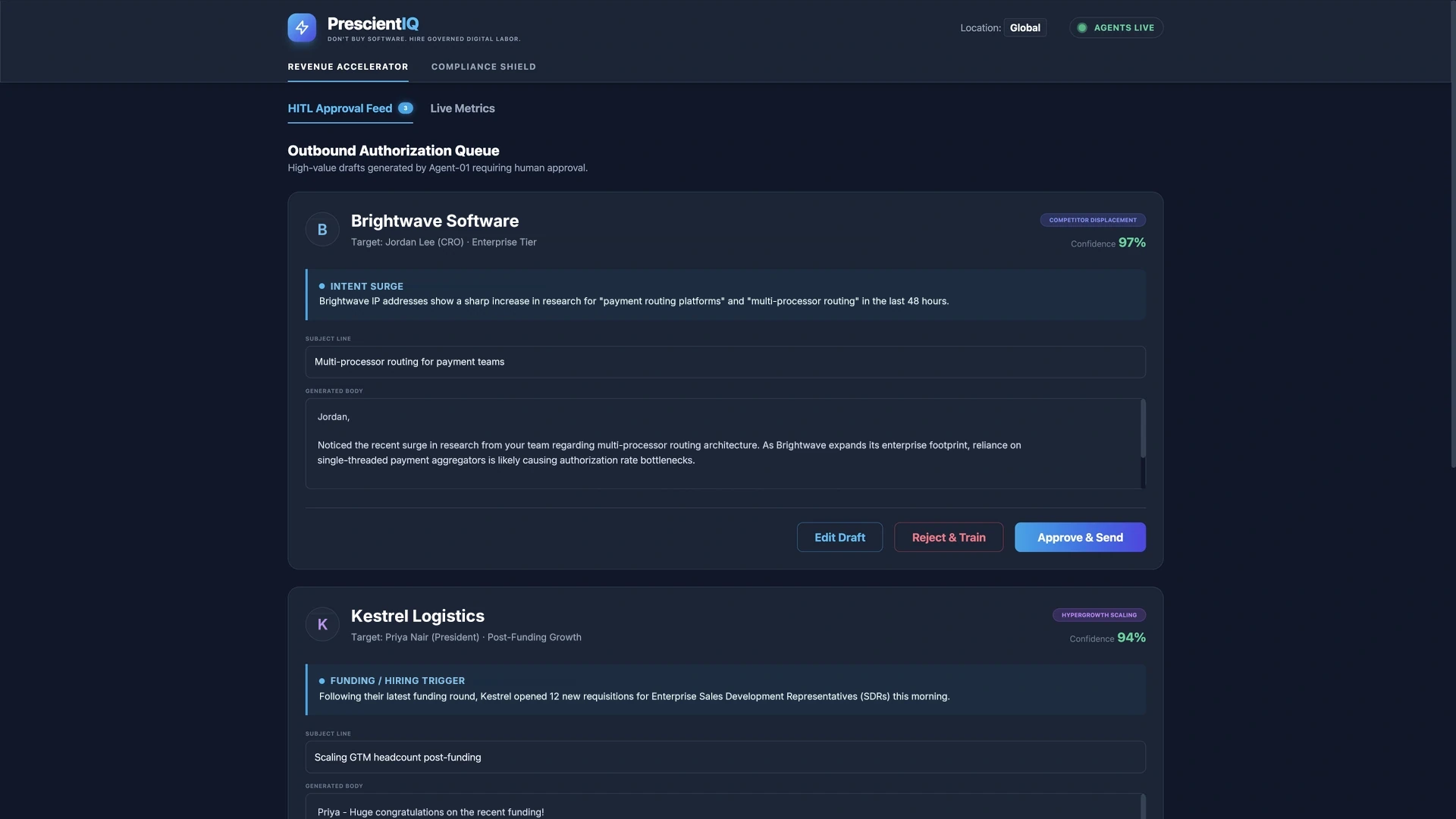
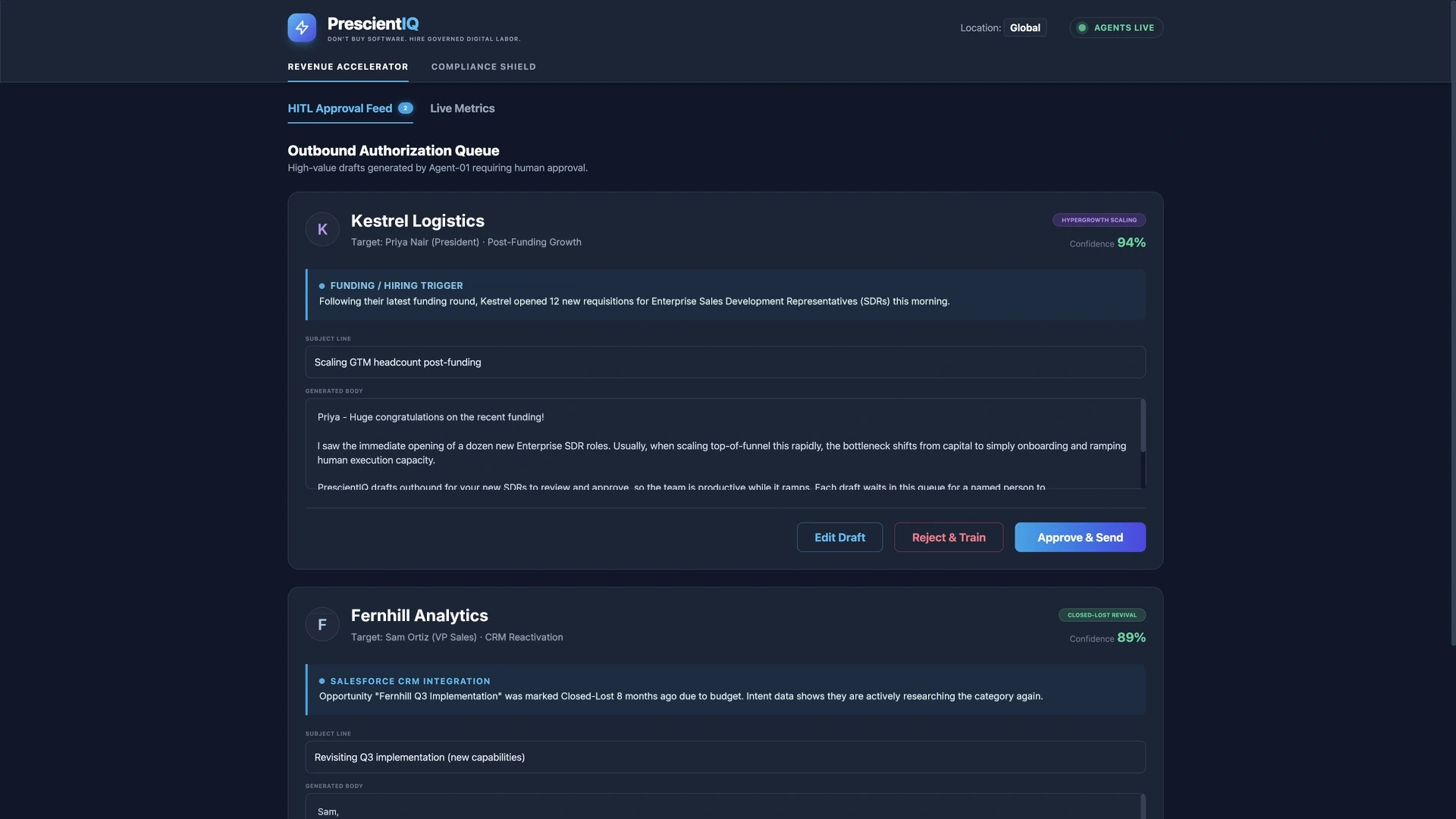
Drafts personalized outreach grounded in the exact signal that triggered it, with the reasoning behind every draft captured alongside it. Every draft is held until a named person on your team approves it. Messages go out through an authenticated delivery provider, and status writes back to your dashboard in real time.
Act
Guide
Trial Activation Specialist
Formerly the Trial Conversion Agent
Watches in-product behavior for the moment a trial stalls before its value event, then prepares a personalized activation sequence at the stall moment, held for approval before it sends. Upgrade and tier math runs on sandboxed deterministic code — never on model arithmetic — so pricing logic stays reproducible and auditable.
Learn
Steward
Expansion & Retention Analyst
Formerly the Expansion Agent
Scans usage patterns, seat utilization, and feature adoption to surface upsell and churn-risk signals before a CSM would catch them in a quarterly review, creating prioritized next-best-action items with a deterministic confidence score attached to each one.
Coordinated by Marshal
Revenue Operations Coordinator
Marshal routes work across the crew and enforces the governance mode you set. It routes intent to the right specialist and persists state after every decision, so a workflow survives a restart mid-run. All inter-agent communication runs over A2A; every external system — your CRM, outbound provider, and intent-data feeds — is reached only through typed, scoped tool integrations, each behind its own least-privilege identity. Every action any agent takes is appended to an immutable audit ledger with actor, rationale, confidence, and before/after state.
Built for teams like these
The Revenue Accelerator Stack is built for mid-market B2B enterprises ($20M–$500M ARR) on Salesforce or HubSpot carrying a specific, dated trigger — not a cold list. Patterns we see most often:
PLG SaaS scaling past $20M ARR
Trial signups outpacing the team's capacity to qualify them by hand.
Guide + Herald
Manufacturing tech with CRM debt
AEs losing a third of the week to manual account deduping instead of working live buyer signals.
Scout + deterministic scoring
HealthTech post-raise
Expansion into new regions outrunning CSMs' ability to track usage by hand.
Steward + Marshal orchestration
Developer tools post-Series D
Outbound that has to reference real repos and stacks, or developers report it as spam.
Herald, personalized to the account
Multi-tool RevOps stack
Paying for separate intent, sequencing, and scoring tools that don't share a ledger.
The full crew
What has to be true before an agent runs in your name?
Which agent leads — and what has to be true before it ships?
Three questions. The output is not a projection — it is the set of controls to require, from us or from anyone else. The numbers come from the free Autonomous Audit Report, modelled on your own data.
Governed by design, not by policy
Governed autonomy
Your team chooses the mode for each action class, based on its risk tolerance, and can change it at any time.
Every action, in either mode, is recorded to the audit ledger with its rationale, before-and-after state, and the approver or policy behind it.
Immutable audit ledger
Every decision, the prompt context behind it, the underlying rationale, and the approval action itself are written to an append-only audit trail — with actor, confidence, and before/after state. Each agent holds a dedicated least-privilege service identity, and external systems are reached only through typed, scoped tool integrations.
Platform and compliance posture
PrescientIQ is hosted and operated by MatrixLabX on Google Cloud. SOC 2, ISO 27001, and PCI DSS attestations are held by Google Cloud, which operates the underlying infrastructure. They are not MatrixLabX certifications. MatrixLabX application-layer SOC 2 is in progress.
Engineered availability SLO of ≥99.5% on the model and inference path, with named third-party carve-outs (Salesforce, HubSpot, intent-data vendors, email delivery).
Every workflow metered, every outcome attributed
Two counters run from the day the Stack goes live, writing to the same immutable ledger that backs your audit trail — so your invoice and your compliance record reconcile from the same source, not from separate tools.
Workflows executed
Every completed agent action increments an auditable counter, per account and per agent.
Outcomes attributed
Pipeline created, trials activated, and expansion items surfaced are tied back to the specific workflow that produced them.
Usage export
RevOps reconciles a monthly invoice directly against the ledger — no separate re-derivation or a dashboard you have to take on faith.
This is what makes outcome-priced Labor as a Service billable rather than aspirational: pricing is tied to metered work and metered results, not a seat count or a per-action toll.
Inside the platform
Two views of the Revenue Accelerator approval feed: each outbound draft arrives with the signal that triggered it, the target account and a confidence score, and waits here for a named person to edit, approve or reject it. Screens show a demo workspace with sample data.
01 — The approval feed
Outbound authorization queue
02 — Signals from the CRM
CRM-triggered drafts
Commercial structure
One annual platform fee, billed monthly, covering the execution a typical mid-market deployment runs. Work is tracked in the same deterministic ledger that backs your audit trail — never per seat, and never for a draft your team rejected.
| Component | Investment | Billing frequency |
|---|---|---|
| Annual platform feeEnvironment provisioning on Google Cloud, per-agent IAM, audit-ledger setup, and context ingestion from your CRM — plus four cooperating agents (Scout, Herald, Guide, and Steward), their coordinator Marshal, the approval queue and standing-policy controls, and the immutable audit ledger, and the monthly execution volume a typical mid-market deployment runs. One fee, from signature, every year.Target — modeled: live in 21 days or less$165,000/year is the complete platform fee. There is no separate implementation charge and no different first-year number — deployment work is included from signature, not billed as a distinct line. Scope beyond a typical deployment — additional bundles, sustained higher volume — is quoted at your AAR before anything is signed. | $165,000/yr | Billed monthly at $13,750/mo against an annual commitment |
PrescientIQ™ Revenue Accelerator commercial structure
Implementation, the annual platform fee, and what each one covers — published in full, and current as of today.
Full platform pricing, including Compliance Shield and the Generative Growth Engine, is on the pricing page.
Not ready for the full platform commitment? PrescientIQ™ Sales Accelerator is a separate, self-serve tiered product for mid-market sales teams starting smaller — customers migrate here as they scale.
Modeled outcomes — validated on your data
These are modeling targets, not measured results. MatrixLabX has not yet accumulated measured outcome data across enough live Revenue Accelerator Stack deployments to state them as fact. The free Autonomous Audit Report runs the model against your own CRM and pipeline data before you sign anything, turning these targets into your specific numbers.
Figures labeled as targets are modeled against current human and copilot baselines. They are not guarantees. Every engagement begins with a free Autonomous Audit Report — a P&L projection built on your own data — and targets are validated against your environment before any commitment.
Figures labeled as targets are modeled against current human and copilot baselines. They are not guarantees. Every engagement begins with a free Autonomous Audit Report — a P&L projection built on your own data — and targets are validated against your environment before any commitment.
Request your free AAR
Our team will map the exact agent configuration to your CRM stack, model these targets against your own pipeline data, and give you an accurate deployment timeline.
Frequently asked questions
What is the Revenue Accelerator Stack?
The Revenue Accelerator Stack is a MatrixLabX PrescientIQ™ agent bundle that runs the revenue loop autonomously — prospecting, outbound, trial conversion, and expansion — coordinated by Marshal, the Revenue Operations Coordinator. Your team chooses the mode for each action class, based on its risk tolerance, and can change it at any time. Every action, in either mode, is recorded to the audit ledger with its rationale, before-and-after state, and the approver or policy behind it.
What are human-in-the-loop and human-on-the-loop?
Human-in-the-loop (HITL): The action is drafted and held. It does not execute until a named person on your team approves it. Human-on-the-loop (HOTL): The action executes under a standing policy your team sets. A named person supervises and keeps intervention, override, and revocation authority. Your team chooses the mode for each action class, based on its risk tolerance, and can change it at any time. Every action, in either mode, is recorded to the audit ledger with its rationale, before-and-after state, and the approver or policy behind it.
Which CRMs and channels does it support?
The Revenue Accelerator Stack connects to Salesforce and HubSpot today, plus licensed intent-data providers such as G2 and Bombora, through typed tool integrations. Outbound delivery runs through an authenticated email provider with SPF/DKIM/DMARC in place. Additional CRM and channel support is on the roadmap.
Is the Revenue Accelerator Stack secure and compliant?
Agents run on Google Cloud, so every action is recorded to an immutable audit ledger. Each agent holds a dedicated least-privilege identity, and every action is written to an immutable audit ledger. MatrixLabX's application-layer SOC 2 is in progress.
How long does deployment take?
The target is 21 days or less from signed contract to production — a modeled target, not a commitment — covering CRM connection, agent configuration, and a staged rollout that starts in monitoring mode before autonomous execution begins. The actual timeline depends on CRM data quality and integration scope, and is set with you during the Autonomous Audit Report rather than assumed.
How is the Revenue Accelerator Stack priced?
One number, contracted, never per seat: $165,000 a year, billed monthly, identical in year one and every year after. Environment provisioning on Google Cloud, per-agent IAM, audit-ledger setup, and context ingestion from your CRM — plus four cooperating agents (Scout, Herald, Guide, and Steward), their coordinator Marshal, the approval queue and standing-policy controls, and the immutable audit ledger, and the monthly execution volume a typical mid-market deployment runs. One fee, from signature, every year. There is no separate implementation fee — deployment is included from signature, not billed as its own line. Drafts, retries and rejected actions never bill. $165,000/year is the complete platform fee. There is no separate implementation charge and no different first-year number — deployment work is included from signature, not billed as a distinct line. Scope beyond a typical deployment — additional bundles, sustained higher volume — is quoted at your AAR before anything is signed.
How do I track ROI from the Revenue Accelerator Stack?
Every completed workflow and every outcome it produces — pipeline created, a trial activated, an expansion item surfaced — writes to the same immutable ledger as your audit trail. RevOps can export that ledger to reconcile a monthly invoice directly against metered work and metered results, without a separate reporting tool.
How is this different from an autonomous AI SDR tool?
Autonomous AI SDR tools send outbound without a review step — a pattern many enterprise buyers moved away from after 2025's deliverability and brand-safety incidents. The Revenue Accelerator Stack is governed by design: agents execute. Your team chooses the mode for each action class, based on its risk tolerance, and can change it at any time. Every action, in either mode, is recorded to the audit ledger with its rationale, before-and-after state, and the approver or policy behind it.
For the category definition behind this product — the loop, the governance modes, and the ledger — read What is a revenue accelerator platform?
Ready to accelerate revenue?
Our solutions team will map the exact agent configuration to your CRM stack and give you an accurate deployment timeline.
Book a Discovery Call →