Bundle 02 · PrescientIQ™ Compliance Shield
Your compliance manual, enforced in the moment.
Compliance Shield is the next release on the PrescientIQ roadmap: closed beta targeted for December 2026, general availability in January 2027. Early-access design-partner slots for fintech and healthcare are limited.
From a document nobody reads to a boundary nobody can skip
In most regulated organizations the compliance manual is a long PDF on a shared drive, and the check on what employees actually say happens afterwards, by sampling, in an archive. A guarantee made over Slack, or a patient record pasted into the wrong channel, is found in a post-mortem — after it has already left the building.
Archive-first
Record, then review a sample
Messages are captured after they send. A fraction are read. Violations surface when someone goes looking, or when a regulator does.
Compliance Shield
Intercept, hold, decide, record
The manual becomes the rules engine. A message that trips a high-tier rule is quarantined before it reaches the recipient and held for a named compliance officer. The decision goes to the ledger.
How the boundary works
Five steps, in the order the work moves. Agents run the first three and the last on their own; a person owns the decision in between.
- 1
Ingest
Your compliance manual — PDF, Word, HTML — is parsed and indexed so every agent decision is grounded in your own documentation, not a generic dictionary. Regulatory updates can be uploaded for the Governance Agent to process.
- 2
Monitor
The Compliance Monitoring Agent scans in-flight text and transaction data from the connected channels against the rules engine.
- 3
Tier
Each flag is scored into one of three severity tiers, and the tier decides what happens next.
- 4
Decide
High-tier intercepts are quarantined and held until a compliance officer grants an exception or confirms the violation. Low and medium tiers run under standing policy with a named supervisor.
- 5
Record
The Auditor Agent writes the flag, the rule, the decision and the person to the immutable ledger, and compiles dossiers from it on demand.
Three severity tiers, two governance modes
Every flag lands in a tier, and each tier is an action class your compliance team assigns to a governance mode. The defaults below are the configuration Compliance Shield is designed around; your team sets every row.
| Tier | Action | Mode | What happens |
|---|---|---|---|
| Low | Educational nudge | Human-on-the-loop | The employee is shown which clause the message brushes against, in the moment. Runs under standing policy your compliance team sets; a named person supervises and can change the policy at any time. |
| Medium | Alert to a manager | Human-on-the-loop | The message proceeds and the manager is notified with the flagged clause. Also a standing-policy action class, so it runs without a per-message approval while staying visible and revocable. |
| High | Quarantine and hold | Human-in-the-loop | The message is quarantined before it reaches the recipient and held until a compliance officer grants an exception or confirms the violation. Nothing in this tier executes on the agent's own authority. |
Governance, stated plainly
Human-in-the-loop (HITL). The action is drafted and held. It does not execute until a named person on your team approves it.
Human-on-the-loop (HOTL). The action executes under a standing policy your team sets. A named person supervises and keeps intervention, override, and revocation authority.
Your team chooses the mode for each action class, based on its risk tolerance, and can change it at any time.
Every action, in either mode, is recorded to the audit ledger with its rationale, before-and-after state, and the approver or policy behind it.
Every action class starts in human-in-the-loop until your team changes it.
The four agents
Each agent has one mandate and works asynchronously over a shared data fabric, so a failure in one never stalls the others.
Observe and flag
Compliance Monitoring Agent
Connects to your communication channels and transaction logs, scans in-flight text and operational data against your ingested manual, and flags what it finds by severity — quarantining the highest tier for a person to review.
Keep the rules current
Governance Agent
Ingests and indexes your compliance manual and the external frameworks it answers to. When a regulation changes, it cross-references the change against your manual and drafts a proposed policy update for your compliance team to approve — never on its own authority.
See the pattern
Risk Intelligence Agent
Looks across the organization over time for patterns of risky behavior that no single message breaks a rule on — a team whose language keeps edging toward the boundary, a channel where exceptions cluster — and surfaces them to the risk owner.
Keep the evidence
Auditor Agent
Maintains the immutable log of every flag, every decision and every human resolution, and compiles it into audit-ready dossiers on demand, in the formats an examiner asks for.
See it work: the active boundary
A message that violates your compliance manual, intercepted before it reaches the recipient — and the audit dossier that documents it.
Inside the platform
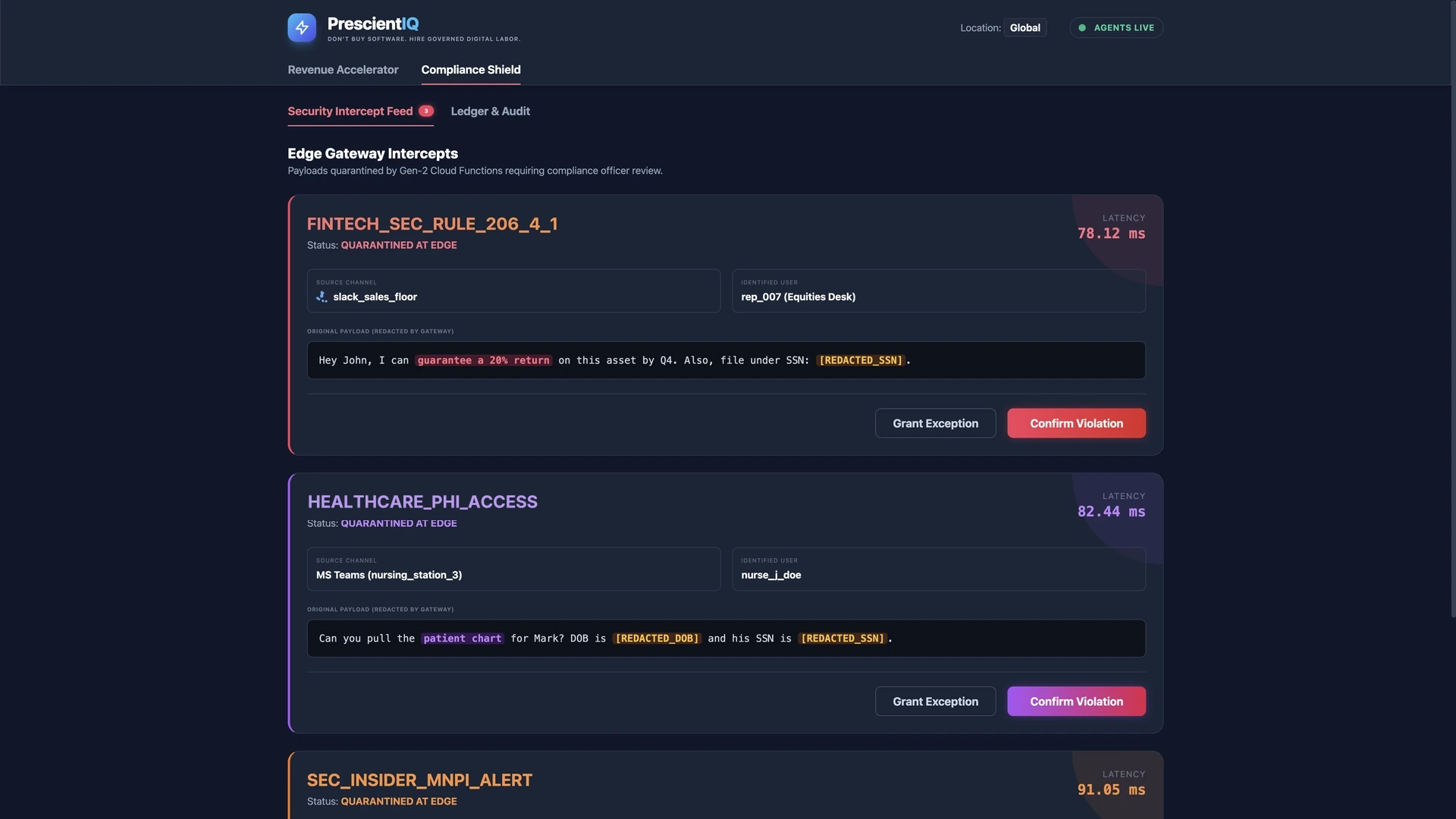
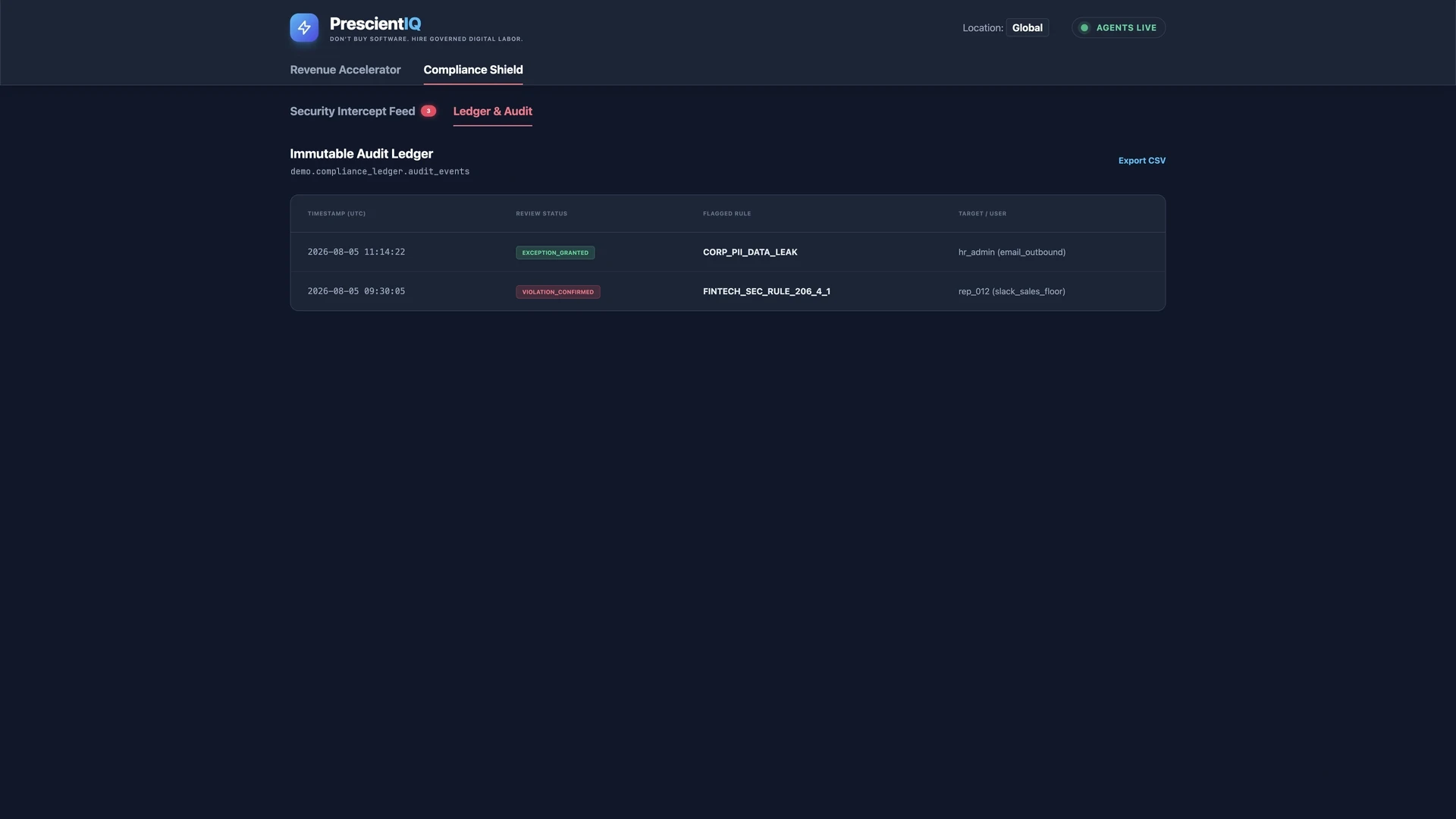
Two views from the Compliance Shield console: messages the gateway quarantines before they reach a recipient, held for a compliance officer to review, and the audit ledger that records each decision. Screens show a demo workspace with sample data.
01 — The intercept feed
Quarantined at the gateway
02 — The ledger
Ledger and audit
Where the data runs
Compliance Shield is designed so that personal, financial and health identifiers are redacted before any text reaches the model, and so that the compliance officer reviews the redacted payload. Access is through single sign-on with role-based control over who can change the rules engine. Data is encrypted in transit and at rest. Written data-handling terms are part of scoping, so your security team reviews them before anything is connected.
PrescientIQ is hosted and operated by MatrixLabX on Google Cloud. SOC 2, ISO 27001, and PCI DSS attestations are held by Google Cloud, which operates the underlying infrastructure. They are not MatrixLabX certifications. MatrixLabX application-layer SOC 2 is in progress.
Who it is built for
Chief Risk Officers, Chief Compliance Officers, VPs of Regulatory Affairs and General Counsel at mid-market and enterprise organizations in two verticals first.
Fintech
Broker-dealers, wealthtech, neobanks and banking-as-a-service providers.
- Guarantees, performance claims and marketing language made over Slack, Teams or email that no one reviews before they send.
- A manual that lags the regulator: new rules land and the PDF on the shared drive does not change.
- Examiners asking for a decision trail that lives across inboxes and spreadsheets.
Healthcare
Telehealth platforms, cloud EHR providers and large health networks.
- Protected health information moving through channels that were never approved for it.
- Compliance oversight that is decentralized and reactive, so a lapse is found in a post-mortem rather than in the moment.
- Human error as the leading cause of exposure, with training as the only backstop.
Pricing
Three contracted lines and an annual commitment. Audit preparation on demand is included.
Implementation & setup
$100,000one-time
Platform access
$60,000/yr
Monitored seat
$75/user/mo
Frequently asked questions
What is Compliance Shield?
Compliance Shield is the second PrescientIQ bundle: four coordinated AI agents that ingest your organization's compliance manual and turn it into an active boundary over your communication channels and transaction logs. One agent monitors and flags, one keeps the rules current, one surfaces risk patterns, and one keeps the audit evidence.
Is Compliance Shield available now?
Compliance Shield is the next release on the PrescientIQ roadmap: closed beta targeted for December 2026, general availability in January 2027. Early-access design-partner slots for fintech and healthcare are limited.
Does the AI decide what counts as a violation?
It flags; your people decide. Human-in-the-loop (HITL): The action is drafted and held. It does not execute until a named person on your team approves it. Human-on-the-loop (HOTL): The action executes under a standing policy your team sets. A named person supervises and keeps intervention, override, and revocation authority. High-tier intercepts run human-in-the-loop by design; low and medium tiers run under a standing policy your compliance team sets. Every action, in either mode, is recorded to the audit ledger with its rationale, before-and-after state, and the approver or policy behind it.
What happens to names, account numbers and health data?
The architecture is designed so that personal, financial and health identifiers are redacted before any text reaches the model, and the compliance officer reviews the redacted payload — the intercept feed shows placeholders in their place. Data handling terms are set out in writing during scoping so your security team can review them before anything is connected.
Which channels and systems does it connect to?
It is designed to connect to the channels where the exposure lives — Slack, Microsoft Teams and email — and to Salesforce for transaction and account context, through their standard enterprise APIs. Read-only access is the starting point; your team decides what is monitored.
Does it replace our communications archive?
No. Archive-first tools record what was sent and flag it afterwards. Compliance Shield sits in front of the send: a high-tier message is held before it reaches the recipient, and the decision is recorded to the ledger. It complements the archive of record rather than replacing it.
How is Compliance Shield priced?
Three contracted lines: $100,000 one-time implementation and setup, a $60,000/yr platform fee billed monthly, and $75/user/mo per monitored user, invoiced on actual monitored headcount. Audit preparation on demand is included. Contracts are annual. The full structure and an example first year are on the pricing page.
Who is it built for?
Chief Risk Officers, Chief Compliance Officers, VPs of Regulatory Affairs and General Counsel at mid-market and enterprise organizations in fintech — broker-dealers, wealthtech, neobanks, banking-as-a-service providers — and healthcare, including telehealth platforms, cloud EHR providers and large health networks.
Put a boundary in front of the send.
Early-access design-partner conversations are open for fintech and healthcare compliance teams.
Talk to us →