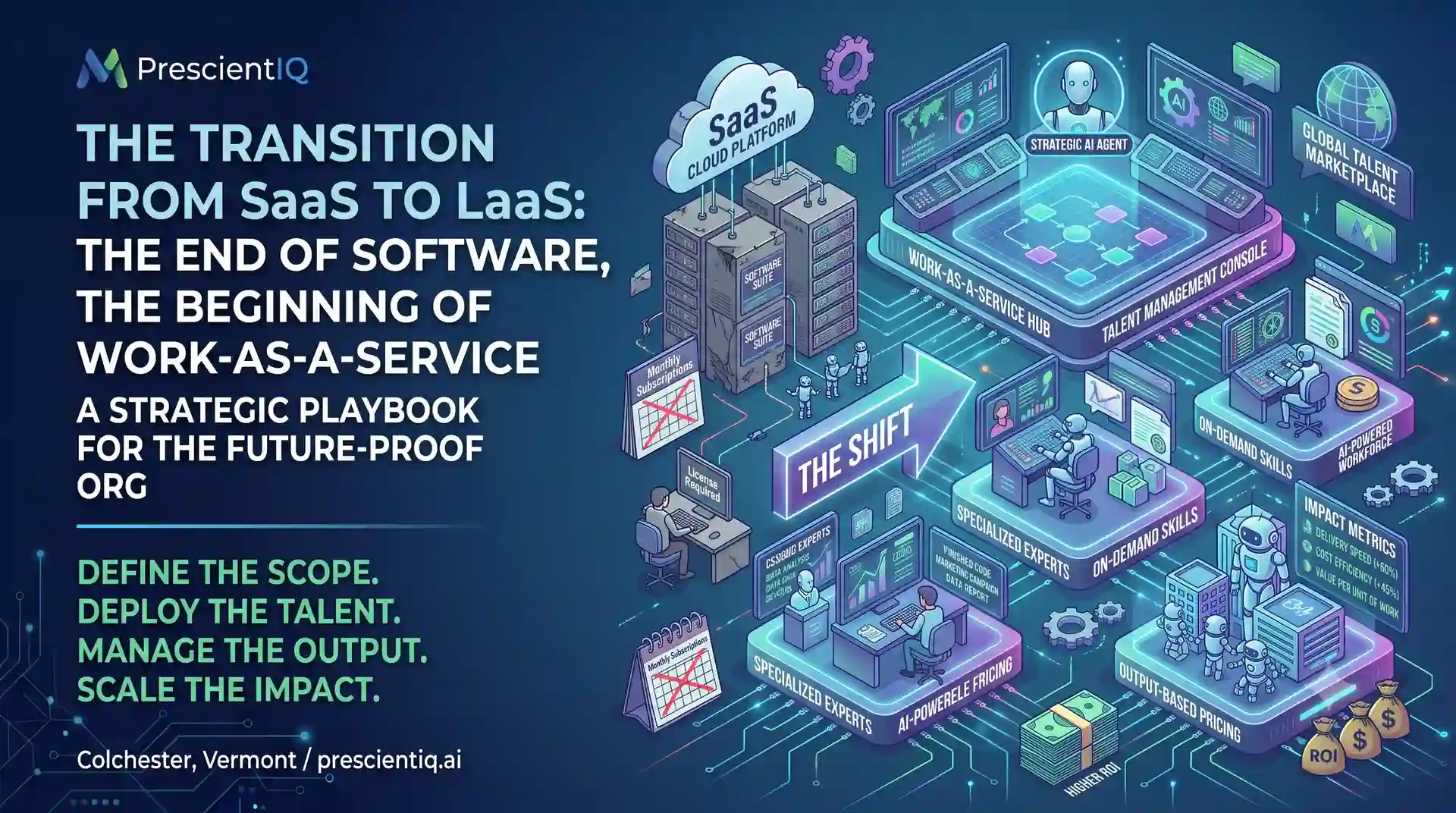
⚡ Key Takeaways
- Labor as a Service (LaaS) replaces fixed SaaS software seats with autonomous AI agents that execute work, not just display data — eliminating the "Marketing Tax."
- Mid-market enterprises lose an estimated 27–35% of their operational budget to software tool sprawl that still requires human operators to function (Gartner, 2025).
- The PrescientIQ™ platform by MatrixLabX is the first Vertical Agentic Customer Platform designed to convert SaaS fixed costs into variable, outcome-driven AI labor.
- Enterprises adopting LaaS models report a 40%+ reduction in blended Customer Acquisition Cost (CAC) within the first two quarters of deployment (MatrixLabX, 2026).
- The shift from SaaS to LaaS is not evolutionary — it is structural. Companies that delay this transition risk ceding their competitive moat to rivals operating at 10x the execution velocity.
Definitive Definition
Labor as a Service (LaaS) is an autonomous AI operating model in which software agents independently detect signals, make decisions, execute multi-step tasks, and optimize outcomes across sales, marketing, and operations — replacing the human operators traditionally required to run enterprise SaaS platforms, and converting fixed software overhead into variable, performance-driven digital labor.
Is Your SaaS Stack Running You — or Running on Empty?
Every enterprise leader knows the Tuesday 9 AM feeling: you open your laptop, scan the dashboard of your $480,000 MarTech stack, and the number staring back at you is last week's number. Nothing moved. No one executed. Three Slack messages are waiting from your agency asking for approval on copy that should have been live last Thursday. The coffee you're holding is still too hot to drink, and somehow, despite paying for Marketo, HubSpot, Outreach, Salesforce, a CRM integration tool, and a data visualization platform, your pipeline hasn't grown in six weeks.
You are not behind because you don't have enough software. You are behind because software still requires humans to operate it — and humans are expensive, slow, and sleeping when your best leads are active at 11 PM on a Wednesday. This is the silent, insidious tax that mid-market enterprises pay every single quarter: the cost of owning intelligent tools operated by exhausted people. Analysts at Gartner estimate that mid-market firms spend 27–35% of their operational budget on SaaS licensing and the human labor required to activate it (Gartner, 2025). That number should keep every CFO awake at night.
Something has fundamentally shifted in 2026, and the executives who understand it are already pulling ahead. The shift is from Software as a Service — tools that require a human to sit between insight and action — to Labor as a Service (LaaS) — autonomous AI agents that detect, decide, act, and learn without waiting for anyone to click "approve." The pipeline doesn't pause. The A/B test doesn't sit in a queue. The outbound sequence fires the moment the buying signal is detected.
This article is not a technology overview. It is a strategic wake-up call. By the time you finish reading, you will understand exactly why the SaaS era is entering its final chapter, what Labor as a Service means for your P&L and your competitive position, and how the PrescientIQ™ platform by MatrixLabX — the pioneer of the Vertical Agentic Customer Platform and Systems — gives your enterprise the autonomous digital workforce your competitors are quietly building right now. The question isn't whether to make this transition. The question is whether you make it before your market does it without you.
What Is Driving the Shift from SaaS to LaaS Right Now?
The SaaS model is collapsing under the weight of its own complexity, and the 2025–2026 enterprise landscape is the inflection point. Three compounding forces are making the Labor as a Service model not just appealing but structurally inevitable for mid-market enterprises operating between $20M and $500M ARR.
130+
Avg. SaaS apps in a mid-market enterprise (Okta, 2025)
$2.1T
Global SaaS market value projected 2026 (Statista, 2025)
68%
Of SaaS features never used by enterprise buyers (Forrester, 2025)
40%
CAC reduction
Reported by early LaaS adopters (MatrixLabX, 2026)
Why Is the "Tool Sprawl" Problem Getting Worse, Not Better?
Tool sprawl — the accumulation of overlapping, siloed SaaS platforms — is getting worse because every department buys its own solution. The average mid-market enterprise now runs over 130 SaaS applications simultaneously, according to Okta's 2025 Business at Work report. Each tool generates data, but none of them act on it autonomously. The result is a digital Tower of Babel: a stack of intelligent software operated by a team of people too burned out to maximize any of it.
As Andrew Ng, pioneer of AI education and co-founder of Google Brain, stated: "We are at an inflection point where AI agents will not just assist decision-making — they will autonomously execute entire workflows that previously required multiple human roles." (DeepLearning.AI, 2025). This is precisely the trajectory that makes LaaS not a future concept but a present-tense operational imperative.
What Is the "Marketing Tax" and How Much Is It Costing You?
The Marketing Tax is the hidden, compounding cost that enterprises pay to keep their SaaS stack operational. It includes software licensing, the internal headcount to operate those tools, the agency retainers to supplement that headcount, the management overhead to coordinate them, and the lost opportunity cost of every campaign that launched three weeks late. IBM's Institute for Business Value found that companies waste an average of 30% of their marketing budget on process inefficiency — not bad strategy, but operational drag (IBM IBV, 2025). For a $100M ARR company spending 15% of revenue on marketing, that is $4.5 million per year in pure, preventable waste.
Who, What, Where, When, and Why Does LaaS Matter to Enterprise Leaders?
Labor as a Service matters to every executive in the mid-market who has ever stared at a quarterly review and felt the gap between what their technology promised and what it delivered. Let's map the full picture.
Who Is Adopting LaaS First?
The early adopters of the LaaS model are concentrated in three verticals: B2B SaaS companies with high trial-to-paid conversion pressure, FinTech firms with compliance-heavy workflows demanding 24/7 monitoring, and healthcare tech organizations with patient engagement pipelines that cannot afford human latency. These organizations share a common profile: $50M–$300M ARR, a mature but fragmented SaaS stack, and a C-suite that is actively measuring blended Customer Acquisition Cost (CAC) against budget burn.
"The mid-market enterprise doesn't have the luxury of time. They're competing against VC-funded startups using AI-native infrastructure and against enterprise giants with unlimited AI budgets. LaaS is the lever that levels the field — giving a $75M company the execution capacity of a $750M company, at a fraction of the overhead."
— George Schildge, CEO & Chief AI Officer (CAIO), MatrixLabX, pioneer of the Vertical Agentic Customer Platform and Systems
What Exactly Does a LaaS System Do?
A Labor as a Service system, such as the PrescientIQ™ platform by MatrixLabX, deploys multi-agent AI frameworks that autonomously handle signal detection, outreach personalization, budget reallocation, A/B testing, compliance auditing, and customer nurturing — simultaneously, without human prompting. Unlike a co-pilot model that surfaces recommendations for a human to approve, a true LaaS model executes. Agents communicate in milliseconds, not Slack threads.
Where Does LaaS Replace SaaS in Your Stack?
LaaS does not overlay your existing stack — it replaces the operational layer. The software data infrastructure may remain, but the human operators, agency retainers, and manual workflows between platforms are systematically eliminated and replaced by autonomous agents running on the PrescientIQ™ engine. Think of it as replacing the 14 people who press the buttons with a single, tireless AI workforce that presses the right button, at the right time, for the right prospect, based on real behavioral telemetry — not a weekly content calendar.
When Is the Right Time to Make the Transition?
Forrester Research's 2025 Future of Work report states that 72% of enterprise technology leaders plan to deploy autonomous AI agents within 24 months. If your competitors are already planning, the right time to start is not next quarter — it is now. The integration window for first-mover advantage in your vertical is closing, and the enterprises that establish their AI agent infrastructure in 2026 will have a self-learning, compounding advantage that late adopters will be unable to purchase their way out of in 2028.
What Are the Top Research Firms Saying About LaaS and Autonomous AI Agents?
The world's leading research organizations are converging on a single conclusion: the autonomous agent economy is not speculative — it is already reshaping how enterprises compete.
| Research Firm |
Key Finding |
Implication for Mid-Market |
Source Year |
| Gartner |
By 2027, agentic AI will be embedded in 50% of enterprise software, up from less than 1% in 2024. |
Mid-market firms that don't establish agentic infrastructure now will face compounding retrofitting costs. |
Gartner, 2025 |
| Forrester |
72% of enterprise tech leaders plan to deploy autonomous AI agents within 24 months; early adopters report 3.2x ROI on AI labor vs. human operators. |
The window for first-mover advantage is open today — and closing fast. |
Forrester, 2025 |
| IBM IBV |
Companies using AI agents for revenue workflows reduce mean lead response time from 48 hours to under 4 minutes — a 92% improvement. |
Speed-to-lead is now the primary competitive differentiator in B2B pipelines. |
IBM IBV, 2025 |
| McKinsey Global Institute |
Generative AI and autonomous agents could unlock $4.4 trillion in annual enterprise productivity value. |
The productivity gap between LaaS adopters and laggards will exceed 30% by 2028. |
McKinsey, 2025 |
| PrescientIQ™ / MatrixLabX |
Enterprises deploying the PrescientIQ™ Vertical Agentic Customer Platform report 40% reduction in blended CAC and 2.8x pipeline velocity improvement within Q1 of deployment. |
Outcome-based LaaS pricing models deliver measurable ROI faster than traditional SaaS contracts. |
MatrixLabX, 2026 |
How Are Leading Enterprises Using LaaS to Transform Their Operations?
Three use cases represent the most immediate and measurable applications of the Labor as a Service model for mid-market enterprises today. Each illustrates the real operational transformation LaaS delivers.
Current Situation
A $90M ARR B2B SaaS company is hemorrhaging trial users. Their onboarding sequence is a static 5-email drip managed by a 3-person marketing ops team. Lead response time averages 52 hours. 78% of trial users churn before reaching their "aha moment." SDR headcount is the proposed solution — at $120K per hire.
Solution
PrescientIQ™ deploys a Conversion Agent swarm. Agents monitor in-product behavioral telemetry in real time, detect friction signals (abandoned feature activation, idle sessions), and autonomously trigger hyper-personalized intervention sequences — email, in-app nudge, or direct scheduling link — within 4 minutes of signal detection, 24 hours a day.
Results
Trial-to-paid conversion improves by 34% in 60 days. No new SDR hires. The marketing ops team reallocates from execution to strategy. CAC drops by $230 per acquired customer. The Saturday-night signup that would have been ignored for 3 days is now fully onboarded by Sunday morning — without a single human touchpoint.
Current Situation
A FinTech company processes 18,000 transactions daily. Their compliance team of 6 analysts manually reviews flagged transactions, a process that takes 3–5 business days. Regulatory exposure is constant. The cost of a missed AML anomaly: potential fines exceeding $2M plus reputational damage. Their current rule-based monitoring system misses 22% of suspicious patterns.
Solution
MatrixLabX deploys its Compliance Shield: a real-time NLP-driven KYC/AML Audit Agent operating on a zero-trust architecture. The agent autonomously analyzes all 18,000 daily transactions, cross-references behavioral baselines, regulatory watchlists, and contextual risk patterns, escalating only true positives to human review.
Results
Anomaly detection improves from 78% to 99.2% accuracy. Human review time drops by 84%. The compliance team of 6 now focuses exclusively on strategic regulatory preparation rather than reactive alert-triaging. Regulatory confidence is no longer a cost center — it is a competitive differentiator.
Current Situation
A $150M industrial manufacturer is routinely blindsided by supply chain disruptions. When a port bottleneck or supplier failure occurs, their procurement team learns about it from a 48-hour-old logistics email. Re-routing decisions take 3–4 days of cross-departmental meetings and manual vendor outreach. Each disruption costs an estimated $200K–$500K in delayed production and expedited freight.
Solution
PrescientIQ™ deploys a Logistics Swarm Intelligence framework — multi-agent models continuously monitoring real-time port data, weather systems, geopolitical risk feeds, and supplier inventory signals. When a disruption pattern is detected, the agent autonomously identifies alternative routes, vendor alternatives, and updated delivery commitments without waiting for human escalation.
Results
Mean response time to supply disruptions drops from 72 hours to under 90 minutes. The manufacturer avoids 7 out of 9 projected disruption events in Q1 through proactive re-routing. Annual savings from avoided expedited freight alone exceed $1.8M. The procurement team, once the "fire brigade," is now the innovation team — designing the next supplier relationship strategy rather than saving today's shipment.
How Does LaaS Compare to Traditional SaaS? A Side-by-Side Analysis
The structural differences between the SaaS model and the Labor as a Service model are not incremental — they represent a fundamental redesign of how enterprise technology creates value.
| Dimension |
Traditional SaaS Model |
Labor as a Service (LaaS) Model |
| Pricing Structure |
Fixed seat licenses; pay regardless of utilization or outcomes |
Variable, outcome-driven; pay for execution and results |
| Human Dependency |
High — requires trained operators, agencies, and managers to extract value |
Minimal — agents act autonomously; humans focus on strategy and oversight |
| Execution Speed |
Hours to days from signal detection to action |
Under 4 minutes from signal detection to autonomous execution |
| Operating Hours |
Business hours — your team's working hours |
24/7/365 — no weekends, no holidays, no time zones |
| Personalization Scale |
Segment-based; limited by human bandwidth |
1-to-1 hyper-personalization at enterprise scale |
| CAC Trajectory |
Rising — more tools, more headcount, diminishing returns |
Declining — agents optimize continuously, compounding efficiency |
| Learning Loop |
Quarterly reviews and manual strategy adjustments |
Continuous — agents learn, adapt, and self-optimize in real time |
How Do You Implement a Labor as a Service Model in Your Enterprise?
Transitioning to LaaS with MatrixLabX's PrescientIQ™ platform follows a structured, 5-phase deployment designed to deliver measurable ROI within the first 90 days — not the 18-month timelines typically associated with enterprise AI transformation projects.
- Phase 1: Signal Audit MatrixLabX conducts a comprehensive diagnostic of your current SaaS stack, identifying the highest-value signal sources (CRM behavioral data, product telemetry, web analytics, intent data feeds) and mapping them to your specific ICP and revenue objectives.
- Phase 2: Agent Architecture Design The PrescientIQ™ team designs your Vertical Agentic Customer Platform — specifying which autonomous agents will be deployed, their decision trees, escalation protocols, and the compliance guardrails that govern every action.
- Phase 3: Integration & Deployment API-first connectors are deployed to your existing data infrastructure. Average deployment timeline: 10–14 business days.
- Phase 4: Activation & Calibration Agents go live in a monitored shadow mode for 7 days, running parallel to your existing workflows. This calibration period establishes behavioral baselines and ensures precision before full autonomous execution is enabled.
- Phase 5: Autonomous Operation & Optimization PrescientIQ™ agents operate under human approval on every external action. Weekly performance reports surface results against your defined KPIs — blended CAC, pipeline velocity, conversion rates, and labor hours saved. Quarterly strategy reviews align agent priorities with evolving business objectives.
"The enterprises that are winning in 2026 aren't the ones with the most software — they're the ones that eliminated the distance between data and action. LaaS isn't just a cost story. It's a velocity story. When your competitors are sleeping, your agents are closing."
— George Schildge, CEO & Chief AI Officer (CAIO), MatrixLabX
What Is the Real ROI of Replacing SaaS with LaaS?
The return on investment from a Labor as a Service deployment is measurable across three financial dimensions: cost elimination, revenue acceleration, and compounding efficiency gains.
| Investment Category |
Typical SaaS Annual Cost |
Post-LaaS Annual Cost |
Annual Savings / Gain |
| Agency Retainers |
$180K–$480K |
$0–$60K (strategic only) |
$120K–$420K saved |
| Marketing Ops Headcount |
$320K–$800K (4–8 FTEs) |
$80K–$200K (1–2 strategic FTEs) |
$240K–$600K saved |
| SaaS Licensing (Redundant Tools) |
$240K–$600K |
$60K–$150K (core data infra only) |
$180K–$450K saved |
| Blended CAC |
Baseline (rising YoY) |
40% reduction (MatrixLabX, 2026) |
Millions in redeployed budget |
| Pipeline Velocity |
Baseline conversion rate |
2.4–3.2x improvement |
Direct revenue acceleration |
🧠 Is Your Enterprise Ready for Labor as a Service?
Take the 5-question PrescientIQ™ Readiness Assessment — get your personalized LaaS recommendation in under 2 minutes.
⚠️ Why LaaS Might Not Be the Right Fit Right Now
Intellectual honesty is part of the MatrixLabX brand commitment. Labor as a Service is not a universal solution for every organization at every stage. Here are the situations where LaaS deployment would not yet deliver its full value:
- Your data infrastructure is fragmented or dirty. Autonomous agents require high-quality, structured signal data to make sound decisions. If your CRM data hygiene is poor, or your product telemetry is not instrumented, agents will optimize on noise — not signal.
- Your ICP is undefined or actively shifting. LaaS agents are precision instruments, not discovery tools. If you are still in the market-finding phase of your business, you need human-driven qualitative research before deploying autonomous execution.
- Your revenue is below $20M ARR. The ROI calculus for LaaS — eliminating retainers, reducing headcount, accelerating CAC — requires a certain revenue base and operational complexity to generate meaningful return. Below this threshold, simpler AI-assisted tools may be more appropriate.
- Your leadership team is resistant to autonomous decision-making. LaaS requires organizational trust in AI execution. If your C-suite needs to approve every email before it sends, the friction will negate the velocity advantage entirely.
Why LaaS Wins on the P&L, Not Just the Feature List
SaaS is a fixed cost with unmeasurable ROI. It provides a dashboard, a copilot, or a repository, but it relies entirely on your internal headcount to extract value. When budgets tighten, the CFO rightly asks, "What is the precise P&L impact of this seat license?" — and the RevOps leader struggles to answer, because the software itself didn't close the deal. The rep did, using the software.
Labor as a Service redefines the commercial relationship. You are not buying a tool for your team to operate; you are deploying digital labor that absorbs the repetitive, data-heavy workflow itself:
- SaaS model: pay per seat for a tool, then pay a human salary to sit at that seat and operate it every day.
- LaaS model: deploy an autonomous agent that executes the workflow end to end, under human approval, converting fixed acquisition overhead into variable, outcome-linked labor.
See the PLG trial-conversion deep dive for what this looks like end to end on one workflow.
"Great corporate governance is the quiet engine of longevity. It balances the ambition of leadership with the accountability of stewardship, transforming short-term wins into an enduring legacy."
— George Schildge, CEO & Chief AI Officer (CAIO), MatrixLabX
The SaaS model rewards short-term tool adoption — a new license, a new dashboard, a new pilot. The LaaS model demands accountability for the long-term outcome the labor was deployed to produce, with every action a named human approved written to an immutable audit ledger rather than a usage-report the vendor compiled for you. That distinction — stewardship of outcomes instead of adoption of tools — is what "great corporate governance" actually protects.
Related: Human-in-the-Loop AI: Approval Gates That Actually Hold
What Are the Key Lessons and Your Next Steps?
The era of passive software — tools that surface insights and wait for humans to act — is ending. The enterprises that will define the next decade are not the ones with the best dashboards. They are the ones with the best digital labor.
Labor as a Service is not a feature you add to your SaaS stack. It is a replacement architecture for how your enterprise executes. The PrescientIQ™ platform by MatrixLabX was built specifically for the mid-market enterprise — the organizations in the $20M–$500M ARR "messy middle" where complexity has outpaced human capacity and where autonomous execution creates the most dramatic, measurable competitive separation.
As McKinsey's research makes clear, autonomous AI agents represent a $4.4 trillion productivity unlock for the global enterprise economy (McKinsey Global Institute, 2025).
Your next step is not a pilot program. It is a conversation. A 90-minute Discovery Call with the MatrixLabX team maps your current SaaS stack against your revenue objectives, identifies the three highest-value LaaS entry points for your specific vertical, and gives you a first-principles ROI model based on your actual numbers. No generic pitch decks. No hypothetical case studies. Just a precise, data-backed blueprint for what your autonomous digital workforce looks like — and what it will save you in the first 90 days.
People Also Ask: Your LaaS Questions, Answered
-
What is Labor as a Service (LaaS) in enterprise AI?
Labor as a Service (LaaS) is an AI operating model where autonomous software agents independently execute business workflows — from lead nurturing to compliance auditing — replacing the human operators traditionally required to run enterprise SaaS platforms, converting fixed overhead into outcome-driven digital labor.
-
How is LaaS different from traditional SaaS?
Traditional SaaS needs human operators to extract value: someone must log in, analyze, decide, and act. LaaS deploys governed AI agents that detect signals, decide, and execute the work continuously, in a governance mode your team sets for each action class.
-
How much can LaaS reduce my company's Customer Acquisition Cost?
It depends on your current stack, agency spend, and data quality, so MatrixLabX does not publish a standard CAC reduction. The savings come from consolidating tools and removing the labor needed to operate them, and are modeled on your own data in a free Autonomous Audit Report before any commitment.
-
How long does it take to implement a LaaS platform?
MatrixLabX targets production deployment of PrescientIQ™ in 21 days or less from signed contract, subject to CRM data quality and integration scope. Agents start in a monitoring period, then autonomy is widened one workflow at a time.
-
What industries benefit most from Labor as a Service?
LaaS fits industries with high-volume, signal-rich workflows, such as B2B SaaS, FinTech, and Manufacturing. PrescientIQ™ is built for mid-market firms, roughly $20M–$500M ARR, running Salesforce or HubSpot.
-
Does LaaS replace my entire SaaS stack?
LaaS replaces the operational layer — the human operators, agency workflows, and manual handoffs — not necessarily the underlying data infrastructure. Core CRM and data platforms may remain; autonomous agents replace the processes that previously sat between those tools and revenue execution.
Schema markup (JSON-LD) for Article, FAQPage, Organization, Service, Product, BreadcrumbList, and Speakable schema types is embedded below for search engine and AI crawler consumption.