PrescientIQ™ for B2B SaaS
Governed AI agents for the full B2B SaaS funnel.
From first signal to renewal, on the record.
PrescientIQ™ for B2B SaaS is a set of four governed AI agents from MatrixLabX that work the whole revenue funnel. Scout scores accounts, Herald drafts and sends outreach, Guide catches stalling trials, and Steward surfaces upsell and churn-risk signals. Marshal coordinates all four. Your team sets the governance mode for each action class, and every action is recorded to an audit ledger. Built for B2B SaaS companies at $20M–$500M ARR running Salesforce or HubSpot.
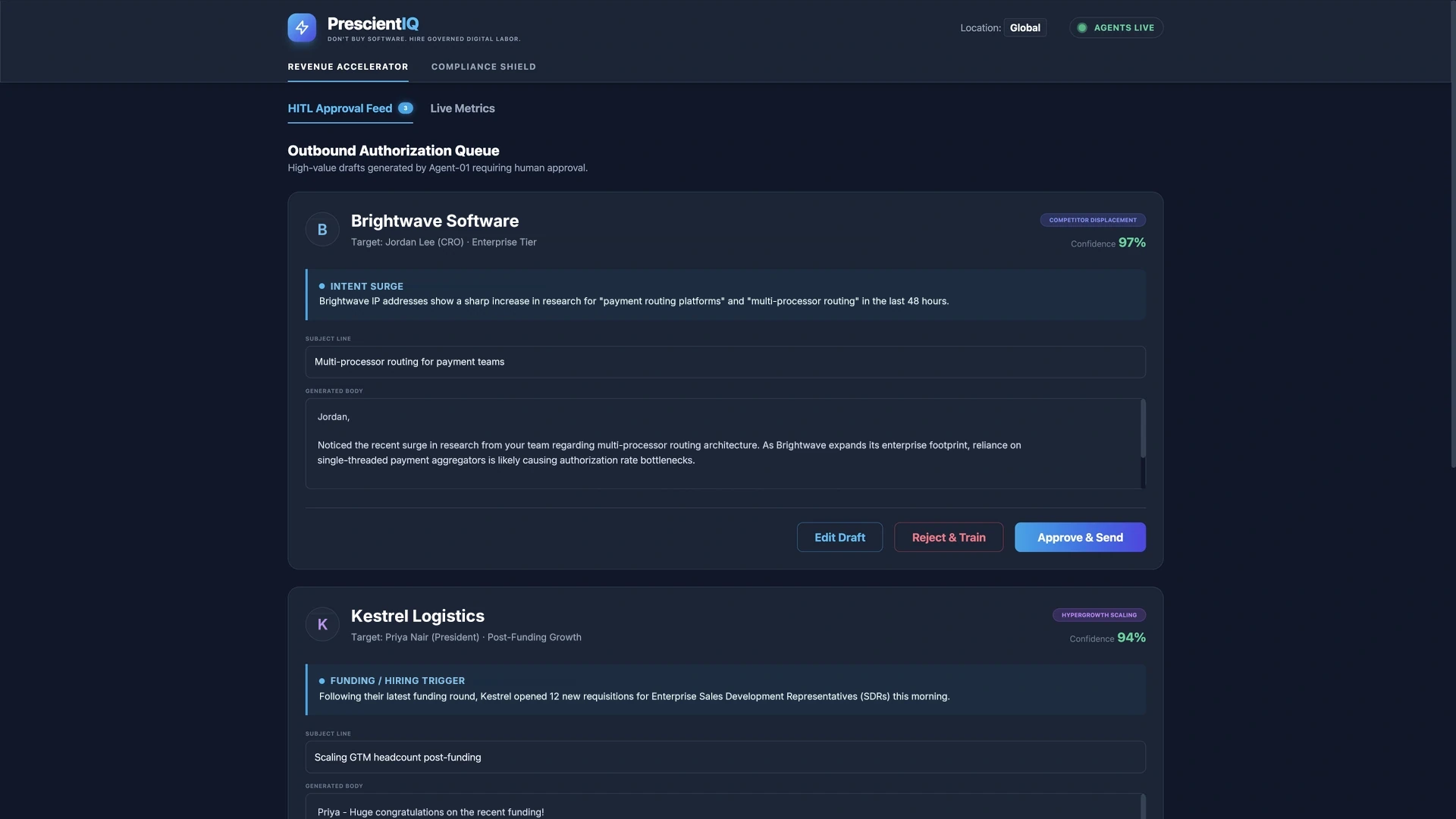
Available now through a founding pilot program for mid-market B2B companies ($20M–$500M ARR) running Salesforce or HubSpot.
Where a SaaS funnel loses revenue
SaaS revenue teams rarely have an insight problem. The intent spike, the stalled trial, and the drop in seat utilization are all visible in a dashboard somewhere. What is missing is the capacity to act on each one while it still matters.
The leaks sit at the handoffs: between a scored account and the first message, between a signup and the value event, between a healthy quarter and a renewal nobody prepared for. Adding tools adds dashboards. It does not add execution.
PrescientIQ puts an agent on each stage and one coordinator across all four. A signal at any point in the funnel becomes a prepared action, governed the way your team decides. The product behind this page is the Revenue Accelerator Stack.
One agent for each stage of the funnel
Each agent is narrow in scope and coordinated centrally, so a failure in one stage does not stall the others. For every stage, this is the signal, the work, and what stays under your control.
Stage 1 · Acquire
Scout
Pipeline Research Analyst
- The signal
- Hiring surges, funding events, and tool-sprawl indicators on accounts that fit your ICP.
- What the agent does
- Scores ICP-fit accounts from firmographic and intent signals sourced through licensed providers. Scoring runs on deterministic code, so identical inputs always produce identical scores.
- What your team controls
- Your team defines the ICP and the thresholds. Each qualified account hands off with its score and the inputs behind it.
Stage 2 · Engage
Herald
Outbound Engagement Rep
- The signal
- A qualified account with a specific, dated trigger.
- What the agent does
- Drafts outreach grounded in the signal that triggered it, with the reasoning behind each draft captured alongside it. Messages go out through an authenticated delivery provider.
- What your team controls
- Each draft is held for a named approver before it sends.
Stage 3 · Convert
Guide
Trial Activation Specialist
- The signal
- A trial that stalls before its value event.
- What the agent does
- Watches in-product behavior and prepares a personalized activation sequence at the stall moment. Upgrade and tier math runs on sandboxed deterministic code, never on model arithmetic.
- What your team controls
- Your team decides which activation messages wait for approval and which run under policy. Pricing logic stays reproducible.
Stage 4 · Expand and retain
Steward
Expansion & Retention Analyst
- The signal
- Shifts in usage patterns, seat utilization, and feature adoption across the install base.
- What the agent does
- Surfaces upsell and churn-risk signals and creates prioritized next-best-action items, each with a deterministic confidence score.
- What your team controls
- The agent surfaces and prioritizes. The account decision stays with your CSMs and account owners.
Which agents lead depends on your motion
Product-led growth
Trial signups outpace the team’s capacity to qualify them by hand, and trials stall before anyone notices.
Guide and Herald lead
Sales-led growth
Outbound has to reference the real trigger and the real stack, or technical buyers report it as spam.
Scout and Herald lead
Expansion-heavy install base
Expansion revenue leaks between quarterly reviews because usage is tracked by hand.
Steward leads, with Marshal
Performance you can check, not take on faith
These are the figures we publish for this motion, each with its proof class. Targets are modeled, not measured. MatrixLabX is in a founding pilot program and does not publish measured customer outcomes. The free Autonomous Audit Report runs the model against your own CRM and pipeline data before you sign anything.
Figures labeled as targets are modeled against current human and copilot baselines. They are not guarantees. Every engagement begins with a free Autonomous Audit Report — a P&L projection built on your own data — and targets are validated against your environment before any commitment.
Figures labeled as targets are modeled against current human and copilot baselines. They are not guarantees. Every engagement begins with a free Autonomous Audit Report — a P&L projection built on your own data — and targets are validated against your environment before any commitment.
How performance is measured once you are live
Two counters run from the first day, and they write to the same ledger that backs your audit trail. Your performance record and your compliance record come from one source.
Workflows executed
Every completed agent action increments an auditable counter, per account and per agent.
Outcomes attributed
Pipeline created, trials activated, and expansion items surfaced are tied back to the workflow that produced them.
Usage export
RevOps reconciles the record against the ledger directly, without a dashboard that has to be taken on faith.
Legal, regulatory, and compliance controls
A SaaS revenue motion touches commercial email rules, privacy law, your own offer terms, and your customers’ security reviews. These are the controls the platform provides, and the line where your team and counsel take over.
Who authorizes an action
Human-in-the-loop (HITL). The action is drafted and held. It does not execute until a named person on your team approves it.
Human-on-the-loop (HOTL). The action executes under a standing policy your team sets. A named person supervises and keeps intervention, override, and revocation authority.
Your team chooses the mode for each action class, based on its risk tolerance, and can change it at any time.
Every action, in either mode, is recorded to the audit ledger with its rationale, before-and-after state, and the approver or policy behind it.
Every action class starts in human-in-the-loop until your team changes it.
An audit ledger written as it happens
Every action, in either mode, is recorded to the audit ledger with its rationale, before-and-after state, and the approver or policy behind it. A review works from a record, not a reconstruction.
A scoped identity for every agent
Each agent runs under its own least-privilege identity instead of a shared service account or a borrowed human credential. Entitlements are enumerable, actions are attributable, and an agent can be revoked without disabling a person.
Deterministic code for anything numeric
Scores, rankings, and upgrade math are computed by sandboxed deterministic code, never by asking a language model to do arithmetic. The same inputs produce the same number every time.
Prompt-injection defense on inbound surfaces
Agents read web pages, email replies, and CRM fields other people write into. Each of those is treated as an untrusted input and defended accordingly.
Where the rules meet the funnel
For each area: what the rule asks of a revenue motion, what the platform gives you, and what stays with your team and counsel.
| Area | What it asks of your motion | What the platform gives you | What stays with you |
|---|---|---|---|
| Commercial email (CAN-SPAM Act) | Accurate sender and subject lines, a working opt-out, and a valid physical postal address on every commercial message, including later steps in a sequence. | Each draft is recorded with its rationale and is held for approval before it sends. Suppression and frequency rules are stated before deployment, not discovered after it. | What your footer says, and how an opt-out is honored across every tool you run. |
| Calls and texts (TCPA) | Consent that matches the channel and the dialing method, and do-not-call scrubbing before anyone is dialed or texted. | Herald delivers through an authenticated email provider. If your motion also dials or texts, the audit maps where those consent and scrubbing records break. | Consent records and scrubbing for any telephony your team runs. |
| Privacy and data protection law | A basis for contacting a person, and the ability to answer access, deletion, and opt-out requests. | The ledger records what an agent did, to which record, and under whose approval or policy, so a request can be traced through agent activity. | Your basis for processing, and the retention, deletion, and model-training terms you hold with us in writing. |
| Trial and renewal offers | Offer, renewal, and cancellation terms that are disclosed the way the rules for your buyers require. Those rules vary by jurisdiction and buyer type. | Upgrade and tier math runs on deterministic code, so a price in a message is reproducible. The message is held for approval before it sends. | Which disclosure and cancellation rules apply to your plans. That is a question for your counsel. |
| Customer security reviews | Where the workload runs, whose attestations apply, how agent identities are scoped, and whether actions are logged as they happen. | PrescientIQ is hosted and operated by MatrixLabX on Google Cloud. SOC 2, ISO 27001, and PCI DSS attestations are held by Google Cloud, which operates the underlying infrastructure. They are not MatrixLabX certifications. MatrixLabX application-layer SOC 2 is in progress. | Your security team’s review. Bring Security and your CRM owner to the same session. |
The pre-send checks behind the first two rows are set out in Outbound compliance controls: TCPA and CAN-SPAM.
Where it runs, stated plainly
PrescientIQ is hosted and operated by MatrixLabX on Google Cloud. SOC 2, ISO 27001, and PCI DSS attestations are held by Google Cloud, which operates the underlying infrastructure. They are not MatrixLabX certifications. MatrixLabX application-layer SOC 2 is in progress.
Engineered availability SLO of ≥99.5% on the model and inference path, with named third-party carve-outs (Salesforce, HubSpot, intent-data vendors, email delivery).
What we will not tell you
These are claims you can expect from vendors in this category, and why we do not make them.
That the platform makes your outreach compliant
Compliance is a property of your program: your consent records, your suppression discipline, and your counsel’s reading of the rules. The platform enforces the governance mode you set and records what happened. It does not turn a non-compliant motion into a compliant one.
That the performance figures are measured results
We are in a founding pilot program and do not publish measured customer outcomes. A figure labeled Target is modeled, and it carries its qualifier everywhere it appears. The audit models it against your own data.
That an agent replaces a set number of reps
We publish no headcount-equivalence figure. The agents take on execution work your team does not have the capacity to reach. What that is worth in your funnel is what the audit is for.
That your data-handling terms are on a web page
Model-training exclusion, retention, and deletion belong in a written agreement your counsel reads. Ask us for those terms in writing, and hold every vendor on your shortlist to the same standard.
“For midmarket SaaS companies, product-led growth requires an AI-driven revenue operations engine. Using AI to analyze product usage data allows marketing and sales teams to intercept churn risks and identify expansion opportunities long before the renewal date.”
— George Schildge, CEO & Chief AI Officer, MatrixLabX
Which stage should an agent start on?
The right starting point depends on where the funnel leaks and on whether the approval rule for that stage already exists. Two questions.
Where should an agent start in your revenue motion?
Three ways to start
Every option publishes its price in full. None is priced per seat.
Full platform
Revenue Accelerator Stack
$165,000/yr
$165,000/year is the complete platform fee. There is no separate implementation charge and no different first-year number — deployment work is included from signature, not billed as a distinct line. Scope beyond a typical deployment — additional bundles, sustained higher volume — is quoted at your AAR before anything is signed.
Self-serve
PrescientIQ™ Sales Accelerator
$399/mo, Starter tier billed annually
A separate, tiered product for sales teams starting smaller. The Starter tier is $499/mo when billed monthly. Customers migrate to the Revenue Accelerator Stack as they scale.
Managed
Managed — we run it for you
From $8,999/mo
A named MatrixLabX operator runs the crew and your team authorizes. Includes the PrescientIQ platform at its published price, plus a managed-service fee.
Request your free Autonomous Audit Report
A P&L projection built on your own CRM and pipeline data. It shows which funnel stage to start with, models the targets above against your environment, and sets a deployment timeline with you.
Frequently asked questions about AI agents for B2B SaaS
- What is PrescientIQ for B2B SaaS?
- PrescientIQ™ for B2B SaaS is the Revenue Accelerator Stack from MatrixLabX applied to a SaaS revenue motion: four governed AI agents (Scout, Herald, Guide, and Steward) covering prospecting, outbound, trial conversion, and expansion. Your team chooses the mode for each action class, based on its risk tolerance, and can change it at any time.
- Which stages of the SaaS funnel do the agents cover?
- All four revenue stages. Scout scores ICP-fit accounts. Herald drafts and sends outreach grounded in a specific signal. Guide prepares activation sequences when a trial stalls. Steward surfaces upsell and churn-risk signals from usage data. Marshal, the coordinator, orchestrates all four.
- Can an agent send email or write to our CRM without approval?
- Only if your team chooses that for an action class. Human-in-the-loop (HITL): The action is drafted and held. It does not execute until a named person on your team approves it. Human-on-the-loop (HOTL): The action executes under a standing policy your team sets. A named person supervises and keeps intervention, override, and revocation authority.
- Does PrescientIQ make our outbound compliant with CAN-SPAM, the TCPA, or privacy law?
- No platform can do that on its own. Compliance depends on your consent records, your suppression discipline, and your counsel’s reading of the rules that apply to you. PrescientIQ enforces the governance mode your team sets and records each action with its rationale, which gives a compliance review a factual record to work from.
- What results should a SaaS company expect?
- We publish modeled targets, not measured customer results, because PrescientIQ is in a founding pilot program. Every figure on this page carries its proof-class label and its qualifier. The free Autonomous Audit Report models those targets against your own CRM and pipeline data, so you see your own numbers before any commitment.
- Where does PrescientIQ run, and whose certifications apply?
- PrescientIQ is hosted and operated by MatrixLabX on Google Cloud. SOC 2, ISO 27001, and PCI DSS attestations are held by Google Cloud, which operates the underlying infrastructure. They are not MatrixLabX certifications. MatrixLabX application-layer SOC 2 is in progress.
- How is PrescientIQ priced for a SaaS company?
- There are two ways to start. The Revenue Accelerator Stack is one flat platform fee of $165,000 a year, billed monthly and never per seat, with deployment work included. PrescientIQ™ Sales Accelerator is a separate self-serve product with tiered plans for teams starting smaller. Both publish their prices in full.
- What do we need in place before deployment?
- Salesforce or HubSpot, an authenticated sending domain with SPF, DKIM, and DMARC configured, and suppression and frequency rules you are willing to state explicitly. If any of those are missing, the audit reports it as a finding before deployment instead of after the first send.
- How long does deployment take?
- The target is 21 days or less from signed contract to production. That is a modeled target, not a commitment. The actual timeline depends on CRM data quality and integration scope, and it is set with you during the Autonomous Audit Report instead of assumed.
- How does a SaaS revenue team get started?
- Request the free Autonomous Audit Report on this page, and a MatrixLabX solution architect will reach out within 48 hours to schedule it. The report is a P&L projection built on your own data. It shows which funnel stage to start with before anything is signed.
Go deeper, wherever you are in the decision
Learning
Working out where the funnel leaks and what kind of system addresses it.
Evaluating
Running diligence with Security, RevOps, and counsel in the room.
Ready to scope
Comparing the commercial structure and the path to production.
This page describes how PrescientIQ is designed to operate. It is not legal advice, and it does not determine how the CAN-SPAM Act, the TCPA, privacy law, or any renewal or cancellation rule applies to your business. Those determinations belong to your counsel.
See your own funnel modeled before you commit to anything.
The Autonomous Audit Report is free, and it is built on your data, not ours.