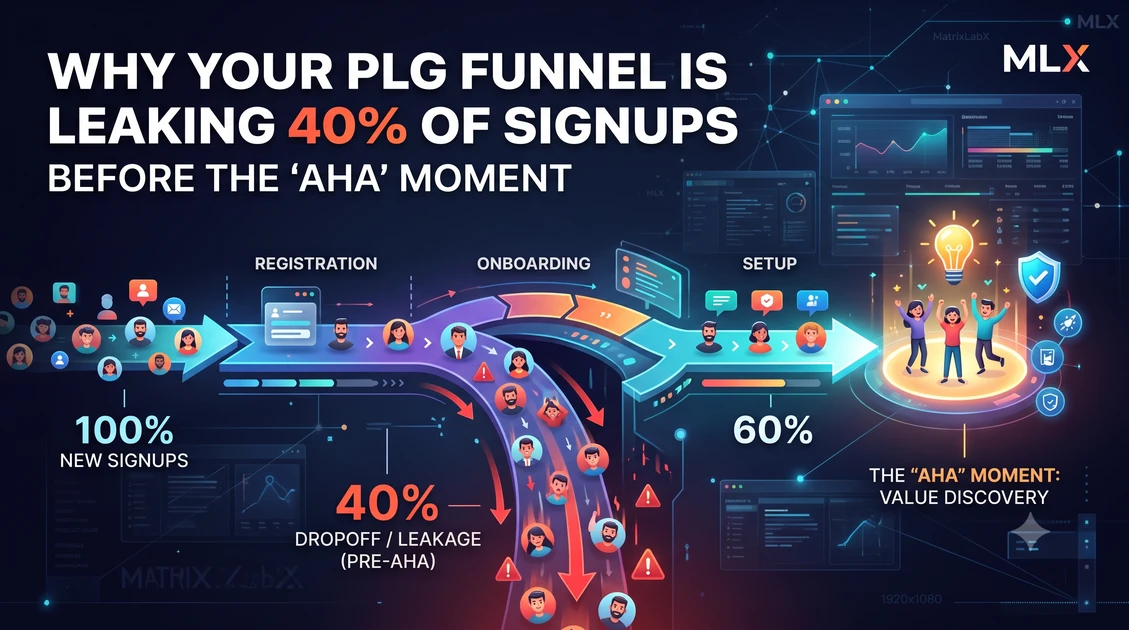
Why your PLG funnel is leaking 40% of signups before the “aha” moment
Trial-to-paid leakageis the share of self-serve signups who never reach product activation and therefore never convert to a paying account. In a product-led growth motion, that gap between “signed up” and “activated” is where a PLG company's growth math quietly breaks. A governed Guide — monitoring usage continuously and drafting outreach for human approval — closes that coverage gap without adding SDR headcount.
Trial conversion is one of three places this pattern pays off in a SaaS motion — the others being outbound coverage and expansion. See Three Revenue Accelerator Applications for B2B SaaS.
Key takeaways
- →Trial-to-paid conversion is bimodal, not average. Published 2026 cohort data (ChartMogul/ProductLed, ~200 B2B products) shows the bottom 20% of self-serve products convert under 2.5%, the top 20% convert above 25%, and almost nobody sits at the “average” of 8–9% — so benchmarking against an industry mean tells you almost nothing about your own funnel.
- →Activation, not trial length, is the real lever. Activated trials convert at dramatically higher rates than un-activated ones, regardless of trial window.
- →The SDR bottleneck is a triage problem, not a headcount problem — reps waste hours pattern-matching free-tier signups for real buying intent, exactly where a governed agent adds leverage without removing the human decision.
- →Governed autonomy — agents execute, humans authorize — lets a PLG team recover leaking signups without hiring more SDRs or asking reps to babysit a dashboard.
What is trial-to-paid leakage in a PLG motion?
Trial-to-paid leakage is the share of self-serve signups who never reach product activation and therefore never convert to a paying account.In product-led growth, the free-signup-to-paid-customer path is the whole business model — but most of the traffic that enters it never gets far enough into the product to experience the value the product was built to deliver. That gap between “signed up” and “activated” is where a PLG company's growth math quietly breaks.
In the context of the 2026 AI search shift, why does this problem matter more now?
Buyers today form their first impression of a vendor before a human ever sees them — inside the product itself, during a free trial, often inside the first session. That shift has moved the highest-leverage moment in the entire revenue motion from the sales call to the onboarding flow. A prospect who stalls in week one of a trial isn't a “cold lead” in the traditional sense; they're a warm lead that the product, not the rep, failed to activate.
Search and AI-driven discovery have made top-of-funnel traffic cheaper and more abundant. Activation — not acquisition — is now the binding constraint on PLG revenue growth.
The mess: a familiar story for mid-market PLG SaaS
Picture a $20M–$50M ARR SaaS company that just closed a strong quarter of self-serve signups. Marketing is thrilled — the top of the funnel has never looked this healthy. But three SDRs, freshly hired to convert this new volume, are drowning.
They open the CRM each morning to a queue of hundreds of free-tier accounts with no way to tell, at a glance, which ones are a director at a mid-market company evaluating the product seriously and which ones are a student poking around on a Tuesday afternoon. So the reps do what any human under time pressure does: they work the loudest signals — the accounts that filled out every field, the ones with a corporate email domain — and let the rest sit. Weeks later, someone runs the numbers and finds that a meaningful share of signups never got a single outreach touch, and a portion of those were exactly the accounts that would have converted if someone had reached them during the trial window, not after it closed.
The pivot: where governed agents fit without replacing human judgment
This is not a story about replacing SDRs with AI. It's a story about giving SDRs a triage layer that never sleeps and never gets tired of scanning the same signup queue. Guide paired with HITL (human-in-the-loop) Outbound works like this:
- Sense. The agent continuously monitors trial-account behavior — feature usage, seat invitations, integration attempts, time-in-product — the same signals a sharp SDR would look for, but across every account, all the time.
- Decide.It scores accounts against your actual activation criteria, not a generic lead score, and flags which accounts are approaching a stall point before they've fully disengaged.
- Act — under approval. The agent drafts the outreach — a check-in, an integration nudge, a comparison to how similar accounts got unstuck — and queues it for a human to approve, edit, or reject.
- Learn. Every approval and edit feeds back into how the agent triages the next cohort.
The rep still makes the call on every message that goes out. The audit ledger records what was proposed, what was approved, and what was sent — so nothing leaves the building without a human decision behind it.
The payoff: what changes for the team
SDRs stop spending their morning guessing which accounts matter and start spending it approving and personalizing outreach the agent has already drafted for the accounts that matter most. The stalled-trial problem — the single highest-leverage moment in a PLG funnel — gets covered continuously instead of by whichever rep happens to notice first.
Trending signals around PLG trial conversion in 2026
| Signal | What it means for mid-market PLG teams |
|---|---|
| Activation-first landing pages and in-trial nudges are becoming standard | The industry has converged on activation, not trial length, as the primary lever — supporting agent-driven, milestone-based outreach over blanket drip email |
| Hybrid PLG + sales-assisted motion is now the norm, not the exception | Most PLG companies now layer a human touch onto self-serve — exactly the "agents execute, humans authorize" model, rather than pure automation or pure manual triage |
| Product-qualified lead (PQL) scoring remains underused industry-wide | A large share of PLG companies still route leads on generic criteria instead of real usage signals — a clear gap a governed scoring agent is built to close |
SaaS vs LaaS: who operates the triage layer?
| Status quo (SaaS + manual triage) | Governed digital labor (LaaS) | |
|---|---|---|
| Who scans the signup queue | SDRs, manually, a few times a day | An agent, continuously, across every account |
| What gets missed | Accounts that stall quietly, off-hours signups, slow-building intent | Nothing — every account is scored on the same cycle |
| Who sends the outreach | The rep, after they've done the scanning | The rep, after the agent has done the scanning — same approval step, less wasted time |
| Audit trail | Ad hoc, usually just CRM notes | Immutable ledger: every proposal, approval, and edit logged |
| Scales with signup volume? | No — more signups means more manual triage hours | Yes — the agent's workload scales; the human approval step doesn't have to |
Three ways this plays out (before → after → bridge)
Onboarding stall detection. Before: a trial account invites two teammates, imports data, then goes quiet for a week — and nobody notices until the trial expires. After: the same account gets a same-week, context-aware check-in drafted by the agent and sent by a rep who actually knows what stalled. Bridge: Guide watching product usage in real time, with human approval on every message.
SDR time reallocation. Before: three SDRs split their day between qualifying leads and writing outreach, with qualification eating the majority of the clock. After: SDRs spend the bulk of their time on approval, personalization, and actual conversations — the part of the job that needs a human. Bridge: the same agent doing the qualification pass continuously, instead of a rep doing it in batches.
Free-to-paid handoff visibility. Before: leadership finds out about a leaky funnel stage in a quarterly review, long after the cohort has already been lost. After: stall points and intervention outcomes are visible on an ongoing basis, tied to an audit trail that shows what was tried and what worked. Bridge: the immutable ledger that governed autonomy requires by design.
Is your PLG funnel leaking signups it could recover?
Five questions for a directional read on where your trial-conversion coverage gap actually sits.
How would a mid-market PLG team actually implement this?
- Map your real activation event— the specific in-product action that correlates with eventual conversion, not a generic “logged in” signal.
- Define the human-approval gate — decide which outreach types need rep sign-off before send (usually: all of them, for at least the first few cycles).
- Connect the agent to your CRM and product analytics — HubSpot or Salesforce, plus your usage-event stream.
- Run a pilot cohort — a defined slice of trial signups, agent-triaged, rep-approved, measured against a control cohort handled the old way.
- Review the audit ledger weekly — not just conversion numbers, but what the agent proposed, what reps changed, and why.
Why this might not work for you
If your trial volume is small enough that a single SDR can genuinely stay on top of every signup by hand, the leverage here is limited — the agent adds the most value at volume, not at a handful of trials a week. And if your product's activation event is genuinely ambiguous or still being figured out, it's worth nailing that down first; an agent triaging against a fuzzy activation definition will just automate the fuzziness.
Conclusion: the leak is fixable without more headcount
The gap between signup and activation isn't a staffing problem — it's a coverage problem. Guide working under human approval closes that coverage gap continuously, so your existing SDR team spends its time on judgment calls instead of triage. The next step is seeing what this looks like against your own funnel data, not a generic benchmark.
Get your free AAR benchmark → · Learn about the Revenue Accelerator → · What is Labor as a Service? →
Frequently asked questions
What counts as a "stalled" trial?
Generally, a trial account that has stopped taking meaningful in-product action — no new usage, no new integrations, no new invited teammates — for a defined window that's shorter than the remaining trial period, giving time for an intervention.
Does this replace our SDR team?
No. The model is agents execute, humans authorize. The agent handles continuous monitoring and drafts outreach; a human decides what actually gets sent.
How is this different from a marketing automation drip sequence?
A drip sequence sends the same message on a fixed schedule regardless of behavior. A governed agent reads live product usage and drafts a specific, contextual message tied to what the account actually did or didn’t do — then still routes it through a human before it goes out.
Will this work with our existing CRM?
MatrixLabX's PrescientIQ™ platform is built to integrate with HubSpot and Salesforce; ask your team about your specific CRM and product analytics stack on a discovery call.
What does this cost?
Pricing depends on account volume and configuration. [See pricing for specifics] — get a modeled read on your own funnel through a free Autonomous Audit Report.
See where your funnel is actually leaking
Book a 30-minute discovery call. We'll map the exact agent configuration to your stack and give you accurate deployment timelines.
Book a Discovery Call →George Schildge
Founder & Chief AI Officer, MatrixLabX
George Schildge founded MatrixLabX to close the gap between what mid-market revenue teams can staff and what their funnel actually needs covered — governed AI agents that execute continuously, with a human approving every consequential action.
Related posts
See where your own execution effort is going
The Autonomous Audit Report models where your team's execution capacity is currently spent, what your configuration is actually paying for, and what the governed alternative looks like on your own data — before any commitment.
Get your free AAR benchmark