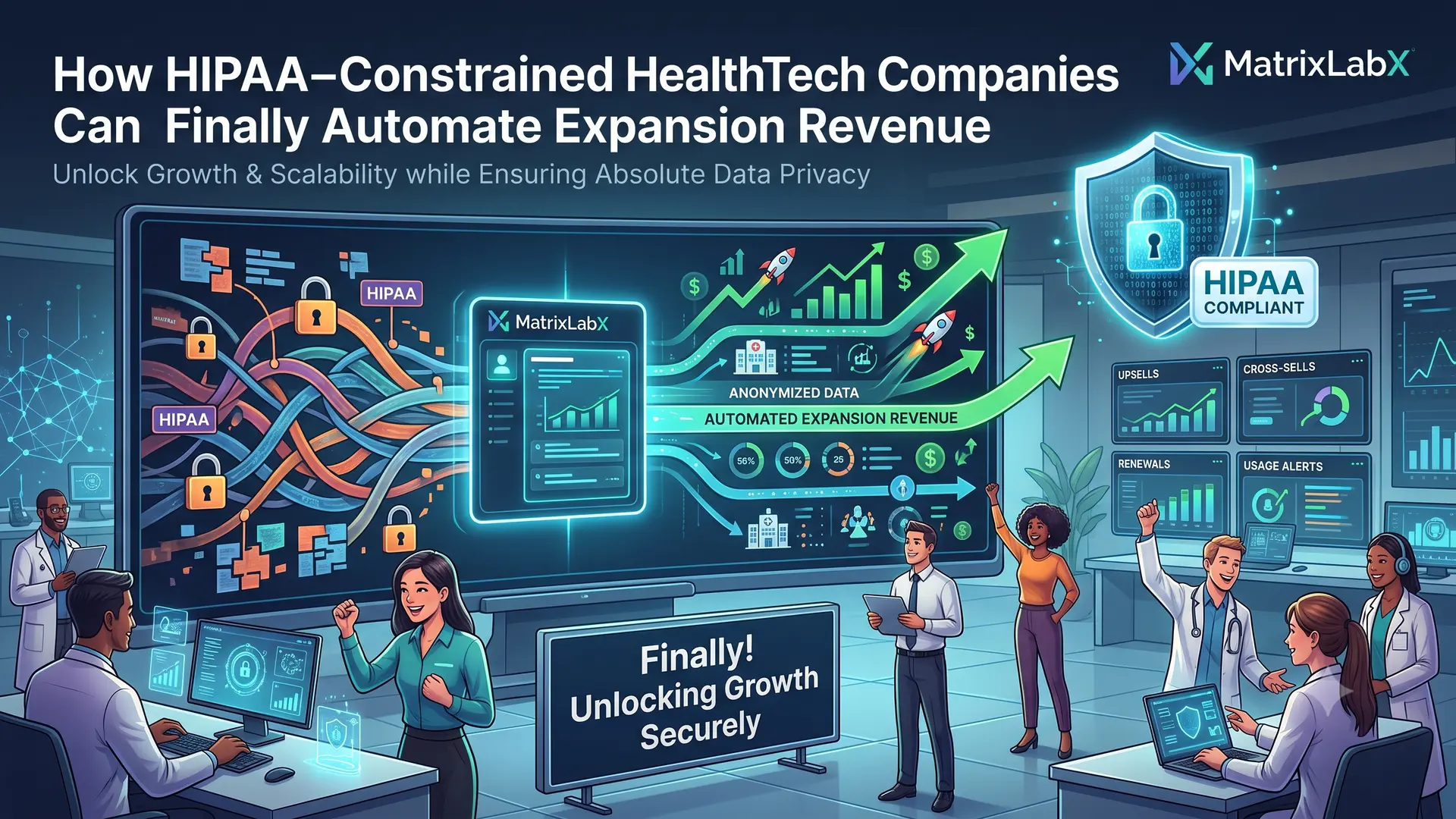
How healthtech companies can automate expansion revenue without a black box
Key Takeaways
- 1.Healthtech compliance teams have had a legitimate reason to keep AI away from usage-based expansion workflows: an unexplainable trigger is a real exposure, not an excuse.
- 2.The core requirement isn't "no AI" — it's deterministic, explainable logic for anything that touches a clinical customer's billing relationship.
- 3.Expansion revenue now accounts for 40–50% of new ARR at high-performing SaaS companies, according to High Alpha's analysis — the growth pressure is real even where compliance is strict.
- 4.Marshal Orchestration model — a deterministic layer handling the trigger logic, with a human approving every consequential action — is built specifically for this constraint.
Direct Answer
Steward, coordinated by Marshal, is a governed AI system that identifies cross-sell and upsell opportunities in existing accounts using deterministic math rather than probabilistic AI inference, with a human approving every workflow before it triggers. Marshal routes signals to the right specialist logic and enforces that nothing consequential fires without passing through the required approval step first — which matters in healthtech, where an incorrect upsell sent to a clinical customer is more than an embarrassment.
Why does this matter now, in 2026?
Healthtech infrastructure companies that have recently raised growth capital and are expanding into new regions face a specific version of a common problem: leadership wants expansion revenue from the existing clinic base to scale alongside new-logo growth, but the compliance function — rightly — has kept AI at arm's length from anything touching product usage data tied to patient-adjacent workflows.
The pressure to solve this well is only increasing. Expansion revenue now accounts for 40% to 50% of new ARR at high-performing SaaS companies, according to High Alpha's analysis, and net revenue retention has become a primary lens investors use to value the business. That has created a gap where healthtech companies are often behind less-regulated SaaS peers in usage-based expansion automation — not because the opportunity is smaller, but because the tooling available didn't meet the compliance bar.
The regulatory bar, meanwhile, is rising rather than easing. AI-related regulatory enforcement actions rose 340% between 2020 and 2025, and 47 states introduced more than 250 healthcare AI bills in 2025 alone. Any expansion workflow that touches usage or billing data needs to be built for that trajectory, not for today's rules.
The mess: a familiar story for healthtech infrastructure
A $50M–$100M ARR healthtech infrastructure company closes a growth round and starts expanding into new regions. Leadership wants existing clinics — the ones already live on the platform — to be a growth engine too, not just new logos. The obvious play is usage-based cross-sell: flag clinics using the platform heavily enough to be a strong candidate for an upsell, and trigger an AE-led conversation.
But the moment “AI” and “flag clinics based on usage” enter the same sentence, compliance asks a hard question: what happens when the model is wrong? A false-positive AI recommendation that misreads clinic usage and triggers an incorrect upsell conversation isn't a minor CRM mistake in this context — it's a workflow touching a customer relationship built on regulatory trust. The initiative stalls, not because the growth opportunity isn't real, but because nobody can guarantee the AI won't hallucinate its way into a compliance problem.
The pivot: deterministic math, not AI guessing, triggers the workflow
The fix isn't avoiding AI — it's being precise about where AI reasoning is allowed to operate and where deterministic logic has to be the trigger, run through a Sense → Decide → Act → Learn loop with Marshal routing every flag:
Sense
Steward monitors product usage signals against explicit, pre-defined thresholds — not a black-box inference about "engagement."
Decide — deterministically
A clinic crossing a defined usage threshold is flagged using straightforward, auditable math: this metric crossed this line, for this duration. No probabilistic guessing decides whether an upsell conversation gets triggered.
Coordinate
Marshal routes the flagged account to the correct specialist workflow — cross-sell to a new module, seat expansion, a check-in call — based on which threshold was crossed.
Act — under approval
An AE or customer success manager reviews the flag and the underlying data before any customer-facing action happens. Nothing reaches a clinic without a human confirming the trigger was correct.
Leadership gets a systematic way to surface expansion opportunities across a growing clinic base without waiting for a CSM to notice usage patterns manually. Compliance gets a system where the trigger logic is deterministic and inspectable — the opposite of the black-box risk that stalled the initiative in the first place.
Manual CSM review vs. Marshal-coordinated expansion
| Manual CSM Review | Steward, coordinated by Marshal | |
|---|---|---|
| How opportunities are found | CSM notices usage patterns manually, inconsistently across accounts | Continuous monitoring against explicit thresholds, every account, all the time |
| Trigger logic | Subjective, judgment-based | Deterministic — a defined threshold crossed for a defined duration |
| Compliance defensibility | Depends on documentation discipline of individual CSMs | Every flag traceable to the exact metric and threshold that fired it |
| Scales with new regions | No — more clinics means more manual review load | Yes — the agent's monitoring scales; human approval stays the gate |
| Risk of false-positive outreach | Present, hard to audit after the fact | Minimized by deterministic triggers, every flag human-reviewed before contact |
Three use cases
Usage-based cross-sell flagging
Before: A clinic's usage grows steadily, but nobody notices until a renewal conversation surfaces it, months late.
After: The clinic is flagged the moment it crosses a defined threshold, with the underlying data attached for a human to review.
Bridge: Steward's deterministic threshold monitoring, running continuously.
New-region rollout support
Before: Expansion into new regions outpaces the CSM team's ability to monitor usage across a growing account base.
After: The same monitoring logic scales to new regions without needing to hire proportionally.
Bridge: Marshal routing flagged accounts to the right team, wherever they are.
Compliance-defensible growth reporting
Before: Leadership reports expansion revenue growth to the board without a clear, auditable story for how opportunities were identified.
After: Every expansion opportunity traces back to a specific, deterministic trigger and a logged human approval.
Bridge: The immutable audit ledger, doing double duty as compliance evidence and board reporting.
How would a healthtech infrastructure team actually implement this?
- Work with compliance from the start to define the exact usage thresholds and durations that should trigger a flag — a joint RevOps/compliance exercise, not a RevOps-only decision.
- Confirm what data the agent can and cannot access, and document that scope explicitly before connecting any systems.
- Start with flagging only, no auto-outreach — let CSMs review and approve every trigger for an initial period.
- Expand the threshold logic gradually as trust builds, always keeping the human approval step intact.
- Use the audit ledger in compliance reviews as evidence the system operates within defined, deterministic bounds.
Why this might not work for you
If your compliance function hasn't yet defined what data the agent would be allowed to touch, this isn't a technology problem to solve first — it's a scoping conversation to have internally before any vendor evaluation. And if your expansion opportunities are concentrated in a small number of large accounts rather than a broad clinic base, the leverage of continuous automated monitoring is smaller than it would be at higher account volume.
Frequently Asked Questions
Does this agent access protected health information directly?+
What happens if the agent flags an account incorrectly?+
How is "deterministic" different from "AI-powered"?+
Does this work with our existing CRM?+
What does this cost?+
Next Step
Compliance and growth were never actually in conflict
The block was never AI itself — it was AI systems that couldn't explain their own triggers to a compliance team with every reason to ask hard questions. Steward, which is deterministic and coordinated by Marshal, gives healthtech infrastructure companies a way to grow expansion revenue that compliance can actually stand behind.
Continue Reading
See where your own execution effort is going
The Autonomous Audit Report models where your team's execution capacity is currently spent, what your configuration is actually paying for, and what the governed alternative looks like on your own data — before any commitment.
Get your free AAR benchmark