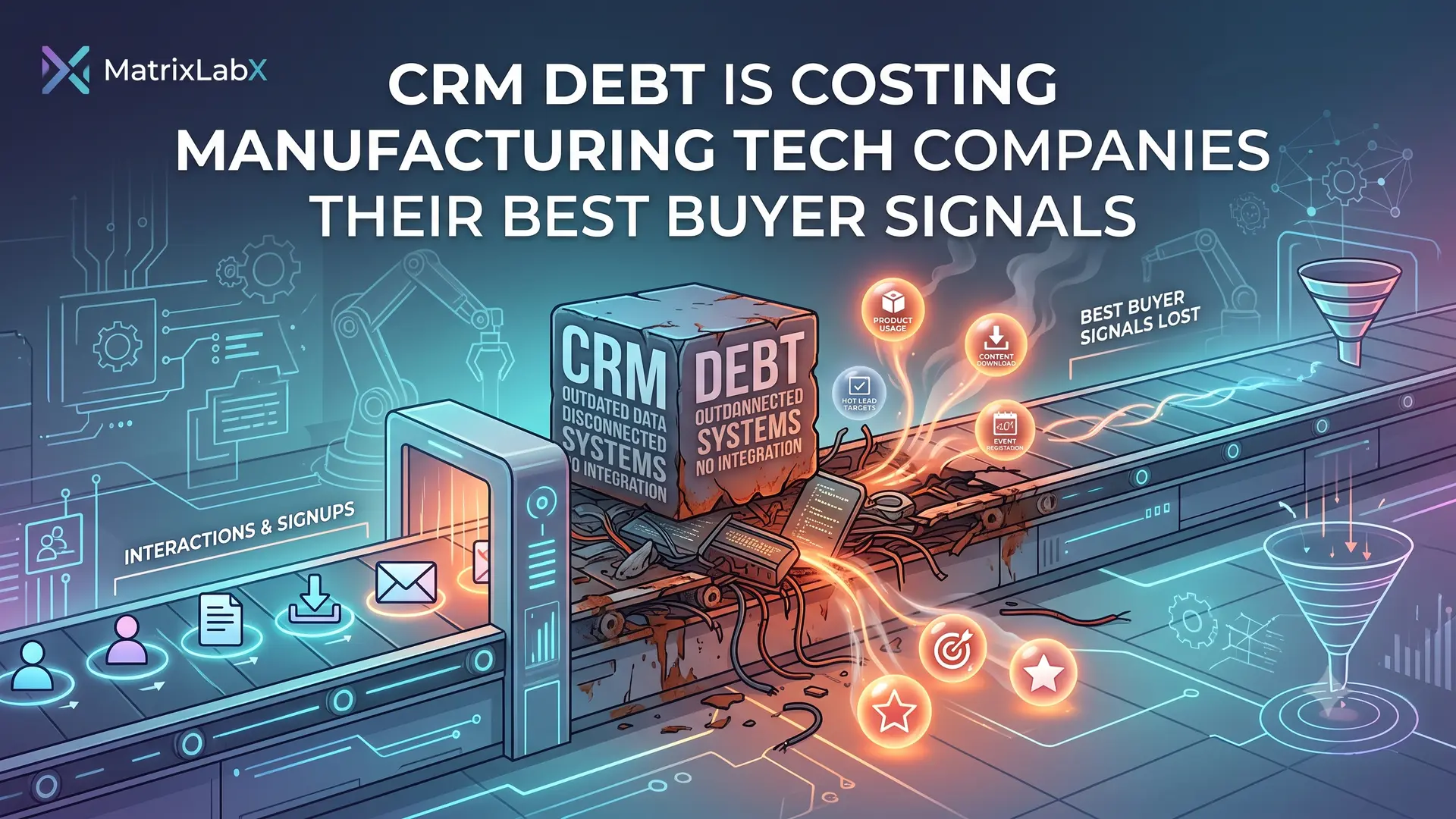
CRM debt is costing manufacturing tech companies their best buyer signals
Key Takeaways
- 1.CRM debt — duplicate accounts, stale contacts, unlinked plant-level records — is a compounding cost, not a one-time cleanup problem, especially for manufacturing tech companies selling into multi-facility accounts.
- 2.Sales teams lose an average of 550 hours per rep annually — about 14 weeks of selling time — to inaccurate CRM data and duplicate records, according to Data Axle hygiene research.
- 3.Deterministic scoring, not black-box AI guessing, is what manufacturing buyers and their own leadership actually trust, because the logic can be explained and defended in a forecast review.
- 4.A governed Scout paired with deterministic scoring restores visibility into which plants and accounts show real buying intent, without asking AEs to become data janitors.
Direct Answer
CRM debt is the accumulated cost of duplicate, stale, or disconnected account and contact records that make it harder over time to tell which accounts are real buying opportunities. In manufacturing technology sales, this compounds faster than in most verticals because a single enterprise customer might have dozens of plant-level locations, each entered into the CRM slightly differently by a different rep over several years. The fix is a governed Scout that proposes deduplication and scores accounts against explicit, auditable criteria — with a human confirming every merge.
What is CRM debt in a manufacturing tech sales motion?
CRM debt is the accumulated cost of duplicate, stale, or disconnected account and contact records that make it harder over time to tell which accounts are real buying opportunities. Manufacturing technology sells into organizations that are themselves highly distributed — corporate headquarters, regional operations, and individual plants often make separate purchasing decisions on separate timelines. That structure is exactly what breaks a CRM that wasn't built with plant-level hierarchy in mind.
The cost is measurable and recurring. Sales teams lose an average of 550 hours per representative annually — roughly 14 weeks of selling time — to inaccurate CRM data and duplicate records, according to Data Axle hygiene research. That is time an AE spends untangling which plant record is real instead of making a single outbound call.
Why does this problem matter more for manufacturing in 2026?
RevOps teams industry-wide are grappling with the same underlying problem: sprawling, ungoverned data. Gartner projects that through 2027, organizations that fail to attain centralized visibility and coordinate software lifecycles will overspend by at least 25% due to unused entitlements and unnecessary, overlapping tools. The manufacturing-specific version of that problem shows up as account records that don't reflect the real hierarchy of the buyer's organization — and AEs who can't tell whether “Acme Plant 4” and “Acme Facility West” are the same buying committee or two different ones.
Buyers are also getting pickier about how vendors reach that judgment. Duplicate records account for 15–30% of a typical contact database, which is more than enough to break a black-box lead score before it ever reaches a rep's queue.
The mess: a familiar story for mid-market manufacturing tech
Picture a $200M–$500M ARR manufacturing technology company that has grown for years through a mix of inbound and outbound motion, each rep entering accounts their own way. An AE opens their pipeline on a Monday morning and finds three separate CRM records that might all be the same plant, two contacts who left the company over a year ago still marked as active, and a hiring signal — the buyer is publicly recruiting for a RevOps and data-cleansing role — that nobody on the sales team has connected to the fact that this account is fighting the same CRM-debt problem the vendor solves.
The AE spends the first two hours of the day untangling which record is real before making a single outbound call. Multiply that across a team, every day, and a large share of selling capacity disappears into administrative work that has nothing to do with selling.
The pivot: deterministic scoring instead of black-box guessing
Manufacturing buyers — and the sales leaders selling to them — have good reason to distrust AI systems that can't explain their own decisions. A forecast built on a scoring model nobody can audit doesn't survive a hard question from the CRO. This is why the fix isn't just “add AI” — it's Scout with deterministic scoring, run through the same Sense → Decide → Act → Learn loop that governs every MatrixLabX agent:
Sense
The agent continuously ingests account and contact data, hiring signals, and firmographic changes — including exactly the kind of public RevOps/data-hiring signal that indicates a prospect is fighting the same CRM-debt problem.
Decide — deterministically
Instead of an opaque model score, accounts are ranked against explicit, inspectable criteria: hierarchy match confidence, contact recency, signal strength. Every score can be traced back to the specific data points that produced it.
Act — under approval
The agent proposes account merges, flags likely duplicates, and surfaces the highest-scoring real opportunities for the AE to act on — but doesn't auto-merge or auto-delete anything without a human confirming it.
Learn
Each confirmed merge and each corrected score sharpens the deduplication logic for the next pass.
AEs start their day with a clean, confident view of which accounts are real, which plants belong to which buying committee, and which of those show genuine signal — instead of spending the first hours of the morning doing data hygiene. The forecast conversation with the CRO gets easier, because every score is explainable in plain terms, not defended as “the model said so.”
Manual CRM hygiene vs. governed deduplication
| Manual CRM Cleanup | Governed Scout | |
|---|---|---|
| Who does the deduping | AEs, ad hoc, whenever the pain gets bad enough | The agent, continuously, flagging for human confirmation |
| Scoring method | Rep intuition or a black-box lead score | Deterministic, explainable criteria tied to real signals |
| Plant-level hierarchy | Manually reconstructed, often incorrectly | Modeled explicitly, with merges proposed not forced |
| Time cost to AEs | Significant, recurring, unbudgeted | Minimal — approval only, not data entry |
| Forecast defensibility | Depends on whoever cleaned the data last | Every score traceable to source data |
Three use cases
Duplicate account resolution
Before: The same manufacturing plant exists as three different CRM records, split across two reps, with no clear owner.
After: The records are flagged as likely duplicates with a confidence score and merge proposal, confirmed by a human before anything changes.
Bridge: Scout's deterministic matching logic, running continuously instead of during an annual data-cleanup sprint.
Hiring-signal prospecting
Before: A target account posts three open RevOps and data-cleansing roles, and nobody on the sales team notices or connects it to a sales opportunity.
After: The signal surfaces automatically, scored against known intent criteria, and routed to the right AE with the context already attached.
Bridge: Continuous signal-sensing that doesn't depend on a rep happening to check job postings that week.
Forecast defensibility
Before: A CRO asks why an account is scored high, and the answer is “the tool said so.”
After: The answer traces to specific, inspectable data points — hierarchy confidence, signal recency, contact validity.
Bridge: Deterministic scoring built to be explained, not just trusted.
How would a manufacturing tech RevOps team actually implement this?
- Map your real account hierarchy — corporate, regional, and plant-level — as it should exist, not as it currently sits in the CRM.
- Define your deterministic scoring criteria explicitly, so the agent's logic matches what your team already considers a strong signal.
- Connect the agent to your CRM and any external signal sources you currently rely on, including hiring/job-posting data.
- Start with merge proposals, not auto-merges — build trust in the scoring before increasing autonomy.
- Review the audit ledger monthly with RevOps and sales leadership to refine the hierarchy model.
The same pattern — deterministic scoring, a proposal rather than a forced write, and a named human confirming it — runs on the operations side of a manufacturer as well. That build is described in Autonomous demand forecasting agents, where the approved artifact is an inventory commitment instead of a merge.
Why this might not work for you
If your CRM debt is relatively contained — a handful of plants, a small team, records that are mostly accurate — the deduplication problem this solves may not be big enough to justify the change management. And if your organization doesn't yet have a clear point of view on what “real” account hierarchy should look like, an agent will surface the mess faster, but someone still has to make that structural decision.
Frequently Asked Questions
What does "deterministic scoring" mean, exactly?+
Will this automatically merge or delete CRM records?+
Does this only work with Salesforce?+
How is this different from a generic data-cleansing tool?+
What does this cost?+
Next Step
Clean data is a byproduct, not the goal
The real cost of CRM debt isn't messy records — it's the buying signals that get lost inside the mess. A governed Scout with deterministic scoring fixes the visibility problem continuously, with a human confirming every change.
Continue Reading
See where your own execution effort is going
The Autonomous Audit Report models where your team's execution capacity is currently spent, what your configuration is actually paying for, and what the governed alternative looks like on your own data — before any commitment.
Get your free AAR benchmark