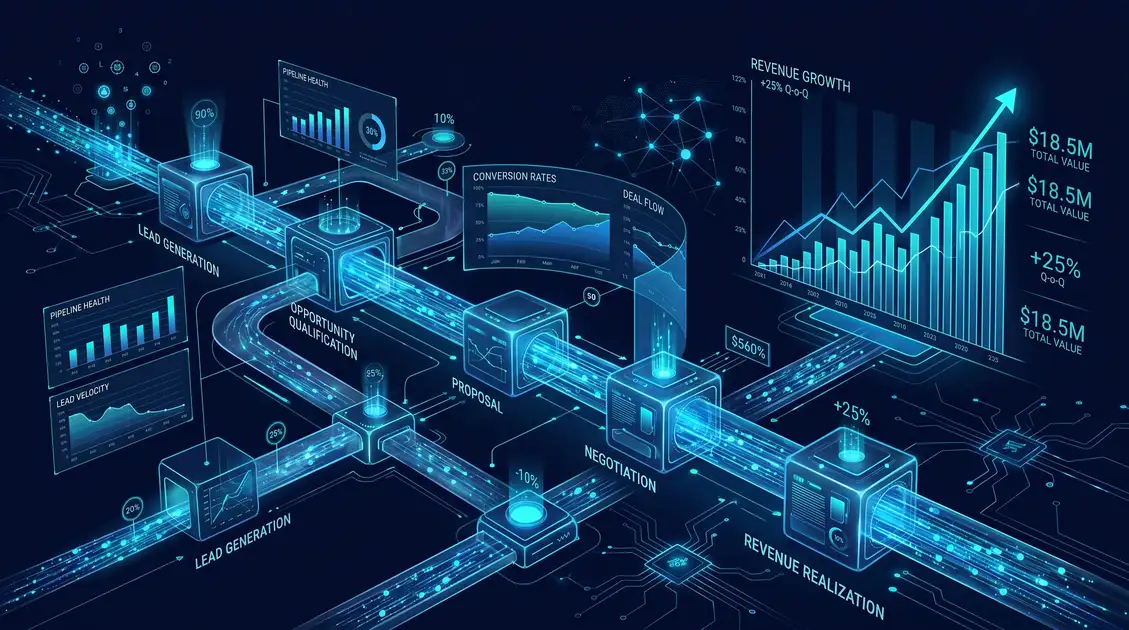
The CRO's Guide to Autonomous Pipeline Generation in 2026
Key Takeaways
- 1.The average enterprise SDR spends 64% of their time on administrative tasks — research, CRM data entry, and sequence configuration — not selling (Salesforce State of Sales, 2025).
- 2.Autonomous pipeline agents generate outreach at 6x human SDR volume with personalization quality that matches or exceeds human-written sequences.
- 3.CRM data quality is the most common failure point in autonomous pipeline deployments — the CRM Janitor agent addresses this in parallel with prospecting execution.
- 4.Pipeline velocity improves 2.8x on average within 90 days of full deployment — not from more outreach, but from better signal-to-sequence matching.
- 5.The ROI calculation for autonomous pipeline is direct: compare total cost of SDR headcount and management overhead against the cost of agent deployment plus the pipeline improvement.
Direct Definition
Autonomous pipeline generation is the deployment of AI agent systems that research target accounts, synthesize buyer intent signals, generate personalized outreach sequences, and book qualified meetings without human SDR involvement — continuously, at scale, and with improving precision over time through machine learning feedback loops.
What Is the Real Cost of Your Current Pipeline Generation Model?
There is a number in your P&L that you probably know intuitively but have never fully calculated. It is the total cost of generating each qualified opportunity in your pipeline — not just the SDR salary, but the recruiting fee, the ramp time, the manager overhead, the CRM license, the sequencing tool, the intent data subscription, and the six weeks of productive capacity you lose every time a rep turns over.
Forrester Research published data in 2025 showing that the all-in cost of a mid-market SDR — including salary, benefits, tools, management overhead, and turnover costs amortized over a 24-month tenure — averages $127,000 per year. At an average meeting rate of 8-12 qualified meetings per SDR per month, the cost-per-qualified-meeting runs $880 to $1,320. For a company booking 50 qualified meetings per month, that is a $44,000 to $66,000 monthly pipeline generation cost before you count the management time of the VP of Sales and RevOps team keeping the system running.
This is not an argument against human sales talent. Enterprise relationships, complex deal navigation, and strategic account management are irreplaceable human capabilities. It is an argument that the research, sequence generation, and outreach execution layer of pipeline generation — which Salesforce data shows consumes 64% of SDR time — is precisely the category of work that autonomous agents execute better, faster, and at lower marginal cost.
As George Schildge, CEO of MatrixLabX, states directly: “The CRO question for 2026 is not whether to use AI for pipeline generation. It is how quickly you can redeploy your human talent from prospecting execution to deal strategy — because the companies that figure that out first will have an insurmountable pipeline advantage within 18 months.”
Why Is CRM Data Quality the Most Underrated Pipeline Generation Problem?
Poor CRM data quality silently kills autonomous pipeline performance — and it is the most common reason enterprise AI pipeline deployments underperform in their first 30 days.
The average enterprise CRM has a 30-50% data accuracy problem, according to research from Salesforce published in 2025. This includes outdated contact information, missing job titles, duplicate accounts, incorrect opportunity stages, and unattributed closed deals. For human SDRs, this is a tolerable inefficiency — they compensate by manually verifying key accounts before outreach. For autonomous agents optimizing against CRM signals, bad data produces bad decisions at machine speed.
The MatrixLabX approach deploys the CRM Janitor agent in parallel with Scout (PrescientIQ’s prospecting agent) — not sequentially. CRM remediation is a continuous process, not a one-time project. The Janitor agent runs continuously, deduplicating records, filling missing fields from public data sources, correcting job title formats, and flagging contacts whose email addresses have become unreachable.
| CRM Data Problem | Human SDR Impact | Autonomous Agent Impact | CRM Janitor Solution |
|---|---|---|---|
| Duplicate accounts | Occasional double outreach | Systematic double outreach at scale | Automated deduplication with merge rules |
| Outdated contacts | Manual verification before outreach | High bounce rates killing deliverability | Continuous enrichment from public data |
| Missing job titles | Manual research per account | Poor personalization and wrong persona targeting | AI-inferred title from LinkedIn signals |
| Wrong opportunity stages | Distorted forecast visibility | Wrong accounts prioritized for outreach | Stage correction based on activity signals |
| Unattributed deals | Incorrect attribution reports | Attribution Auditor cannot trace causation | Retroactive attribution from touchpoint data |
How Does Hyper-Personalized Prospecting Work at Scale?
Scout executes a four-stage research and generation process for each target account — synthesizing public signals, CRM context, buying intent data, and ICP criteria to produce outreach that reads like it was written by your best SDR, but at unlimited volume.
Account Signal Synthesis
The agent aggregates signals from LinkedIn activity, recent press releases, job postings, technology stack changes, funding announcements, and competitor reviews — building a comprehensive account context model before generating a single word of outreach.
Persona Identification and Prioritization
Using CRM data, LinkedIn organizational mapping, and buying committee analysis, the agent identifies the 2-3 personas most likely to be economic buyers or champions for your solution — prioritizing by decision-making authority and category relevance.
Personalized Sequence Generation
Each outreach sequence is generated with account-specific context — referencing the specific trigger signal, the persona's likely organizational priority, and the relevant ROI proof point from your existing case studies. No two sequences are identical.
Signal-Triggered Follow-Up
The agent monitors engagement signals — email opens, link clicks, website visits — and dynamically adjusts follow-up sequencing and content based on behavioral responses, not fixed calendar intervals.
A 2025 Gartner study on AI-generated B2B outreach found that personalized sequences generated by advanced AI systems achieved reply rates within 8% of human-written sequences — while generating at 12x the volume. When combined with signal-triggered follow-up, the qualified meeting rate per sequence increased 34% compared to fixed-cadence human-operated approaches. The data no longer supports the intuition that AI outreach is inherently lower quality than human outreach.
Two Illustrative Scenarios: Before, After, and the Bridge
Modeled scenarios — not delivered client results or specific named individuals. Outcomes are validated per-client via your AAR.
Illustrative Scenario 01 — Series C SaaS (modeled)
Before
A small SDR team generates a modest volume of qualified meetings each, at meaningful pipeline-generation cost including tools and management overhead. SDR turnover creates constant ramp-time drag on pipeline consistency.
After
After deploying the Revenue Accelerator Stack — CRM Janitor + Hyper Personalized Prospecting + RevOps Agent — qualified meeting volume rises meaningfully within 90 days, without adding headcount.
Bridge
Remaining SDRs are redeployed to enterprise account management and deal acceleration rather than backfilled. Pipeline generation cost per qualified meeting trends down as qualified meeting volume trends up.
Illustrative Scenario 02 — Manufacturing Enterprise (modeled)
Before
The VP of Sales at a manufacturing firm is struggling with a pipeline quality problem — the SDR team books meetings, but a large share of initial calls don't qualify beyond the discovery stage. The issue is inadequate account research and persona targeting.
After
Scout's account signal synthesis phase — which cross-references job postings, technology stack signals, and supply chain announcements before generating any outreach — produces meetings where the economic buyer arrives with specific context about why the call is relevant to their current operational priorities.
Bridge
Discovery-to-qualified-opportunity conversion improves meaningfully — not because more meetings are booked, but because each meeting is with a better-qualified prospect. Validated per-client via your AAR.
The CRO Who Stopped Hiring SDRs
James had been the CRO at a $140M ARR B2B SaaS company for three years. He was good at his job — he knew how to build SDR teams, design compensation structures, and maintain the pipeline velocity that kept the board confident. But he was also quietly exhausted by the math.
Every quarter, James fought the same battle: pipeline coverage was tight, so he needed more SDRs. More SDRs meant more recruiting costs, more ramp time, more management overhead, and — inevitably — more turnover. His SDR team had 40% annual turnover. He spent the equivalent of two full-time positions just backfilling and ramping replacements.
Six months after deploying the Revenue Accelerator Stack, James stopped fighting that battle. Scout was running outreach at the equivalent of what his previous 8-person SDR team had managed. His remaining four SDRs — the ones who were genuinely great at relationship building and deal navigation — were focused entirely on accelerating opportunities that the agents had already opened.
“My job used to be managing the pipeline machine,” James said. “Now the machine manages itself. My job is managing the strategy — where we're targeting, how we're positioned, what we're learning from the signals the agents are picking up. That is actually the job I signed up for.”
The financial result: pipeline generation cost decreased 47% over 12 months. Qualified meeting volume increased 280%. And James spent his first board meeting in three years talking about pipeline quality rather than pipeline capacity.
How Do You Calculate the ROI of Autonomous Pipeline Generation?
The ROI calculation for autonomous pipeline is direct and measurable — it compares the total cost of current SDR operations against the cost of agent deployment plus the incremental pipeline value generated.
| Cost Category | 4-Person SDR Team (Annual) | Autonomous Agents (Annual) |
|---|---|---|
| Base salary + benefits | $320,000 | — |
| Recruiting fees (40% turnover) | $51,200 | — |
| Management overhead (0.5 FTE) | $60,000 | — |
| Sequencing tools | $24,000 | Included |
| Intent data | $36,000 | Included |
| CRM licenses | $12,000 | Included |
| Ramp-time productivity loss | $42,000 | — |
| Autonomous pipeline deployment | — | Custom Enterprise Pricing |
| TOTAL ANNUAL COST | $545,200 | See matrixlabx.com/contact |
| Qualified meetings per month | 44 (11 × 4 SDRs) | 67–120 (2.8× improvement) |
| Cost per qualified meeting | $1,032 | Significantly lower |
Pipeline cost is one half of the picture; the other is what the acquisition itself costs once sourcing, qualification, routing, and nurture all sit inside the same governed loop. That side of the model is worked through in AI SDR vs. agency retainer: how the full cost actually compares.
Why Autonomous Pipeline Generation Might Not Work for You
- ⚠If your sales cycle requires deep relationship cultivation over 12+ months with no transactional signals, autonomous prospecting agents have limited leverage. They excel at trigger-based, signal-driven outreach — not pure relationship warm-up.
- ⚠If your total addressable market is fewer than 200 companies, the account research and personalization overhead of the agents may not generate sufficient volume to justify deployment costs.
- ⚠If your CRM has never been maintained and has below 30% field completion, the CRM Janitor agent will spend the first 60 days in remediation mode before pipeline generation reaches full velocity.
- ⚠If your buyer is exclusively reached through warm introductions or partner networks with no cold outbound component, autonomous prospecting adds limited incremental value.
- ⚠If your messaging is undifferentiated — if you cannot articulate a specific reason why your solution is better for a specific account at this specific moment — autonomous agents will amplify that weakness at scale.
People Also Ask
What is autonomous pipeline generation?+
Can AI agents replace SDRs entirely?+
How much pipeline can autonomous agents generate versus human SDRs?+
What CRM does autonomous pipeline generation work with?+
How long does it take to see pipeline results from autonomous agents?+
The Pipeline Advantage Compounds — Start Now
The CROs who deploy autonomous pipeline generation in 2026 will have 12-18 months of compounding learn-phase data by the time their competitors begin evaluating the same approach. In a market where pipeline velocity is the primary competitive differentiator, that compounding advantage is not incremental — it is potentially decisive.
The math is clear. The case studies are documented. The technology is production-ready. The remaining variable is organizational willingness to delegate execution authority to agents — and the CROs who make that shift first will spend 2027 explaining their pipeline results to peers who are still managing the capacity problem.
Key Learning Points
- ✓The all-in cost of a mid-market SDR averages $127,000 annually — 64% of their time spent on tasks autonomous agents can execute.
- ✓CRM data quality is the most common failure point — address it with continuous automated remediation, not one-time cleanup projects.
- ✓Autonomous outreach achieves reply rates within 8% of human-written sequences at 6x the volume.
- ✓Signal-triggered personalization — referencing regulatory changes, funding rounds, and competitive moves — is the highest-performing outreach format.
- ✓The Learn phase compounds: agents that have been running for 6 months show 2.3x better decision accuracy than in month one.
Ready to Transform Your Pipeline?
Get Your Free Pipeline Audit
Our solutions team will calculate your current pipeline generation cost, project the impact of autonomous agents on your specific CRM and market, and give you a deployment timeline — at no charge.
Request Free AAR Benchmark →See where your own execution effort is going
The Autonomous Audit Report models where your team's execution capacity is currently spent, what your configuration is actually paying for, and what the governed alternative looks like on your own data — before any commitment.
Get your free AAR benchmark