Mid-market CFOs running standard SaaS stacks carry an average of 14 disconnected tools — each requiring human operators to produce any attributable revenue outcome.
The Marketing Tax — the compounding cost of owning intelligent tools operated by exhausted people — drives blended CAC up even when software subscription lines stay flat.
Labor as a Service converts fixed SaaS overhead and RevOps headcount into variable, outcome-priced digital labor — shifting cost from the P&L fixed column to variable execution.
Deployment timeline: 21 days or less from contract to full autonomous operation. No ramp-up. No training period. Agents execute on day one.
Definitive definition
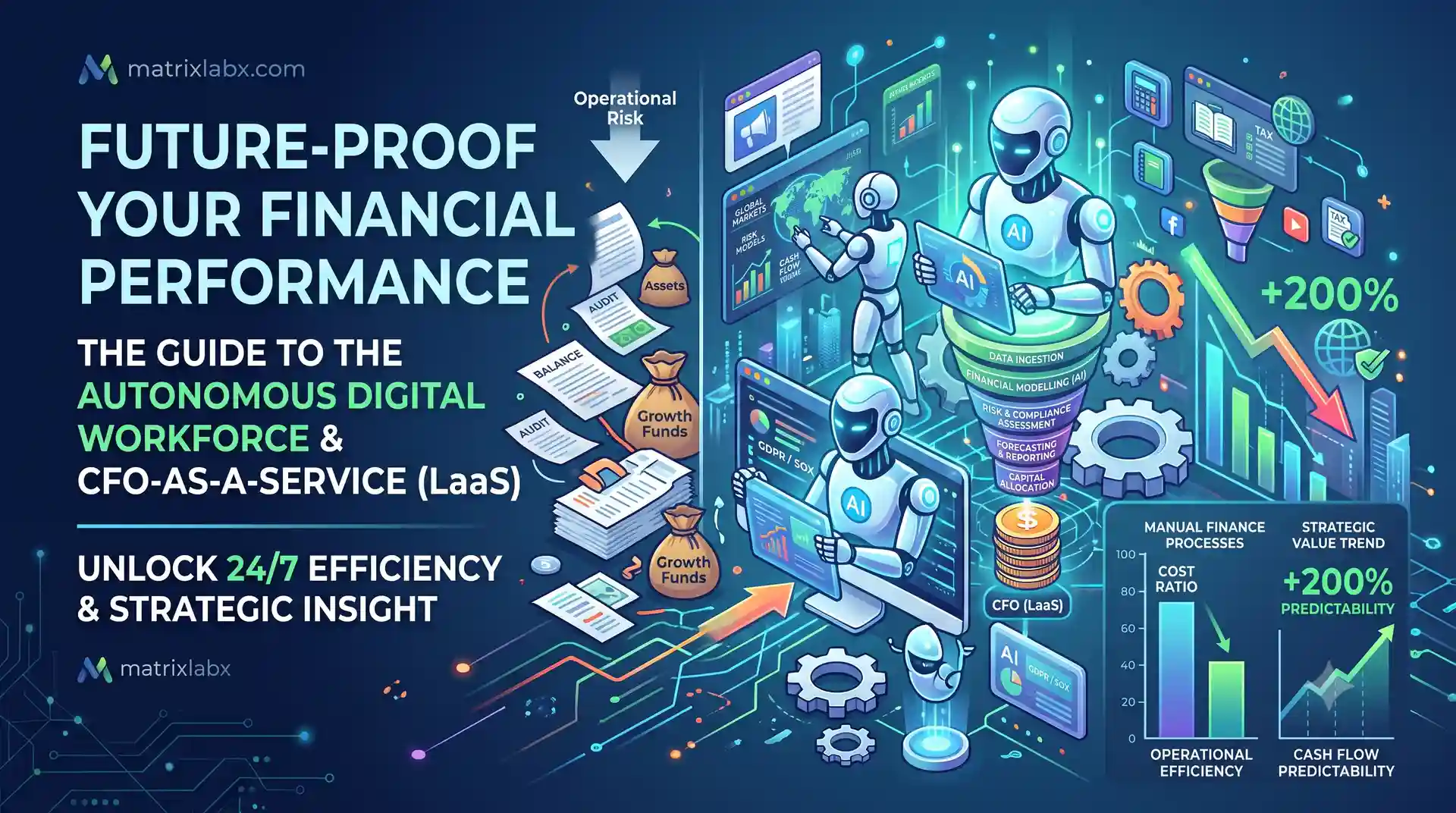
An autonomous digital workforce is a coordinated system of AI agents that independently sense signals in business data, form decisions using causal models, execute marketing, sales, and operational workflows, and continuously improve their own performance — executing without manual prompts or handoffs while routing every externally visible action through human approval. In CFO terms: it converts fixed labor overhead into variable, outcome-priced digital execution.
Why does your software get cheaper while your margin gets thinner?
The SaaS economics paradox is one of the most expensive blind spots in mid-market finance. Software subscription prices are declining — cloud commoditization, vendor competition, and AI-native alternatives are compressing per-seat costs across the stack. Yet blended Customer Acquisition Cost (CAC) continues to rise. Pipeline velocity slows. Marketing ops headcount grows. Agency retainers expand. The CFO who looks at the software line on the P&L and sees a declining number is missing the labor multiplier hidden in every row above it.
Here is the structural reason: SaaS tools do not execute. They display. They report. They store. They alert. But between the dashboard and the outcome — the campaign that fires, the lead that gets a personalized sequence, the budget that reallocates to a higher-performing channel — sits a human being. And that human being is expensive, slow, and unavailable at 11 PM on a Wednesday when your highest-intent prospect submits a form.
14Average disconnected MarTech tools per mid-market stack (Gartner, 2025)
58%Of MarTech capabilities that go unused — paid for but never producing revenue (Gartner, 2025)
30%Of marketing budget wasted on operational drag, not bad strategy (IBM IBV, 2025)
For a mid-market company at $100M ARR spending 15% of revenue on marketing and RevOps, a 30% operational drag rate represents $4.5M in annual waste. That is not a rounding error — it is a business case for structural change. The question is not whether to act on it, but what model of action produces durable P&L improvement rather than temporary cost reduction.
"The distinction between a copilot and an autonomous agent is not philosophical — it is a P&L line item. One waits for instructions. The other executes at machine speed, continuously, without an approval queue between signal and action."
— George Schildge, CEO & Chief AI Officer (CAIO), MatrixLabX
Where is the hidden labor cost buried in your SaaS stack?
The Marketing Tax does not appear as a single line item on any income statement. It is distributed across at least five cost centers — which is exactly why it survives so many budget cycles undetected. A CFO who audits each cost center in isolation finds every number defensible. A CFO who maps them together finds a structural drag that can be measured, modeled, and eliminated.
The total exposure for a $75M ARR company runs $2.0M–$4.6M annually — before accounting for the compounding opportunity cost of delayed execution. Gartner's 2025 Hype Cycle for Digital Workplace confirms that 58% of enterprise MarTech capabilities are never used. Enterprises are paying full subscription rates for features that never produce a single attributable dollar.
What is the total loaded cost of a SaaS operator role?
The loaded cost of a RevOps or marketing operations hire at a mid-market enterprise ($60K–$95K base salary) reaches $140K–$220K annually when you include employer taxes, benefits, management time, onboarding cost, attrition risk, and the performance variance inherent in any human workforce. An autonomous agent executing the same workflows costs a fraction of that — and operates with zero sick days, zero attrition, and zero performance variance.
What is driving CFOs toward Labor as a Service in 2026?
Three structural forces are converging in 2026 that make the Labor as a Service transition not merely attractive but operationally urgent for mid-market finance leaders.
Research firm
Key finding
CFO implication
Source
Forrester
72% of enterprise technology leaders plan to deploy autonomous AI agents within 24 months
First-mover advantage window in your vertical is closing
Future of Work, 2025
McKinsey
AI-driven automation could add $4.4T in annual global productivity
Competitors capturing this before you creates a compounding moat
McKinsey Global Institute, 2025
Gartner
By 2027, 50% of enterprises will have deployed autonomous AI agents in at least one revenue workflow
Laggards face structural disadvantage, not just efficiency gaps
Emerging Technology, 2025
IDC
Organizations adopting agentic AI report 3.2× faster time-to-decision on revenue opportunities
Pipeline velocity is now a function of AI infrastructure, not headcount
AI Innovation, 2025
The third force — and the most significant for CFOs — is the price-performance collapse of autonomous AI infrastructure. The compute costs required to run production-grade autonomous agents have declined 94% since 2022 (a16z, 2025). What required a $40M infrastructure budget three years ago is now deployable by a $50M ARR company in an engagement of 21 days or less. The barrier is no longer technological or economic. It is organizational — specifically, whether the CFO and CEO understand the structural case for the transition before their competitors do.
What does Labor as a Service actually mean on the income statement?
Labor as a Service changes the income statement in three measurable directions simultaneously: it reduces fixed costs, improves contribution margin, and accelerates the revenue numerator in the CAC payback calculation. Understanding all three effects — and the order in which they materialize — is the foundation of a defensible LaaS business case.
How does the CFO math work? Three before-and-after models
Deployed Compliance Shield autonomous agents. Real-time transaction pattern detection, automated flagging, audit trail generation. Compliance team redeployed to strategic regulatory preparation rather than reactive alert triage.
Anomaly detection accuracy: 78% → 99.2%. False positives reduced 80%. Human review time reduced 84%. Compliance labor cost reduction: $680K annually. Risk exposure: materially lower. Competitive differentiator vs. peers.
3
Healthcare tech: admin automation deployment
$55M ARR healthcare SaaS. 8 administrative staff processing prior auth documents, scheduling coordination, and patient communication follow-ups. 20 hours/week consumed by document processing per coordinator. Error rate: 6.4%. Patient response latency: 48–72 hours.
Autonomous agents deployed for document ingestion, prior auth routing, and patient communication workflows. All patient data remains within GCP perimeter. Deployment to full production in 21 days or less.
How does Labor as a Service compare to SaaS-plus-headcount on total cost of ownership?
The total cost of ownership comparison between a traditional SaaS-plus-headcount operating model and a Labor as a Service deployment changes significantly when you include all five hidden cost layers. Most TCO analyses only capture software licensing — which makes SaaS look deceptively affordable.
TCO category
SaaS + headcount (annual)
Labor as a Service (annual)
Delta
Software licenses
$420K (14 tools)
Included in LaaS contract
−$420K
RevOps headcount
$640K (4 FTEs loaded)
$0 (agents replace operators)
−$640K
Agency retainers
$264K
$0 (autonomous execution)
−$264K
Management overhead
$160K
$40K (platform governance)
−$120K
LaaS platform fee
$0
$380K (outcome-based pricing)
+$380K
Total annual cost
$1,484K
$420K
−$1,064K (−72%)
Execution velocity
Weekly optimization cycles
Continuous (24/7/365)
Compounding advantage
"CFOs who run a LaaS TCO model correctly — including all five hidden cost layers — consistently find that the autonomous execution platform pays for itself within two quarters. The ones who compare only software license costs are measuring the wrong denominator."
— George Schildge, CEO & Chief AI Officer (CAIO), MatrixLabX
Is Labor as a Service right for your P&L?
Answer 4 questions to get a CFO-level readiness assessment.
How many SaaS tools does your revenue and marketing ops stack currently run?
What is your current blended CAC payback period?
How many FTEs are dedicated to operating your SaaS stack (RevOps, marketing ops, analytics)?
When did your pipeline velocity last improve meaningfully without adding headcount?
HIGH READINESS
Your P&L is ready for Labor as a Service
Your stack profile shows strong LaaS fit. A 30-minute scoping call will map your exact consolidation opportunity and produce a before/after TCO model.
How do you move from fixed labor to variable execution?
The transition from SaaS-plus-headcount to Labor as a Service follows a structured 5-phase process. MatrixLabX has executed this process across eight enterprise verticals with a consistent deployment window of 21 days or less — zero downtime, full compliance from day one.
Phase 1 — Loaded-cost audit Map all five Marketing Tax layers: software, headcount, agency, overhead, and opportunity cost. This produces the TCO baseline that quantifies the business case and establishes the ROI denominator for post-deployment measurement.
Phase 2 — Context ingestion PrescientIQ™ connects to your CRM, ad platforms, compliance documentation, web telemetry, and product analytics via API-first connectors. No data leaves the GCP perimeter. Average ingestion time: 2–4 business days.
Phase 3 — Agent architecture design Your Vertical Agentic Customer Platform is configured: which autonomous agents deploy, their decision logic, escalation protocols, and the compliance guardrails governing every action.
Phase 4 — Production deployment Agents go live with full audit trails established from day one. Deployment: 21 days or less from contract execution. Autonomous execution begins immediately — no calibration period, no ramp-up.
Phase 5 — Measurement and compounding The Sense → Decide → Act → Learn loop feeds hard performance data back into the model after every cycle. Results documented at 90 days consistently improve through month 12 as agents self-optimize on your actual outcome data.
When Labor as a Service will not improve your P&L
LaaS is a structural shift, not a patch. It will not produce the documented outcomes for every organization. Be honest about these conditions before engaging:
Revenue below $15M ARR. Below this threshold, the SaaS stack is typically simple enough that the consolidation benefit does not justify the platform investment. Focus on product-market fit first.
No CRM or structured data infrastructure. Autonomous agents require signal inputs — buyer intent data, CRM records, ad performance telemetry. Without this foundation, agents have nothing to sense.
Active sales cycle under 30 days with no nurture motion. Very short-cycle transactional sales produce insufficient signal variation for autonomous optimization to add material velocity.
No executive mandate for the transition. LaaS displaces human roles and vendor relationships. Without C-suite commitment to the structural change, implementation stalls at the first organizational friction point.
People also ask: autonomous digital workforce and LaaS, answered
What is an autonomous digital workforce in financial terms?
An autonomous digital workforce is a coordinated system of AI agents that execute sales, marketing, and operational workflows under customer-governed authority. In financial terms, it converts fixed labor overhead into a variable cost priced on work executed, so spend follows output instead of headcount.
How does Labor as a Service lower total cost of ownership?
LaaS lowers total cost of ownership by consolidating overlapping SaaS subscriptions into one contract priced on work executed, and by removing the labor needed to operate those tools. The size of the reduction depends on your stack, so it is modeled on your own data in a free Autonomous Audit Report before any commitment.
Why is my blended CAC rising even though my software spend is flat?
Flat software spend hides rising human operating costs. As each SaaS tool adds complexity, you add headcount or agency retainers to operate it. The Marketing Tax — the compounding cost of owning intelligent tools operated by exhausted people — drives CAC up even when subscription line items stay constant.
How fast does Labor as a Service pay for itself?
It depends on your stack and data quality, so MatrixLabX does not quote a standard payback period. Every engagement begins with a free Autonomous Audit Report, a P&L projection built on your own data, and targets are validated against your environment before any commitment.
Is an autonomous digital workforce auditable and compliant?
It is auditable. Every action is recorded to the audit ledger with its rationale, before-and-after state, and the approver or policy behind it. PrescientIQ is hosted and operated by MatrixLabX on Google Cloud. SOC 2, ISO 27001, and PCI DSS attestations are held by Google Cloud, which operates the underlying infrastructure. They are not MatrixLabX certifications.
What size company benefits most from Labor as a Service?
Mid-market enterprises between $20M and $500M ARR see the highest near-term ROI from LaaS deployment. At this scale, the SaaS stack is complex enough to produce significant tool sprawl, but lean enough that autonomous execution creates an outsized competitive advantage over larger incumbents.
Does Labor as a Service reduce headcount?
LaaS reduces the operator work of running SaaS tools and managing agency workflows. Most teams redeploy that capacity from execution to strategy. The effect on headcount depends on your stack and is modeled in a free Autonomous Audit Report.
How long does deployment take and what does onboarding involve?
PrescientIQ™ targets production deployment in 21 days or less from signed contract, subject to CRM data quality and integration scope. Onboarding covers Context Ingestion (CRM, ad platform, and compliance document connections), agent configuration for your vertical, governance mode setup, and production validation.
Deploy your autonomous digital workforce
Book a 30-minute discovery call to receive a loaded-cost audit and before/after TCO model for your specific stack. Production in 21 days or less.
The Autonomous Audit Report models where your team's execution capacity is currently spent, what your configuration is actually paying for, and what the governed alternative looks like on your own data — before any commitment.