Scaling Operations 10x Without 10x Headcount: The Shift to Autonomous Labor Architectures
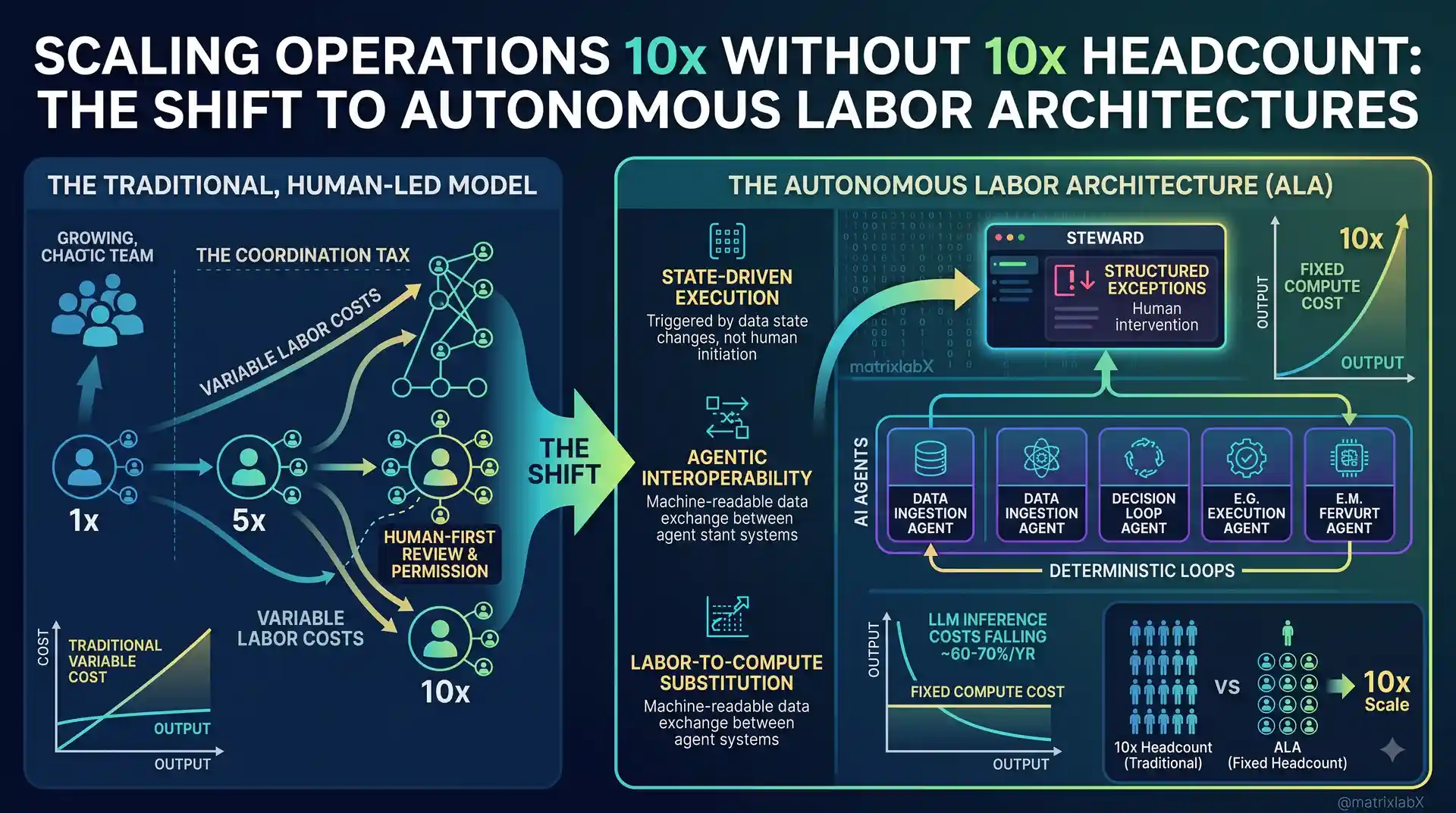
Operational output has been treated as a function of headcount for so long that the link looks like physics. It is not. It is an artifact of software that requires a human operator for every unit of work. Break that requirement for the volume-bounded, judgment-light majority of the work, and capacity becomes a compute decision — while people move to the judgment, approval, and exception handling that actually needs them.
The false choice
Every operating plan that needs more output offers the same two doors.
Door one: hire. Add operators, coordinators, and analysts. Predictable, slow, and permanently expensive — and each addition raises the coordination burden on everyone already there, so the tenth hire delivers materially less than the first.
Door two: tool up. Add automation on top of the existing stack. Faster to buy, and it produces a familiar outcome: the team now operates more tools, the integration burden lands on people, and the routine cases get automated while every exception routes back to a human. Volume relief is smaller than the business case promised.
Both doors accept the same premise — that a person must be present for each unit of work. That premise is what to attack.
Separate execution from judgment
This is the whole move, and it is unglamorous. Take the workflow consuming the most staff hours and split every step into one of two buckets.
Execution is volume-bounded and judgment-light: researching an account, reconciling a record, chasing a status, assembling a case file, drafting a routine message, checking eligibility. The quality bar is consistency. More volume needs more throughput, not more wisdom.
Judgment is the opposite: deciding whether an exception is acceptable, whether a risk is tolerable, whether this customer needs a different approach, whether to escalate. Volume rises here far more slowly than total work, because judgment concentrates on the tail.
In most mid-market operations the split is heavily weighted toward execution — which is why headcount tracks volume so tightly, and why breaking that link produces a step change rather than a percentage gain.
Where is your constraint?
Before choosing an intervention, find out what actually binds. The three answers call for different first moves.
What is actually limiting your operational capacity?
The architecture underneath
“Autonomous labor architecture” sounds abstract. It is four concrete components, and the value comes from the arrangement rather than any one of them.
- Specialist agents with scoped identities. Each agent does a bounded job and holds least-privilege credentials in the systems of record. Not one general assistant with broad access — many narrow workers with auditable ones.
- An orchestration layer. Something has to route work between agents, hold state across a multi-step process, and know what to do when a step fails. This is where most single-agent pilots stall.
- An approval gate on the execution path. Consequential actions stop and wait for a named human before they leave the building. On the path — not a log written afterwards.
- An append-only ledger. Every decision, input, approval, and action recorded immutably. This is what makes the capacity defensible to an auditor, a regulator, or a board.
The full build is covered in agentic AI architecture, and the multi-agent coordination patterns in the swarm blueprint.
Three scaling constraints, three responses
The constraint is industry-specific even when the architecture is not. These are illustrative composites, not named client accounts.
Use case
B2B SaaS
Founder / COO · trial volume doubled, success team flat
Trial starts doubled quarter over quarter, exactly as planned
A campaign worked. Trial starts doubled quarter over quarter, which is exactly what everyone wanted.
The success team did not double, so coverage collapsed to the largest third
The success team did not double. Onboarding outreach that used to reach every new account now reaches the largest third, and the long tail self-serves or churns. The team is working longer to cover less of the base, activation is falling precisely as acquisition improves, and the obvious fix — hire six coordinators — carries a ninety-day ramp against a problem that is live this month.
Agents cover the tail, and hiring tracks judgment rather than volume
Agents cover the tail continuously: watching activation signals across the product and CRM, assembling the account picture, and drafting the intervention for approval. Human CSMs keep the accounts where judgment and relationship carry the outcome. Coverage stops being a function of how many accounts a person can hold in their head, and hiring is timed to judgment load rather than volume.
Use case
Financial Services
Managing Director · expansion into three new markets
Three new markets with no staff and no established process
The growth plan requires operational capacity in three markets where the firm has no staff and no established process.
Build ahead of revenue and you carry burn; build behind it and you fail the service
Licensed and vetted operations staff take months to recruit, longer to onboard against internal controls, and carry fixed cost from day one — against revenue that ramps over four to six quarters. Build the team ahead of the revenue and you carry the burn. Build it behind and you cannot service what you sell. Every quarter of that mismatch is either wasted payroll or a service failure in a regulated context.
Cost tracks activity while named humans hold approval and accountability
Provision agent capacity against the volume-bounded operational work — onboarding document collection, data reconciliation, alert triage, reporting — so the cost curve tracks activity rather than the plan. Named humans hold approval authority and regulatory accountability from day one, and every action is attributable on an immutable ledger. Hire into judgment roles as revenue proves out.
Use case
Healthcare
VP Operations · provider group adding sites
Each new location has historically needed its own administrative back office
Each new location historically requires its own administrative staffing for scheduling, eligibility, authorization, and follow-up.
A vacancy does not pause the work — it ages the queue, and aged claims collect less
The per-site administrative overhead is what makes expansion economics marginal. Hiring for each location in a tight administrative labor market means long vacancies, and a vacancy does not pause the work — it ages the queue. Aged claims collect at a lower rate, so the staffing gap converts directly into revenue leakage at exactly the moment the new site needs to prove out.
Shared agent capacity turns opening a site into a routing change
Centralize the volume-bounded administrative work as shared agent capacity serving every site, rather than replicating a back office per location. Eligibility, authorization status, and follow-up run continuously; site staff handle patients and exceptions. Adding a location becomes a routing change against existing capacity rather than a hiring cycle, with PHI staying inside the tenant that governs it.
The sequence that works
- Determine capacity first. Maximum throughput of the current configuration, measured and written down. Not quota — quota is assigned downward; capacity is measured upward. Without this number you cannot prove anything changed.
- Classify one workflow. The one consuming the most hours. Every step into execution or judgment. Resist doing this for the whole operation at once.
- Write the specification. What the unit of work is, what “done” means, who approves what. This is the step organizations skip and the reason most agent deployments underperform — the material list was never written down.
- Deploy against execution, gate on judgment. Agents take the classified execution steps. Approval stays with named humans on consequential actions.
- Measure three numbers. Cost per completed unit, exception rate, approval-queue latency. If cost falls while exceptions climb, you moved the work rather than removing it.
- Redeploy the people. Team leads move to managing capacity and approving output. This is a role split, not a reduction, and treating it as the latter is how these programs lose internal support.
Frequently asked questions
How can operations scale without adding headcount?
By separating execution from judgment. Volume-bounded, judgment-light work — research, data reconciliation, status chasing, first-pass triage, routine outreach — moves to governed agents whose capacity is a compute decision. Headcount is then added only against judgment, approval, and exception handling, which scale far more slowly than volume.
What is an autonomous labor architecture?
A configuration in which specialist agents hold scoped identities in your systems of record, an orchestration layer routes work between them, an approval gate screens consequential actions before they execute, and an append-only ledger records every decision. The architecture, not the model, is what makes the capacity safe to deploy.
Will this make my existing team redundant?
It changes what the team does. Team leads move from executing tasks to managing capacity and approving output — a role split rather than a replacement. Organizations that redeploy people into judgment and exception work typically absorb volume growth without proportional hiring, rather than cutting existing staff.
How long does a deployment take?
The gating factor is rarely the technology. It is whether the work is documented: what the unit of work is, what completion looks like, and who approves what. Organizations with written specifications move quickly. Organizations whose process lives in three tenured people’s heads spend most of the timeline writing it down.
How do we measure whether it worked?
Determine capacity before you start — the maximum throughput your current configuration produces — then measure actual output against it continuously. Cost per completed unit of work, exception rate, and approval-queue latency are the three numbers that show whether capacity actually moved or the work just relocated.
Model your capacity before you hire against it
Bring the workflow consuming the most hours. We will classify execution versus judgment and model what capacity looks like without the headcount step.
Book a Discovery Call