Why Seat-Based Pricing Is Taxing Your Growth (And How Digital Labor Replaces It)
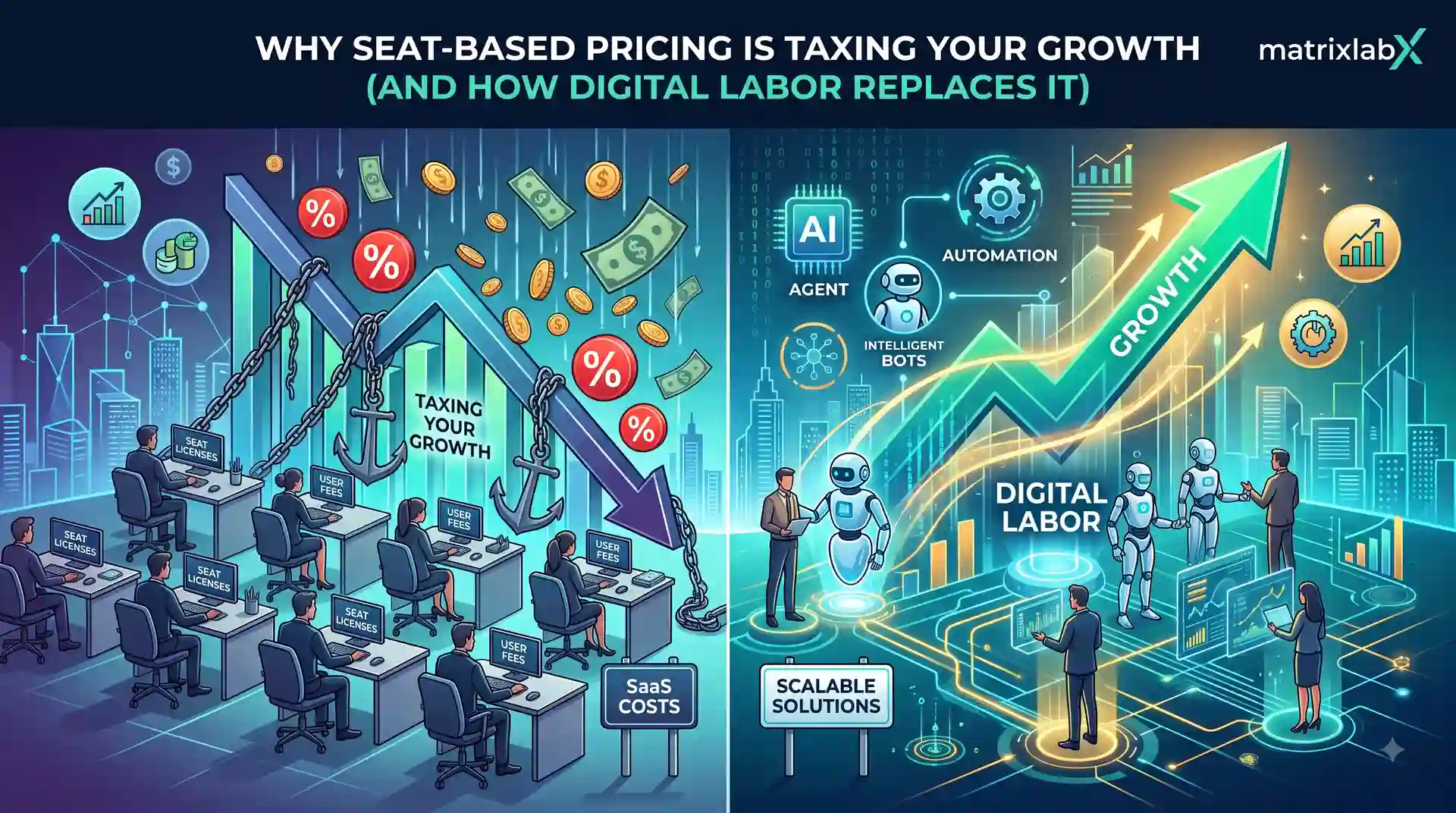
Seat-based software bills for provisioned access, not completed work. Every licence you own but do not use is idle capacity you are paying full price for — and because seats are bought ahead of demand and reclaimed late, the gap is structural rather than accidental. The seat tax is the annual cost of that gap. Removing it does not mean negotiating a better per-seat rate; it means changing what you are billed for.
The line item nobody owns
Ask a CFO what their company spends on software and you will get a number within a few minutes. Ask what share of that spend produced measurable work last quarter and the room goes quiet.
This is not a diligence failure. It is a measurement gap created by the billing model itself. A per-seat contract prices the right to log in. It does not price logging in, and it certainly does not price getting anything done once you have. So the invoice is precise about capacity and silent about output, and the organization inherits a cost it cannot evaluate.
Manufacturing solved this problem eighty years ago by measuring determined capacity against actual output and recording the gap as waste. We covered that framing in the 1940s waste audit. The seat tax is the software-line version of exactly that gap.
How the tax accumulates
Seat waste is not one bad decision. It is four ordinary ones, compounding on a renewal cycle:
- Seats are bought ahead of demand. Procurement negotiates a tier, and tiers reward volume. Buying twenty-five seats for eighteen people is cheaper per seat, so it looks like savings on the day it is signed.
- Seats are reclaimed late or never. Offboarding removes access for security reasons; it rarely removes the licence from the contract, because the contract runs to an anniversary date.
- Occasional users cost the same as heavy users. A manager who opens a dashboard once a quarter occupies the same tier as someone in the tool six hours a day.
- Overlap is invisible across vendors. Two tools with partially overlapping capability are each billed in full, and no single owner sees both lines.
None of these are irrational in isolation. Together they produce a bill that grows with headcount and never shrinks with it.
The cost underneath the licence cost
Here is the part that makes seat waste worth more than a procurement exercise: the licence is the smaller number.
Under 30%
Salesforce’s research across thousands of sales professionals found reps spend less than a third of their time on direct selling, with the balance going to administrative work, internal meetings, manual research, and CRM upkeep. Price that against a fully loaded six-figure salary and the conclusion is uncomfortable: the seat is a rounding error next to the human hours being consumed inside it.
So the real question is not are we over-licensed. It is why are we paying skilled people to perform work that has no judgment in it, and paying a per-seat fee for the privilege.
Measure your own seat tax
Three questions produce a defensible number, per tool, in an afternoon. Run the tree below against your largest contract first — concentration matters more than count.
How heavy is the seat tax on your stack?
The arithmetic is deliberately blunt: provisioned seats, minus seats with meaningful thirty-day activity, times the annual per-seat rate. Sum across vendors. That figure is your annual spend on capacity nobody used, and it is the number to bring to a renewal conversation — not a request for a discount.
What replaces it
The alternative is not a cheaper seat. It is a different billable unit.
Under a digital labor model you buy completed work: a qualified account researched, a record reconciled, an alert triaged, a claim followed up. Agents execute the repetitive motion, a named human approves anything consequential, and every action is written to an immutable audit ledger. Because the unit is output rather than access, idle capacity becomes the provider’s problem rather than a line on your invoice.
That is the structural difference, and it is the whole argument. We cover the delivery model in depth in the Labor as a Service guide and the pricing mechanics in the shift from per-seat to outcome-based pricing.
Three ways this shows up
The seat tax looks different depending on what your licences are attached to. These are the patterns we see most often — illustrative composites, not named client accounts.
Use case
B2B SaaS
VP Revenue Operations · 340 provisioned seats across the GTM stack
Five per-seat contracts, one renewal line, and no owner for the question
The GTM stack carries a CRM, a sequencer, a dialer, an enrichment vendor, and a conversation-intelligence tool — each billed per seat. Finance approves the renewal as a single line. Nobody owns the question of how many of those seats produced anything last quarter.
The bill grows with headcount and never shrinks with it
Headcount moved twice this year. Offboarded reps still hold licences until the anniversary date. A manager who opens the dashboard quarterly occupies the same seat tier as a full-time closer. Meanwhile the renewal quote escalates on a per-seat uplift, so the bill grows while active usage flattens — and the board is asking for efficiency, not more tooling.
Keep seats for judgment, move execution to completed work
Separate the workflows that need a human in a screen from the ones that only need work completed. Research, list building, enrichment, CRM hygiene, and first-touch sequencing are execution, not judgment. Move those to governed agents billed on completed workflows, keep seats for the people exercising judgment, and let the licence count fall at renewal against a documented activity baseline.
Use case
Financial Services
COO · regulated brokerage, seats tied to system-of-record access
Seats are granted at onboarding and treated as a prerequisite, not a cost
Every analyst needs provisioned access to the CRM, the surveillance platform, and the case-management system. Seats are granted at onboarding and treated as a prerequisite for the role rather than a cost.
Dormant entitlements are a cost line and an audit finding at the same time
Each new hire triggers three or four licence additions. Each departure leaves entitlements that persist until someone runs an access review. The finance exposure is real, but the compliance exposure is worse: dormant provisioned access to a system of record is an audit finding waiting to happen, and the seat sprawl that drives cost is the same sprawl that drives access risk.
Fewer standing seats shrinks the licence bill and the access-review surface together
Collapse the count of humans who need standing write access. Agents execute alert triage, data enrichment, and case preparation under scoped, least-privilege identities, with a named human approving anything consequential and every action written to an immutable audit ledger. Fewer standing seats means a smaller licence bill and a shorter access-review surface at the same time.
Use case
Healthcare
VP Revenue Cycle · multi-site provider group, high administrative turnover
Licences budgeted per FTE in a department with high turnover
Revenue-cycle staff each require licensed access to the practice management system, the clearinghouse portal, and the patient-outreach platform. Licences are budgeted per FTE.
The seat is paid continuously; the output is not
Administrative turnover in the department runs high, and every vacancy leaves a paid seat idle through the notice period, the requisition, the hire, and the ramp. The cost is paid continuously; the output is not. Meanwhile the work queue does not pause for the vacancy — it ages, and aged claims are collected at a lower rate.
Make the work queue the unit of work, not the desk
Treat the queue as the unit of work rather than the desk. Eligibility checks, claim status follow-up, and prior-authorization portal work are volume-bounded and judgment-light — exactly what governed agents absorb. Clinical and financial judgment stays with named staff. Capacity stops being a function of who is currently employed.
What to do this quarter
- Pull thirty-day activity per seat on your three largest contracts. Most vendors expose this; if yours does not, that is itself informative.
- Compute the gap in dollars, not percentages. A percentage is arguable. An annual figure is a budget conversation.
- Separate execution from judgment in the workflows those seats support. Execution is what moves to agents; judgment is what stays with people.
- Time the change to the renewal date. Mid-term seat reduction is usually contractually impossible. Arriving at renewal with a documented activity baseline is what changes the negotiation.
Frequently asked questions
What is the seat tax?
The seat tax is the recurring cost of software licenses billed per provisioned user regardless of whether that capacity is used. Because seats are purchased ahead of demand and rarely reclaimed when people leave or change roles, the gap between provisioned and active seats becomes a standing line item that buys nothing.
How do I calculate my seat tax?
Take the number of provisioned seats, subtract seats with meaningful activity in the last 30 days, and multiply the difference by the per-seat annual rate. Repeat per tool and sum. The result is annual spend attributable to capacity nobody used.
What is the difference between seat-based and outcome-based pricing?
Seat-based pricing bills for access to a tool, so cost scales with headcount whether or not work gets done. Outcome-based pricing bills for completed units of work, so cost scales with output. The distinction moves the cost of idle capacity from the buyer to the provider.
Does consolidating tools eliminate the seat tax?
Consolidation reduces it but does not remove it. Fewer vendors means fewer overlapping licenses, but any remaining per-seat contract still bills for provisioned access rather than completed work. Removing the tax entirely requires changing the billable unit.
How does digital labor change the economics?
Digital labor prices the work rather than the workspace. Agents execute the repetitive motion under a human approval gate, so you are buying completed workflows instead of licensed desks. Idle capacity becomes the provider’s cost rather than a line on your invoice.
Put a number on your seat tax
Bring your three largest contracts and thirty days of activity data. We will model what the same workflows cost priced on completed work.
Book a Discovery Call