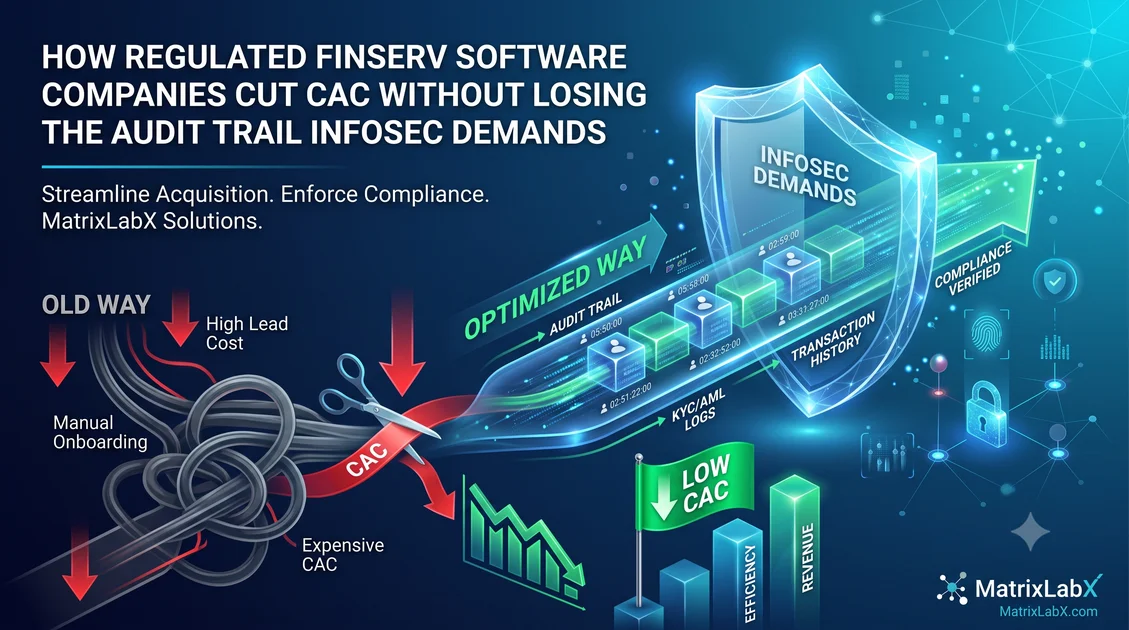
How regulated FinServ software companies cut CAC without losing the audit trail Infosec demands
A hard gate is a mandatory human-approval checkpoint that a governed AI agent cannot bypass before taking a consequential action, such as sending outbound communication to a regulated contact. Unlike a soft-approval workflow, a hard gate means nothing goes out until a named human explicitly approves it — and that approval is recorded on an immutable audit ledger, which is what lets a regulated FinServ software company cut acquisition cost without losing what Infosec needs to sign off.
Key takeaways
- →Boards are pushing CAC reduction hard, and outbound SDR agencies are usually the first line item on the chopping block — but replacing them with a generic AI outbound tool creates a new problem for regulated software companies: nothing your Infosec team can audit.
- →A “hard gate” is not the same as light-touch approval.
- →Cryptographic, immutable audit trails are the actual blocker for most compliance-gated AI adoption — not the AI capability itself.
- →Governed autonomy — agents execute, humans authorize, on an immutable ledger — is built for exactly this constraint, not as an add-on feature but as the operating model.
What is a “hard gate” in governed AI outbound?
A hard gate is a mandatory human-approval checkpoint that a governed AI agent cannot bypass before taking a consequential action, such as sending outbound communication to a prospect or regulated contact. Unlike a soft-approval workflow — where an agent might act by default unless a human intervenes — a hard gate means nothing goes out until a named human explicitly approves it, and that approval is recorded on an immutable audit ledger.
In the context of the 2026 compliance landscape, why does this distinction matter?
Regulated software companies have spent the better part of the last two years fielding AI outbound pitches from vendors who treat “human in the loop” as a marketing phrase rather than a requirement. Infosec teams at these companies have learned, often the hard way, to ask a simple question before approving any AI tool: can you show me, with a timestamp and a signature, exactly what this system did and who approved it?
Most generic AI SDR tools cannot answer that question. That gap — not a lack of AI sophistication — is what has kept regulated FinServ software companies stuck running expensive, slow, manual outbound long after their less-regulated competitors moved to AI-assisted prospecting.
The mess: a board mandate colliding with an Infosec veto
A $100M–$200M ARR compliance-adjacent SaaS company takes a down round. The board's directive is blunt: cut customer acquisition cost by a meaningful margin, starting with the outbound SDR agency contracts that eat a huge chunk of the sales budget. Revenue leadership goes shopping for an AI outbound replacement — and finds one they like.
Then Infosec reviews it. The tool is a black box: prospect data goes in, personalized emails come out, and there's no way to reconstruct, after the fact, exactly what data the model saw, what it decided, or who — if anyone — reviewed the output before it reached a regulated contact's inbox. The deal dies in security review, the board mandate is still unmet, and the SDR agency invoices keep arriving.
The pivot: governance as the feature, not the obstacle
This is the exact scenario governed digital labor is built to resolve — not by making the compliance requirement smaller, but by making it the foundation of how the agent operates:
- Sense. Herald (PrescientIQ’s outbound agent) ingests intent signals and account data the same way any prospecting tool would — but every data access is logged.
- Decide. It drafts prospect-specific outreach based on defined criteria and templates that Infosec has already reviewed and approved.
- Act — only after a hard gate. Nothing sends without an explicit, named human approval. This isn't a configurable nicety; for regulated FinServ software companies, it's the non-negotiable default.
- Record. Every draft, every edit, every approval, and every send is written to an immutable audit ledger — the artifact your Infosec team actually needs to sign off on the tool in the first place.
The payoff: a CAC reduction story Infosec can actually approve
The board gets a lower-cost outbound motion than a full SDR agency retainer. Infosec gets a system where every action is reconstructable after the fact — the same standard they'd apply to any other regulated workflow.
Revenue leadership gets outbound that scales without waiting on agency headcount. Nobody has to choose between the CAC mandate and the compliance requirement, because the architecture treats them as the same problem.
Trending signals in compliance-gated AI adoption
| Signal | What it means for regulated FinServ software |
|---|---|
| Gartner and other analysts increasingly frame AI governance as a board-level risk topic, not just an IT concern | Compliance teams are gaining veto power earlier in AI vendor evaluation — architecture matters as much as capability |
| Shadow AI tools — adopted without security review — are a growing audit finding across SaaS-heavy organizations | Regulated companies face pressure to formalize AI governance before informal adoption creates exposure |
| Immutable, cryptographically verifiable logs are becoming a stated requirement in enterprise AI RFPs | "Agents execute, humans authorize" plus an audit ledger is moving from differentiator to baseline expectation |
SaaS outbound agency vs governed AI outbound agent
| Outbound SDR agency | Generic AI outbound tool | Governed AI outbound agent (hard gate) | |
|---|---|---|---|
| Cost structure | Retainer + per-SDR fees | Per-seat or per-send | Outcome-based, tied to work performed |
| Scales with volume | Slowly — hiring lag | Yes, but often uncontrolled | Yes, with human approval preserved at every send |
| Auditable decision trail | Inconsistent, manual notes | Usually none | Immutable ledger — every action logged |
| Passes Infosec/compliance review | Depends on agency's own practices | Frequently blocked | Built for this from the ground up |
| Human control over what’s sent | Full, but slow | Often bypassed entirely | Full — hard gate, no silent auto-send |
Three use cases (before → after → bridge)
Rip-and-replace outbound at renewal windows. Before:a competitor's price hike creates a 30-day window to win displaced accounts, but the SDR agency can't personalize fast enough to capture it. After:the same window gets covered with agent-drafted outreach, held for a named person’s approval, at a pace that matches the opportunity. Bridge: Herald with a hard gate, moving at agent speed with human judgment intact.
Infosec-approved AI pilot. Before: every AI outbound vendor pitch dies in security review because there's no audit trail. After: the pilot clears review because the audit ledger is the architecture, not an afterthought. Bridge: immutable, cryptographic logging of every proposal and approval.
Board reporting on CAC reduction. Before: CAC numbers move, but nobody can show the board exactly how — which channels, which messages, which approvals drove the change. After: every action ties back to a logged decision, giving the CFO a defensible story, not just a lower number. Bridge: the same ledger Infosec required, doing double duty as board-level reporting evidence.
Would your current outbound stack pass an Infosec review?
Five questions to gauge how close your outbound motion is to audit-ready, before a vendor evaluation gets to security review.
How would a regulated FinServ company actually implement this?
- Bring Infosec into the evaluation from day one, not after commercial terms are set — the hard-gate architecture is the thing they need to see first.
- Define what “consequential action” means for your organization — which outreach types require approval (usually: all external communication to a regulated contact).
- Have compliance pre-approve message templates and data-access scopes the agent will operate within.
- Pilot against a defined account segment, with the audit ledger reviewed by both revenue leadership and Infosec.
- Use the pilot's audit trail as the artifact for a broader compliance sign-off, rather than starting that conversation from scratch each time.
Why this might not work for you
If your organization hasn't yet defined what “consequential action” means internally, or if your compliance function isn't positioned to review AI tooling at all, the hard-gate architecture doesn't solve a problem you've already solved another way — it solves the specific problem of AI tools that compliance can't approve. And if your CAC pressure is coming from channel mix rather than SDR cost, this isn't the first lever to pull.
Conclusion: you don't have to choose between the board and Infosec
The CAC mandate and the compliance requirement have felt like opposing forces because most AI outbound tools were built for speed, not for auditability. A governed agent with a hard human-approval gate and an immutable ledger is built to satisfy both constraints at once — because for a regulated company, they were never actually separate problems.
Get your free AAR benchmark → · Security & governance → · What is Labor as a Service? →
Frequently asked questions
What’s the difference between a "soft" approval and a "hard gate"?
A soft approval workflow may let an agent act unless a human intervenes. A hard gate requires explicit human sign-off before any consequential action executes — no default-send path exists.
How is this different from the black-box AI tools our Infosec team already blocked?
Those tools typically had no reconstructable record of what data was accessed, what was decided, or who approved an action. The audit ledger here is the core architecture, not an optional log.
Can this replace our outbound SDR agency entirely?
Some companies use it to replace agency spend outright; others use it alongside a smaller in-house team. The right mix depends on your volume and account complexity.
What does this cost compared to an SDR agency retainer?
Pricing is outcome-based and depends on volume and configuration. [See pricing for specifics] — a free Autonomous Audit Report can model the comparison against your actual agency spend.
See the governance architecture Infosec can actually approve
Book a 30-minute discovery call. We'll walk through the hard-gate architecture and audit ledger with your revenue and security teams together.
Book a Discovery Call →George Schildge
Founder & Chief AI Officer, MatrixLabX
George Schildge founded MatrixLabX to resolve the tension regulated software companies face between board-level cost mandates and Infosec's auditability bar — building governance into the agent architecture itself, rather than treating it as a compliance afterthought.
Related posts
See where your own execution effort is going
The Autonomous Audit Report models where your team's execution capacity is currently spent, what your configuration is actually paying for, and what the governed alternative looks like on your own data — before any commitment.
Get your free AAR benchmark