Why Compliant Companies Fail Audits: The Evidence Production Gap
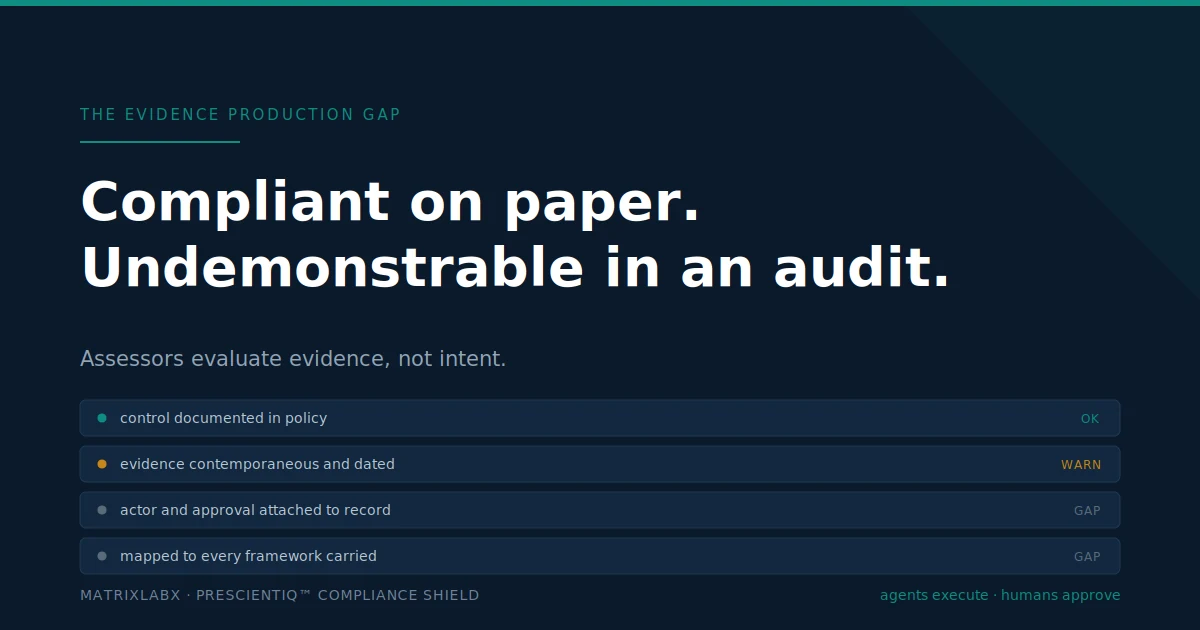
Most organizations that fail a regulatory assessment are not operating without controls. They are operating without retrievable, dated, attributable proof that those controls ran. Policy exists on paper; evidence exists in screenshots someone took last quarter. Auditors assess the second thing. Closing that gap is a continuous evidence-production problem — and it is the specific problem governed digital labor is built to solve: agents execute the collection, humans approve what it means, and every action lands on an immutable audit ledger.
What is the evidence production gap?
There are two different questions a regulator or assessor can ask, and organizations routinely prepare for the wrong one.
The first is “do you have a control for this?” — answered by a policy document. The second is “show me that the control operated, on this date, for this record, and who authorized the exception.” That one is answered by evidence, and evidence has properties a policy does not: it must be contemporaneous, attributable to an actor, dated, and unaltered since it was written.
The gap is the distance between those two answers. It is where audit findings come from, and it widens quietly. Nobody notices a control is unevidenced until someone asks for the proof, which by definition happens at the worst possible time.
Why does manual evidence collection fail?
Not because compliance teams are careless. Because the method has three structural defects.
It is retrospective. Evidence gathered during audit prep is a reconstruction of what happened months ago, assembled from logs that may have rotated, from people who may have left, about configurations that may have changed twice since. Reconstruction is not the same artifact as a contemporaneous record, and a good assessor knows the difference.
It is sampled.A human collecting screenshots collects some of the population. Assessors increasingly want the population. The gap between “here are twelve representative access reviews” and “here is every access change in the period” is the gap between a qualified opinion and a clean one.
It competes for the same hours as everything else. Audit prep is a scramble because it is unplanned labor landing on people who already have jobs. Volume of frameworks rises; headcount does not.
The pattern is familiar to anyone who has read our argument about why hiring more people stops producing more output: the work is volume-bounded and judgment-light, so it consumes hours linearly while the judgment that actually needs a human — is this exception acceptable, is this residual risk tolerable — gets squeezed into whatever is left.
What does continuous evidence collection actually mean?
It means the evidence is a byproduct of operations rather than an activity performed on top of them.
Concretely, four things have to be true, and they are worth stating separately because vendors in this category routinely claim the first and skip the rest:
- Collection is continuous, not periodic. Access changes, configuration deltas, data movements, and agent actions are recorded when they occur.
- Every record carries an actor. Not “the system updated the field” — which actor, under which identity, with which least-privilege scope, on whose approval.
- The record is append-only. An audit trail that can be edited is a document, not evidence. Immutability is the property that makes it worth anything to an assessor.
- The record maps to an obligation. A log line is not evidence until it is bound to the control it demonstrates. This mapping is the part that is almost always missing.
That fourth point is where most tooling stops and where the actual leverage is.
What is a compliance crosswalk, and why does it matter?
The practical consequence of not having one: an organization satisfying four frameworks collects the same encryption-at-rest evidence four times, in four formats, on four calendars, for four assessors. The work triples while the underlying security posture does not change at all.
With a crosswalk, evidence is collected once against a canonical control and projected onto each framework's schema. Assess once, report many. The reduction is in the reporting labor, not in the security work — an important distinction, because vendors habitually blur the two and buyers eventually notice.
Who is accountable when an agent produces the evidence?
You are. That does not change, and any vendor implying otherwise is selling you a liability, not a product.
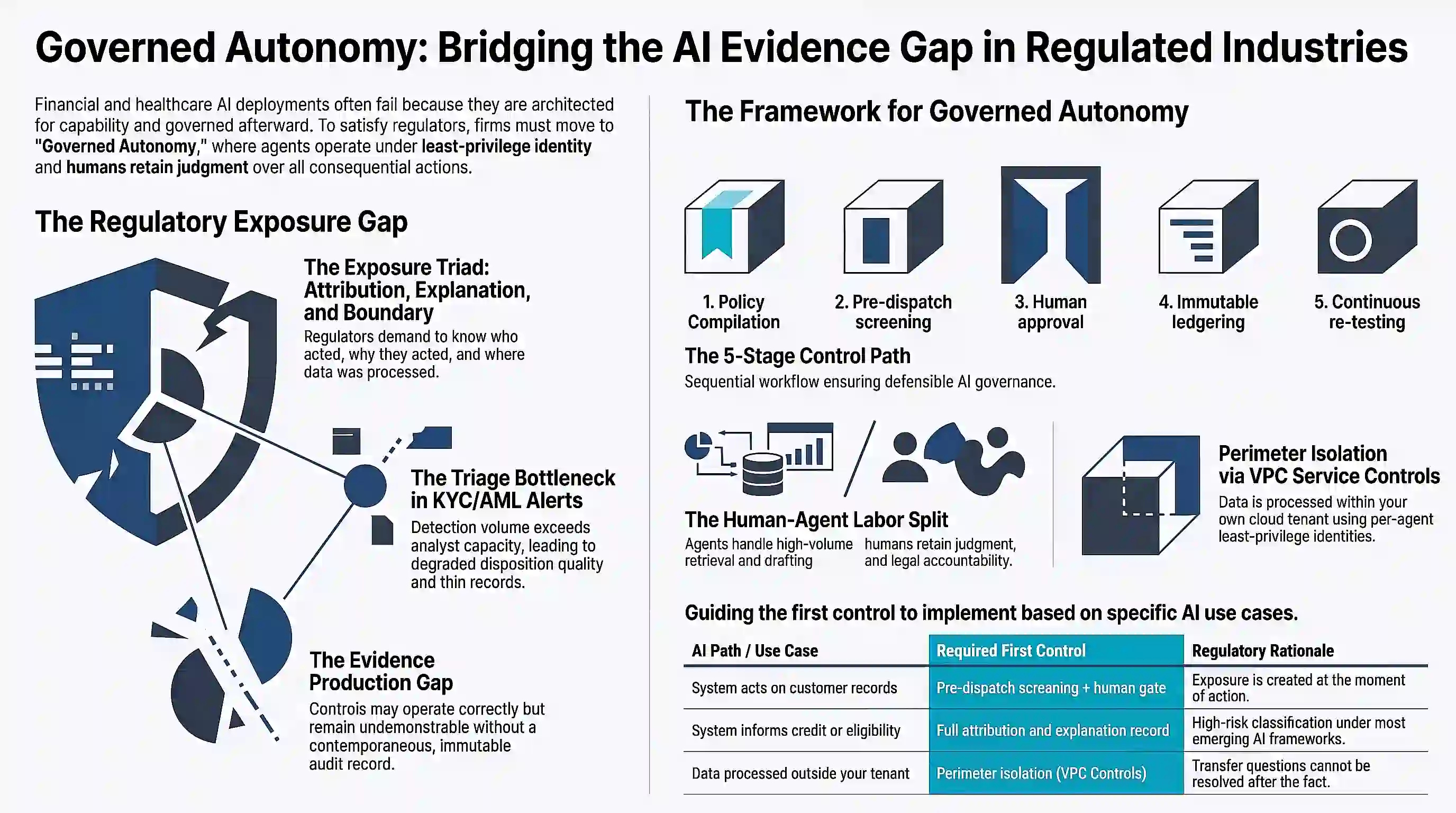
Which is exactly why the governance model matters more than the automation. The operating principle is agents execute, humans authorize:
- Agents run the volume work — harvesting evidence, testing controls against a rule set, re-checking standing records when a rule changes.
- A person holds the approval gate on anything consequential. Approval is a property of the dispatch path, not a setting someone can switch off.
- Every action — approved, blocked, or executed — writes to an immutable ledger with actor, rationale, sources consulted, and before/after state.
The result an assessor cares about is not “an AI did it.” It is that when they ask who authorized this and on what basis, there is a name, a timestamp, and a clause.
Where should evidence physically live?
In a store you control, written to an append-only ledger your auditor can read directly.
Routing regulated data to a third-party AI service introduces a processor relationship, a transfer question, and a vendor whose posture you now have to evidence too. MatrixLabX agents execute on Google Cloud [Inherited — Google Cloud platform capability], with per-agent least-privilege identity and a gateway that validates tool calls against your policy before any external action runs.
Every action is recorded to an immutable audit ledger. That is a design property, not a promise about outcomes — and it is the one worth verifying yourself in any vendor evaluation, including ours.
Decision tree: is continuous evidence collection your actual constraint?
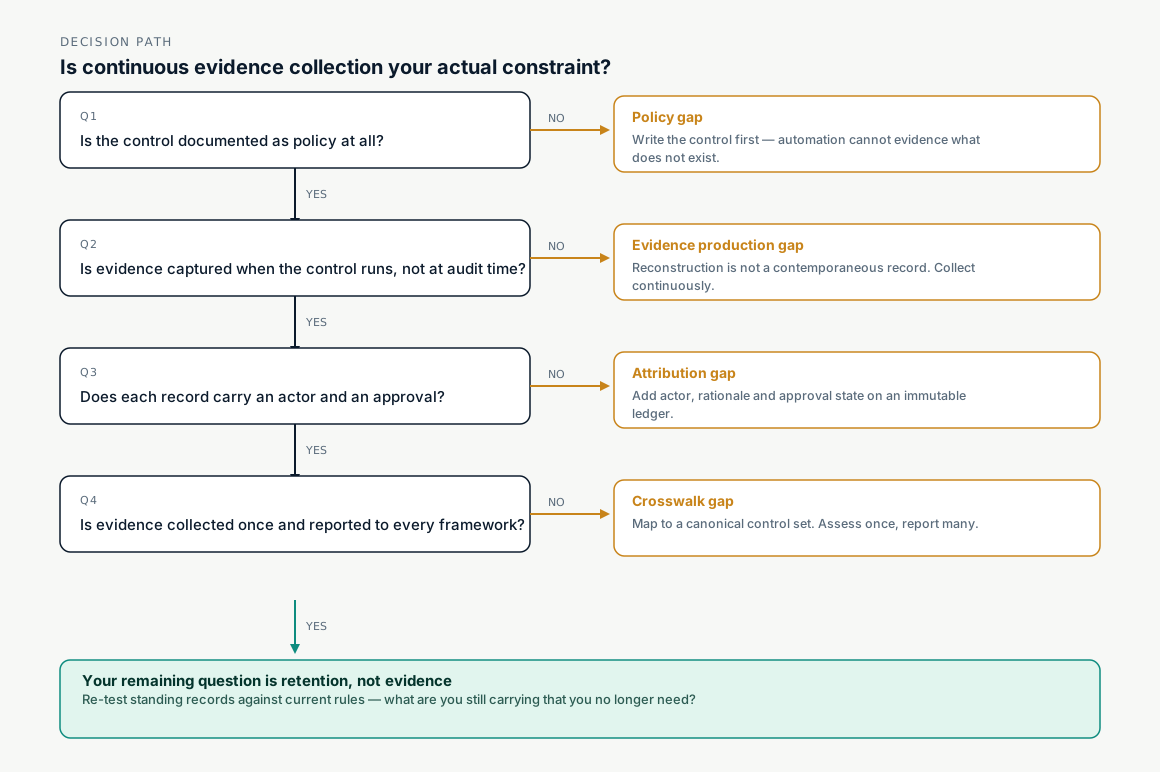
Walk it honestly:
| Where you stop | What you actually have | What fixes it |
|---|---|---|
| No documented control | A policy gap | Write the policy first — automation cannot evidence a control that does not exist |
| Control documented, evidence reconstructed at audit time | An evidence production gap | Continuous collection |
| Evidence exists but is re-gathered per framework | A crosswalk gap | Canonical control mapping, assess once |
| Evidence exists but no actor or approval attached | An attribution gap | Immutable ledger with actor, rationale, and approval state |
| All four clear | A retention question — how long are you carrying records you no longer need? | Re-testing standing records against current rules |
Most organizations that describe themselves as having a compliance problem have the second or third. Those are the two that respond to capacity, not to more policy work.
The underlying thesis — that execution capacity, not software access, is the constraint on regulated mid-market operations — is in digital labor. The platform is PrescientIQ™.
Where to start: the ladder
Four steps, each one a real decision point rather than a funnel stage. You can stop at any of them and still be better off than you were.
1 — Autonomous Audit Report (free). A modeled read on your own data: which controls currently have contemporaneous evidence, which are reconstructed, where framework overlap is duplicating work, and what your retention exposure looks like. No commitment attached. [Assessment scope — modeled on client data]
2 — Control Mapping Sprint. A fixed-scope engagement that builds your canonical control set and crosswalks it to every framework you carry. Output is yours whether or not you go further.
3 — Governed pilot. One motion, one framework, on Google Cloud. Continuous evidence collection running against a live control set, with the human approval gate and the ledger in place, so you can evaluate the artifact an assessor would actually see.
4 — Compliance Shield, in production. The full control path — policy compilation, pre-dispatch screening, immutable ledger, standing-record re-testing — across your framework set.
Step 1 is the only one that needs a decision today.
Frequently asked questions
Why do companies with good security controls still fail audits?
Because assessors evaluate evidence, not intent. A control that operates correctly but produces no contemporaneous, attributable record cannot be demonstrated, and an undemonstrable control is treated as an unimplemented one.
What is continuous compliance evidence collection?
Recording control operation as a byproduct of the operation itself — every access change, configuration delta, and agent action captured when it occurs, attributed to an actor, written append-only, and mapped to the obligation it demonstrates.
Does automating evidence collection transfer liability to the vendor?
No. Regulatory accountability stays with your organization. What automation changes is whether you can substantiate what happened — which is why the human approval gate and the attribution record matter more than the automation itself.
Where does the audit evidence live?
On Google Cloud, under per-agent least-privilege identity, in an immutable audit ledger recording every action, its rationale, and the approving human.
Related
See where your own execution effort is going
The Autonomous Audit Report models where your team's execution capacity is currently spent, what your configuration is actually paying for, and what the governed alternative looks like on your own data — before any commitment.
Get your free AAR benchmark