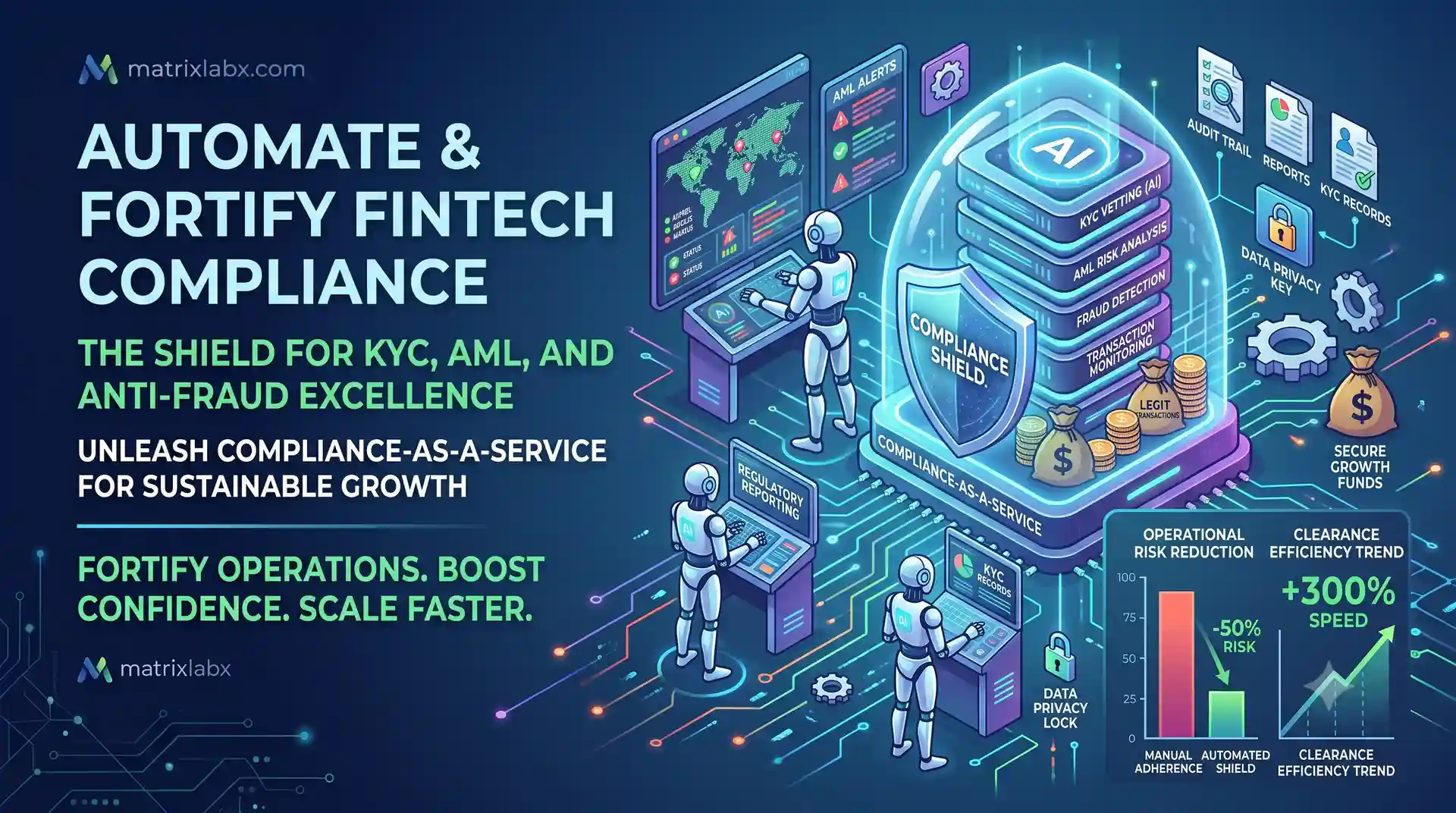
How FinTech Firms Use Governed AI Agents for AML and KYC Compliance
Key Takeaways
- 1.Most FinTech compliance spend does not buy risk reduction. It buys analyst hours spent clearing alerts on legitimate activity, assembling audit evidence by hand, and rewriting rules when regulations change.
- 2.False-positive remediation is the largest and most tractable cost, because it comes from one technical limitation: rules that cannot read customer context.
- 3.Governed agents run the investigative loop (monitor, contextualize, triage, document) and stop at the decision line. Escalations, SAR decisions, and high-risk KYC calls stay with named humans.
- 4.A regulator-ready deployment looks like a controls implementation, not a software install: read-only integrations, encoded policy, monitoring mode, governance review, then staged autonomy.
- 5.Every agent action lands in an immutable ledger with actor, rationale, and before/after state, which is what makes the work examinable.
Direct Definition
Autonomous AML and KYC agents are governed AI systems that continuously monitor transactions, screen customers against sanctions and politically exposed person lists, investigate alerts in full customer context, and assemble audit-ready case files. They execute the repetitive investigative work while compliance officers approve every consequential decision.
Why Is Compliance Such a Heavy Line Item in FinTech Operations?
There is a conversation that happens in every FinTech board meeting, usually when margins are being scrutinized. Someone pulls up the compliance budget (compliance officers, outside counsel, audit preparation, regulatory reporting, and the rules-based monitoring systems that generate a steady flood of alerts) and the room goes quiet. The line grows with every new customer, every new product, and every new piece of regulatory guidance.
The core problem is structural. Traditional compliance is a reactive, human-operated process. Violations are found after they occur, often days or weeks later, through periodic manual review of transaction logs, communication records, and operational data. The detection lag creates regulatory risk. The manual review creates cost. And audit preparation, assembling evidence across fragmented systems to show a regulator the program works, consumes weeks of senior professional time.
Regulations are not going away. The compliance burden is an execution-model problem, and that is the kind of problem governed agents are built for.
Where Does FinTech Compliance Spend Actually Go?
Most of it goes to investigating noise. Compliance leaders can usually name their headcount and their software vendors. Few can put a number on false-positive remediation: every alert an analyst opens, reviews, documents, and closes as legitimate. It is the largest, most opaque, and most addressable part of the budget.
| Cost category | What drives it |
|---|---|
| False-positive remediation | Analyst and supervisor time spent reviewing and closing alerts on legitimate transactions |
| Analyst headcount | Alert triage and case management that scales linearly with transaction volume |
| Outside counsel and advisory | Regulatory interpretation, examination preparation, escalated cases |
| Audit preparation | Manually assembling evidence, transaction samples, and disposition records |
| Regulatory reporting | SAR and CTR submissions prepared largely by hand |
| Compliance technology | Monitoring software, KYC platforms, and watchlist feeds that still need people to operate them |
Anyone who has walked a compliance floor at month-end knows the texture of it: the queue that resets overnight, the second monitor full of half-closed cases, the good analyst who quietly starts interviewing elsewhere. That human strain is the real cost line.
False-positive remediation is addressable because it comes from one specific limitation. Rules-only systems fire on surface characteristics (an amount, a jurisdiction, a velocity threshold) with no context. They are simultaneously over-sensitive, catching large volumes of legitimate activity, and under-sensitive, missing typologies that emerge across time and account relationships rather than inside a single transaction.
What Do Governed Compliance Agents Actually Do?
They run the investigative loop and stop at the decision line. The Compliance Shield deploys four specialized agents that divide the work the way a well-run compliance team would.
Compliance Monitoring Agent
Continuously evaluates transactions and workflows against your regulatory requirements and written policy. Rather than firing on a static rule, it scores each event against the customer's behavioral history, peer-group norms, channel and timing, and counterparty profile, then closes what makes sense in context with a documented rationale.
Governance Agent
Enforces policy boundaries across automated workflows. When a workflow approaches a regulatory limit (transaction thresholds, retention rules, cross-border transfer rules) the Governance Agent intervenes before the violation occurs rather than flagging it afterward. When a regulation changes, it flags the affected logic and drafts a proposed policy update for compliance officer approval.
Risk Intelligence Agent
Synthesizes signals across transaction patterns, account relationships, access records, and communication logs to surface structuring, layering, account-takeover, and mule-network patterns that rules-only systems miss. It gives the Chief Risk Officer a forward-looking view instead of a retrospective audit.
Auditor Agent
Assembles examination-ready documentation directly from the immutable ledger, mapping every agent action to the rule it satisfies: alert disposition records, SAR case summaries, supervisory review evidence, transaction samples. It is read-only, which is why skeptical compliance teams often deploy it first.
Across AML, KYC, and SAR workflows: who does what
| Workflow | What the agents do | Human gate |
|---|---|---|
| KYC onboarding and refresh | Extract and cross-check identity, beneficial-ownership, and source-of-funds documents; screen against sanctions, PEP, and adverse-media sources; apply your risk-scoring model | Approval on high-risk classifications and rejections |
| Transaction monitoring | Continuous behavioral analysis in full customer context | None: surfaces scored alerts only |
| Alert triage | Investigate each alert and close noise with a written rationale | Sign-off on every escalation |
| SAR preparation | Assemble a pre-populated case file and draft narrative with supporting evidence | A named officer decides whether to file, and files |
| Regulatory change | Monitor publications, flag affected logic, draft policy updates | Officer approval before any update propagates |
| Examination and audit | Generate case files and evidence packages from the ledger | None: read-only over immutable records |
The architecture matters as much as the agents. Each agent holds a least-privilege identity, reaches core systems only through typed, scoped integrations, and appends every action to an immutable ledger with actor, rationale, and before/after state. It is the same governed pattern described in our multi-agent architecture blueprint.
How Does Autonomous Compliance Compare to Rules-Based Systems?
The difference is context. A rules engine asks whether a transaction matches a condition. A governed agent asks whether the behavior makes sense given everything known about the customer, and writes down its answer.
| Dimension | Rules-Based Systems | Governed Compliance Agents |
|---|---|---|
| Detection method | Fixed rules trigger on known patterns | Contextual scoring against customer history, peers, and counterparties |
| False-positive handling | Every alert reviewed by a human | Noise closed with documented rationale; genuine risk routed to humans |
| Detection timing | Batch processing and periodic review | Continuous monitoring |
| Novel typologies | Missed until someone writes a rule | Surfaced through cross-account pattern analysis |
| Audit documentation | Manual assembly | Generated from the ledger |
| Regulatory updates | Manual rule rewriting | Affected logic flagged; update drafted for officer approval |
| Scaling with volume | Headcount grows with alerts | Agent capacity grows without a matching headcount increase |
| Auditability | Human reasoning often undocumented | Every action logged with actor and rationale |
What Regulatory Frameworks Do the Agents Monitor Against?
A common concern among chief compliance officers is whether agents can hold the coverage depth examiners expect. Agents are configured against the frameworks your program already operates under, plus your own written policies. They support the program; accountability for it stays with your compliance officer.
- BSA/AML — Customer due diligence, enhanced due diligence for high-risk accounts, SAR case preparation, and CTR support.
- CFPB guidance — Monitoring for fair-lending and UDAAP patterns in approvals, with statistical anomalies escalated for compliance review.
- PCI DSS — Monitoring that works alongside your existing cardholder-data environment and controls.
- SOC 2 evidence — Per-action ledger records that support your own change-management, access-logging, and monitoring evidence.
SOC 2, ISO 27001, and PCI DSS attestations are held by Google Cloud, which operates the underlying infrastructure. They are not MatrixLabX certifications.
What Does a Regulator-Ready Deployment Look Like?
It looks like a controls implementation, not a software install. The sequence FinTech compliance teams run:
| Step | Action | What it establishes |
|---|---|---|
| 1. Ingestion | Typed, read-only connections to core banking, the KYC vendor, and the case manager | Full context without new write access |
| 2. Policy encoding | Your AML program and risk appetite become the agents' boundary | Agents enforce your policy, not a vendor default |
| 3. Monitoring mode | Agents propose triage decisions without executing them | A measured agreement rate against your own analysts |
| 4. Governance review | Compliance and internal audit inspect the ledger and the approval gates | Sign-off before any autonomous action |
| 5. Staged autonomy | Low-risk closures first, one closure type at a time; escalations stay human-gated | Autonomy expands only as far as the evidence supports |
Three Illustrative FinTech Compliance Scenarios: Before, After, Bridge
Illustrative scenarios for representative company profiles. These are not delivered client results and carry no measured outcomes.
Illustrative Scenario 01 — Payments platform buried in alerts
Before
Analysts open every morning to an alert queue that reset overnight, and month-end closes on overtime. Almost all of the queue clears as legitimate. Meanwhile, a pattern of structuring transactions spread across several accounts goes unnoticed for weeks because no single transaction trips a rule.
After
The Compliance Monitoring Agent investigates each alert in full customer context and closes the noise with a written rationale. The Risk Intelligence Agent surfaces the cross-account structuring cluster before a threshold is crossed. Humans see a short queue of genuine escalations.
Bridge
Monitoring mode first: the agent's proposed closures are scored against what analysts actually decided, so the compliance officer turns on autonomy with an agreement rate in hand, not a vendor promise.
Illustrative Scenario 02 — Neobank losing applicants at onboarding
Before
Verification takes days of back-and-forth, and prospects abandon the application at the point of highest intent. The onboarding team is the bottleneck in the acquisition funnel.
After
Agents run document checks, sanctions and PEP screening, and risk scoring as the application arrives, escalating only high-risk classifications for human sign-off.
Bridge
The agents enforce the bank's own written risk policy, encoded during deployment, so faster onboarding comes with a stronger evidence trail rather than a looser one.
Illustrative Scenario 03 — Lender facing an examination
Before
Audit preparation means weeks of senior staff reconstructing case histories from shared inboxes, spreadsheets, and several disconnected systems.
After
The Auditor Agent assembles examination-ready case files directly from the immutable ledger. Every decision already carries its actor, rationale, and before/after state.
Bridge
Read-only access: this agent delivers value without touching a single production workflow, which makes it the natural first step for a team, or an examiner, that is skeptical of automation in the alert path.
The Chief Risk Officer Who Stopped Fighting Fires
Illustrative scenario — not a delivered client result or a specific named individual.
Picture a Chief Risk Officer at a mid-market FinTech firm: meticulous, respected by the board, and permanently in reactive mode. Every week brings another batch of false positives, another regulator request, another jurisdiction with new reporting requirements. Her team spends much of its time on what practitioners privately call “compliance janitorial work”: triaging alerts, assembling evidence, updating monitoring rules by hand.
A staged deployment changes the texture of the job more than any dashboard does. Month-end without overtime. An examination file that exports instead of being excavated. Her strongest analyst working true escalations instead of noise. The detail that sells it internally is the rationale field: every closed alert explains itself, in writing, permanently.
The shift it is designed to produce is a team that moves from fighting fires to preventing them, with agents on the operational layer and humans on the judgment layer.
Why Autonomous Compliance Might Not Work for Your Organization
- ⚠If your alert volume is small enough that a couple of analysts clear the queue comfortably, the coordination overhead can outweigh the benefit. Revisit at scale.
- ⚠If your AML policy lives mostly in fragmented files and institutional knowledge, write it down first. Agents enforce written policy; ambiguity in is ambiguity out.
- ⚠If your transaction history is thin, contextual models have little to learn normal behavior from, and early triage will lean heavily on human review.
- ⚠If your examiners have taken a hard position against automation in the alert path, start with the read-only Auditor Agent. Case assembly builds the evidence base that changes that conversation.
- ⚠If the real obstacle is organizational (board resistance, cultural skepticism about AI in regulated decisions), a technical deployment will not resolve it on its own.
Conclusion: Compliance as a Controlled System, Not a Cost Center
The money the industry spends on compliance mostly buys manual review of noise. Governed AML and KYC agents move the noise to machines, keep judgment and accountability with your officers, and hand your examiners a cleaner trail than manual casework produces. See how this maps to FinTech operating models on the FinTech industry page.
The practical next step is small: name your highest-volume alert type, pull last quarter's false-positive rate for it, and ask what your team would do with those hours back. That number, your own rather than an industry average, is what turns evaluating AI in the abstract into pricing a specific queue you already pay for every month.
People Also Ask
What are autonomous AML and KYC agents?+
How do AI agents reduce the AML false-positive workload?+
Are autonomous compliance agents acceptable to regulators?+
Do the agents file SARs on their own?+
What regulatory frameworks can the agents monitor against?+
How long does compliance agent deployment take?+
Is the platform running the agents itself compliant?+
Next Step
Deploy the Compliance Shield
Our solutions team will map the Compliance Shield to your specific regulatory frameworks and give you a deployment timeline — at no charge.
Request Free AAR Benchmark →See where your own execution effort is going
The Autonomous Audit Report models where your team's execution capacity is currently spent, what your configuration is actually paying for, and what the governed alternative looks like on your own data — before any commitment.
Get your free AAR benchmark