Why SDR Ramp Time Is the Hidden Cost Nobody Models
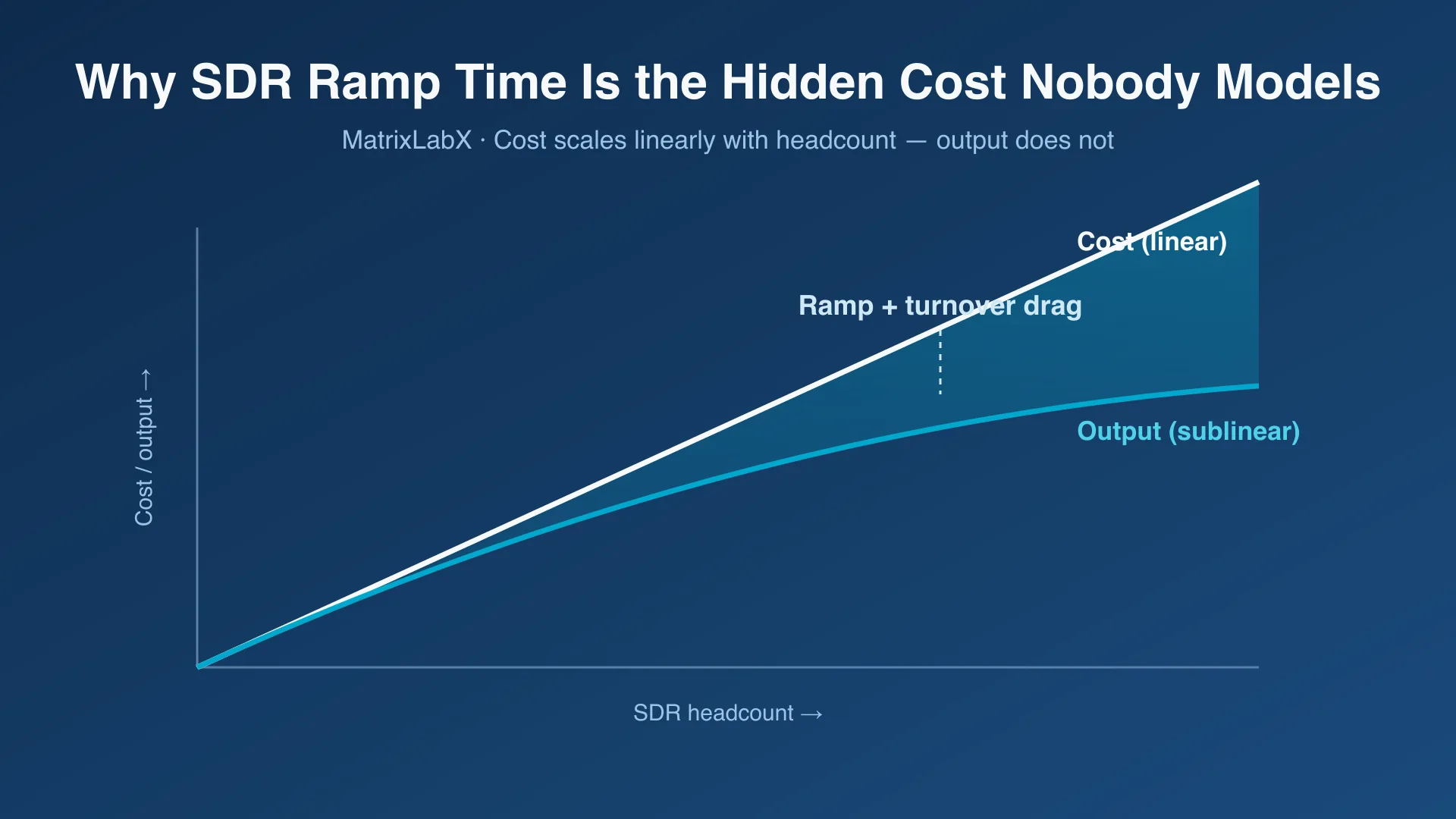
Most fully-loaded SDR cost models count salary, commission, benefits, tooling, and management overhead. Very few count ramp: the period during which a newly hired rep draws full cost while producing partial output. Because sales development is a high-turnover entry role, ramp is not a one-time onboarding expense — it is a permanent, recurring drag that scales with headcount.
What is SDR ramp time?
Ramp time is the interval between a rep's start date and the date they reach expected productivity. During that window the company pays the full cost of the seat and receives some fraction of the output.
The reason it goes unmodeled is that it doesn't appear anywhere as a line item. There's no invoice for ramp. It shows up as a gap between what the headcount plan promised and what the pipeline delivered, two quarters later, attributed to something else.
Why doesn't ramp cost go away after onboarding?
Because the seat doesn't stay filled.
Sales development is structurally an entry-level role. It is where people start, and the explicit career path is out of it — into an account executive seat, into customer success, into marketing. That's not dysfunction; it's how the role is designed. But it means the seat turns over on a cycle measured in months rather than years.
Now run the consequence. If tenure is short and ramp is a meaningful fraction of tenure, then at any given moment some proportion of your team is ramping. Not once, at team formation. Continuously, forever. A team of ten is never ten productive reps — it is some productive reps, some ramping reps, and some open requisitions where a productive rep used to sit.
That is the real fully-loaded cost, and it is the number that belongs in a headcount model.
What does ramp do to the “just hire more reps” plan?
It bends the curve, and not in your favor.
Cost scales linearly. Each new rep costs what a rep costs. Ten reps cost roughly ten times one rep. This part is simple to model, which is why it's the part that gets modeled.
Output scales sublinearly. Each new rep arrives at zero output and climbs. Meanwhile the existing team is losing members at the tenure rate, and each departure removes a fully-ramped rep and replaces them with another zero. Add management overhead — a growing team needs more of it, and management time comes out of production time — and the gap widens.
The practical expression is the plateau every scaling revenue org eventually hits: the team keeps growing and the pipeline doesn't grow proportionally. The instinct is to look for a coaching problem or an enablement problem. Sometimes there is one. But often the arithmetic is sufficient explanation on its own, and no amount of enablement fixes arithmetic.
We've made the adjacent argument about what this does to per-seat pricing models in per-seat to outcome-based pricing.
What ramps and what doesn't?
Worth being precise about what a ramping rep is actually learning, because it isn't one thing:
| What's being learned | Why it takes time | Transfers to a new hire? |
|---|---|---|
| Product and market knowledge | Volume of material | No — relearned every time |
| ICP pattern recognition | Requires reps of the actual work | No |
| Objection handling and messaging | Requires live conversations | Partially, via enablement |
| Tooling and process | Training | Partially |
| Account and relationship context | Accumulated over time in seat | No — leaves with the rep |
The last row is the expensive one. Institutional memory about accounts is held in a person, partially written down, and lost on departure. The next rep starts from whatever made it into the CRM — which is a description of a data decay problem as much as a ramp problem.
How does governed digital labor change the ramp equation?
By moving the parts of the work that require no ramp out of the ramping seat.
Sourcing, enrichment, sequence execution, and record maintenance are rule-and-signal work. An agent executing them doesn't onboard, doesn't accumulate context that walks out the door, and doesn't lose institutional memory when a person changes jobs — because the context lives in the system rather than in the rep.
What that does to the headcount model isn't “fewer people.” It's that the people you have spend their ramp learning the part of the job that actually requires learning — judgment, conversation, objection handling — instead of spending it learning which tab to update.
And the governance layer is what makes this survivable for a CFO. Agent execution isn't unsupervised: consequential actions pass a human approval gate, and every action lands on an immutable audit ledger. You get continuity without giving up control of what goes out under your company's name.
The broader case is in digital labor. The governance model is on the PrescientIQ™ platform.
The honest way to size any of this for your own team is against your own numbers, not a benchmark. That's what the Autonomous Audit Report does — it models your current cost structure and your projected delta on your own data before you commit to anything.
Frequently asked questions
What is SDR ramp time?
The period between a new sales development rep's start date and the date they reach expected productivity, during which the company pays full cost for partial output.
Why is ramp time a recurring cost rather than a one-time cost?
Because sales development is a high-turnover entry role by design. Reps are expected to move on, so seats turn over continuously and some share of the team is always in ramp.
Does hiring more SDRs increase pipeline proportionally?
Rarely. Cost scales linearly with headcount while output scales sublinearly, because each new hire starts at zero, departures remove fully-ramped reps, and management overhead grows with team size.
How do you reduce SDR ramp time?
Better enablement and tighter playbooks help at the margin. The structural lever is reducing how much of the job requires ramping at all — moving rule-and-signal execution out of the human seat so ramp is spent on judgment work.
What's the difference between ramp cost and turnover cost?
Turnover cost is recruiting and backfilling. Ramp cost is the productivity gap after the backfill starts. They compound: high turnover means you pay ramp cost more often.
What does ramp and turnover drag actually cost on your own numbers?
Get Your Free AAR Benchmark →George Schildge is Founder & Chief AI Officer of MatrixLabX.
See where your own execution effort is going
The Autonomous Audit Report models where your team's execution capacity is currently spent, what your configuration is actually paying for, and what the governed alternative looks like on your own data — before any commitment.
Get your free AAR benchmark