What Does an SDR Actually Do All Day?
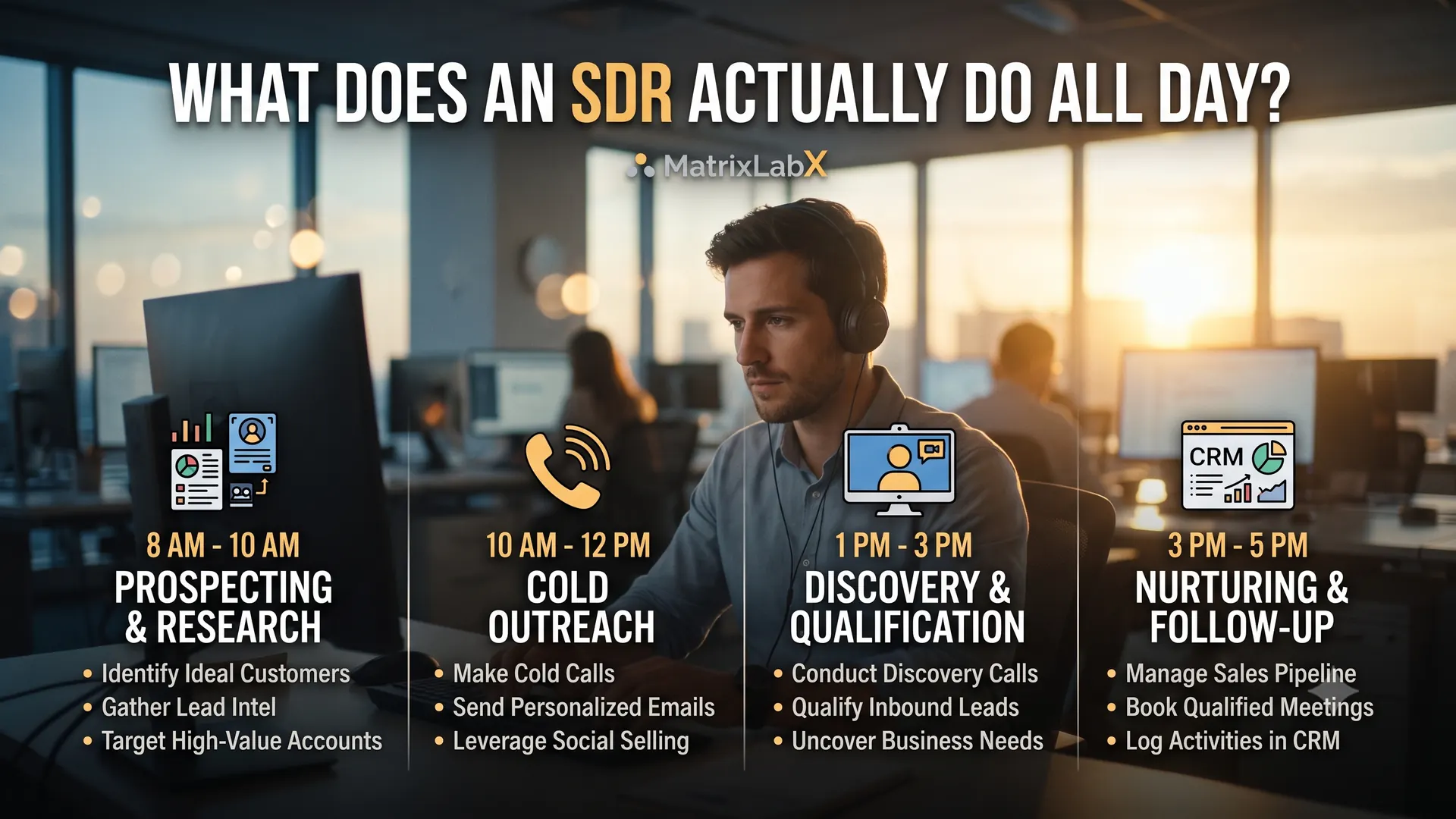
A sales development representative (SDR) is the front end of a B2B revenue motion: they build target lists, research accounts, run outbound sequences across email, phone, and social, qualify inbound leads, and book meetings for account executives. They do not close deals. The job is almost entirely execution — and that is precisely why its output has a hard ceiling.
What is an SDR?
An SDR is a specialist whose entire function is converting raw market interest into a qualified conversation. The role exists because closing is a different skill from sourcing, and because an account executive's hour is worth more spent in a meeting than spent building a list.
The scope is deliberately narrow. An SDR owns the top of the funnel and hands off at the point of qualification. Everything after that — discovery, proposal, negotiation, close — belongs to someone else.
What does an SDR do in a typical day?
The work decomposes into five repeating activities:
1. Sourcing. Identifying accounts that fit the ideal customer profile, then identifying the right people inside those accounts. This means working intent data, technographic signals, job-change alerts, and inbound form fills — and reconciling all of it against whatever the CRM already says.
2. Research. Before contact: what does this company do, what changed recently, who else have we talked to there, what did they say. This is the step that determines whether the outreach reads as relevant or as spam, and it is the step that gets cut first when volume targets bite.
3. Outreach. Running sequences — email, phone, LinkedIn, sometimes video — across a working set of accounts. Each touch is a small unit of work, and there are a great many of them.
4. Qualification. Handling replies, running short discovery, applying a qualification framework, and deciding whether a conversation is worth an AE's calendar.
5. Administration. Logging every activity, updating records, correcting stale data, maintaining sequence enrollment, and reporting. This is the tax on all four activities above.
The pattern worth noticing: four of the five activities are judgment-light and volume-heavy. Only qualification consistently requires a human read.
When does an SDR do this work?
Timing is not incidental to the role — it is most of the role's advantage.
Inbound leads decay fast; the value of a response is highest in the minutes after the trigger and falls steeply from there. Intent signals are perishable in the same way. A job change is worth acting on this week, not next month. A trial signup that stalls is worth a touch at the moment it stalls.
And an SDR works during business hours, in one time zone, with a finite number of them. Signals do not.
This is the first structural constraint on the role: the highest-value moment to act is frequently a moment when no one is working. No amount of rep discipline resolves that. It is a coverage problem, not an effort problem.
Why does SDR output hit a ceiling?
Because output is bounded by two things that don't scale with headcount:
Hours. Sourcing, researching, sequencing, and logging all consume real minutes. The working set an SDR can carry is capped by how many minutes each account consumes. Push the account count up and the minutes per account go down — which shows up as research getting skipped, which shows up as reply rates falling. Volume and quality trade against each other on a fixed time budget. In practice the ceiling is concrete: an unassisted rep tops out around 30–40 call attempts and 30–50 emails a day — on the order of 1,150 touchpoints a month — which caps the resulting pipeline at roughly 8–12 booked meetings, the same throughput model behind our outbound prospecting analysis.
Ramp and tenure. A newly hired SDR is not productive on day one, and the average tenure in the seat is short by design — it is an entry role people are expected to leave. So a team is always carrying some proportion of members who are not yet at full output, and losing some proportion who were. Growing the team adds ramp load along with capacity.
Together these produce the counterintuitive result every VP of Sales eventually meets: cost rises linearly with headcount, output rises sublinearly. More reps is a real lever, but a decaying one — and the decay is arithmetic, not managerial.
What part of the SDR role can be automated — and what can't?
Sorting the five activities by whether they need human judgment gives a clean answer:
| Activity | Nature of work | Automatable? |
|---|---|---|
| Sourcing | Signal matching at volume | Yes — this is pattern work |
| Research | Retrieval and summarization | Largely |
| Outreach | Sequenced execution against rules | Largely, under approval |
| Qualification | Judgment, objection handling, relationship | No — this stays human |
| Administration | Record maintenance | Yes |
This is the split that matters, and it is not “replace the SDR.” It is: the parts of the job that are bounded by hours become agent work, and the part of the job that requires a person to exercise judgment stays with the person — with the human holding the approval on anything consequential.
That is the model MatrixLabX calls governed autonomy: agents execute, humans authorize, and every action lands on an immutable audit ledger so you can show exactly what was sent, to whom, and on whose authority. It is the difference between an automation that quietly did something in your name and an execution layer a CRO can defend in a board meeting.
Related reading
- SDR vs BDR vs AE: who owns what in the revenue motion
- Why SDR ramp time is the hidden cost nobody models
- Which SDR metrics actually predict pipeline?
- The compliance exposure hiding in your SDR, BDR, and MDR motion
- AI SDR vs. human SDR: what each one actually costs
The broader argument — why execution capacity, not software access, is the constraint on mid-market revenue teams — is in digital labor. How governed agents run under approval is covered on the PrescientIQ™ platform.
Frequently asked questions
What does SDR stand for?
SDR stands for sales development representative — a specialist who sources, contacts, and qualifies prospects, then hands qualified opportunities to an account executive.
Do SDRs close deals?
No. An SDR’s role ends at qualification. Closing belongs to the account executive.
What is the difference between an SDR and a BDR?
In most organizations the titles are used interchangeably. Where they are distinguished, SDRs typically work inbound and marketing-generated leads while BDRs work cold outbound into net-new accounts.
How many accounts can one SDR realistically work?
It depends entirely on how much research each account requires. The working set is bounded by minutes per account, not by ambition — which is why raising the account target usually lowers the per-touch quality rather than raising total output.
Can AI replace an SDR?
Not wholesale. The sourcing, research, sequencing, and record-maintenance portions of the role are volume-bounded and can be executed by agents. Qualification, objection handling, and relationship judgment remain human. The practical model is agents executing under human approval, not agents operating unsupervised.
See where your own execution effort is going
The Autonomous Audit Report models where your team's execution capacity is currently spent, what your configuration is actually paying for, and what the governed alternative looks like on your own data — before any commitment.
Get your free AAR benchmark