SDR vs BDR vs AE: Who Owns What in the Revenue Motion
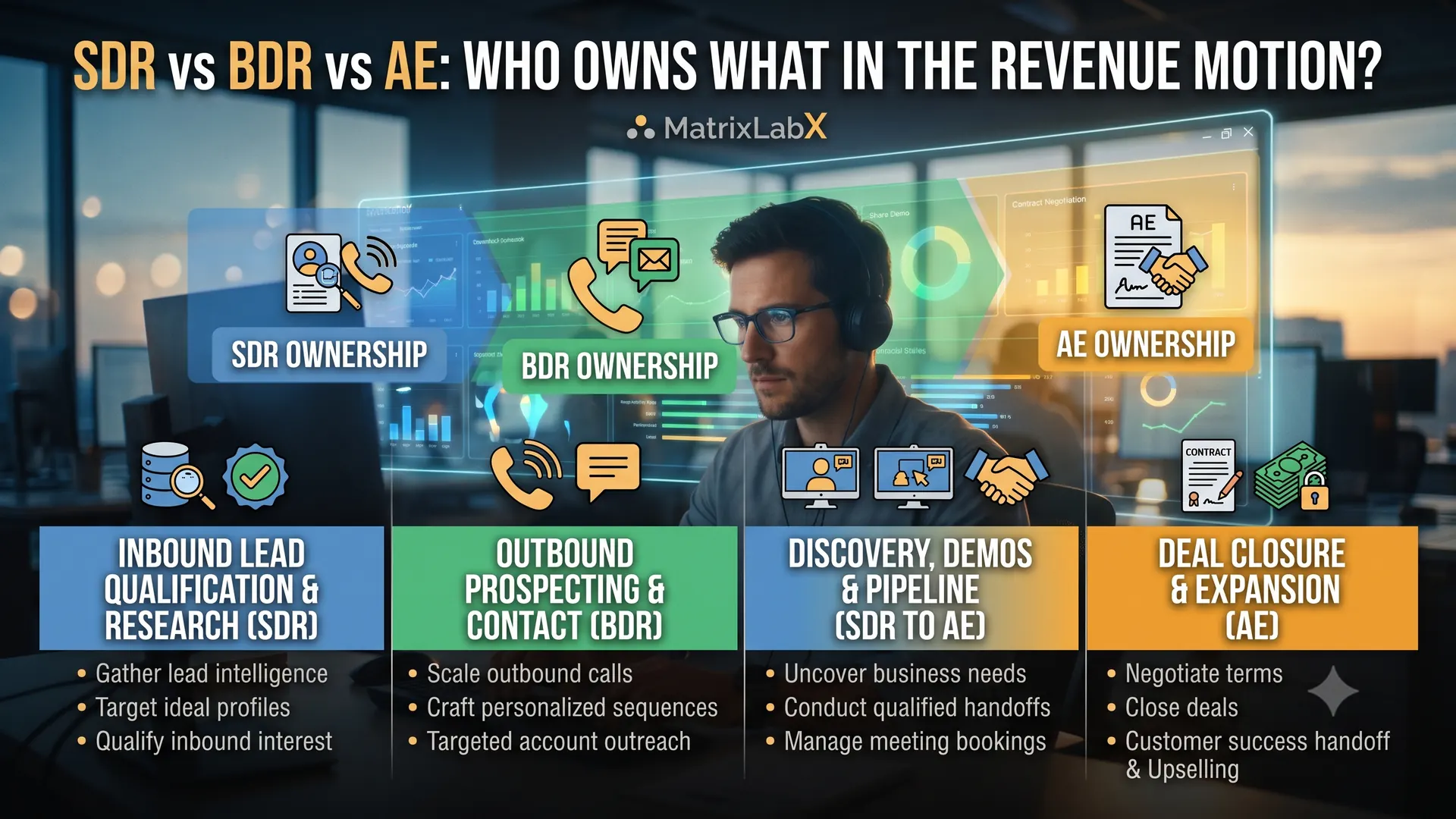
An SDR qualifies leads that came to you. A BDR generates leads that didn't. An AE closes what either one hands over. The titles vary by company — many use SDR and BDR interchangeably — but the functional split is consistent: two roles produce qualified conversations, one role converts them into revenue.
What is the difference between an SDR and a BDR?
Both are sales development roles and in a large share of companies the titles are simply synonyms determined by which one the VP of Sales used at their last job.
Where organizations do distinguish them, the split is by lead origin:
- SDR — inbound. Works demand that marketing generated: form fills, content downloads, trial signups, event registrations, pricing-page visits. The prospect has already raised a hand. The SDR's job is speed and qualification.
- BDR — outbound. Works accounts that have shown no interest yet. Builds target lists from ICP criteria and intent signals, then runs cold sequences. The prospect has not raised a hand. The BDR's job is relevance and persistence.
The distinction matters operationally because the two require different skills and different tooling, and because they fail differently. Inbound fails on latency — the lead went cold while it sat in a queue. Outbound fails on relevance— the message didn't earn a reply. The six stages that inbound latency is made of are broken out in speed to lead.
What does an AE do that an SDR doesn't?
The account executive owns the deal from qualified conversation to signature: discovery, demo, multi-threading across the buying committee, proposal, negotiation, close. Where the development roles are execution-heavy and volume-bounded, the AE role is judgment-heavy and relationship-bounded.
The economic logic of splitting the roles is straightforward: an AE's time is the expensive resource, so you don't spend it building lists.
Side-by-side comparison
| SDR | BDR | AE | |
|---|---|---|---|
| Lead source | Inbound / marketing-generated | Cold outbound / net-new | Handed over, qualified |
| Primary activity | Qualify and route | Source and prospect | Discover, demo, close |
| Owns | Speed to lead, qualification quality | List quality, sequence relevance | Deal progression, revenue |
| Ends at | Qualified meeting booked | Qualified meeting booked | Closed/won or closed/lost |
| Bounded by | Response latency, hours in the day | Research minutes per account | Calendar and relationship capacity |
| Typical measure | Meetings accepted, speed to first touch | Accounts touched, reply rate | Quota, win rate, cycle length |
| Judgment intensity | Moderate | Moderate | High |
Where does this structure leak?
At the handoffs — which are the only places in this diagram where work changes hands and context can be dropped.
Marketing → SDR. A lead arrives and enters a queue. Every minute in that queue costs conversion probability, and queues form precisely when volume spikes — which is exactly when the leads are most valuable. A team sized for average inbound volume is by definition undersized for peak inbound volume.
BDR → target account. An account gets sourced, researched, and enrolled in a sequence. Then the contact changes jobs, or the intent signal that justified the outreach expires, and the sequence continues anyway — now landing as irrelevant. Sequence quality decays as the underlying data decays.
SDR/BDR → AE.A meeting gets booked and context transfers. Whatever the development rep learned that didn't get written down is gone. Whatever got written down is only as reliable as the record-keeping discipline of a person who had four more accounts to work that afternoon.
Each of these is a coverage or continuity failure, not a competence failure. They happen because a human-operated handoff has a finite throughput and an imperfect memory.
How does governed digital labor change the structure?
Not by deleting a role. By changing what's bounded by hours.
The volume-bounded portions — sourcing, enrichment, sequence execution, record maintenance, follow-up at the moment a signal fires rather than the next business morning — become agent work running continuously. The judgment-bounded portions — qualification calls, objection handling, deal strategy, the relationship itself — stay with the people who are good at them.
The governance requirement is what makes that safe to actually deploy. Every agent action passes a human approval gate on anything consequential and lands on an immutable audit ledger. When a prospect asks who sent them a message, or a compliance review asks what touched a record, there's an answer with a name on it.
That's the model: agents execute, humans authorize. The org chart doesn't collapse into an agent — it stops being the throughput constraint on the parts of the work that were never about judgment in the first place.
Related: why ramp time is the hidden cost in this structure · what governed digital labor is · the PrescientIQ™ platform
Frequently asked questions
Is a BDR the same as an SDR?
In most companies, yes — the titles are used interchangeably. Where they differ, SDRs work inbound and marketing-generated leads while BDRs prospect cold into net-new accounts.
Which comes first, SDR or AE?
SDR. The development role produces the qualified conversation; the account executive takes it from there and owns the deal to close.
Do BDRs report to sales or marketing?
Both structures are common. Outbound BDR teams more often sit under sales; inbound SDR teams more often sit under marketing or a shared revenue operations function.
Can one person do all three roles?
In very small companies, yes — a full-cycle rep sources, qualifies, and closes. It stops working as volume grows, because the three activities compete for the same hours and closing always wins that competition, which starves the top of the funnel.
Where does pipeline leak in this structure?
At the handoffs. Inbound leaks to response latency, outbound leaks to data decay making sequences irrelevant, and the development-to-AE handoff leaks whatever context didn't get written down.
See where your own execution effort is going
The Autonomous Audit Report models where your team's execution capacity is currently spent, what your configuration is actually paying for, and what the governed alternative looks like on your own data — before any commitment.
Get your free AAR benchmark