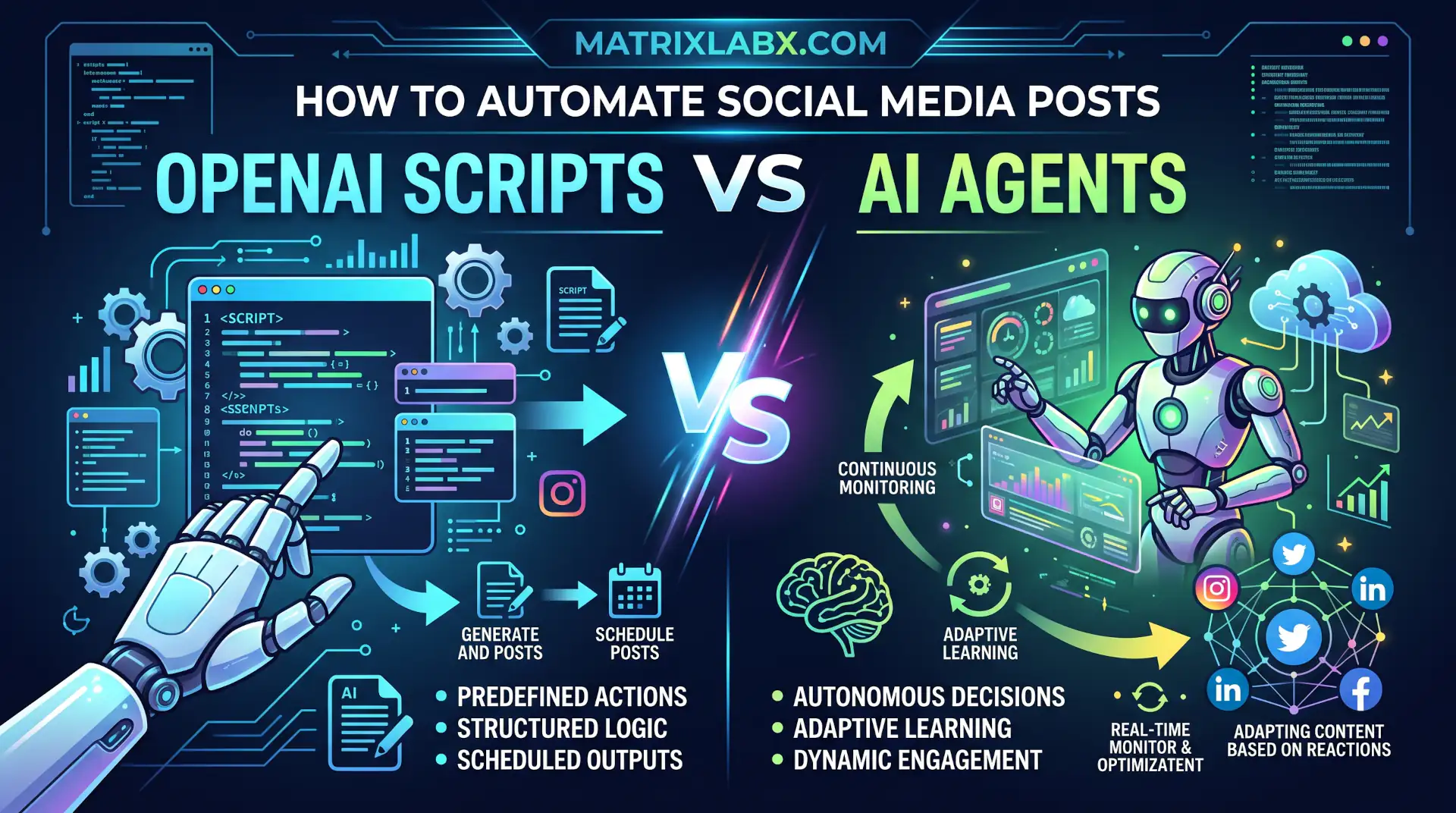
How to automate social media posts: OpenAI scripts vs. AI agents (2026 guide)
Key Takeaways
- 1.OpenAI's API generates content — but publishing it requires separate platform API connections, each with approval friction, rate limits, and in X's case, $0.20 per URL post.
- 2.Platform API access in 2026: Instagram caps at 25 posts/24 hr, LinkedIn requires MDP partner approval, TikTok forces a sandbox audit, Reddit charges ~$12,000/year commercially.
- 3.Three automation tiers exist: scripts (run when triggered), scheduling tools (AI-assisted), and autonomous agents (perceive, reason, execute without human direction).
- 4.Teams running agentic social workflows report 3.2× more content output at ~40% lower cost per post, saving 10–15 hours per week versus manual production.
- 5.78% of marketers using AI for content report equal or higher engagement — but hallucination rates of 15–27% mean human review gates are non-negotiable before publishing.
Direct Answer
To automate social media posts in 2026, you need two things working together: a content generation layer (OpenAI or another LLM) and a publishing layer (platform APIs or a unified API wrapper). An OpenAI script handles generation but stalls on publishing friction. An autonomous agent closes the full loop — generate, schedule, publish, monitor, adjust — without human intervention per post. The right choice depends on volume, channel count, and whether social needs to connect to revenue.
What “automate social media posts” actually means in 2026
The phrase covers three meaningfully different things. A script that calls OpenAI and formats output for a platform. A scheduling tool that uses AI to suggest captions and post times. And an autonomous agent that perceives performance data, generates platform-specific content, publishes across channels, and adjusts its own strategy based on results — without a human driving each step.
Most guides conflate all three. The distinction matters because the infrastructure required, the failure modes, and the ROI ceiling are completely different at each tier. The AI in social media market is projected to reach $10.33 billion by 2029, and Meta is actively targeting fully automated ad generation by end of 2026 — which means the category is moving fast toward genuine autonomy, not just better scheduling.
Three Tiers of Social Media Automation
Script / API integration
OpenAI generates text. Your code formats it and calls the platform API. Runs when triggered. Does not learn or adapt. Breaks when APIs change or rate limits trigger.
AI-assisted scheduling tool
A human drives every decision. The tool suggests captions, hashtags, and post times. Reduces production time but doesn't remove the human from the workflow.
Autonomous agent
Perceives data from social platforms, reasons about what action to take, executes across channels without step-by-step human direction. Adapts based on performance. Runs continuously.
What an OpenAI script can do — and where it stops
A script that calls OpenAI's API is a reasonable starting point for teams posting to 1–2 platforms at low volume. GPT-4o costs $2.50 per million input tokens and $10 per million output tokens. A Tier 1 account (after $5 in payments) allows 500 requests per minute and 200,000 tokens per minute — generation volume is not the bottleneck. What stops most scripts is everything downstream of generation.
The script generates text. You still need to connect each platform's API separately — and in 2026, those connections range from tedious to expensive to gated by weeks of review.
| Platform | Posting Cap | Approval Friction | Key Gotcha |
|---|---|---|---|
| X (Twitter) | 500 posts/month free tier | Same-day | $0.20 per post containing a URL |
| 25 posts / 24 hours | Weeks for Meta App Review | Business/Creator account required; personal accounts gone | |
| 100 req/member/day (Dev) | MDP partner application + screencast | Community Management API requires partner approval | |
| TikTok | ~15 posts/day post-audit | 1–2 weeks sandbox audit | All posts private until audit clears — no public content |
| YouTube | ~100 uploads/day | Quota increase review: weeks | Search burns 100 quota units per call; 10K/day default |
| 100 req/min (non-commercial) | Commercial contract required | ~$12,000/year floor for commercial API access | |
| Bluesky | 5,000 pts/hour | None (open AT Protocol) | Each post costs 3 points; write-heavy bots hit ceiling fast |
Source: Blotato, Social Media APIs in 2026: Developer's Guide to Every Platform (May 26, 2026)
Beyond the platform friction, scripts have three structural failure modes that compound with scale:
No error recovery
When a platform API returns a 429 rate-limit error or a 400 content rejection, a script logs the error and stops. An agent retries with backoff logic, reformats the content, or reroutes to a different platform automatically.
No performance feedback loop
A script cannot read its own results and adjust. It runs the same generation prompt regardless of whether last week's posts drove engagement or were ignored entirely.
Brand voice drift
OpenAI without specific system prompts and brand-voice training generates generic content. At scale across multiple platforms, that genericism compounds — and 31% of consumers say they are less likely to choose a brand whose content feels obviously AI-generated.
What autonomous agents do differently
An autonomous agent is not a better script. It is a different architecture. Where a script executes a fixed sequence, an agent perceives context, reasons about options, and acts — then evaluates the result and adjusts future behavior. That loop is what makes the ROI numbers measurable at scale.
Teams running agentic social media workflows report 3.2× higher content output at roughly 40% lower cost per post compared to fully manual production, with an average of 10–15 hours per week returned to strategic work. Average ROI from agentic AI deployments across industries is 171%, with 74% of teams achieving positive ROI within the first year.
| Capability | OpenAI Script | Autonomous Agent |
|---|---|---|
| Content generation | Calls OpenAI per prompt, fixed format | Brand-voice training + platform-specific adaptation |
| Publishing | Your code manages each platform API | Handles platform connections, auth, rate limits |
| Error handling | Logs error, stops | Retries with backoff, reformats, reroutes |
| Performance loop | None — runs same prompt regardless | Reads engagement data, adjusts format and schedule |
| Multi-platform | Separate API code per platform | Single brief → channel-specific posts across all platforms |
| Brand voice | System prompt you maintain manually | Trained on brand assets, applied consistently at scale |
| Revenue attribution | No connection to pipeline data | CRM integration tracks social → pipeline contribution |
| Operating cadence | Runs when triggered by cron or human | Runs continuously, 24/7 |
The content repurposing case makes the cost difference concrete. A single long-form piece becomes a LinkedIn article, a TikTok script, an Instagram carousel, and an X thread — each adapted to that platform's format and audience expectations. A script requires a separate prompt and a manual QA pass for each. An agent produces all four from one brief, adapted correctly, and routes each to its platform without human intervention between steps.
Trend detection adds another dimension scripts cannot touch. Agents that monitor real-time signals across platforms identify emerging topics and draft reactive content while the trend still has momentum. Trend-related content gets 2–3× the reach of evergreen posts within the first 24–48 hours — which means speed of response matters more than production polish, and that is exactly the gap agents close.
The engagement reality: what the data says about AI-automated content
The fear that automated content underperforms is only partially true — and the part that is true is fixable. 78% of marketers using AI for content report equal or higher engagement compared to human-only content. The results come primarily from platform-specific adaptation — tailoring format, length, and tone to each channel — not from raw generation quality alone.
The risks are real but containable:
Hallucination (15–27% rate)
AI models generate content that sounds plausible but contains fabricated statistics or misattributed claims. One in five to one in four outputs may contain something factually wrong without a review gate. The fix is a human spot-check step before publication — not avoidance of AI generation.
Source: Vectara Hallucination LeaderboardConsumer trust gap
Only 40% of consumers trust generative AI output, and 31% say they are less likely to choose a brand whose content feels obviously AI-generated. Brand-voice training and a disclosure strategy close most of this gap — generic AI output is the problem, not AI output per se.
Source: Euromonitor, June 2025Brand safety incidents
Over 70% of marketers have encountered at least one AI-related incident including hallucinated claims or off-brand content. These are the current baseline for teams deploying at scale — which is an argument for review gates, not for abandoning automation.
Source: IAB, 2026The governance baseline for mid-market teams is straightforward: auto-publish standard content (product announcements, reshared articles, templated updates) with automated quality checks; route high-stakes content (complaints, pricing claims, anything involving named individuals) to human approval before it goes live. That workflow eliminates most of the risk while keeping the throughput advantage intact.
How to choose the right approach for your team
Start with an OpenAI script if
You are posting to 1–2 platforms, fewer than 20 posts per week, and social media is not a primary pipeline channel. A script connected to Buffer or a similar scheduling tool gives you generation speed without the infrastructure overhead. This is also the right starting point if you want to understand the technology before committing to an agent platform.
Move to autonomous agents when
You need to publish across 4+ platforms simultaneously, maintain brand-voice consistency without a human editor on every post, connect social activity to pipeline attribution, or reduce the manual hours your team spends on content production below a threshold where the cost justifies the infrastructure investment. The break-even point for most mid-market teams is around 30–40 posts per week across 3+ platforms — at that volume, the time saved by agents pays for the platform cost within 60–90 days.
The question that matters most
Whether you choose a script or an agent, the same question determines whether automation produces results: does it connect social output to business outcomes? Content volume metrics (posts per week, impressions, engagement rate) don't tell you whether automation is working — pipeline influenced, LLM-referred traffic, and revenue attributed do. If your automation cannot track those, you are optimizing for activity rather than impact. The AI Report and the Generative Growth Engine are built around that distinction.
People Also Ask
What is the best way to automate social media posts in 2026?+
Can you use the OpenAI API to automate social media posts?+
What's the difference between a social media automation script and an AI agent?+
How many social media posts can you automate per day with the OpenAI API?+
What does an autonomous social media agent cost vs. a manual team?+
Do AI-automated social posts perform worse than human-written posts?+
Next Step
See what autonomous social media agents cost at your volume
The Generative Growth Engine runs autonomous content production and distribution across LinkedIn, Instagram, X, and YouTube — with brand-voice training, CRM attribution, and pipeline reporting built in. No agency retainer. No per-post headcount.
Complimentary for qualified mid-market enterprises
Continue Reading
See where your own execution effort is going
The Autonomous Audit Report models where your team's execution capacity is currently spent, what your configuration is actually paying for, and what the governed alternative looks like on your own data — before any commitment.
Get your free AAR benchmark