The Governed Compute-Powered Economy: What Happens to Oversight When Headcount Stops Being the Constraint
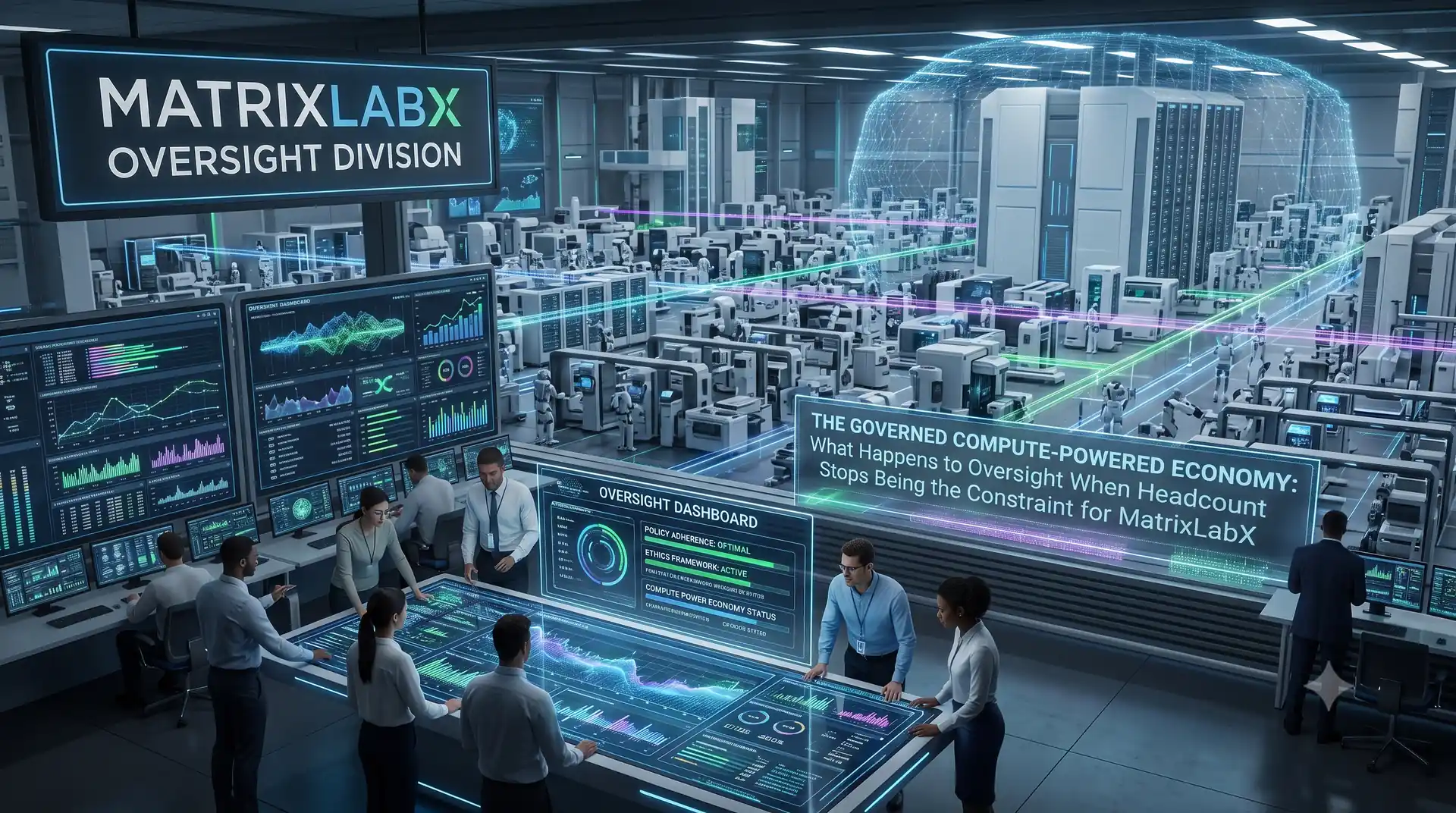
The compute-powered economy is the shift from output bound by how many people you employ to output bound by how much compute you can access. The part the framing leaves open: headcount was never only a production input — it was also the oversight mechanism. Every approval, every second pair of eyes, every “wait, why did we do that?” ran through a person. Remove the people from execution and that layer does not survive by default. It has to be rebuilt deliberately, as an approval gate on consequential actions and an immutable record of everything executed. That is the governed compute-powered economy: agents execute, humans authorize.
It is the compute-scale extension of governed digital labor — the same approval-and-ledger structure, applied where headcount stops being the constraint.
What is the compute-powered economy?
The term was popularized by OpenAI co-founder Greg Brockman in April 2026. His argument runs roughly like this: people no longer need to micromanage computers, because machines increasingly adapt to human intent instead of the reverse. Once that holds, the rate and sophistication of AI-driven problem solving becomes bound by the amount of compute you have access to [Inherited — third-party claim, Greg Brockman / OpenAI, April 2026]. Intent converts more or less directly into software, workflows, analysis, and companies. Smaller teams start matching the output of larger ones.
Strip out the enthusiasm and there are three separate claims stacked on top of each other. They are not equally established, and it is worth pulling them apart before building a business on any of them:
- Substitution. Work that used to require a person operating a tool is increasingly performed by the model directly. Broadly true at the margin, still contested in magnitude.
- Rate-limiting. If substitution holds, throughput scales with inference capacity rather than with hiring. This is the genuinely novel claim — and the one that makes it an economy rather than just a productivity story.
- Capital reallocation. Spend shifts from payroll to compute. This is already visible in how much capital is being committed across the sector to secure compute infrastructure.
Claim 2 is the load-bearing one. It is also the one with a hole in it.
There is a second hole further downstream. Even where throughput does scale with compute, the market's capacity to absorb what gets shipped does not move at the same rate — which relocates the constraint rather than removing it. That argument is made in Navigating the AI Coherence Crisis: Moving from Code Abundance to Market Impact.
Why does removing headcount also remove oversight?
Because headcount was doing two jobs at once, and only one of them was execution.
Think about what actually happens when a mid-market company sends a pricing exception to a strategic account. Someone builds the case. Someone else reviews it. A manager signs off. There is a Slack thread, an email chain, a note in the CRM. Nobody designed that as a control system — it emerged from the simple fact that work passing through several people leaves a trail and collects judgment along the way.
That is not a process. It is a byproduct of headcount. And it disappears the moment the work stops passing through people.
This is the structural gap in the compute-powered framing. Organizations correctly hear “you need fewer people to produce the same output” and reallocate the budget. What they do not hear, because nobody says it, is that they have also just deleted their approval layer, their institutional memory of why decisions were made, and their ability to answer a regulator, a board, or an angry customer six months after the fact.
The failure mode is not agents going rogue. That is the Hollywood version, and it is rare. The realistic failure mode is far more boring and far more common: an agent does exactly what it was asked, the outcome is bad, and nobody can reconstruct why. No record of what data it used. No record of who approved the action or whether anyone did. No way to distinguish a good decision that got an unlucky outcome from a bad decision that should never have been made.
That is an evidentiary failure, not a technical one — and evidentiary failures are the ones that end up in front of lawyers.
What actually breaks first?
In practice, three things, roughly in this order:
Attribution of decisions. Six weeks after a campaign underperforms, someone asks why the budget moved. In a headcount model, there is a person to ask. In an ungoverned compute model, there is a log of API calls — which tells you what happened but not what was intended or who owned it.
The approval record. Most regulated obligations do not require that a human made the decision. They require that you can demonstrate what the decision was, what it was based on, and who was accountable. Compute-scaled execution generates decisions far faster than an undesigned oversight layer can document them.
Reversibility. Human-paced work has natural friction that catches errors before they compound — a person sleeps on it, notices something odd, asks a colleague. Compute-paced execution has none of that unless you build it in. An error at machine speed is an error at machine scale.
None of this is an argument against the compute-powered economy. It is an argument that the version being sold is incomplete, and that the missing half is where the actual enterprise risk sits.
What does “governed” add?
Three specific mechanisms — none of them exotic, all of them things that have to exist before deployment rather than after an incident:
A scoped identity per agent. Each agent gets its own least-privilege credential and its own bounded set of tools and data. Not a shared service account with broad access. This is what makes the audit trail meaningful in the first place — you cannot attribute an action to an actor that does not have a distinct identity.
An approval gate on consequential actions. The agent proposes and executes freely inside its guardrails, and stops at a human for the actions that carry real consequence. This is not rubber-stamping and it is not a person watching a dashboard — it is a designed interrupt in the execution path with a named owner on the other side. The design work is deciding what counts as consequential, and that decision belongs to the business, not to the vendor.
An immutable audit ledger. Every action, the inputs behind it, the approval state, and the outcome, written append-only. Not a log you can rotate away. The distinction matters enormously the day someone asks you to prove a negative.
Together these give you the thing the ungoverned version cannot: the ability to scale execution with compute while keeping the accountability that used to ride along free with headcount.
Ungoverned vs. governed: what actually differs
| Headcount-bound | Compute-bound, ungoverned | Compute-bound, governed | |
|---|---|---|---|
| Throughput ceiling | People you can hire | Compute you can access | Compute you can access |
| Who executes | People operating tools | Agents | Agents |
| Who approves | People, informally | Often nobody by design | Named humans, at designed gates |
| Decision record | Emergent — email, Slack, CRM | Fragmented API logs | Append-only ledger, per action |
| Agent permissions | N/A | Frequently shared, broad | Scoped, least-privilege, per agent |
| Error blast radius | Human-paced, self-limiting | Machine-paced, compounding | Bounded by the approval gate |
| Answer to an auditor | "Ask the person who did it" | "We'll try to reconstruct it" | "Here is the record" |
Doesn't governance cap the compute advantage?
This is the serious objection, and it deserves a serious answer rather than a marketing one.
Partly, yes — and deliberately. An approval gate is friction, and friction on consequential actions is the entire point. If a governance layer adds no friction at all, it is decorative.
But the objection assumes governance sits on every action, and that is a design failure, not an inherent property. The great majority of what agents do in a revenue motion is not consequential in any meaningful sense: enriching a record, drafting a variant, flagging a signal, reconciling two systems. Those run at full speed. The gate applies to the narrow band where an action touches money, a customer commitment, a regulated obligation, or something genuinely hard to reverse.
The practical answer is that governance is a scoping exercise, not a throttle. Companies that experience it as a throttle have almost always skipped the scoping — they either gate everything, which strangles the throughput they just paid for, or they gate nothing, which is the failure mode described above wearing a governance label.
There is also a second-order effect that cuts the other way. Ungoverned deployments tend to stall out at the pilot stage, not because they fail technically but because nobody senior will sign off on expanding them. A CFO who cannot see the record will not approve scope. Governance is frequently what unblocks scale rather than what limits it.
What limits the compute-powered economy in the first place?
Worth naming, because it is routinely omitted from the optimistic version: compute is not a frictionless input.
Data-centre electricity consumption reached 415 TWh in 2024, with an IEA Base Case projection of roughly 945 TWh by 2030 [Inherited — third-party, International Energy Agency Base Case; projections are modeled assumptions, not realized facts]. Which means access to compute is materially constrained by electricity, grid capacity, cooling, siting, and energy prices — physical infrastructure that does not scale on software timelines.
The honest framing is therefore not “compute-powered” but compute-and-energy-powered, with a governance layer determining how much of that capacity you can actually deploy against consequential work. Three constraints, not one.
Where should a mid-market operator start?
Not with a platform decision. With an inventory.
- List the consequential actions in one revenue workflow — the ones touching money, customer commitments, or regulated obligations. Usually a much shorter list than people expect.
- Name an owner for each. If an action has no human owner today, it will not acquire one just because an agent starts performing it.
- Decide what the record has to prove. Work backwards from the question you would be asked in an audit, a board review, or a customer escalation.
- Then evaluate execution. Once 1–3 exist, the technology question becomes straightforward. Before they exist, no platform choice is safe.
Steps 1–3 are governance design and they belong to you regardless of vendor. MatrixLabX runs them as the front half of a deployment because attempting them afterwards is how pilots die.
The PrescientIQ™ platform is built around exactly this shape — specialist agents with scoped identities running a sense → decide → act → learn loop, with human approval on consequential actions and an immutable ledger underneath. The Revenue Accelerator applies it to the revenue motion specifically. If the governance question is the sharper one for you, Compliance Shield starts from that end instead.
Get the model built on your own numbers
Every claim above is structural, not numeric — deliberately. What a compute-powered shift is actually worth depends entirely on your workflows, your stack, and where your consequential actions sit.
The Autonomous Audit Report (AAR) maps that on your own data: which work is agent-addressable, where the approval gates belong, and what the P&L delta looks like — before you commit to anything.
Frequently asked questions
What is the compute-powered economy?
It is the idea that as AI performs more of the actual work, the limit on how much an organization can produce shifts from how many people it employs to how much compute it can access. The term was popularized by OpenAI co-founder Greg Brockman in April 2026.
What makes a compute-powered economy governed?
Governance means three things are designed in before deployment: each agent has its own least-privilege identity, consequential actions pass a human approval gate with a named owner, and every action is written to an immutable audit ledger. Agents execute, humans authorize.
Why does scaling with compute create a governance problem?
Because headcount carried oversight as a byproduct. Work passing through several people collected review and left a trail without anyone designing it that way. When execution stops passing through people, that trail disappears unless it is rebuilt deliberately.
Does adding governance slow down AI agents?
Only on the actions where slowing down is the point. Routine work such as enrichment, drafting, flagging, and reconciliation runs at full speed. The approval gate applies to the narrow band of actions touching money, customer commitments, regulated obligations, or anything hard to reverse. Deployments that feel throttled have usually gated everything instead of scoping what is genuinely consequential.
What limits access to compute?
Physical infrastructure. Data-centre electricity consumption was 415 TWh in 2024 with an IEA Base Case projection near 945 TWh by 2030, meaning grid capacity, cooling, siting, and energy prices all constrain compute availability on timelines much slower than software.
What would a governed, compute-scaled operation change on your P&L?
Get Your Free AAR Benchmark →George Schildge is CEO & Chief AI Officer of MatrixLabX.
Related
See where your own execution effort is going
The Autonomous Audit Report models where your team's execution capacity is currently spent, what your configuration is actually paying for, and what the governed alternative looks like on your own data — before any commitment.
Get your free AAR benchmark