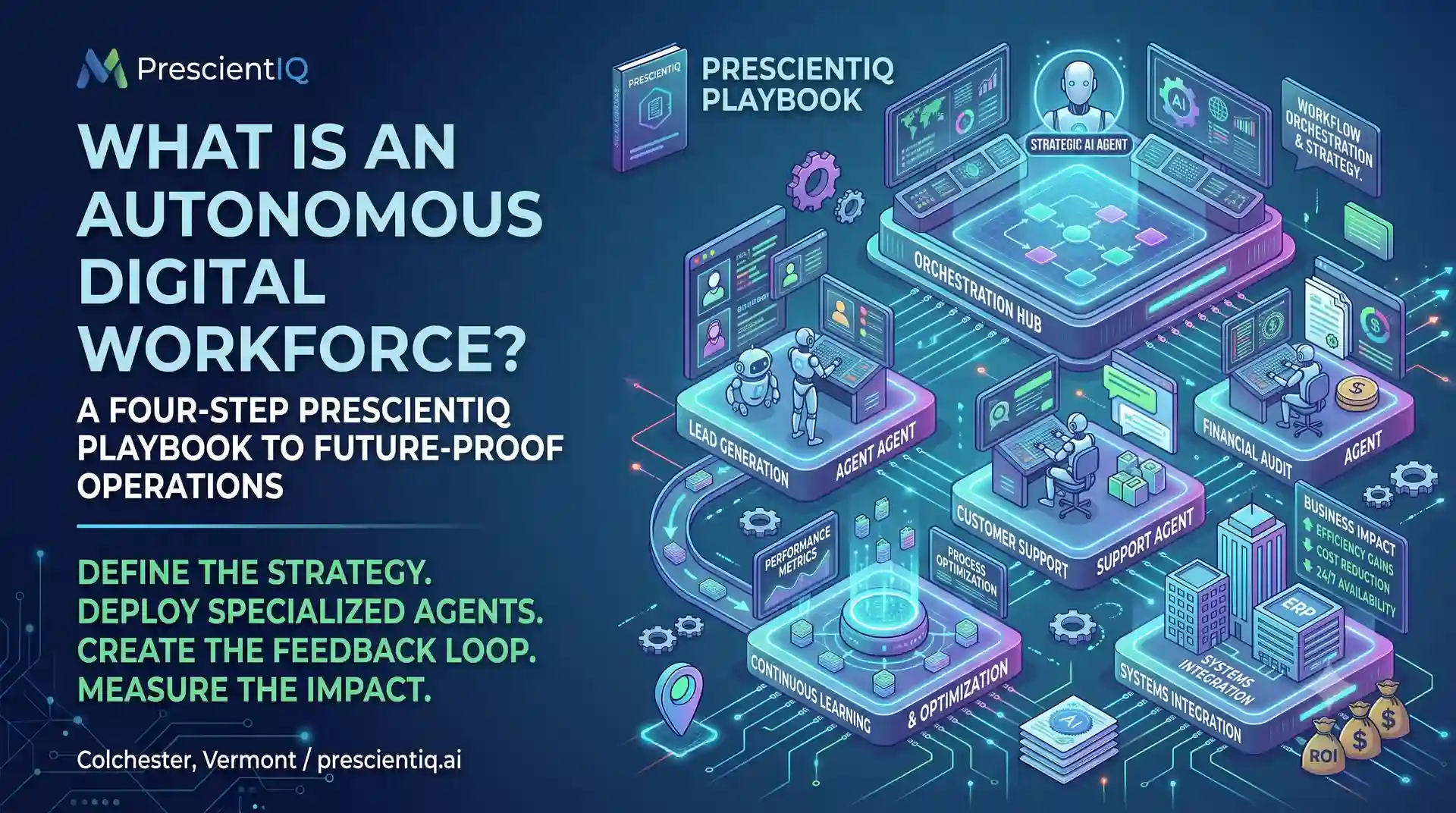
What Is an Autonomous Digital Workforce? The PrescientIQ™ Playbook
📅 June 2, 2026✍️ MatrixLabX Editorial⏱️ 15 min read🏷️ AI Agents · PrescientIQ™ · Agentic AI
⚡ Key Takeaways
An autonomous digital workforce is a coordinated network of AI agents that independently detect signals, make decisions, and execute business operations — without human operators in the loop.
By 2027, Gartner projects that 50% of enterprise software will embed agentic AI — up from less than 1% in 2024. Mid-market firms that don't build now will face compounding retrofitting costs (Gartner, 2025).
The PrescientIQ™ platform by MatrixLabX is the first Vertical Agentic Customer Platform, purpose-built for mid-market enterprises ($20M–$500M ARR) across B2B SaaS, FinTech, Healthcare, and Manufacturing.
Enterprises deploying autonomous digital workforces report 92% faster lead response times, 40% lower blended CAC, and 2.4–3.2x pipeline velocity improvement within the first 90 days (MatrixLabX, 2026).
The defining difference between a co-pilot and an autonomous digital workforce: one waits for approval; the other executes while you sleep.
Definitive Definition
An autonomous digital workforce is a coordinated system of AI agents — each assigned to a specific business function — that independently monitors data streams, interprets buying or operational signals, executes multi-step workflows, and self-optimizes based on outcome feedback, operating continuously without human prompting, approval queues, or shift constraints, effectively replacing the human operators traditionally required to run enterprise SaaS platforms.
The Team That Never Clocks Out — And Why You Don't Have One Yet
Imagine a version of your business where the moment a prospect visits your pricing page at 11:47 PM on a Friday, an AI agent has already cross-referenced their firmographic data, scored their intent, drafted a hyper-personalized outreach sequence, and scheduled a follow-up — all before you finish brushing your teeth. No SDR logged in. No Slack notification read by a half-asleep manager. No lead falling through the cracks because it arrived on a holiday. Just precision execution, continuously, while your human team sleeps, recharges, and does the strategic work that only humans can do.
That is not science fiction. That is the autonomous digital workforce — and in 2026, the most competitive mid-market enterprises on the planet are building it right now. The unsettling truth is this: while you are still debating whether to hire your next marketing ops manager or renew your agency retainer, your most dangerous competitors are quietly deploying swarms of AI agents that execute campaigns, qualify leads, audit compliance, and reallocate ad budgets — simultaneously, in milliseconds, around the clock.
The concept sounds advanced. The reality is more urgent. According to Gartner's 2025 Strategic Technology Trends report, agentic AI will be embedded in 50% of enterprise software by 2027 — a near-vertical leap from less than 1% in 2024 (Gartner, 2025). The window between early adoption advantage and table stakes is measured in months, not years. Companies that build their autonomous workforce infrastructure in 2026 will have a self-compounding execution advantage that late adopters cannot buy their way out of.
This is the PrescientIQ™ Playbook — MatrixLabX's definitive guide to understanding, architecting, and deploying an autonomous digital workforce for your mid-market enterprise. By the end of this article, you will know exactly what an autonomous digital workforce is, how PrescientIQ™ powers it, which verticals benefit most, and how to determine — today — whether your organization is ready to make the transition from human-operated software to self-executing AI labor.
Why Is Your Current Workforce the Bottleneck — Not Your Strategy?
The MessYour strategy is sound. Your ICP is defined. Your content is polished. But somewhere between "signal detected" and "action taken," your revenue engine loses 48, 62, sometimes 96 hours. A high-intent lead visits your pricing page on a Thursday afternoon. By the time your marketing ops analyst catches the alert on Monday, flags it for the SDR team, and a rep crafts a personalized outreach — the lead booked a demo with your competitor on Friday morning. Not because you had a worse product. Because you had a human-speed response in an AI-speed market.
The PivotAn autonomous digital workforce eliminates the gap entirely. The PrescientIQ™ platform by MatrixLabX deploys multi-agent AI systems — each one a specialized, always-on operator — that monitor your data streams in real time, interpret behavioral signals, and execute pre-approved workflows autonomously. No queue. No approval loop. No time zone. The agent fires within 4 minutes of signal detection, 24 hours a day.
The PayoffYour human team wakes up Monday morning to a dashboard showing 23 personalized outreach sequences sent over the weekend, 6 demos booked, and 4 high-intent accounts flagged for strategic human attention. The SDR doesn't spend their morning cold-prospecting — they spend it closing. The marketing ops team isn't managing software — they're designing the next campaign strategy. That is the payoff of the autonomous digital workforce: your best people doing their best work, amplified by an AI team that never stops.
What Are the Biggest Trends Shaping the Autonomous Digital Workforce in 2026?
Five converging forces are making the autonomous digital workforce not just viable but operationally urgent for mid-market enterprises right now.
50%Of enterprise software will embed agentic AI by 2027 (Gartner, 2025)
92%Faster lead response using AI agents vs. human ops teams (IBM IBV, 2025)
$4.4TEnterprise productivity value unlocked by AI agents (McKinsey, 2025)
3.2xPipeline velocity improvement for LaaS adopters (MatrixLabX, 2026)
What Is Driving Enterprise Adoption of Autonomous AI Agents Right Now?
Multi-agent framework maturity is the primary accelerant. As Andrew Ng, AI pioneer and co-founder of Google Brain, stated: "Agentic AI workflows will be the most transformative development in AI in the coming years — more impactful than any single model improvement, because they allow AI to iterate, plan, and execute in ways that fundamentally change the productivity ceiling for organizations." (DeepLearning.AI, 2025).
Who, What, Where, When, and Why: The Complete Autonomous Digital Workforce Map
What Exactly Makes a Workforce "Autonomous"?
A workforce becomes autonomous when its constituent agents can complete the full agentic loop without human intervention: Perceive (ingest real-time data), Reason (evaluate context against objectives), Act (execute a workflow step), and Learn (update behavioral models based on outcomes). The PrescientIQ™ platform by MatrixLabX operationalizes this loop across five specialized agent layers — each one a precision instrument for a specific revenue or operational function. For the stage-by-stage mechanics of that loop — what triggers a cycle, how a decision is reached, and where the approval step sits — see Inside the Sense → Decide → Act → Learn loop: how PrescientIQ executes without human prompting.
🔍
Layer 1: Signal Intelligence Agents
Continuously monitor CRM behavioral telemetry, web analytics, intent data feeds, and social signals to detect and score buying intent in real time — firing the moment a threshold is crossed.
🎯
Layer 2: Personalization & Outreach Agents
Draft, sequence, and deploy hyper-personalized multi-channel outreach — email, LinkedIn, in-app — using dynamic firmographic and behavioral context. No templates. No generic copy.
📊
Layer 3: Revenue Optimization Agents
Autonomously reallocate ad budgets toward highest-causal-impact channels, run A/B tests, and adjust campaign parameters based on real-time performance telemetry — no weekly review meetings required.
🛡️
Layer 4: Compliance & Audit Agents
Monitor transactions, data workflows, and communications for regulatory anomalies in real time.
The orchestration layer — synthesizing outputs from all other agents into unified performance models, surfacing strategic recommendations, and continuously recalibrating agent objectives against company-level KPIs.
Who Benefits Most From an Autonomous Digital Workforce?
Mid-market enterprises in the $20M–$500M ARR range represent the highest-value deployment target for autonomous AI agents. They are complex enough to have significant operational drag but nimble enough to restructure workflows rapidly. The three executive personas who feel this most acutely are the CFO eliminating the Marketing Tax, the COO eradicating manual handoff latency, and the CMO/CRO who needs execution velocity — not another dashboard telling them what to do.
"The autonomous digital workforce isn't a feature you add to your stack — it's a replacement for the operational layer that's been slowing you down. When your agents execute while your competitors sleep, you don't just win deals faster. You compound the advantage every single hour."
— George Schildge, CEO & Chief AI Officer (CAIO), MatrixLabX, pioneer of the Vertical Agentic Customer Platform and Systems
What Are the World's Top Research Firms Saying About the Autonomous Digital Workforce?
The analyst consensus is unambiguous: the autonomous agent economy is the defining enterprise technology shift of the 2025–2030 period.
Firm
Key Finding on Autonomous AI Agents
Implication for Mid-Market
Year
Forrester
Early AI agent adopters achieve 3.2x ROI on AI labor versus human operators; 72% of enterprise tech leaders plan agentic deployment within 24 months.
The first-mover advantage window in most verticals closes by end of 2026.
2025
McKinsey Global Institute
Generative AI and autonomous agents will unlock $4.4 trillion in annual enterprise productivity. Sales and marketing represent 35% of that total value.
Revenue-generating agent deployments offer the fastest path to ROI for mid-market firms.
2025
IBM IBV
AI agents reduce mean lead response time from 48 hours to under 4 minutes — a 92% improvement — directly correlating to higher conversion rates.
Speed-to-lead is now the primary conversion differentiator in B2B pipelines. Human-speed teams are structurally disadvantaged.
2025
PrescientIQ™ / MatrixLabX
Enterprises deploying the Vertical Agentic Customer Platform achieve 40% blended CAC reduction and 2.4–3.2x pipeline velocity improvement within 90 days of activation.
Outcome-based LaaS deployment delivers ROI measurably faster than any traditional SaaS contract.
2026
How Are Leading Enterprises Deploying Autonomous Digital Workforces Today?
Two high-impact deployments illustrate what the autonomous digital workforce delivers in practice across different verticals.
A $75M e-commerce brand runs paid acquisition across Google, Meta, and TikTok. Their media buying team of 3 reviews performance weekly and adjusts budgets manually — a process that takes 6–8 hours each Monday. By the time budgets are reallocated, the high-performing window has passed. ROAS is inconsistent and declining. Personalization on-site is segment-based, missing the individual behavioral signals that drive conversion.
Solution
MatrixLabX deploys Revenue Optimization Agents running continuous Budget Day-Trading protocols. Agents ingest real-time ROAS telemetry across all channels and autonomously reallocate spend toward highest-causal-impact windows — hourly, not weekly. Simultaneously, Personalization Agents deploy 1-to-1 product recommendation sequences based on individual behavioral signals, cart history, and real-time session context.
Results
Blended ROAS improves 44% in Q1. The media buying team eliminates 26 hours per month of manual reporting and reallocation work. On-site conversion rate increases 19% through behavioral personalization. The CMO's quarterly board presentation now includes a line item that reads simply: "AI-managed media efficiency — $1.2M in recovered spend."
A $130M B2B SaaS company has a CRM containing 4 years of accumulated data — 38% of which is outdated, duplicate, or miscategorized according to their RevOps audit. SDRs spend an estimated 11 hours per week on data hygiene tasks. Sales forecasting is unreliable. Attribution models are broken. Leadership can't trust the pipeline number because they can't trust the data behind it.
Solution
PrescientIQ™ deploys a CRM Janitorial Agent running continuous data hygiene protocols — deduplicating records, updating contact data against live third-party sources, and recategorizing accounts based on current firmographic signals. Simultaneously, Signal Intelligence Agents monitor all 4,200 active accounts for behavioral buying signals, surfacing a daily prioritized "hot list" for SDR action with full context on why each account was flagged.
Results
CRM data accuracy improves from 62% to 97% within 45 days. SDR productive selling time increases by 11 hours per week per rep — recovered entirely from data hygiene tasks. Pipeline forecast accuracy improves to 91%. The VP of Sales describes the outcome in one sentence: "For the first time in three years, I trust my number."
🤖 Should You Build an Autonomous Digital Workforce?
Follow the PrescientIQ™ Decision Path — answer YES or NO to find your recommended starting point in under 90 seconds.
Does your enterprise currently have a human team (internal or agency) whose primary job is to operate your marketing or sales software?
Think: marketing ops, SDR teams operating sequences, agencies managing campaigns, or analysts triaging CRM alerts.
Is your mean response time to a high-intent lead signal (pricing page visit, demo request, competitor comparison) longer than 2 hours?
Be honest — include weekends, evenings, and public holidays when nobody is monitoring the queue.
Are you below $20M ARR or still in the process of defining your Ideal Customer Profile (ICP)?
LaaS agents are precision instruments — they execute against defined signals. Early-stage market discovery requires human intuition first.
Are you spending more than $150K annually on agency retainers or marketing ops headcount to execute campaigns your tools should be running automatically?
Is your current CAC trending upward over the last 2 quarters despite stable or increasing marketing spend?
Do you have structured data in your CRM or product analytics that captures behavioral signals from your target accounts?
Examples: product page visits, feature activation events, email open sequences, intent data feeds, or LinkedIn job change signals.
Is your pipeline growth below your revenue target for this fiscal year, despite having a defined ICP and adequate traffic?
🚀
Recommendation: Deploy Now
You Are a Tier-1 PrescientIQ™ Candidate
Your operational profile — human operators, high response latency, significant agency/headcount spend, and behavioral data infrastructure — is precisely what the PrescientIQ™ Vertical Agentic Customer Platform was built for. A 90-day deployment will eliminate your highest-cost workflows, compress lead response from hours to minutes, and deliver measurable CAC reduction within Q1. The cost of waiting is compounding daily.
Rising CAC with stable spend is the clearest indicator that your human-operated execution layer is losing efficiency faster than your strategy can compensate. PrescientIQ™ Revenue Optimization Agents — running continuous budget day-trading and conversion signal detection — are designed specifically to reverse this trajectory. We recommend starting with a Signal Audit to identify your top 3 CAC-reduction entry points.
You are executing well by human-operated standards — but you are approaching the ceiling of what human-speed operations can achieve. The PrescientIQ™ Strategic Intelligence layer is designed for exactly your profile: enterprises with strong fundamentals who want to compound their advantage through autonomous execution before competitors close the gap. The question is not whether to deploy — it is how fast you want to pull away.
Your Pipeline Has a Speed Problem, Not a Volume Problem
When pipeline underperforms despite adequate traffic and a clear ICP, the bottleneck is almost always execution velocity — the lag between signal and action. PrescientIQ™ Signal Intelligence and Personalization Agents compress this gap from hours to minutes, dramatically improving the percentage of high-intent leads that receive a response before they book with a competitor. We suggest starting with a 30-day Velocity Diagnostic.
Autonomous agents are precision instruments — they execute against signals. Without structured behavioral data, agents optimize on noise. The good news: MatrixLabX offers a Data Architecture Sprint that instruments your CRM, product analytics, and intent data feeds in 21 days — giving you the signal infrastructure that makes a full PrescientIQ™ deployment possible and immediately impactful.
At your current stage, the highest-value investment is human-driven ICP refinement and data instrumentation — not autonomous execution. LaaS agents amplify what already works; they don't replace the discovery process. When you reach $20M ARR with a defined ICP and instrumented data stack, PrescientIQ™ will be the natural next step. We are happy to outline what that foundation looks like today.
How Do You Build an Autonomous Digital Workforce? The PrescientIQ™ 6-Step Deployment
The PrescientIQ™ deployment process is engineered for speed-to-value — delivering measurable autonomous execution within 30 days and full operational ROI within 90. Here is the complete playbook.
Step 1: Signal Audit MatrixLabX maps your entire data ecosystem — CRM behavioral signals, product telemetry, ad performance feeds, and intent data sources — to identify the 5–7 highest-value signal patterns correlated with your revenue objectives. This is the intelligence foundation every agent is built on.
Step 2: Agent Architecture Design Based on your vertical, ICP, and operational profile, the PrescientIQ™ team designs your custom agent stack — specifying which of the 5 agent layers are deployed, their decision thresholds, escalation protocols, and the compliance guardrails governing every autonomous action.
Step 3: Compliance Scoping For regulated verticals (Healthcare, FinTech, Legal), a dedicated compliance scoping session defines the zero-trust data handling rules and human-override triggers built into the agent architecture before a single line of code is deployed.
Step 4: Integration Sprint API-first connectors are deployed to your existing data infrastructure in 10–14 business days. Zero-downtime deployment. No rip-and-replace. Your existing CRM, analytics stack, and ad platforms remain intact — agents integrate at the data layer.
Step 5: Shadow Mode Calibration Agents run in parallel with your existing workflows for 7 days — executing actions in a monitored environment to establish behavioral baselines, validate signal accuracy, and confirm compliance integrity before full autonomous operation is enabled.
Step 6: Full Autonomous Operation + Continuous Optimization PrescientIQ™ agents go fully live. Weekly dashboards surface performance against your defined KPIs. Quarterly strategic reviews align agent objectives with evolving business priorities. Agents self-optimize continuously — improving execution precision with every data cycle.
"The enterprises that deploy autonomous digital workforces in 2026 aren't just automating tasks — they're building an execution infrastructure that compounds. Every week the agents operate, they get smarter. Every week your competitors wait, they fall further behind. That asymmetry is the entire value proposition."
— George Schildge, CEO & Chief AI Officer (CAIO), MatrixLabX
How Does a Human-Operated Stack Compare to an Autonomous Digital Workforce?
Capability
Human-Operated SaaS Stack
Autonomous Digital Workforce (PrescientIQ™)
Signal Detection
Manual review cycles — hours to days
Real-time, continuous — milliseconds
Lead Response Time
48–96 hours average (IBM IBV, 2025)
Under 4 minutes, 24/7/365
Personalization Scale
Segment-level; limited by human bandwidth
1-to-1 behavioral personalization at enterprise scale
Budget Optimization
Weekly manual review and reallocation
Continuous hourly day-trading across all channels
Operating Hours
Business hours, 5 days/week
24/7/365 — no weekends, holidays, or sick days
A/B Testing Velocity
1–2 tests per month (planning + approval)
Continuous multivariate testing, auto-optimizing
Compliance Monitoring
Periodic audits; human error risk
Continuous zero-trust enforcement; full audit trail
Cost Structure
Fixed (headcount + licenses + retainers)
Variable, outcome-driven (LaaS pricing model)
Learning Loop
Quarterly strategy reviews
Continuous — agents self-optimize every cycle
⚠️ When an Autonomous Digital Workforce Won't Work for You
The PrescientIQ™ platform delivers transformative results in the right conditions. But intellectual honesty demands acknowledging the situations where autonomous agent deployment would fall short:
Your CRM data is dirty or fragmented. Agents execute against signals. If your data quality is poor — duplicates, outdated contacts, miscategorized accounts — agents will optimize on noise and produce inconsistent results. A Data Architecture Sprint must precede agent deployment.
Your ICP is still being discovered. Autonomous execution amplifies what already works. If you are still in the market discovery phase, human-driven qualitative research must establish your ICP foundation before agents take over execution.
Leadership requires human approval on every action. If your organizational culture requires a human to approve every email, ad adjustment, or outreach sequence before it fires, the execution latency benefit of autonomous agents is neutralized. Cultural readiness is a prerequisite.
You are below $20M ARR. The LaaS ROI model — eliminating retainers, reducing headcount, compressing CAC — requires sufficient operational complexity and revenue base to generate meaningful return within the first 90 days.
What Are the Key Lessons and Your Next Steps?
The autonomous digital workforce is not a future state you plan toward — it is a present-tense competitive reality being built by your most aggressive competitors right now. The enterprises that win the next five years will not be the ones with the most software or the largest headcount. They will be the ones that closed the gap between signal and action, converted fixed labor costs into variable AI execution, and built a self-improving intelligence infrastructure that compounds with every operating cycle.
The PrescientIQ™ platform by MatrixLabX is the only Vertical Agentic Customer Platform purpose-built for the mid-market enterprise. It is not a co-pilot that surfaces recommendations for an exhausted team to act on. It is an autonomous digital workforce — a coordinated network of specialized AI agents that execute your revenue and operational workflows with precision, compliance, and speed that no human team can match.
As Forrester's research confirms, early adopters of autonomous AI agents achieve 3.2x ROI on AI labor versus human operators — and 72% of enterprise technology leaders plan deployment within 24 months (Forrester, 2025). The gap between planning and deploying is where your competitive position is won or lost.
Your next step is a 90-minute PrescientIQ™ Discovery Call. In that conversation, the MatrixLabX team will map your current operational stack against your revenue objectives, identify your three highest-value agent deployment entry points, and deliver a first-principles ROI model built on your actual numbers. No hypothetical benchmarks. No generic slide decks. A precise, data-backed blueprint for your autonomous digital workforce — and a deployment timeline that puts it in market within 30 days.
People Also Ask: Autonomous Digital Workforce Questions, Answered
What is an autonomous digital workforce?
An autonomous digital workforce is a coordinated system of AI agents that detect signals, make decisions, and execute business workflows continuously, under a governance mode the customer sets for each action class.
How is an autonomous digital workforce different from an AI co-pilot?
An AI co-pilot surfaces recommendations and waits for a person to act on each one. An autonomous digital workforce executes the work itself, within a governance mode your team sets: held for a named person's approval, or run under a standing policy with a named supervisor. One advises; the other operates.
What is the PrescientIQ™ platform by MatrixLabX?
PrescientIQ™ is MatrixLabX's governed digital labor platform for mid-market revenue teams. Four specialist agents, Scout (prospecting), Herald (outbound), Guide (trial conversion), and Steward (expansion), are coordinated by Marshal, and every action is recorded to an audit ledger.
How long does it take to deploy an autonomous digital workforce?
MatrixLabX targets production deployment of PrescientIQ™ in 21 days or less from signed contract, subject to CRM data quality and integration scope. Agents start in a monitoring period, then autonomy is widened one workflow at a time.
What ROI can mid-market enterprises expect?
It depends on your current stack, agency spend, and data quality, so MatrixLabX does not publish standard ROI figures. Every engagement begins with a free Autonomous Audit Report, a P&L projection built on your own data, and targets are validated against your environment before any commitment.
What industries benefit most from an autonomous digital workforce?
Industries with high-volume, signal-rich workflows and measurable outcomes benefit most, such as B2B SaaS, FinTech, E-commerce, and Manufacturing.
JSON-LD Schema Markup for Article, FAQPage, Organization, Service, Product, BreadcrumbList, and Speakable schema types is embedded below for search engine and AI crawler indexing.
See where your own execution effort is going
The Autonomous Audit Report models where your team's execution capacity is currently spent, what your configuration is actually paying for, and what the governed alternative looks like on your own data — before any commitment.